-
-
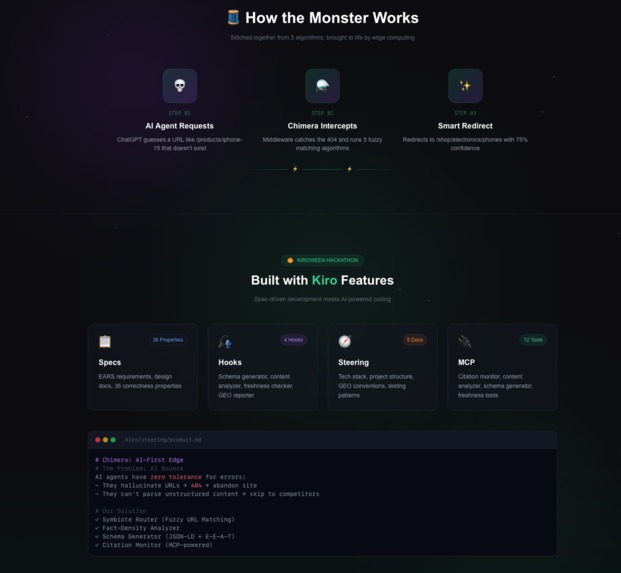
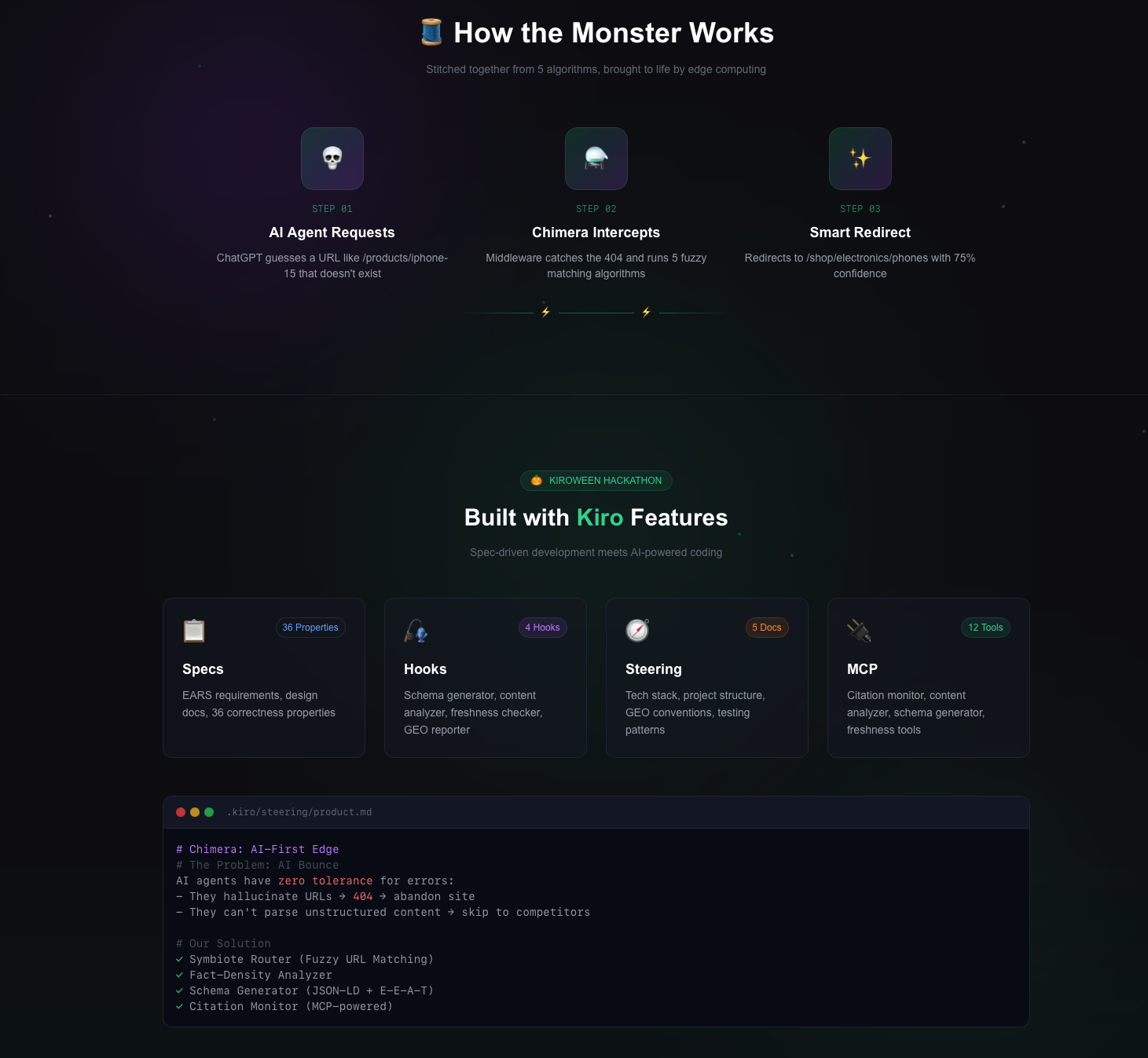
kiro ide features used
-
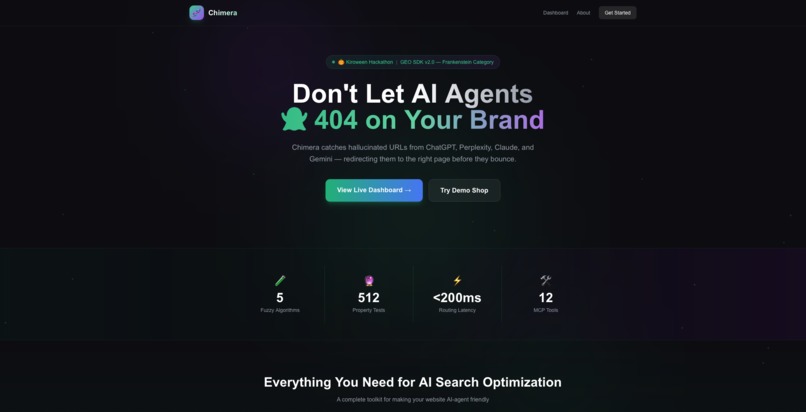
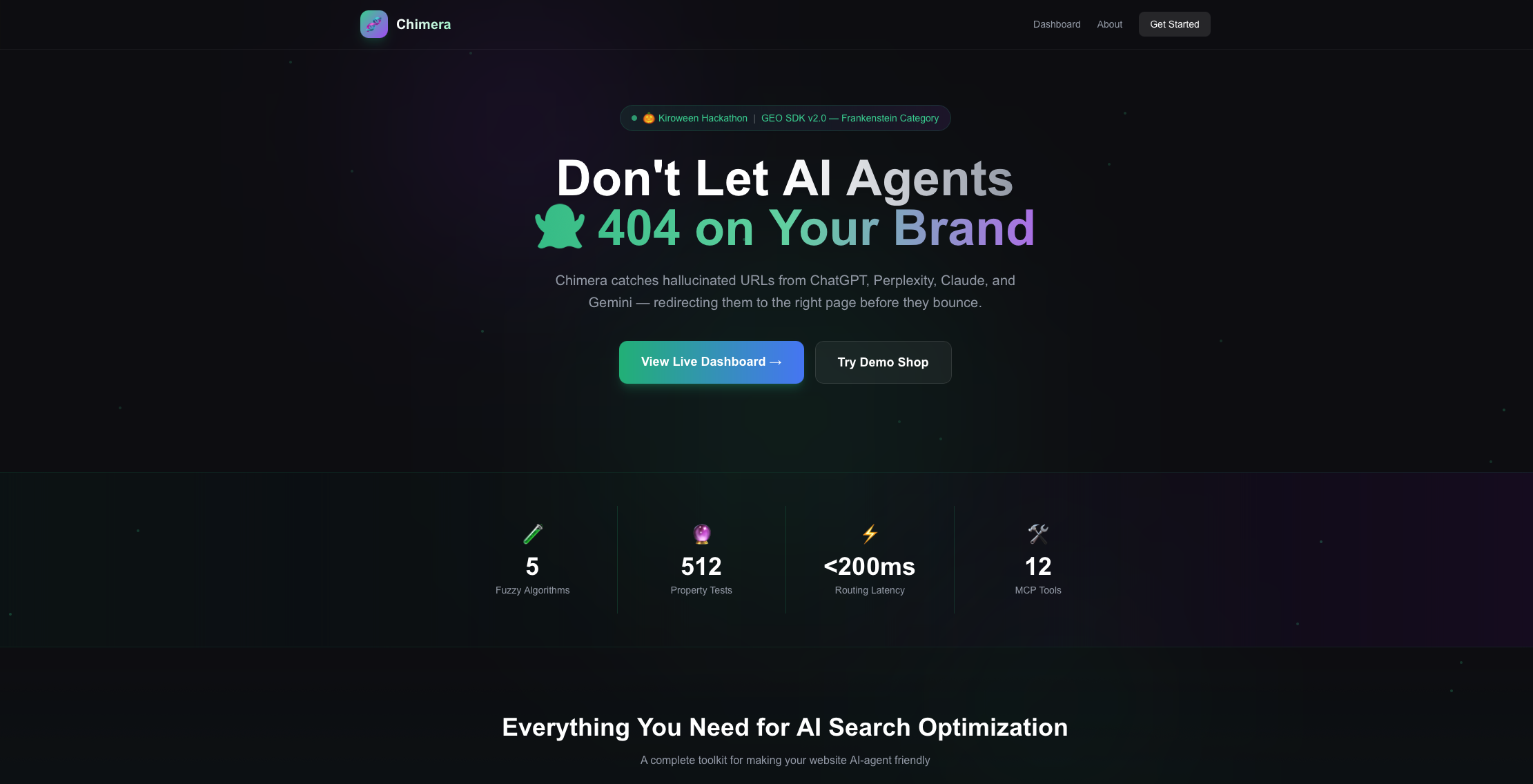
homepage
-
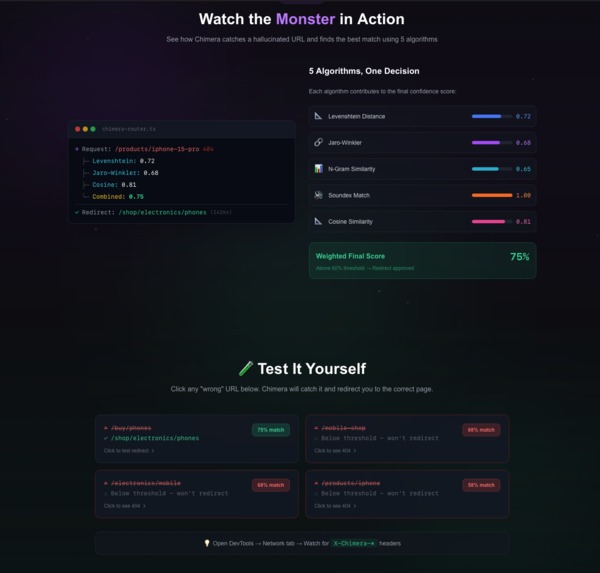
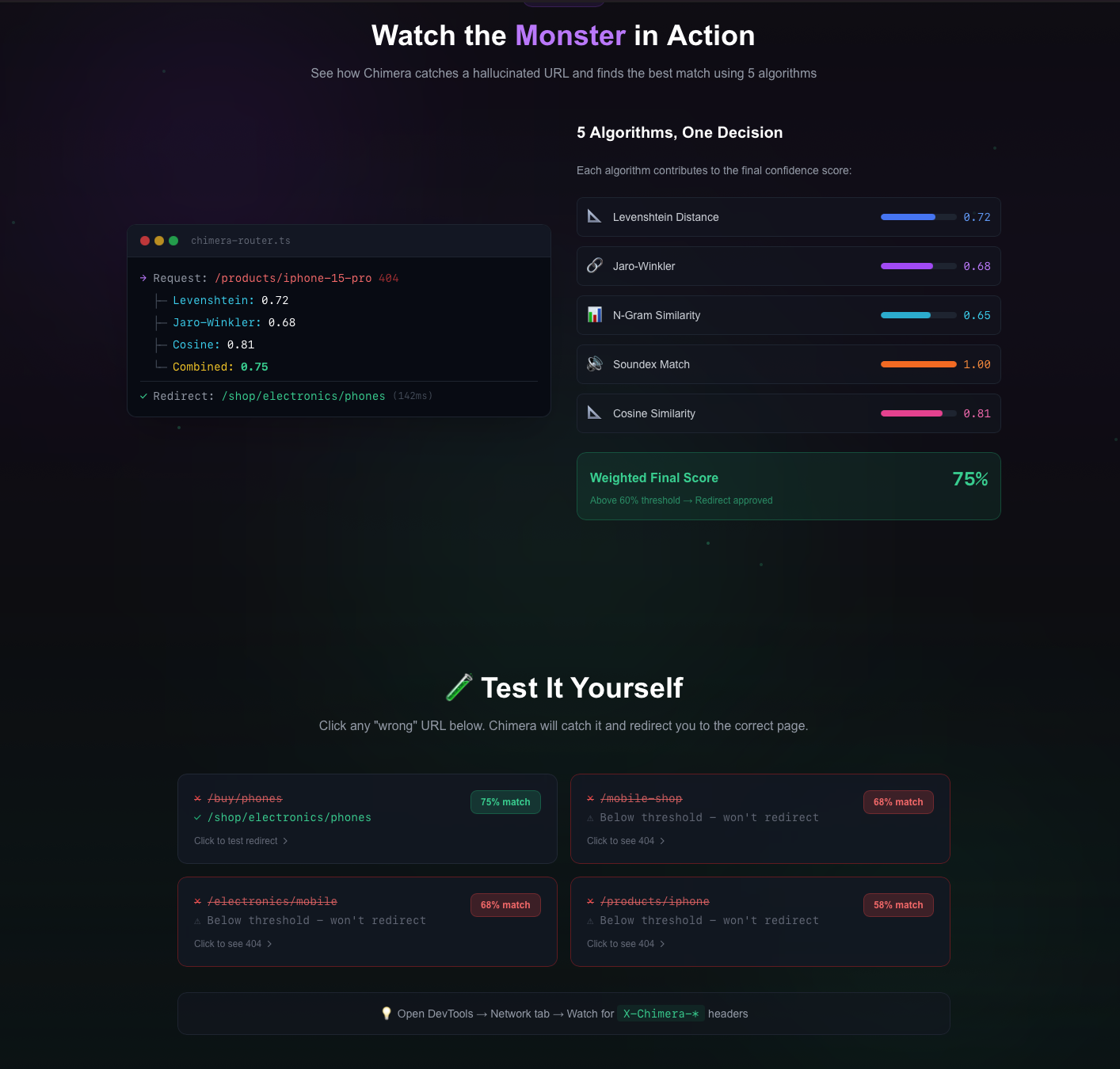
algorithms for fuzzy routing
-
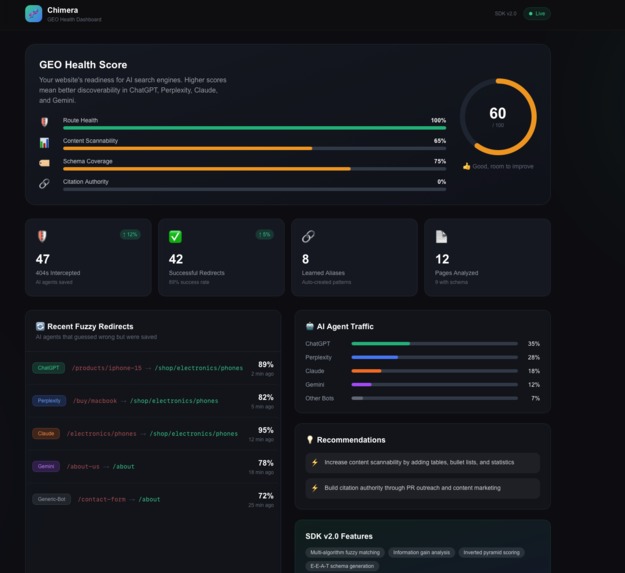
GEO optimization dashboard
-
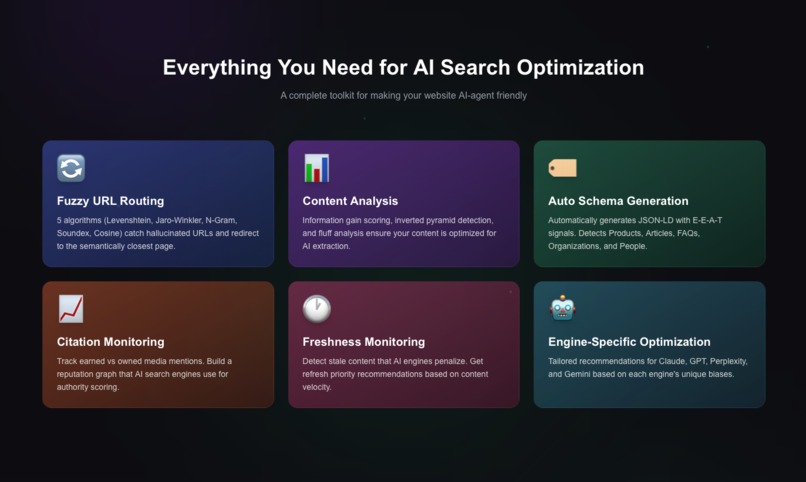
features
Chimera: Generative Engine Optimization (GEO) SDK
💡 Inspiration: Solving the "AI Bounce"
The inspiration for Chimera struck from a frustrating observation: AI agents like ChatGPT and Perplexity are terrible at handling 404 errors. When an agent hallucinates a slight variation of a URL (e.g., /products/iphone-15 instead of the correct /shop/apple/iphone-15), the user receives a dead end. This costs websites traffic, visibility, and revenue.
I call this phenomenon "AI Bounce," and it represents a massive gap in modern SEO. Traditional optimization methods are blind to this problem. The solution requires a new infrastructure: Generative Engine Optimization (GEO). Chimera is that infrastructure—a developer toolkit designed to make websites natively friendly to $\text{AI}$ agents.
⚙️ What Chimera Does
Chimera is a GEO optimization SDK that stitches together eight distinct technologies to maximize a website's "AI-readiness" score.
🎯 Core Components: The Eightfold Path to GEO
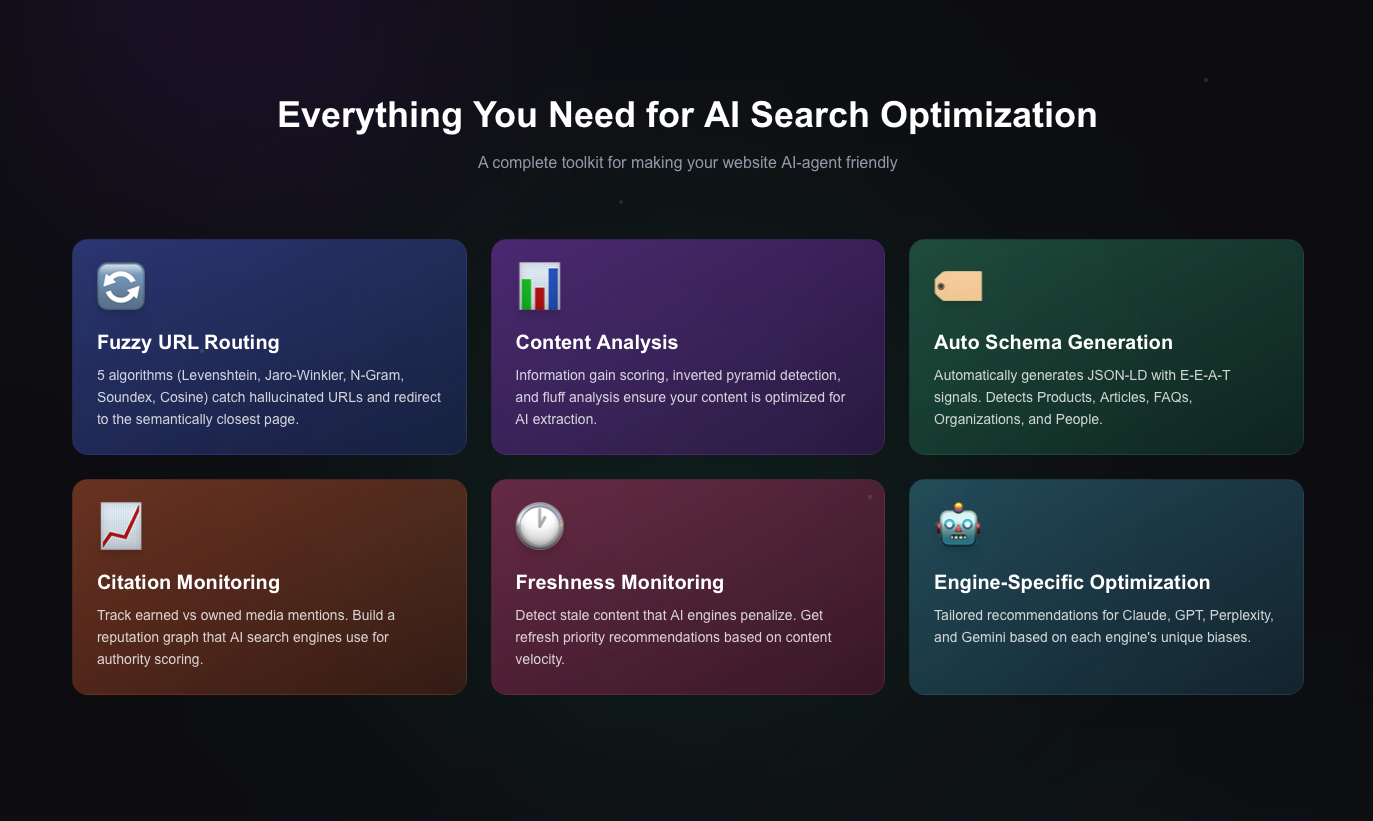
Symbiote Router (Fuzzy URL Matching): Intercepts $404$ errors using a weighted ensemble of 5 similarity algorithms (Levenshtein, Jaro-Winkler, Cosine, etc.) to redirect hallucinated $\text{URLs}$ to the correct page in $<200\text{ms}$.
Fact-Density Analyzer: Scores content ($\text{0-1}$ scale) based on "AI candy" (tables, lists, statistics) and Information Gain—the ratio of unique facts to commodity phrases.
Schema Generator: Auto-generates fully validated $\text{JSON-LD}$ structured data, detecting entities ($\text{Product, Article, FAQ}$) and including essential $\text{E-E-A-T}$ signals.
Citation Monitor: Tracks brand mentions across the web, building a reputation graph using graph theory and calculating the earned vs. owned media ratio.
Freshness Monitor: Detects stale content ($\ge 90$ days old) and tracks content velocity (updates per month).
Content Transformer: $\text{NLP}$-driven module that detects listicle opportunities and converts content into $\text{AI}$-preferred formats like comparison tables.
Engine Optimizer: Provides tailored content recommendations and bias weights specific to major $\text{LLM}$ platforms (GPT, Claude, Gemini, Perplexity).
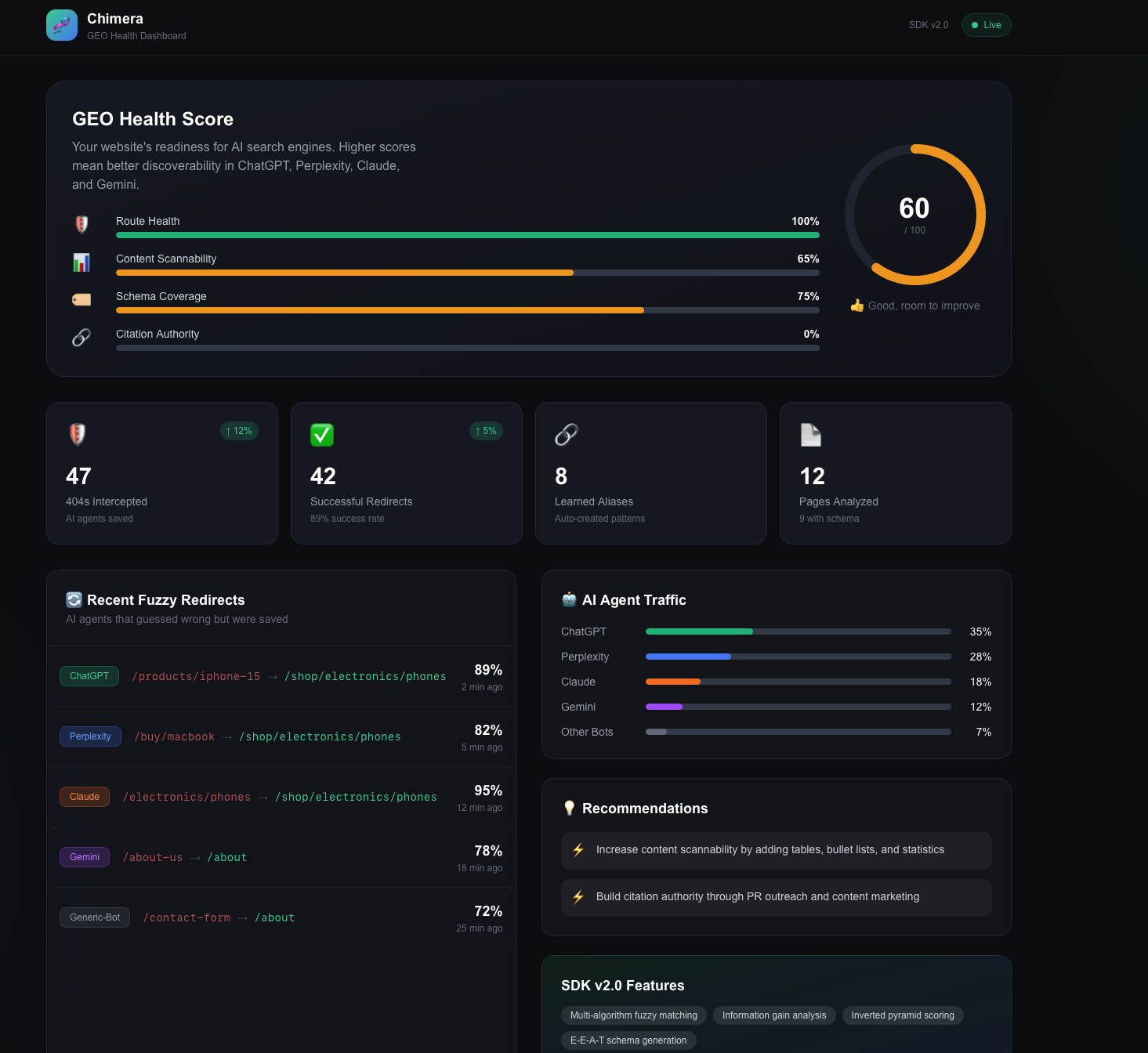
GEO Health Dashboard: Provides a composite $\text{0-100}$ score combining all metrics for real-time monitoring and actionable advice.
🏗️ How We Built It: The Frankenstein Approach
As a solo developer, Chimera’s development followed a rigorous Spec-Driven Development methodology, combining disparate domains to create a powerful, integrated solution.
🧩 Stitched Technologies
The project earned its name, Chimera, by stitching together technologies that do not usually interact:
Fuzzy String Matching (for routing)
Information Theory (for content scoring via $\text{TF-IDF}$ and Entropy)
Graph Theory (for citation networks and domain authority)
Natural Language Processing (for content transformation)
Schema.org (for structured data generation)
📐 Mathematical Rigor via Property-Based Testing
A cornerstone of the build was ensuring provable correctness. Instead of traditional unit tests, we used Property-Based Testing with the fast-check library. We defined 36 correctness properties that must hold true for all inputs, running $100$ iterations per property.
- Example Property: We verified that fuzzy matching algorithms satisfy the Triangle Inequality in metric spaces:
$$ d(x, z) \le d(x, y) + d(y, z) $$
- This approach caught three complex bugs in the schema serializer and routing logic that unit tests would have missed.
🧠 Kiro Integration (Extending the Agent's Brain)
To accelerate development, the project was deeply integrated with the Kiro environment's capabilities:
MCP Server (12 Tools): We gave Kiro domain expertise by defining 12 domain-specific $\text{GEO}$ analysis tools via the $\text{MCP}$ protocol (e.g.,
analyze_information_gain,generate_schema).Agent Hooks (6 Hooks): Automation hooks like
security-scanner(which prevented 3 credential leaks) andtest-scaffold-generatorstreamlined the workflow.
🚧 Challenges We Ran Into
- Latency Budget: Fuzzy matching is computationally expensive. We had a hard constraint to add less than $\text{200ms}$ latency for Symbiote Router lookups.
- Solution: Implemented edge-side caching and created a weighted ensemble of algorithms to balance accuracy against speed.
- Property Test Complexity: Writing mathematical properties for probabilistic systems like "similarity" was non-trivial.
- Solution: Started with simple properties (reflexivity, symmetry) before moving to complex domain-specific properties, using $\text{Kiro}$'s steering to maintain annotation consistency.
- Keeping Track of 8 Technologies: The sheer scope of integrating fuzzy matching, $\text{NLP}$, graph theory, and schema generation required strict project management.
- Solution: Switched from pure Vibe Coding to spec-driven development, using structured steering files to maintain domain context for each component.
⭐ Accomplishments That We're Proud Of
Statistical Proof of Quality: $512$ tests with a $100\%$ pass rate, including $36$ mathematically rigorous correctness properties.
Real Performance Metrics: Achieved the target route resolution time of $\mathbf{<200\text{ms}}$ for $\text{p99}$ latency, making the $\text{SDK}$ production-ready.
Complete Kiro Integration: Successfully leveraged all five features of the Kiro IDE, proving the value of spec-driven, $\text{MCP}$-enhanced development.
Solving a Real Problem: Chimera provides a foundational solution for the emerging, costly problem of $\text{AI}$ Bounce in the modern web economy.
🎓 What We Learned
Spec-Driven Development is Essential for Complexity: While Vibe Coding is great for exploration, $\text{EARS}$-compliant specs are crucial for implementation rigor and managing $\ge 3$ intersecting technologies.
Property-Based Testing Changes Verification: Testing for properties that must hold true for all inputs is significantly more robust than testing specific examples, leading to higher-quality, mathematically verifiable code.
Domain Expertise is Extensible: The $\text{MCP}$ server demonstrated how effectively an agent's knowledge can be expanded from general coding to specialized domains (like $\text{GEO}$ optimization).
🚀 What's Next for Chimera
The immediate next steps involve publishing the $\text{SDK}$ to $\text{npm}$ and deploying a production service. Future phases include:
Phase 1: Enhanced Intelligence: Integrating $\text{LLM}$ embeddings for semantic similarity matching (beyond string similarity) and integrating live search $\text{API}$s for real-time citation monitoring.
Phase 2: SaaS Platform: Transforming the $\text{SDK}$ into a hosted service with an automated $\text{GEO}$ Health Score dashboard, content generation suggestions, and multi-site management.
Phase 3: Ecosystem: Creating plugins for platforms like WordPress and Shopify, and deploying the Symbiote Router at the edge (Cloudflare Workers, Vercel Edge).
Built With
- edge
- fast-check
- fuzzy-matching
- graph-theory
- json-ld
- kiro-ide
- mcp
- natural-language-processing
- next.js
- node.js
- property-based-testing
- react
- schema.org
- tailwind-css
- typescript
- vercel
- vitest

Log in or sign up for Devpost to join the conversation.