Project Story
Inspiration
ChimeraCLI was inspired during a late-night hackathon session where I found myself working across multiple AI coding assistants—Claude for architecture, GPT-4 for implementation, and Ollama for local tests. Each tool lived in a separate terminal window, and I constantly lost track of outputs, context, and which model had offered which suggestion. I wanted a way to unify these AI agents into a single space where they could be orchestrated visually. This sparked the idea for ChimeraCLI—a node-based environment where each AI becomes a programmable “creature” with its own terminal, chat interface, and sandboxed workspace.
What it does
ChimeraCLI is a fully functioning desktop-based multi-LLM coding lab. It provides:
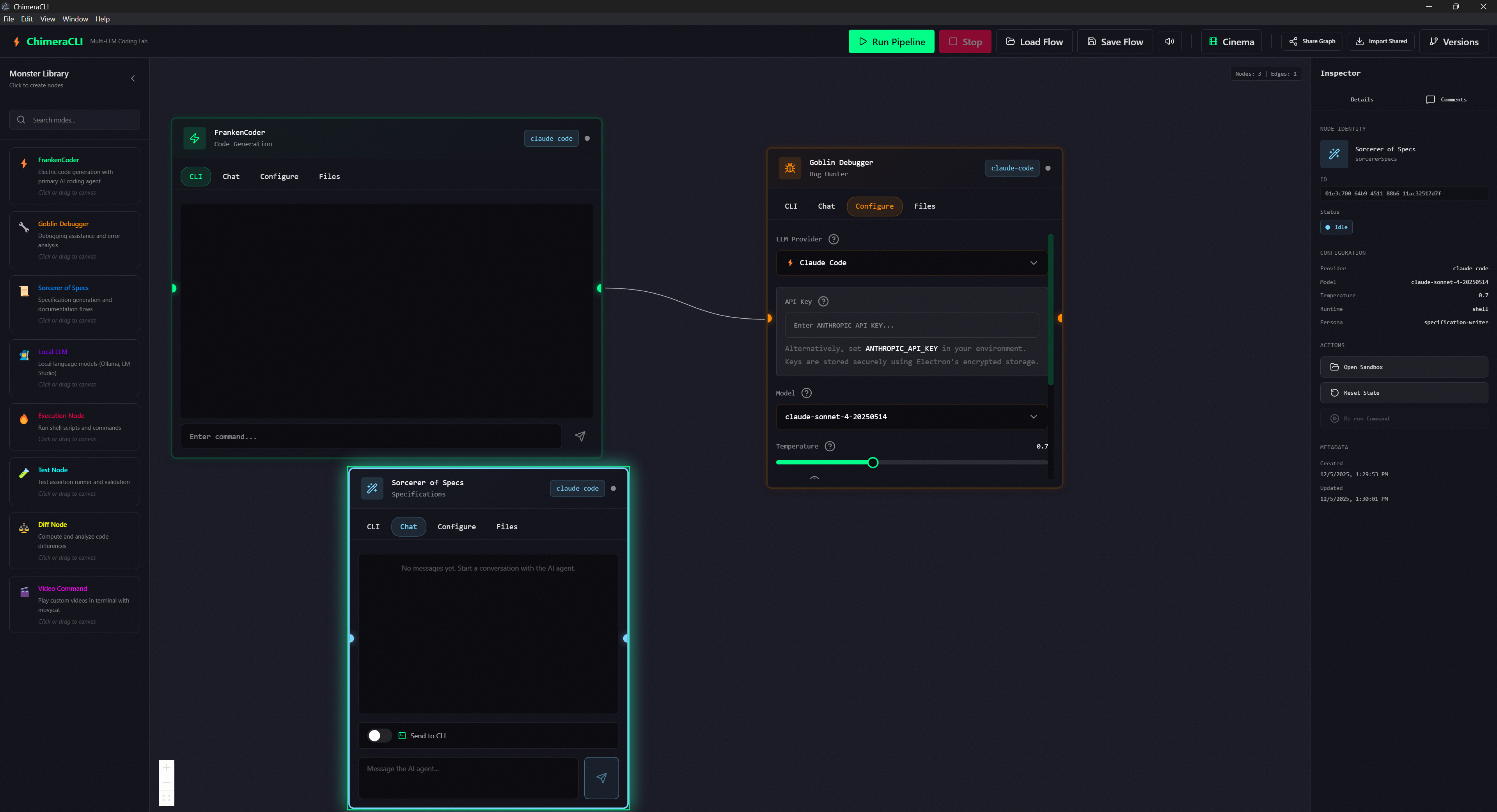
- Node-based visual workflows using React Flow, where each monster node contains a terminal, chat panel, file sandbox, and model configuration.
- Per-node shell sandboxing so commands run safely in isolated directories.
- Multi-LLM orchestration, enabling use of OpenAI, Claude, Gemini, and local models via Ollama.
- A pipeline execution engine that interprets the node graph as a DAG, performs topological sorting, and executes each node in sequence.
- Kiro-driven development hooks for guardrails, specification integration, and automatic code generation.
How we built it
We built ChimeraCLI using a spec-first development approach:
- Specification-driven architecture with 13 requirements and a 1,149-line design document that defined IPC boundaries, node schemas, error handling, and streaming protocols.
- Electron IPC bridge to safely execute commands, handle file IO, manage sandboxes, and provide real-time terminal output.
- Topological pipeline engine using graph analysis to detect cycles, determine execution order, and pass output between nodes.
- Monster-themed UI/UX with distinctive node types such as FrankenCoder, Goblin Debugger, Sorcerer of Specs, Local LLM Node, Execution Node, Test Node, and Diff Node.
- Kiro specs, steering docs, and hooks to ensure consistency across 50+ generated files and automatically enforce safety constraints.
Challenges we ran into
- Real-time IPC streaming: Ensuring smooth, responsive terminal output without UI freezing required careful chunk management and throttling.
- Filesystem safety: Each node needed isolated directories with strict path validation and secure cleanup processes.
- Multi-file generation consistency: Maintaining coherent architecture and naming conventions across dozens of files required strong steering documents.
- Balancing power with usability: Designing a system capable of executing multi-agent workflows while remaining intuitive and approachable.
Accomplishments that we're proud of
- Building a fully functional multi-LLM node editor with real command execution—not just simulations.
- Implementing a DAG-based pipeline engine that transforms the visual canvas into an executable workflow.
- Creating a rich Frankenstein-inspired aesthetic that enhances, rather than distracts from, usability.
- Developing a secure sandboxing system that ensures each agent operates in isolation.
- Successfully integrating Kiro’s full suite—specs, hooks, and steering documents—to guide development at scale.
What we learned
- Clear specifications accelerate development. Writing detailed requirements early prevented scope creep and exposed edge cases before coding began.
- Electron demands careful architectural thinking. IPC boundaries, serialization, and async behavior must be planned from the start.
- Visual metaphors reduce cognitive load. Users instantly grasp how data flows between agents when represented as connected nodes.
- Polish improves engagement. Small touches—glows, animations, themes—make the tool feel delightful and memorable.
What's next for Chimera
ChimeraCLI is only the beginning. Planned future enhancements include:
- Parallel pipeline execution for more complex workflows.
- Real-time data flow visualization along edges.
- Plugin system for community-built monster nodes.
- Cloud syncing for sharing and collaborating on pipelines.
- MCP integration to orchestrate external tools and environments.
The foundation is strong, and future development will push ChimeraCLI even further toward becoming the definitive laboratory for visual multi-agent coding.

Log in or sign up for Devpost to join the conversation.