Inspiration
We were inspired by how important local government is and how inaccessible it still feels. Housing, school changes, spending, zoning, and safety decisions shape daily life, but the information is buried across agenda PDFs, board portals, meeting videos, and legalese spread across city, county, and school systems.
We wanted to build something that makes civic awareness instant, local, and actually usable. Our belief is simple: low local participation is often an information problem before it is an apathy problem.
What it does
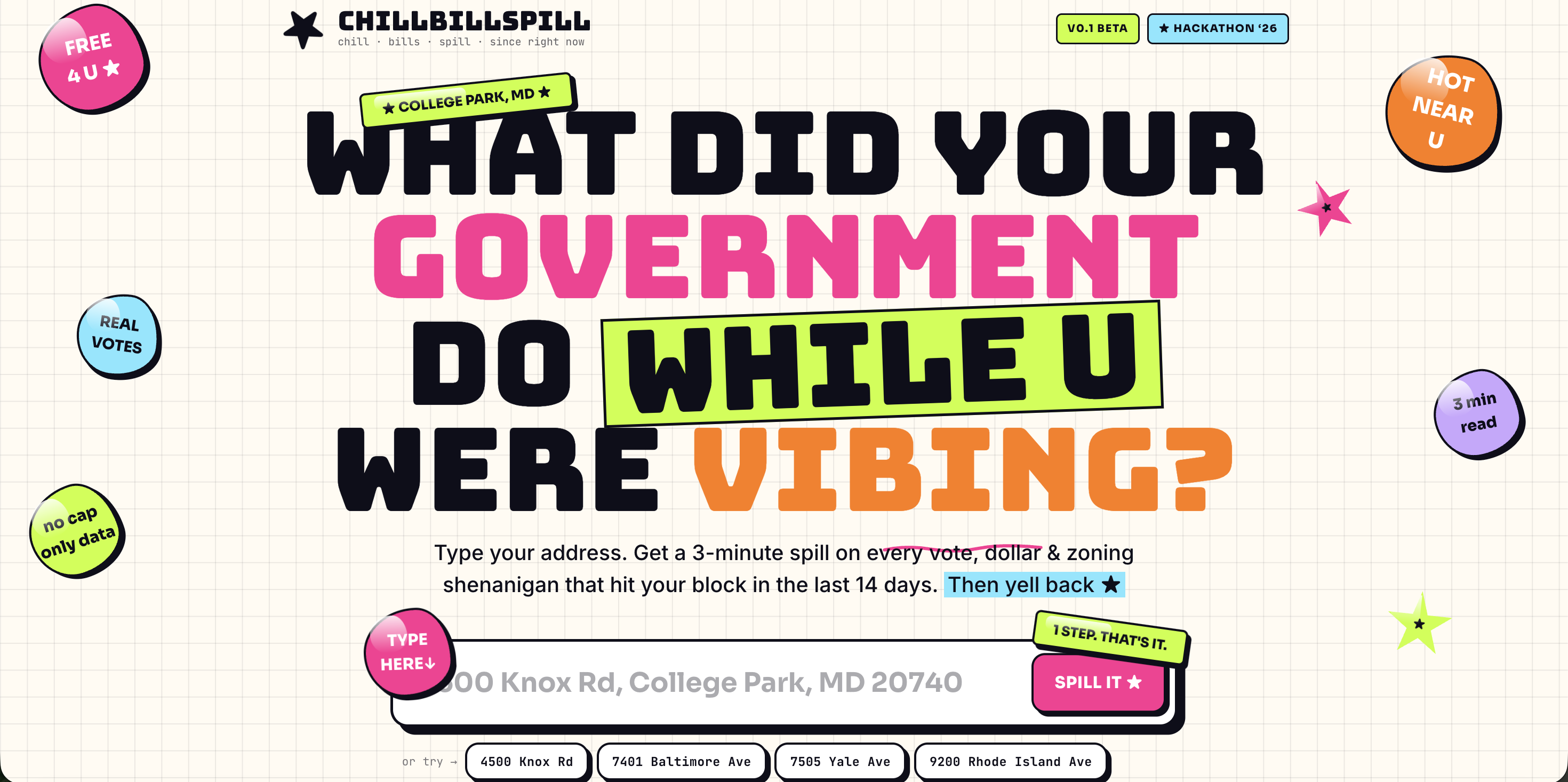
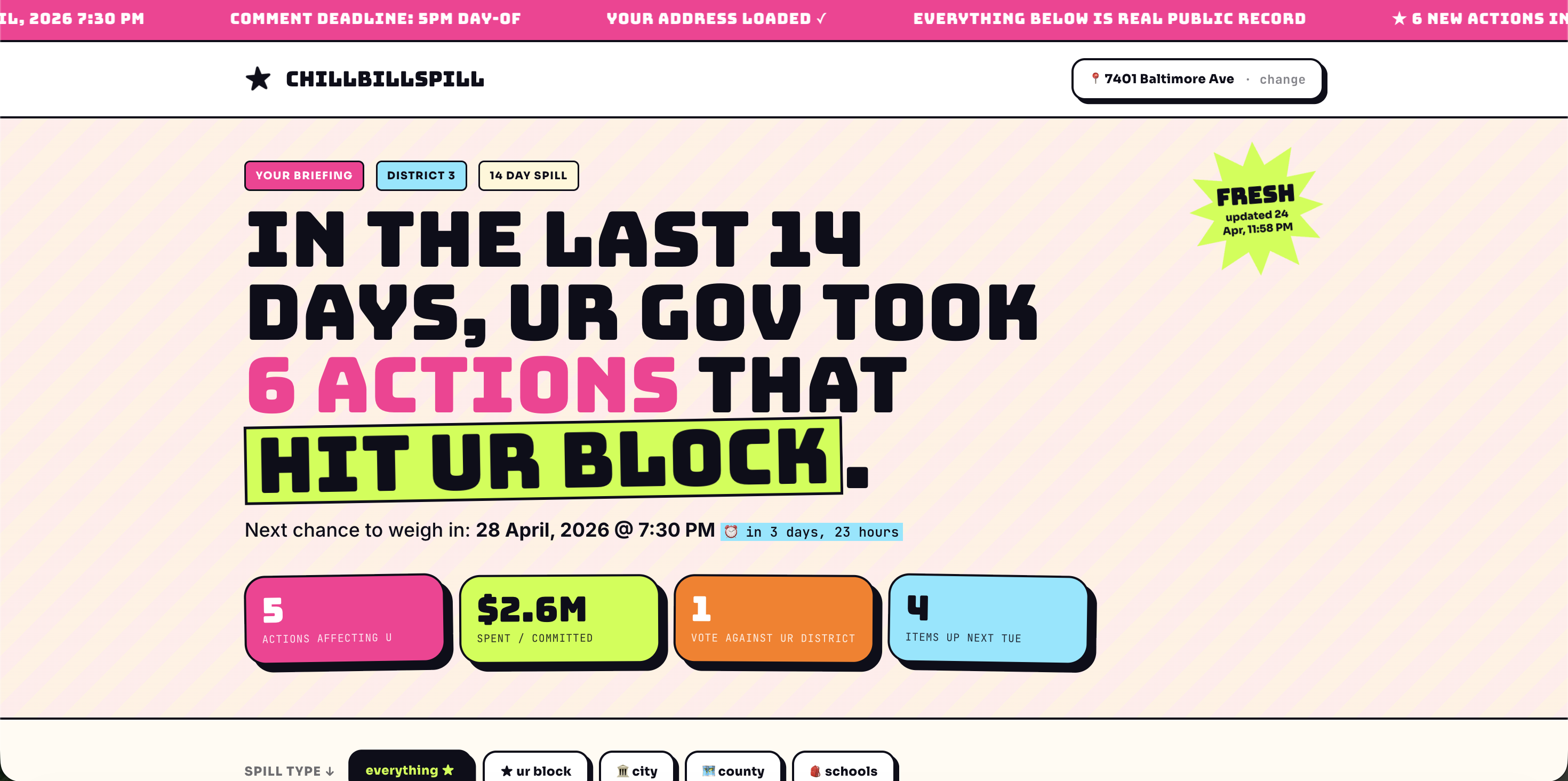
ChillBillSpill turns real local government records into a personalized, source-backed civic briefing. A resident enters their address and gets a fast summary of recent city, county, and school decisions that affect them.
When a user enters an address, the app:
- Geocodes the address and checks whether it is inside the College Park demo area
- Resolves the user's city, county, and school context
- Scrapes recent public records from multiple local government systems
- Uses Claude to turn dense agenda/minutes text into structured, plain-English summaries
- Ranks items by an "Affects-U Score" so the most relevant issues rise to the top
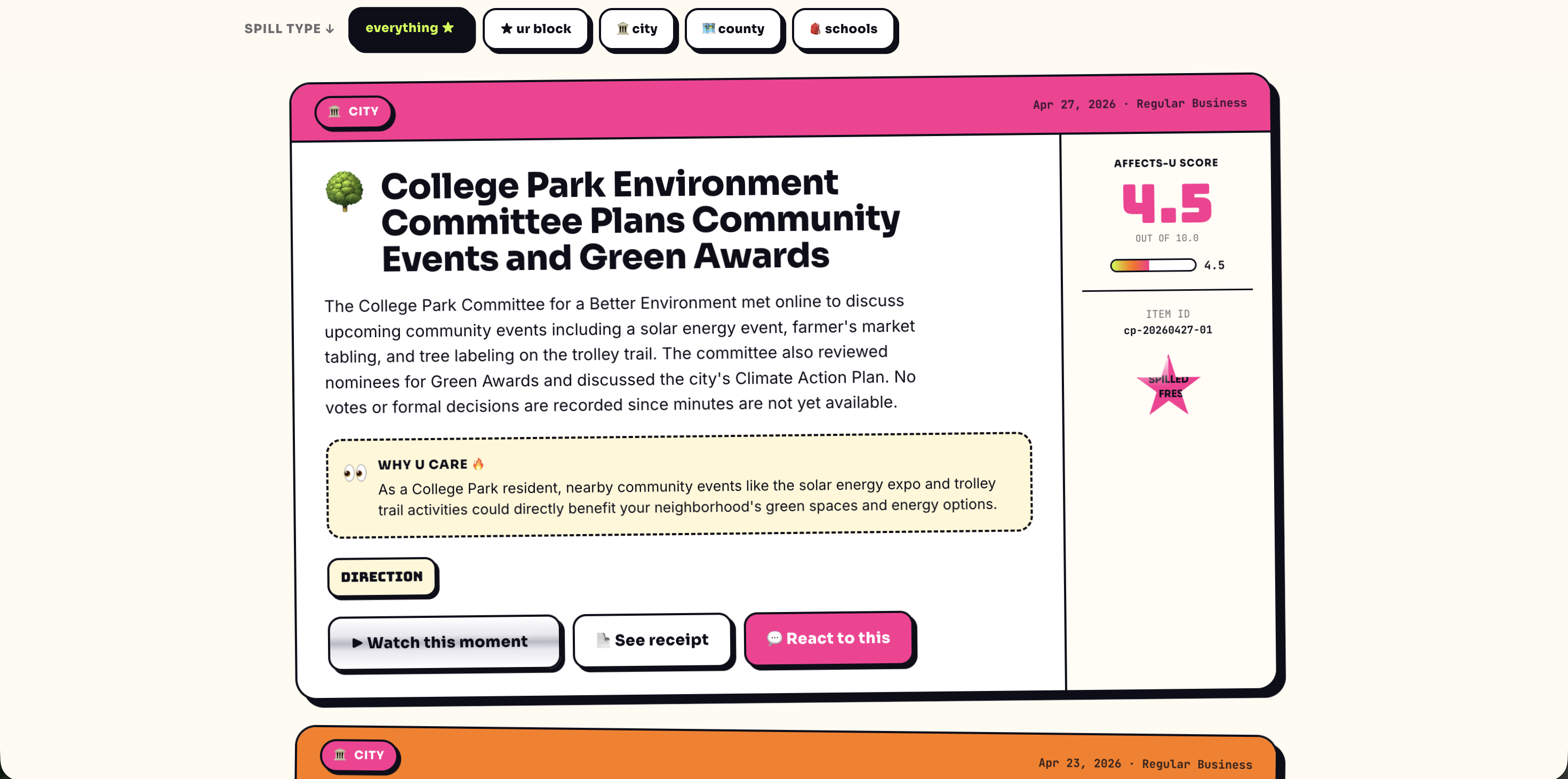
- Shows source-backed briefing cards with meeting type, vote result, dollar amounts, timestamps, and why the item matters to that specific resident
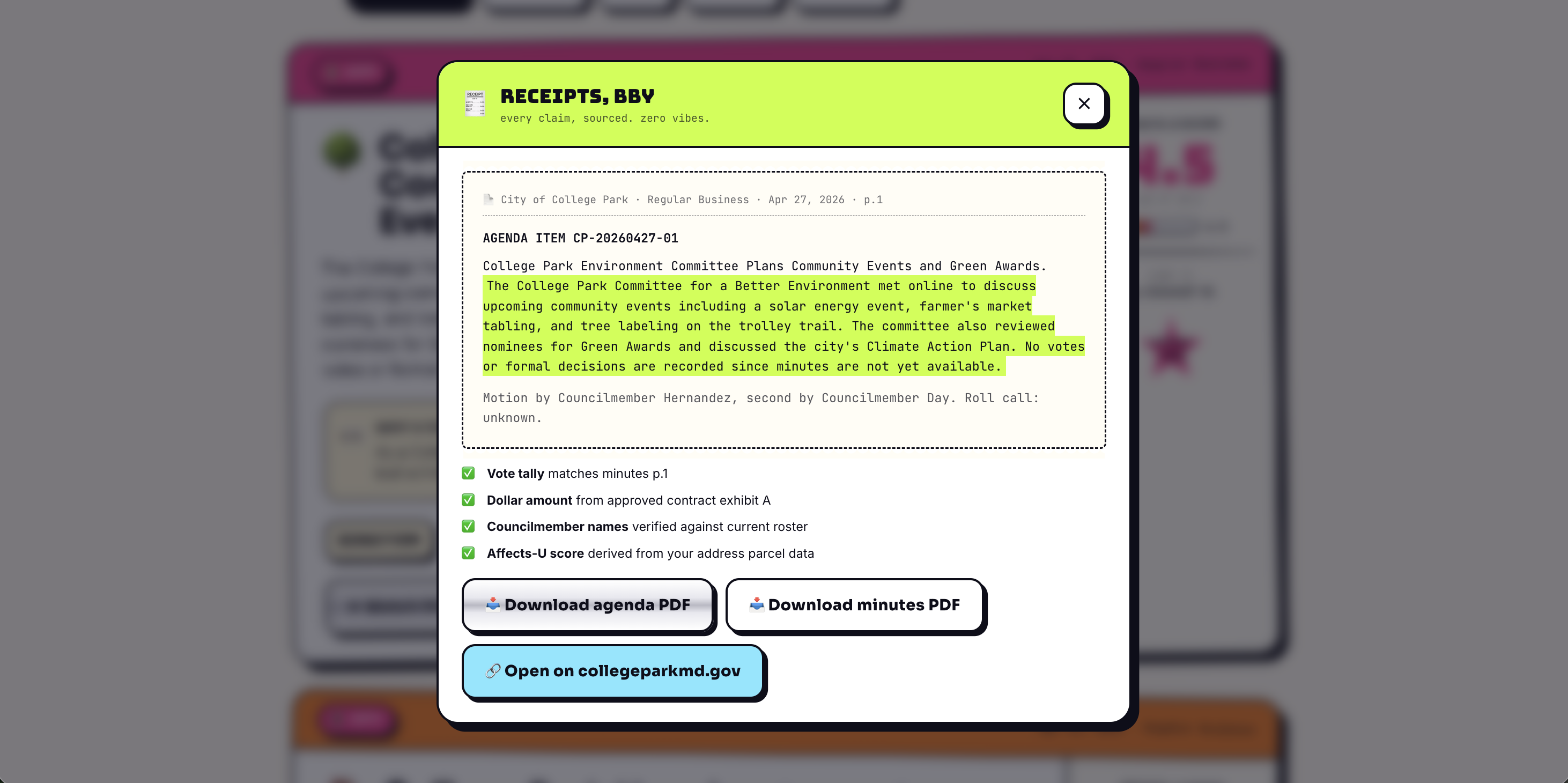
- Lets the user jump to the relevant meeting moment, inspect the "receipt," and draft a public comment email fast
Key user-facing features:
- Address-based civic briefing for the last 14 days
- Coverage across city, county, and school governance
- Plain-English summaries of votes, budgets, zoning, and school items
- Source receipts for every claim
- Meeting video jump points
- Prefilled public comment flow
- Upcoming agenda items so users can react before decisions happen
How we built it
ChillBillSpill is a lightweight full-stack prototype built around a real public-record ingestion pipeline.
Frontend:
- React-based single-page interface
- Bold editorial/Y2K visual system that makes civic information feel approachable instead of bureaucratic
- Screens for landing, loading, personalized briefing, receipts, and public comment
Backend:
- FastAPI server
- Address geocoding with the U.S. Census geocoder and OpenStreetMap Nominatim fallback
- Jurisdiction resolver for the College Park demo area
- Parallel scraping across three government data sources
- SQLite caching layer for scraped records and LLM output
- Claude-powered structured summarization pipeline
Data sources used in the prototype:
- City of College Park Agenda Center
- City of College Park council meeting video pages
- Prince George's County Legistar calendar and legislation pages
- Prince George's County Granicus meeting video publisher
- PGCPS BoardDocs public agenda system
AI layer:
- Claude reads agenda and minutes text and converts it into structured JSON
- The prompt is constrained to avoid fabrication of vote tallies, dollar amounts, names, and positions
- We generate a short personalized intro plus per-item summaries and relevance scoring
Each output includes:
- A headline
- A plain-English summary
- Vote result and opposition details when available
- Dollar amount when present
- Category
- Why it matters to the user
- Video timestamp when available
- Source links
Challenges we ran into
The biggest challenge was normalizing messy public data across completely different government systems with different HTML, document structures, and levels of detail. Some information is in PDFs, some in calendar pages, some in legislation detail views, and some in video systems.
We also had to keep the LLM grounded in source material and avoid hallucinating facts, especially around vote tallies, dollar amounts, and names. On top of that, district boundaries and address relevance are hard to do perfectly in a hackathon setting, so we had to balance speed with enough geographic accuracy for a compelling demo. Finally, we wanted the product to feel fun and culturally alive without sacrificing trust or transparency.
Accomplishments that we're proud of
We built a working end-to-end pipeline from address input to source-backed civic briefing. The app does not just summarize government activity; it personalizes it to a resident's block and district.
We are especially proud that:
- We made public-record verification a first-class part of the UX through the receipts flow
- We connected "what happened" to "what can I do now?" with video jump links and public comment drafting
- We turned a boring civic workflow into something people might actually want to open
- We shipped a prototype that connects real public records, address-level relevance, plain-English summaries, and civic action
What we learned
We learned that transparency alone is not enough. People need relevance, clarity, and timing. Civic engagement tools need to be emotionally legible, not just technically correct.
We also learned that trust improves when every summary is paired with a path back to the underlying source. Hyperlocal relevance matters a lot too: the difference between "city news" and "your block" changes whether someone cares.
What's next for ChillBillSpill
Next, we want to:
- Expand beyond College Park into more municipalities
- Replace simplified district logic with parcel-grade mapping
- Improve timestamp extraction for county and school meeting videos
- Add stronger source linking for receipts and downloadable records
- Support text/email notifications for new agenda items that affect a user's address
- Add better public comment routing for multiple agencies and clerks
- Let users follow topics like housing, schools, transit, or zoning over time
Built With
- anthropic-claude
- boarddocs
- fastapi
- httpx
- javascript
- legistar
- openstreetmap-nominatim
- pdfplumber
- python
- react
- selectolax
- sqlite
- u.s.-census-geocoder


Log in or sign up for Devpost to join the conversation.