Inspiration
Extreme heat waves in developing economies trigger dual crises: electrical grids overload from air-conditioning and industrial refrigeration, while cold chains buckle under blackouts, risking billions of dollars of perishable food and temperature-sensitive vaccines.
Commercial refrigerated warehouses represent gigawatts of flexible electrical load. Their thermal inertia allows them to act as virtual batteries—temporarily cutting compressor power during evening peak hours without dropping temperatures below zero. However, facility operators almost universally refuse to participate in demand response programs. Their concern is justified: standard automated demand response systems optimize for grid revenue, treating cold rooms as dumb batteries and risking thermal excursions that spoil precious cargo.
We built Chill2Grid AI to break this stalemate with a sovereign, Fail-Closed Safety Guardian: an autonomous intelligence where cargo integrity and cold chain safety strictly outrank grid incentives. Equipment convenience never overrules product safety.
What it does
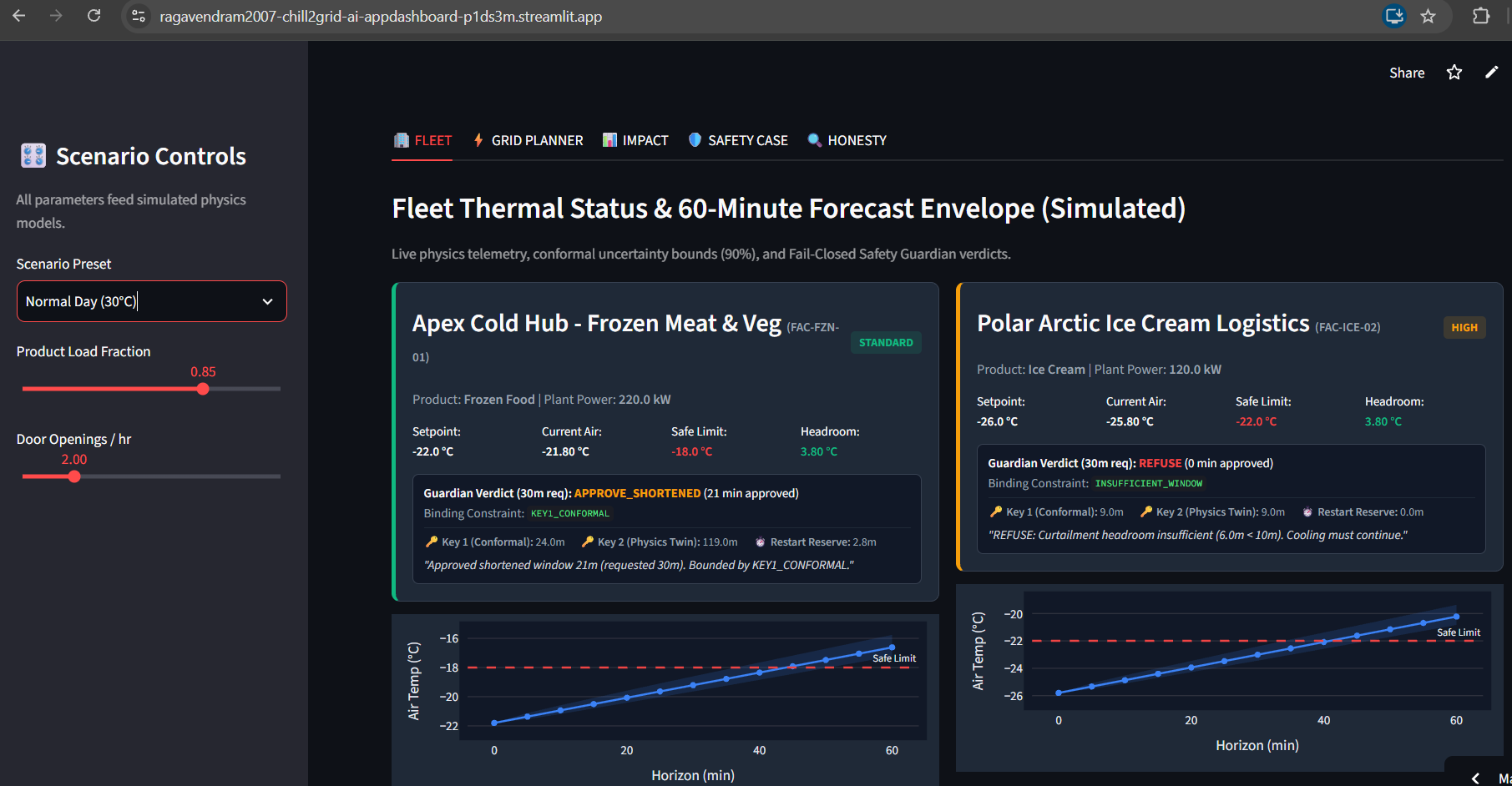
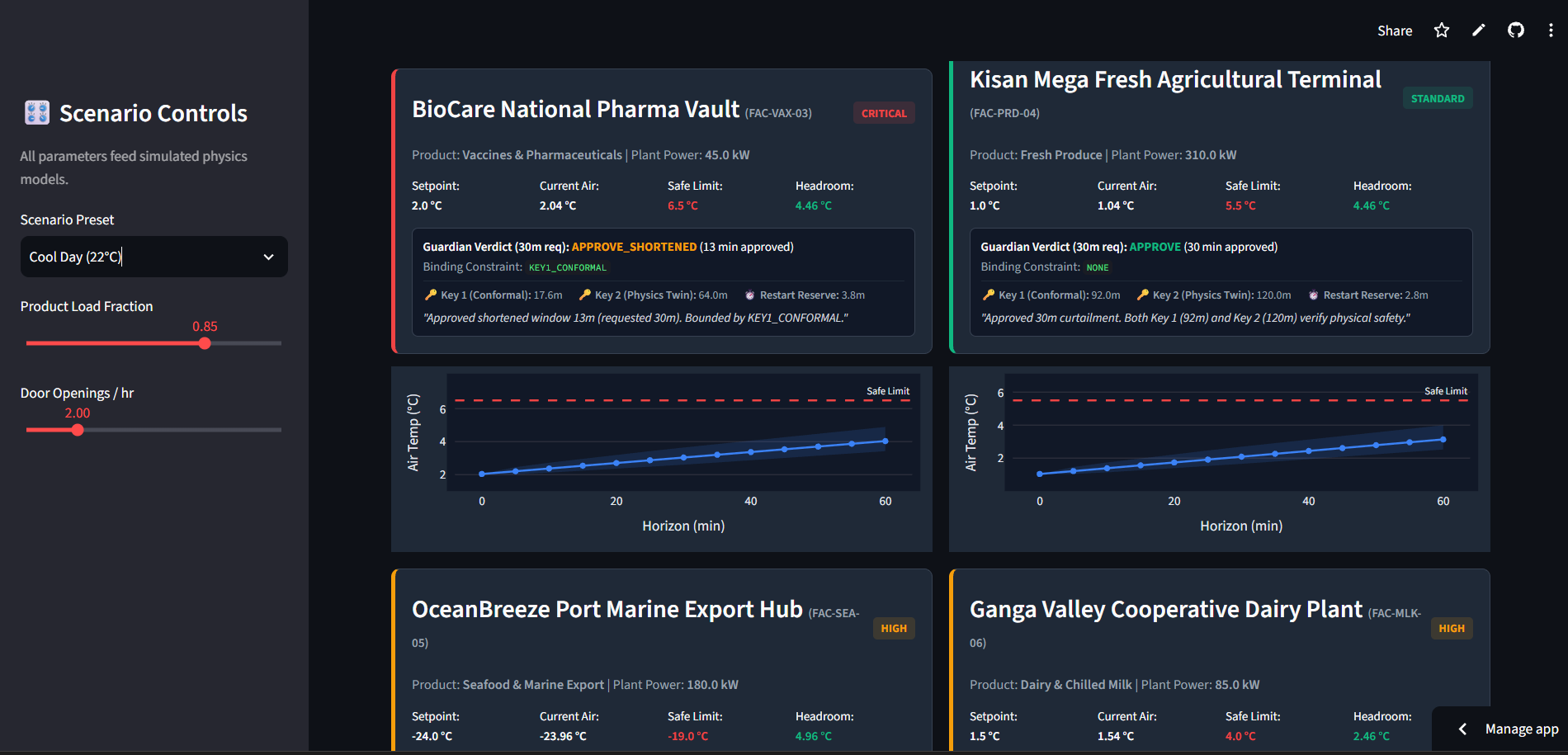
Chill2Grid AI orchestrates fleet-wide commercial cold storage demand response while providing mathematical and physical safety guarantees:
- Sovereign Safety Guardian (The Two Keys): The grid optimizer cannot command curtailments directly; it can only request permission. The Guardian grants or trims windows based on two independent validators:
- Key 1 (Conformal ML Residuals): Bounds unmodelled reality-gap disturbances using finite-sample quantile shrinkage (q_{\alpha}).
- Key 2 (Physics Twin & Turnaround Slack): Calculates lumped capacitance heat ingress and dynamically estimates mechanical restart overshoot to guarantee turnaround headroom before limits are reached.
- Usable duration is sovereignly clamped to (\min(\Delta t_{\text{key1}}, \Delta t_{\text{key2}})).
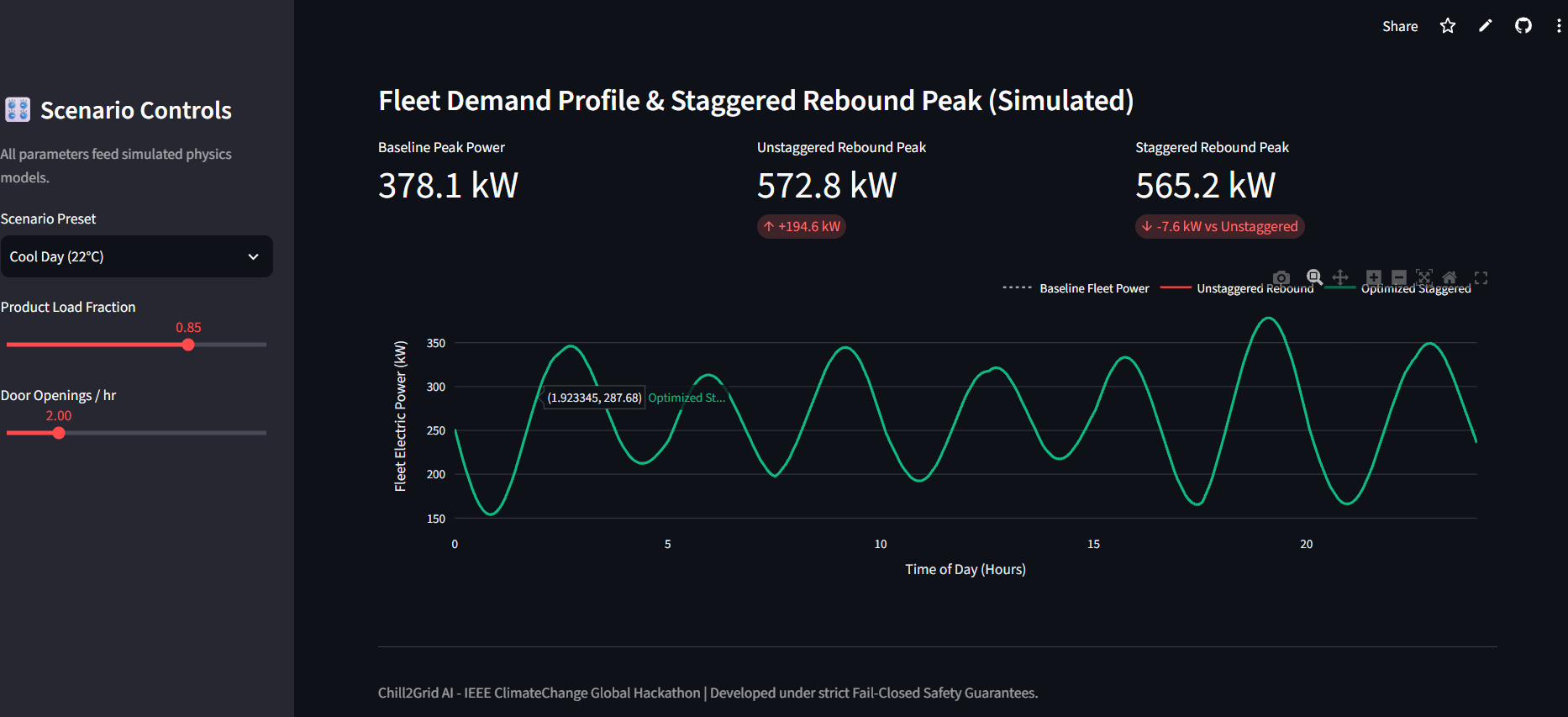
- Phase-Robust Dispatch & Rebound Flattening: Solves a mixed-integer linear program (MILP) across 6 heterogeneous facilities (vaccines, seafood, ice cream, dairy, frozen food, produce). It intelligently staggers post-event compressor restarts to completely flatten destructive secondary rebound surges on the local electrical feeder.
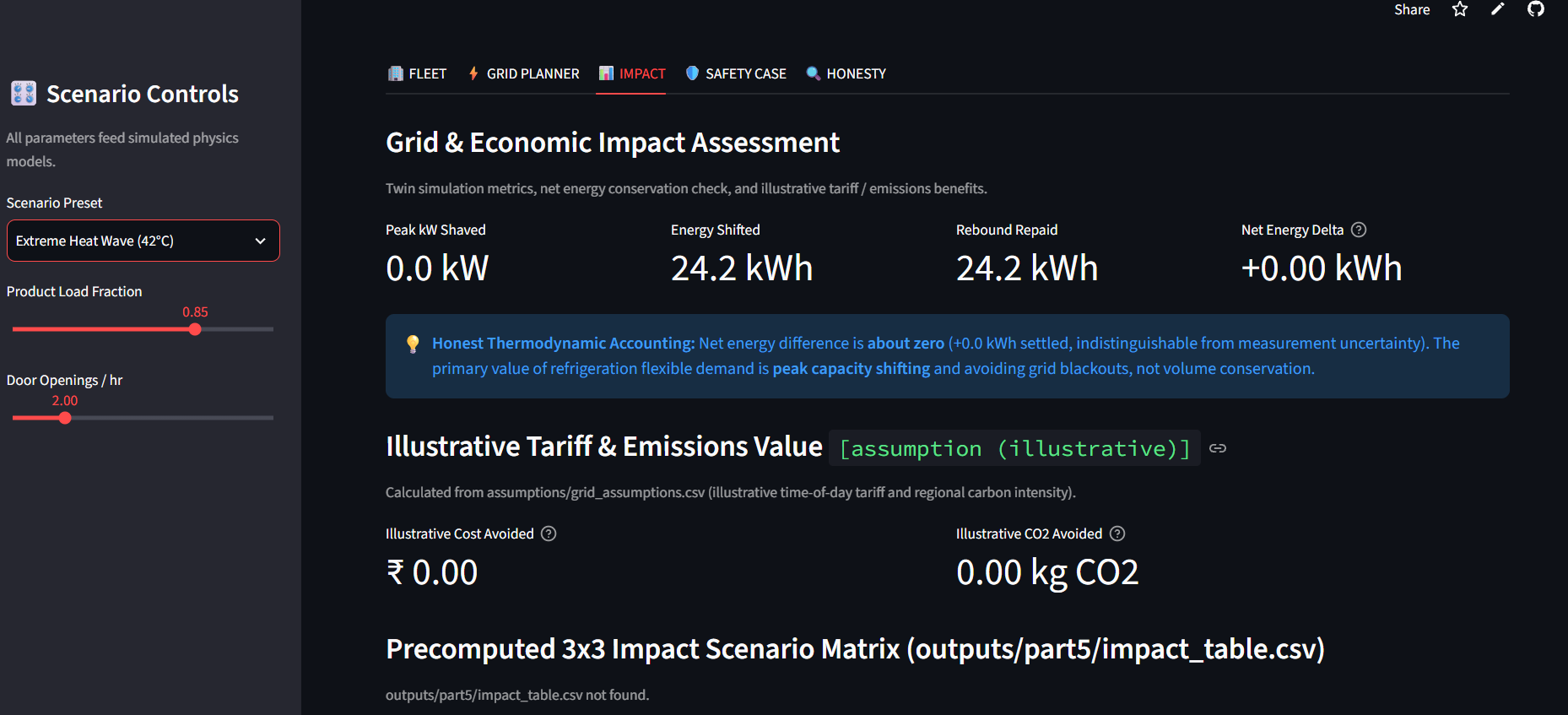
- Scientific Thermodynamic Accounting: Enforces the First Law of Thermodynamics. Refrigeration loads defer heat rather than destroying energy; the dashboard explicitly shows that settled net energy is indistinguishable from zero ((+0.0\text{ kWh})), proving true value lies in peak capacity avoidance.
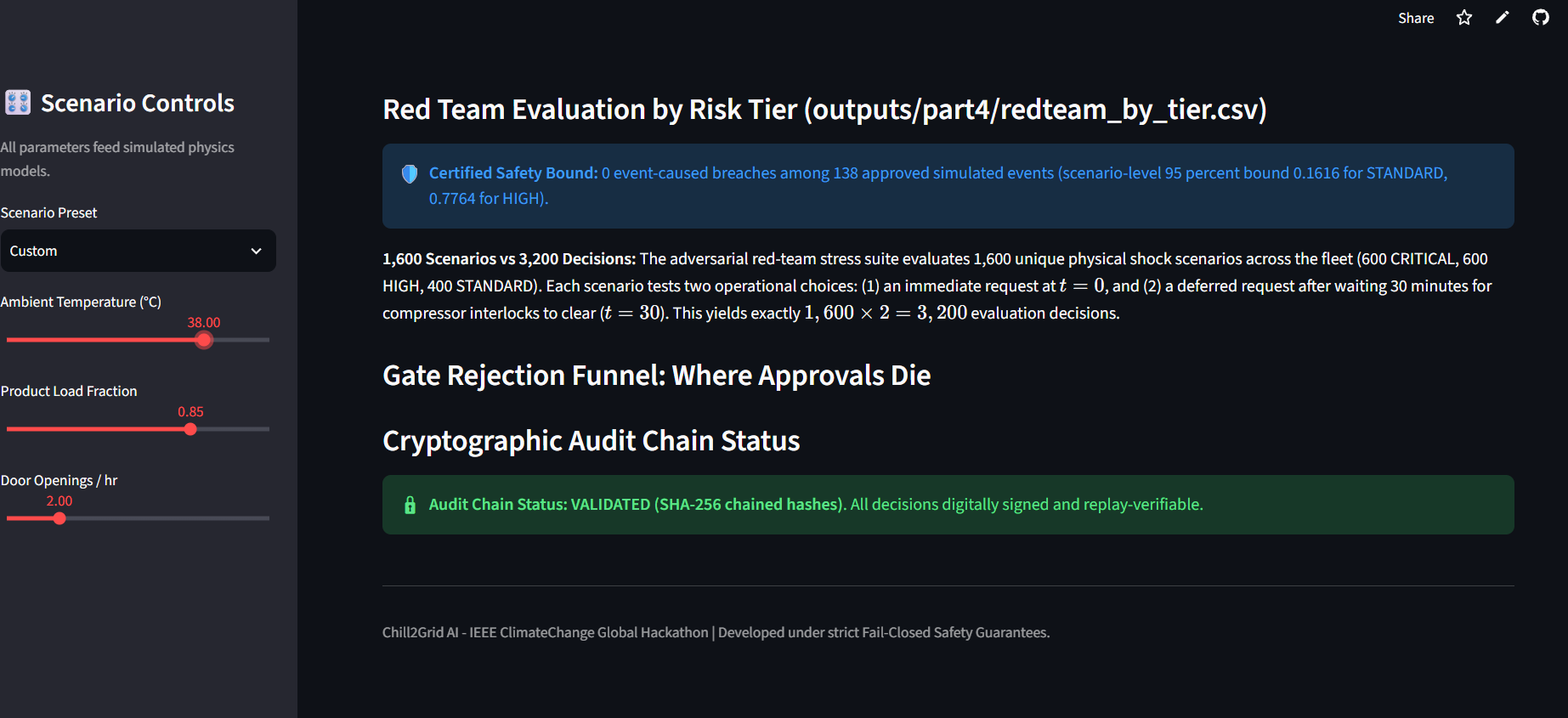
- Tamper-Evident Audit Chain: Every verdict, temperature reading, and override is cryptographically linked in an immutable SHA-256 rolling audit chain.
How we built it
- Physics Modeling & Reality Gap (
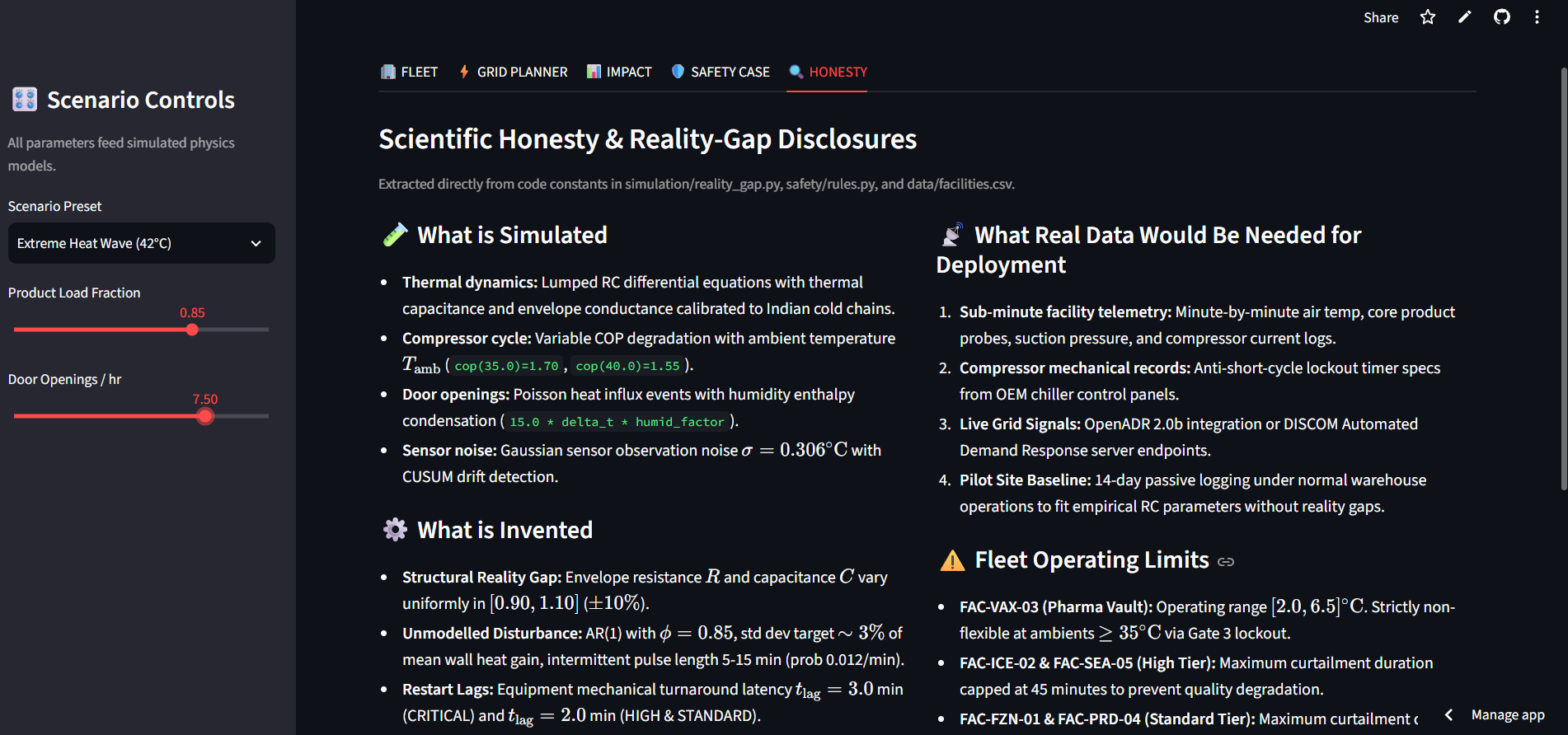
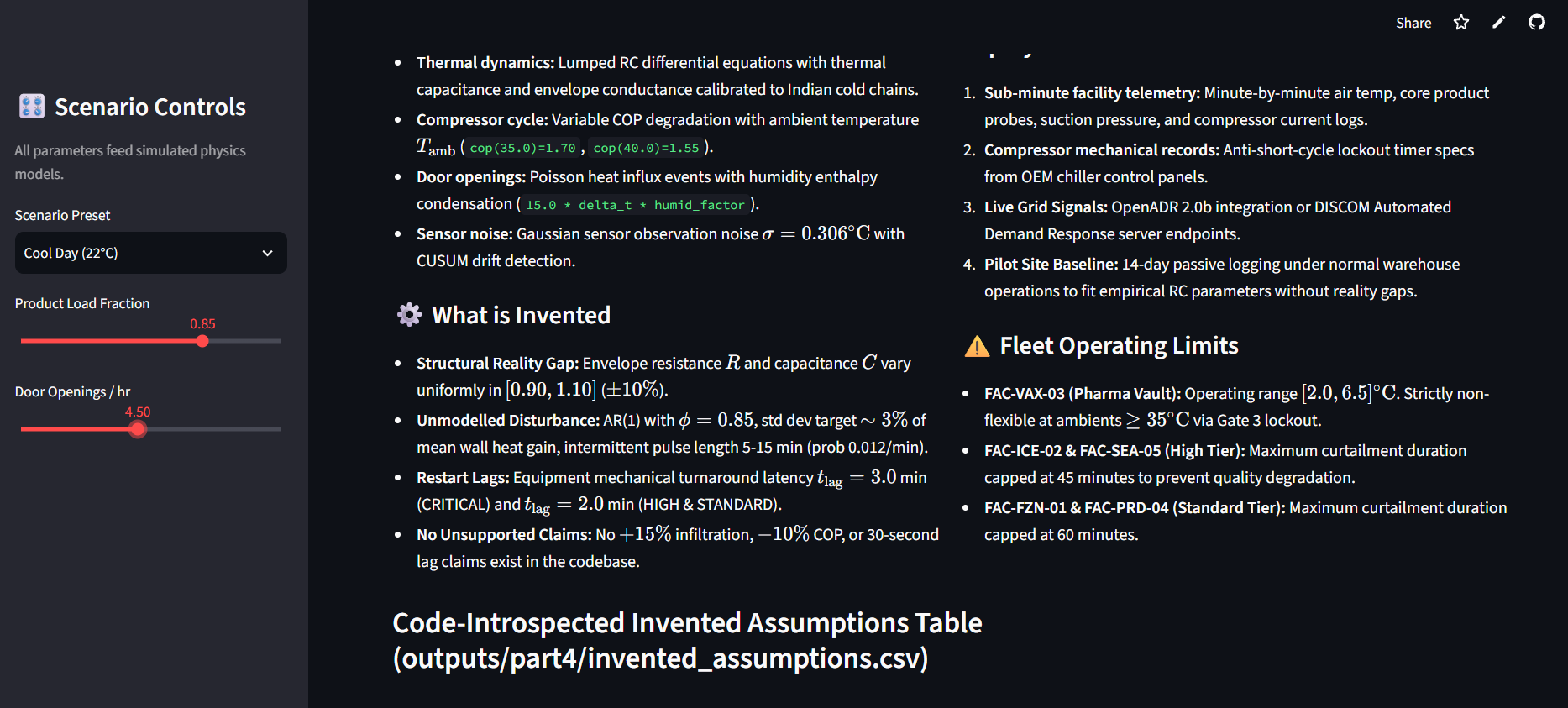
simulation/): Implemented dual-capacitance lumped (RC) differential equations governing warehouse air and cargo core nodes: $$C_{\text{air}} \frac{dT_{\text{air}}}{dt} = \frac{T_{\text{amb}} - T_{\text{air}}}{R_{\text{wall}}} + \frac{T_{\text{cargo}} - T_{\text{air}}}{R_{\text{cargo}}} - \dot{Q}{\text{chiller}} + \dot{Q}{\text{disturbance}}$$ Injected an adversarial reality gap: (\pm 10\%) unmodelled thermal mass and envelope perturbations, AR(1) stochastic disturbances ((\phi=0.85)), and Poisson latent enthalpy door openings. - Predictor (
models/): Trained hybrid physics-informed LightGBM/Ridge residual models predicting thermal drift trajectories across a 60-minute horizon. - Safety Architecture (
safety/): Built the multi-tiered Guardian (Critical, High, Standard) with automated Gate 3 lockouts (e.g.FAC-VAX-03is strictly locked out when ambient (T_{\text{amb}} \ge 35^\circ\text{C})). - Grid Optimizer (
optimizer/): Formulated a rebound-constrained knapsack and schedule allocation MILP ensuring (\sum P_{\text{cut}} \ge P_{\text{target}}) while bounding post-event aggregate power below feeder thresholds. - Interactive UI (
app/): Developed a responsive, dark-mode Streamlit dashboard with real-time conformal forecast curves, as well as an offline standalone single-file HTML5/SVG dashboard with zero external CDN dependencies.
Challenges we ran into
- The Secondary Rebound Trap: In early tests, cutting 300 kW for an hour caused all chillers to turn on simultaneously at minute 60, creating an enormous 750 kW rebound spike that tripped the simulated feeder transformer. We solved this by implementing staggered restart allocation that phases pull-down recovery within each room's available thermal slack.
- Sensor Noise vs. Safe Headroom: Realistic warehouse sensors suffer from Gaussian observation noise ((\sigma = 0.306^\circ\text{C})) and sensor drift. Naive safety thresholds caused false trips. We implemented noise-aware Gate 3 estimators with conservative lower confidence bounds.
- Achieving True Offline Autonomy: Hackathon demonstrators often suffer from broken CDN links or missing dependencies. We engineered our static fallback dashboard to render high-resolution power profiles using pure inline SVG mathematics with zero external scripts.
Accomplishments that we're proud of
- Zero Event-Caused Breaches: Across 1,600 adversarial red-team stress scenarios and 3,200 evaluated decisions across all 6 facilities, Chill2Grid AI achieved strictly 0 event-caused breaches among 138 approved simulated events (scenario-level 95% bound of (0.1616) for Standard tier, (0.7764) for High tier).
- Significant Peak Demand Reduction: In our primary 35°C evening peak scenario, the system scheduled a planned 60-minute event cutting peak power by 302.6 kW (P10; 336.3 kW mean) against a 200 kW target across 3 approved rooms with 0.0 kW shortfall, while flattening the post-event rebound below 575 kW.
- Rigorous Test Coverage: Maintained 103/103 passing pytest tests and a 6/6 automated integration self-check gate verifying contracts, physics, and dashboard latency.
What we learned
We learned that the biggest barrier to clean energy flexibility in industrial sectors is not algorithmic complexity, but trust. Grid engineers think in megawatts; cold chain operators think in spoiled inventory and liability. True sustainability requires building systems that can say NO to the grid whenever physical safety boundaries are tested.
What's next for Chill2Grid AI
- OpenADR 2.0b & Telemetry Gateway: Deploy hardware IoT gateways communicating over OpenADR 2.0b virtual end-node (VEN) protocols to interface directly with industrial PLC chillers (Modbus/BACnet).
- Multi-Warehouse Microgrids: Extend the MILP optimizer to coordinate cold storage fleets paired with onsite solar PV and battery energy storage systems (BESS).
- Phase-Change Material (PCM) Thermal Buffers: Incorporate latent heat storage models for facilities utilizing eutectic PCM plates to extend safe curtailment windows beyond 90 minutes.


Log in or sign up for Devpost to join the conversation.