-
-
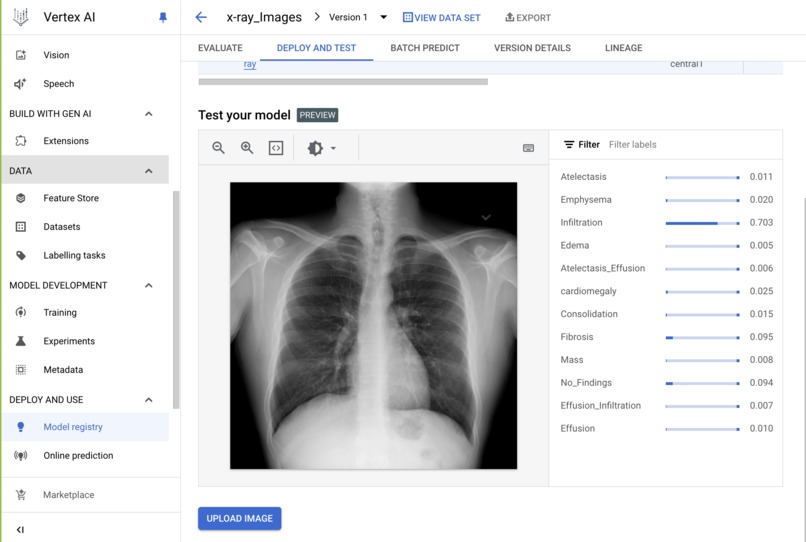
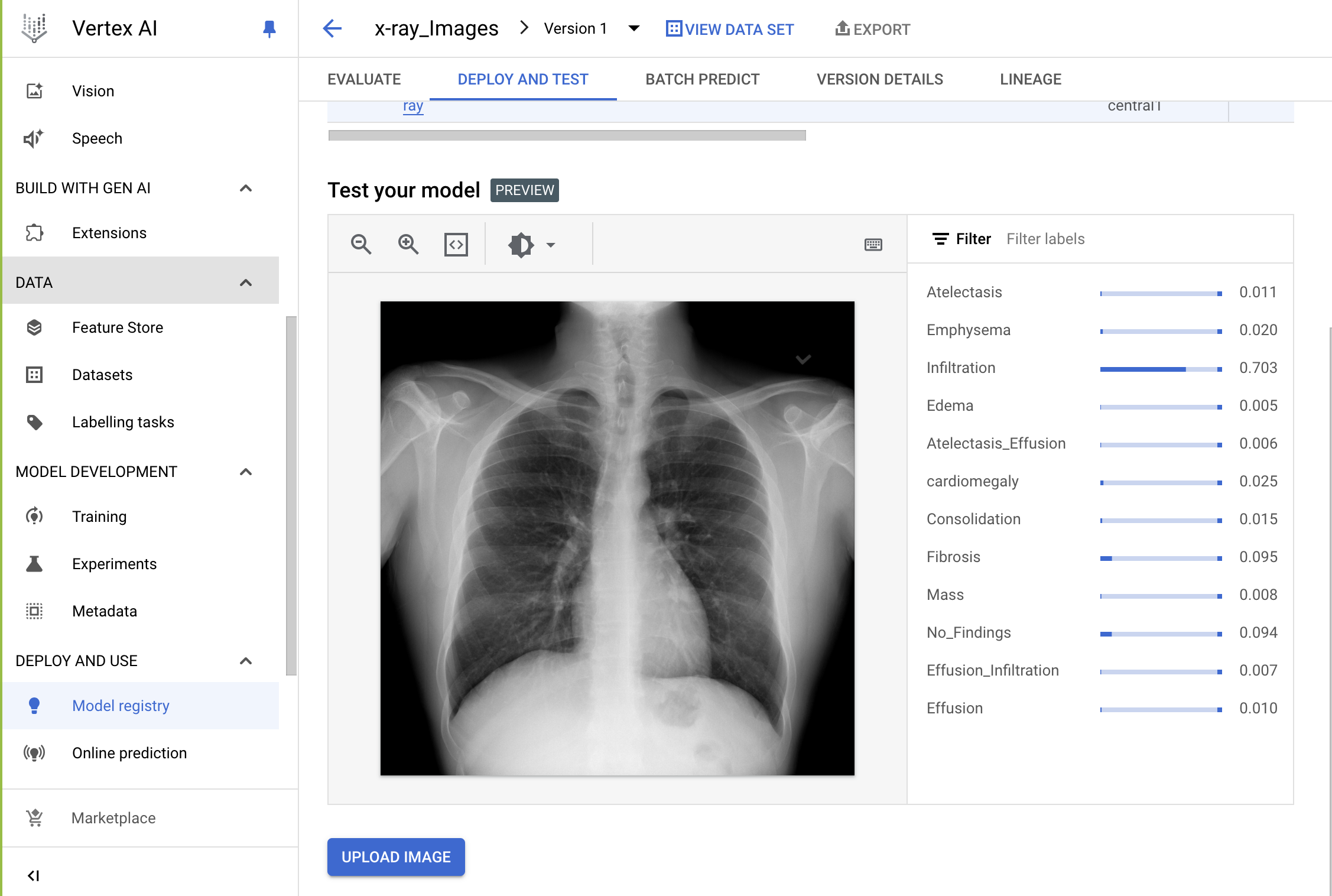
Test Chest X-ray Image
Inspiration
The inspiration for this project came from the need to provide timely and accurate chest disease diagnoses, helping healthcare professionals make informed decisions and improving patient outcomes.
What it does
Our project aims to develop an AI model capable of diagnosing chest diseases from X-ray images. The model analyzes chest X-ray images to determine if there is a disease present, and if so, identifies the specific disease. This project utilizes Google Cloud's Vertex AI platform to manage the dataset, label images, and train a diagnostic model using AutoML.
How we built it
We trained the model using Vertex AI, AutoML, and Google Cloud services on a dataset of 3000 approx labelled chest X-ray images.
Data-set Preparation: Our project focuses on developing an AI model capable of diagnosing chest diseases from X-ray images. We worked with a dataset of approximately 3000 images, including healthy and diseased chests. This diverse dataset was crucial in ensuring our model could learn to distinguish between various chest conditions accurately.
Data Collection and Labeling: The dataset was sourced from medical imaging databases (Kaggle). The first step was importing our dataset into Vertex AI. For this, we utilized Google Cloud Storage for data storage which provides tools to easily upload and manage large datasets. Next, we used the integrated Google Data Labeling Service to categorize each X-ray image as either healthy (no findings) or diseased which has a specific disease name. This step is critical for supervised learning as it provides the model with the necessary information to learn from. With our labelled dataset, we moved on to training the model using AutoML. After training, the model was deployed using Vertex AI's managed endpoint service.
Challenges we ran into
We faced challenges in ensuring high-quality data labelling, making a highly accurate model and managing the computational demands of training a complex neural network.
Accomplishments that we're proud of
We are proud of developing a model that can diagnose multiple chest diseases from X-ray images and successfully deploy it using Vertex AI.
What we learned
We learned the importance of robust data preparation, the efficiency of Vertex AI for model training and deployment, and the critical role of computational resources in ML projects.
What's next for Chest Disease analysis
Learning from our project challenges, we are looking ahead to:
- Enhancing Model Accuracy: Improving the model’s performance metrics, including precision, recall, and overall accuracy.
- Continuously improve the model by using Custom Models or BigQuery ML according to the needs.
- Expanding Dataset: Include a wider variety of chest diseases and more diverse data sources.
- Integration: Develop user-friendly applications to facilitate real-time diagnostics for healthcare professionals, making the technology more accessible and practical for everyday use.
Built With
- chest-xrays
- google-cloud
- python
- vertexai


Log in or sign up for Devpost to join the conversation.