Inspiration
The inspiration for this project came from the need to leverage computer vision techniques in deep learning to accurately classify Chest CT Scan images into four distinct categories: Adeno Carcinoma, Large Cell Carcinoma, Normal, and Squamous Cell Carcinoma. The goal was to create a robust and accurate classification model that could assist in medical diagnoses.
What it does
The project centers around the development of a Convolutional Neural Network (CNN) model using the VGG-16 architecture and pretrained weights. This model is designed to classify Chest CT Scan images into the specified four categories. The primary metric used to evaluate the model's performance is accuracy.
How we built it
We built the project using the following steps:
Dataset
We sourced our dataset from Kaggle, which provided a collection of Chest CT Scan images. These images served as the foundation for our deep learning model.
Preprocessing
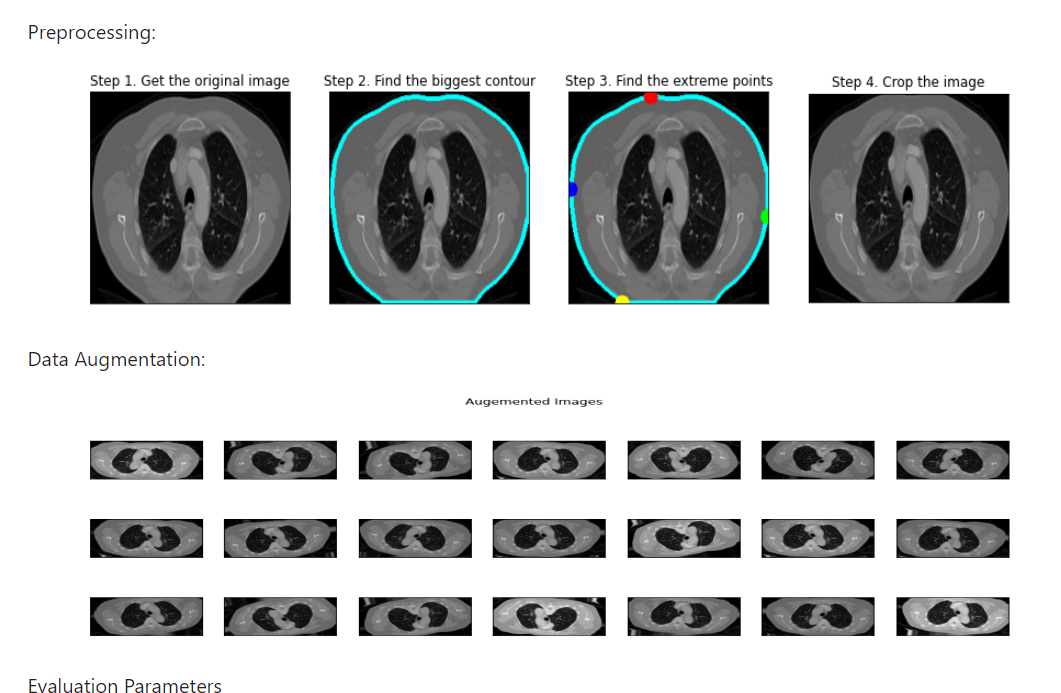
To use the Chest CT Scan images in our deep learning model, we performed preprocessing to ensure they were suitable for training. This included various preprocessing steps such as resizing, normalization, and converting the images into a format compatible with our model.
Data Augmentation
Data augmentation techniques were employed to expand the size of our training dataset and enhance the robustness of our deep learning model. These techniques involved generating new training samples through transformations like rotation, flipping, and zooming.
Model Architecture
The core of our project is the VGG-16 Convolutional Neural Network (CNN) model. We utilized this architecture and fine-tuned it for our specific classification task. The VGG-16 model is known for its deep layers and proven performance in computer vision tasks.
Evaluation Parameters
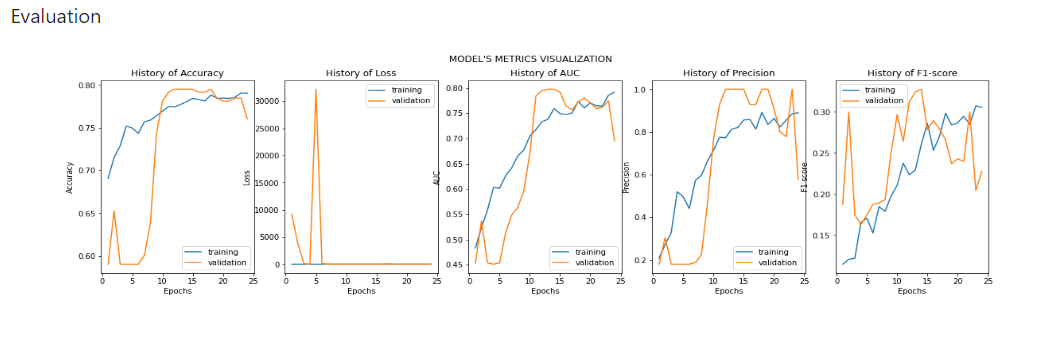
To assess the performance of our model, we employed various evaluation parameters, including precision, recall, F1-score, and confusion matrices. These metrics provided insights into how well our model classified Chest CT Scan images across the four categories.
Challenges we ran into
Throughout the project, we encountered several challenges, including:
Data Size: The dataset's size was limited, which can pose challenges for deep learning models. Increasing the dataset size would be beneficial for improving model performance.
Hyperparameter Tuning: Tuning hyperparameters such as learning rates and batch sizes was a crucial but time-consuming process. Finding the optimal combination required significant experimentation.
Model Selection: While VGG-16 served as a strong base model, exploring state-of-the-art CNN architectures like Attention-based CNNs and Vision Transformers for potential performance gains presented its own set of challenges.
Accomplishments that we're proud of
Despite the challenges, we are proud of several accomplishments:
Successful Classification: We successfully developed a CNN model that could accurately classify Chest CT Scan images into four distinct categories, contributing to the field of medical image analysis.
Data Augmentation: The application of data augmentation techniques improved the model's robustness and performance.
What we learned
Through this project, we gained valuable insights into:
Medical Image Classification: We learned about the unique challenges and considerations involved in classifying medical images, particularly in the context of Chest CT Scans.
Deep Learning and CNNs: We deepened our understanding of Convolutional Neural Networks (CNNs), their architectures, and their applications in computer vision.
Data Augmentation: We explored the significance of data augmentation in enhancing model performance and mitigating overfitting.
What's next for Chest-CT Scan Application
Looking ahead, there are several avenues for further improvement and expansion of the Chest CT Scan application:
Dataset Expansion: Increasing the size and diversity of the dataset by collecting more Chest CT Scan images can lead to enhanced model performance and generalization.
Synthetic Data Generation: Employing Generative Adversarial Networks (GANs) to generate synthetic datasets can further diversify the training data and improve the model's ability to handle various scenarios.
Hyperparameter Tuning: Continuously fine-tuning hyperparameters and exploring advanced optimization techniques can help in achieving even better model performance.
Advanced CNN Models: Exploring and implementing state-of-the-art CNN architectures such as Attention-based CNNs and Vision Transformers can potentially yield significant improvements in classification accuracy.
Overall, this project forms the foundation for further advancements in Chest CT Scan classification, contributing to the field of medical imaging and diagnosis.

Log in or sign up for Devpost to join the conversation.