-
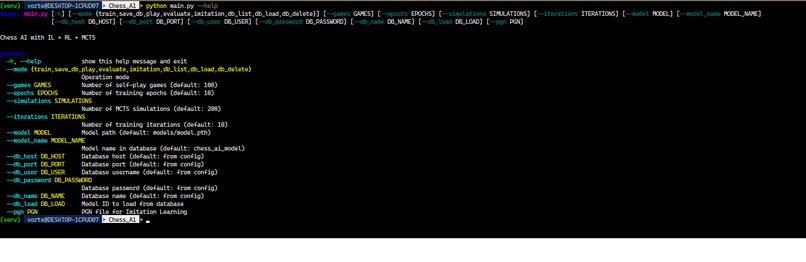
The first breath of my Chess AI.
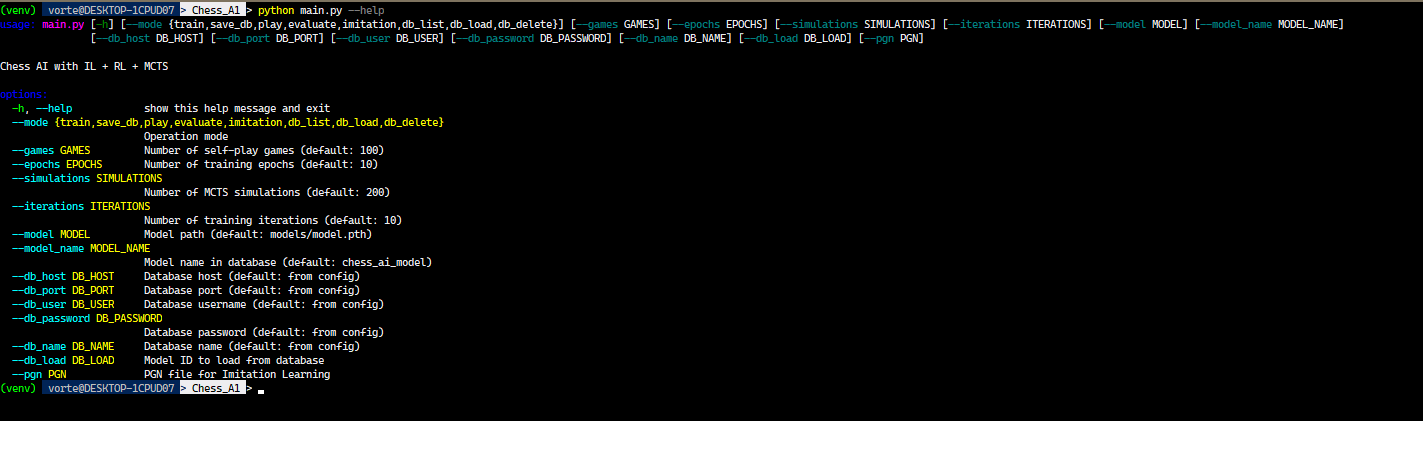
Inspiration
The idea for this project came from my personal experience learning to play chess. As a beginner, I found it difficult to find opponents at my skill level. Commercial chess apps are often expensive or cluttered with ads, and the free ones don't offer a way to learn from masters. I wanted to build an open-source AI that could be a free, offline, and challenging practice partner for anyone, anywhere.
What it does
Chess_A1 is a chess AI that combines three machine learning approaches:
- Imitation Learning (IL): Learns from millions of high-quality master games (PGN datasets) to mimic human-like moves.
- Reinforcement Learning (RL): Improves by playing millions of games against itself (self-play), discovering strategies beyond human intuition.
- Monte Carlo Tree Search (MCTS): Uses a smart tree search algorithm to evaluate the best possible moves, balancing exploration and exploitation.
The result is a powerful, adaptable, and free chess opponent that provides a fair and educational challenge for beginners and intermediate players.
How I built it
- Language & Framework: Python 3.9+ with PyTorch for building and training the neural network.
- Core Logic:
python-chesslibrary to handle all chess rules, board states, and move generation. - AI Pipeline: I built a custom pipeline where the model first learns from a PGN dataset (Imitation Learning), then continues to improve through Reinforcement Learning (self-play).
- MCTS Implementation: I implemented a custom MCTS algorithm that uses the neural network's predictions to guide its search, making the AI efficient and strong.
- Development Tools: Used Git and GitHub for version control, and
tqdmfor tracking the long training processes.
Challenges I ran into
- Balancing IL and RL: The biggest challenge was getting the model to balance what it learned from masters (IL) with its own discoveries (RL). Too much IL made it predictable, too much RL made it erratic.
- Self-Play Instability: RL training is notoriously unstable. I spent a lot of time adjusting hyperparameters (learning rate, MCTS simulations) and adding error handling to prevent the model from diverging or getting stuck.
- Training Time: Training a chess AI from scratch takes a very long time. I had to optimize the code to run efficiently, using progress bars (
tqdm) and logging to monitor performance. - Managing Complexity: Understanding and implementing MCTS, neural network architectures, and the training loop while keeping the code modular and readable was a huge but rewarding challenge.
Accomplishments that I'm proud of
- Building a fully functional Chess AI that combines three complex AI techniques.
- Successfully setting up a complete AI training pipeline from scratch.
- Creating a clean and professional project structure that is easy to navigate.
- Open-sourcing the project on GitHub with comprehensive documentation.
What I learned
- How to apply theoretical AI concepts (IL, RL, MCTS) in a real-world project.
- The importance of logging, error handling, and unit testing in AI development.
- How to manage a Python project professionally (virtual environments, requirements, project structure).
- The challenges of training deep learning models and strategies to overcome them.
What's next for Chess_A1
- Graphical User Interface (GUI): Build a proper interface using Pygame or Tkinter to make it more accessible.
- Web Deployment: Deploy the AI as a web app using Streamlit or Flask.
- Larger Dataset: Train the model on a much larger dataset of master games to improve its strength.
- Difficulty Levels: Implement easy, medium, and hard modes by adjusting MCTS search depth.
- Analysis Mode: Allow players to review their games and get AI-powered feedback on their moves.

