-
-
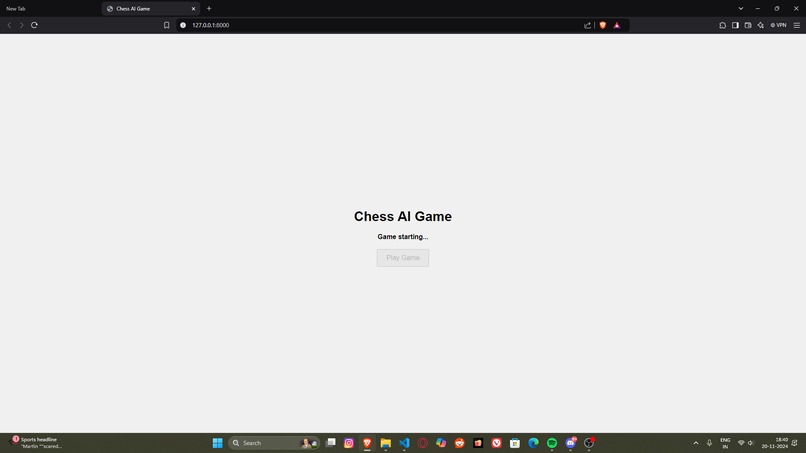
this is the game starting
-
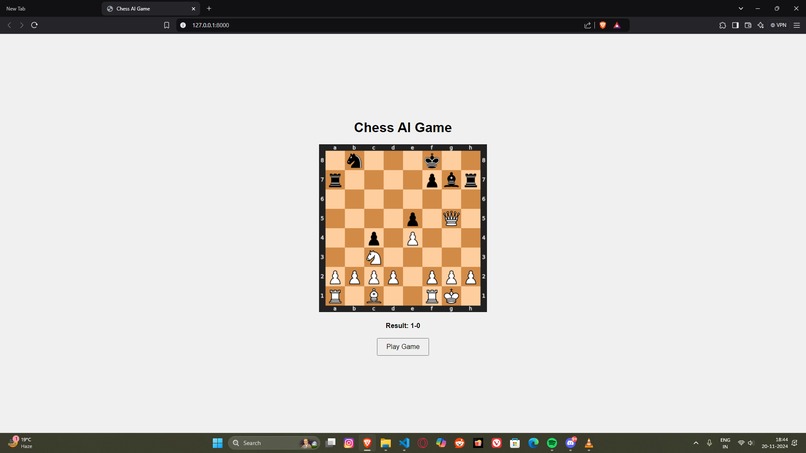
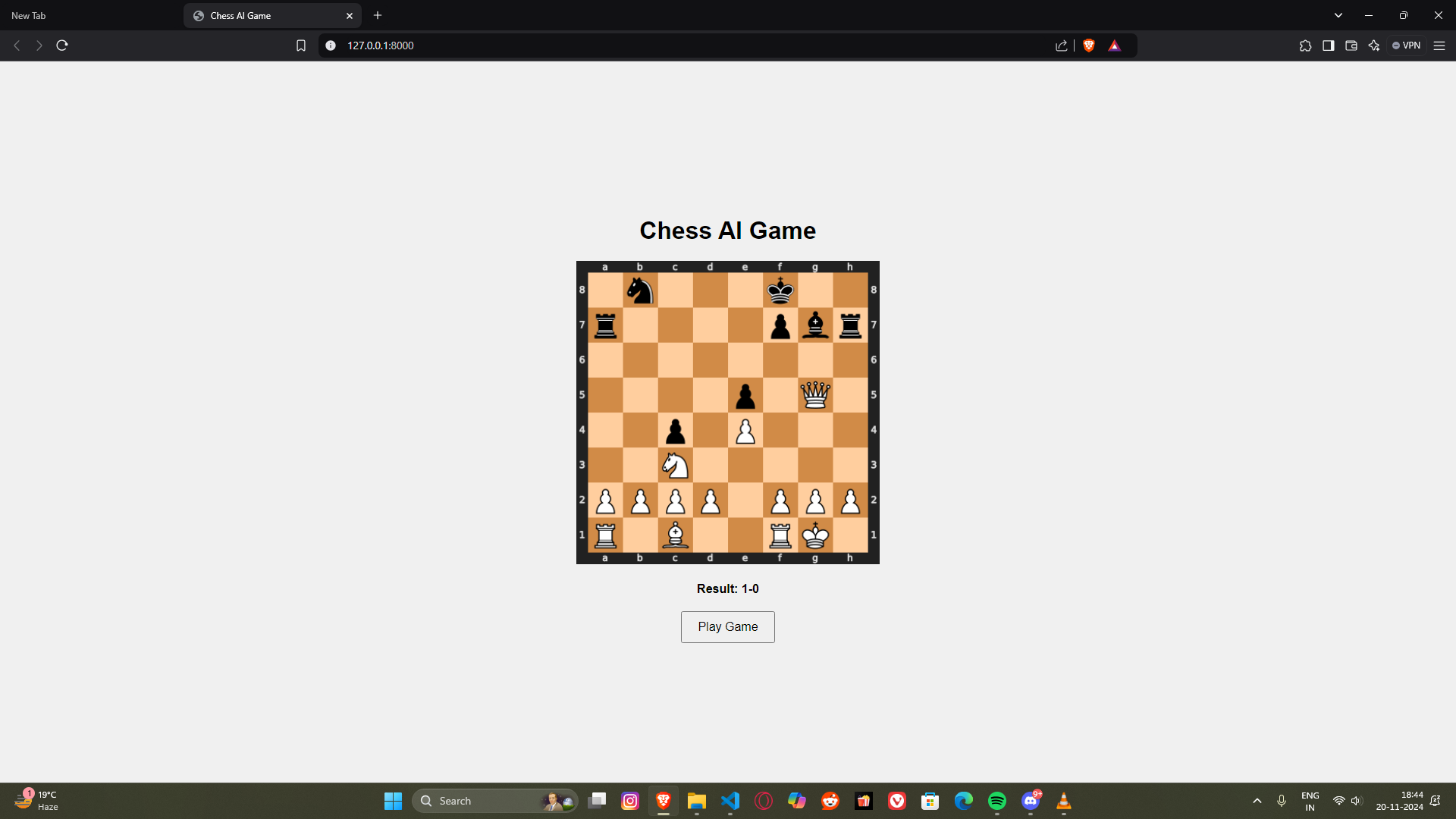
this is the game where AI plays against each other
Inspiration
The inspiration for this project comes from the groundbreaking work of AlphaZero, a deep-learning AI by DeepMind, that mastered chess through self-play. This project aims to explore and implement similar concepts to create a chess AI capable of understanding board states and predicting optimal moves.
What it does
The AI predicts the best possible moves for a given chessboard state using a deep neural network. It evaluates the position (value prediction) and suggests moves (policy prediction), making it capable of playing chess games autonomously.
How we built it
- Deep Neural Network Architecture: Built using TensorFlow and Keras, with Conv2D layers and residual blocks.
- Data Representation: Converted chessboard positions into 3D input planes based on FEN notation.
- Mixed Precision Training: Implemented for faster training on GPUs.
- Training: Trained the AI using custom data generators, splitting the tasks into policy and value predictions.
- Evaluation: The AI plays full games of chess using its trained model.
Challenges we ran into
- Properly encoding chessboard states in a format suitable for deep learning.
- Balancing the policy and value networks for effective move prediction and board evaluation.
- Debugging issues in FEN parsing and move legality checks.
- Optimizing the training process to leverage GPU resources effectively.
Accomplishments that we're proud of
- Successfully implementing a residual network architecture for chess move prediction.
- Building a functional AI capable of playing autonomous chess games.
- Handling both policy (move selection) and value (position evaluation) outputs in a single model.
- Learning advanced deep learning concepts and applying them effectively.
What we learned
- Deep learning principles for game AI, including policy and value network design.
- Efficient representation of complex board games for machine learning.
- Using TensorFlow's mixed precision policy to optimize GPU training performance.
- Parsing and processing chess-specific data formats like FEN.
What's next for Chess-AI-Utkarsh
- Self-Play Training: Enabling the AI to improve by playing against itself.
- Better Move Generation: Incorporating reinforcement learning to refine its decision-making.
- Stronger Model: Experimenting with deeper architectures or transformers for enhanced performance.
- Interactive Web Interface: Creating a user-friendly interface to let people play against the AI.
- Performance Evaluation: Benchmarking against other chess engines.


Log in or sign up for Devpost to join the conversation.