-
-
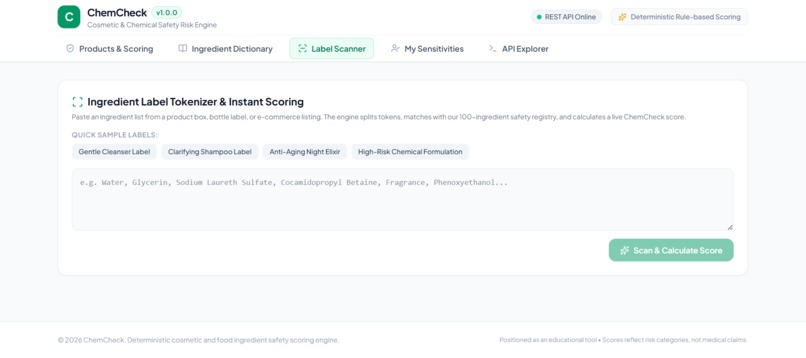
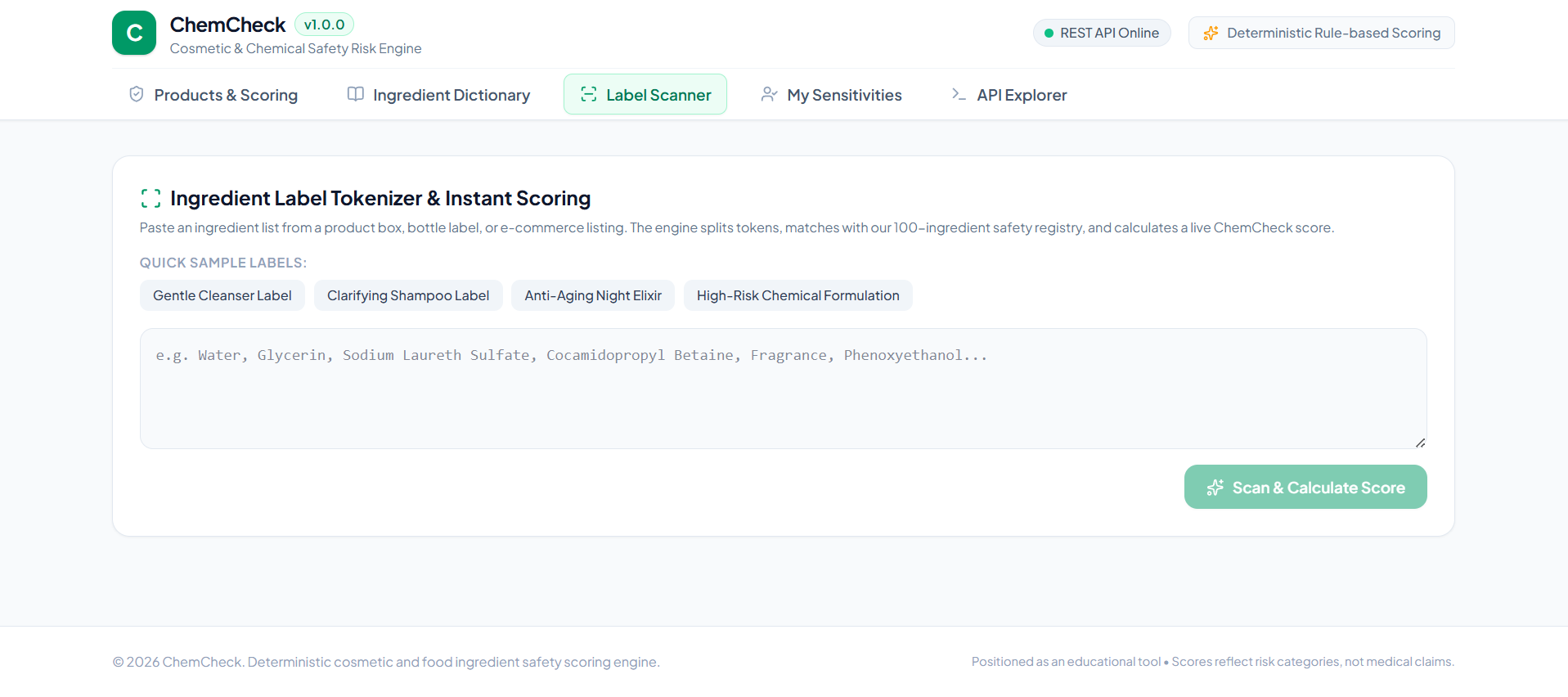
Ingredient Label Scanner
-
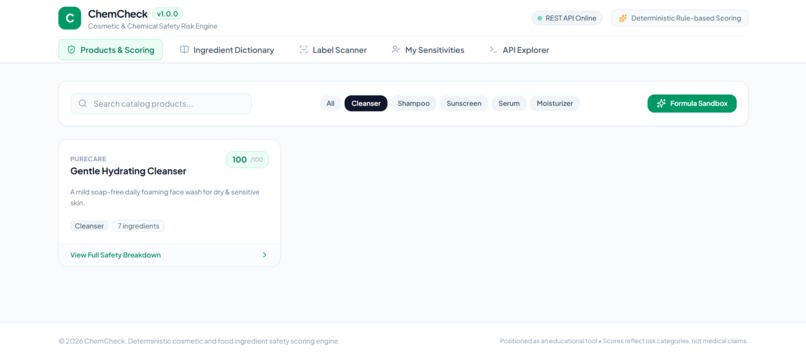
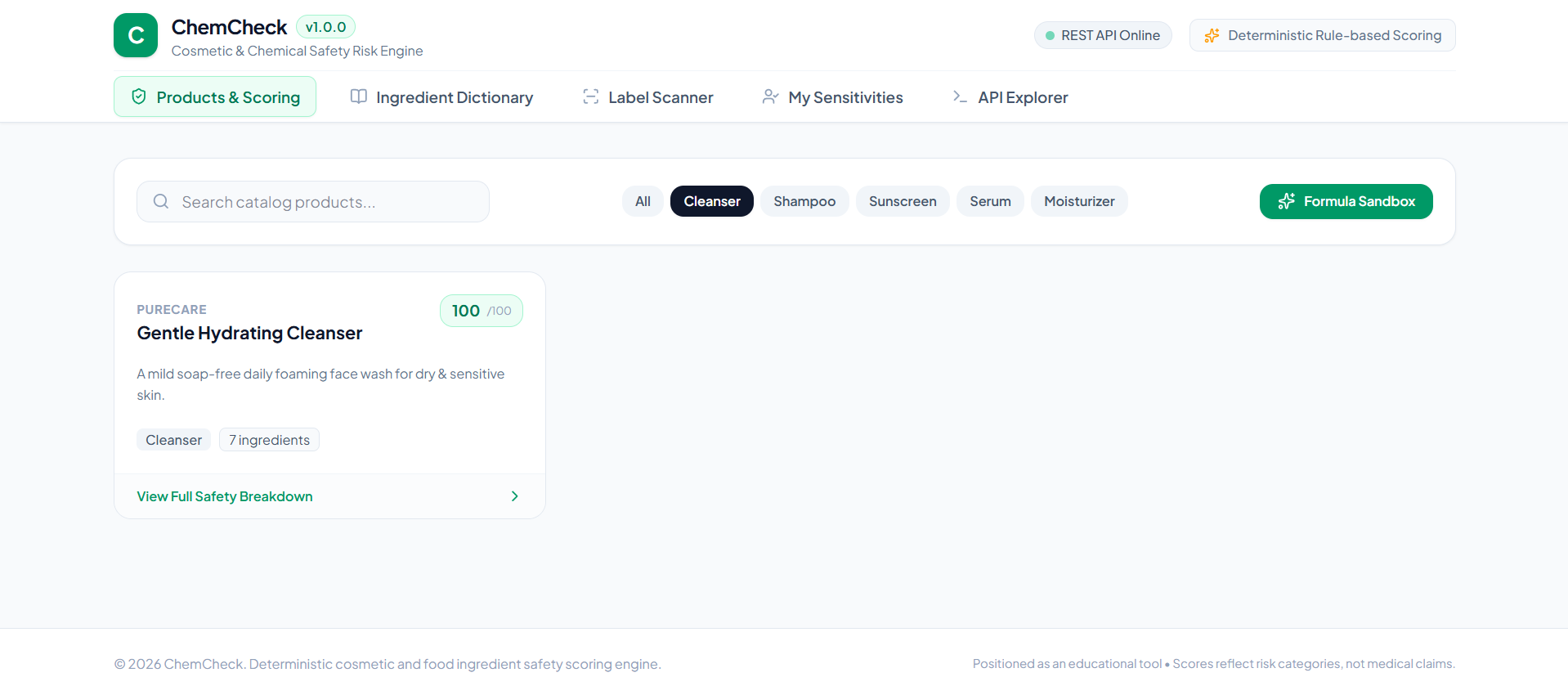
Product and Scoring
-
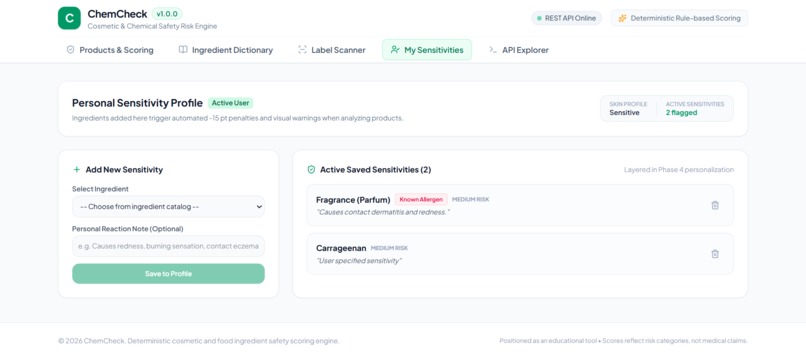
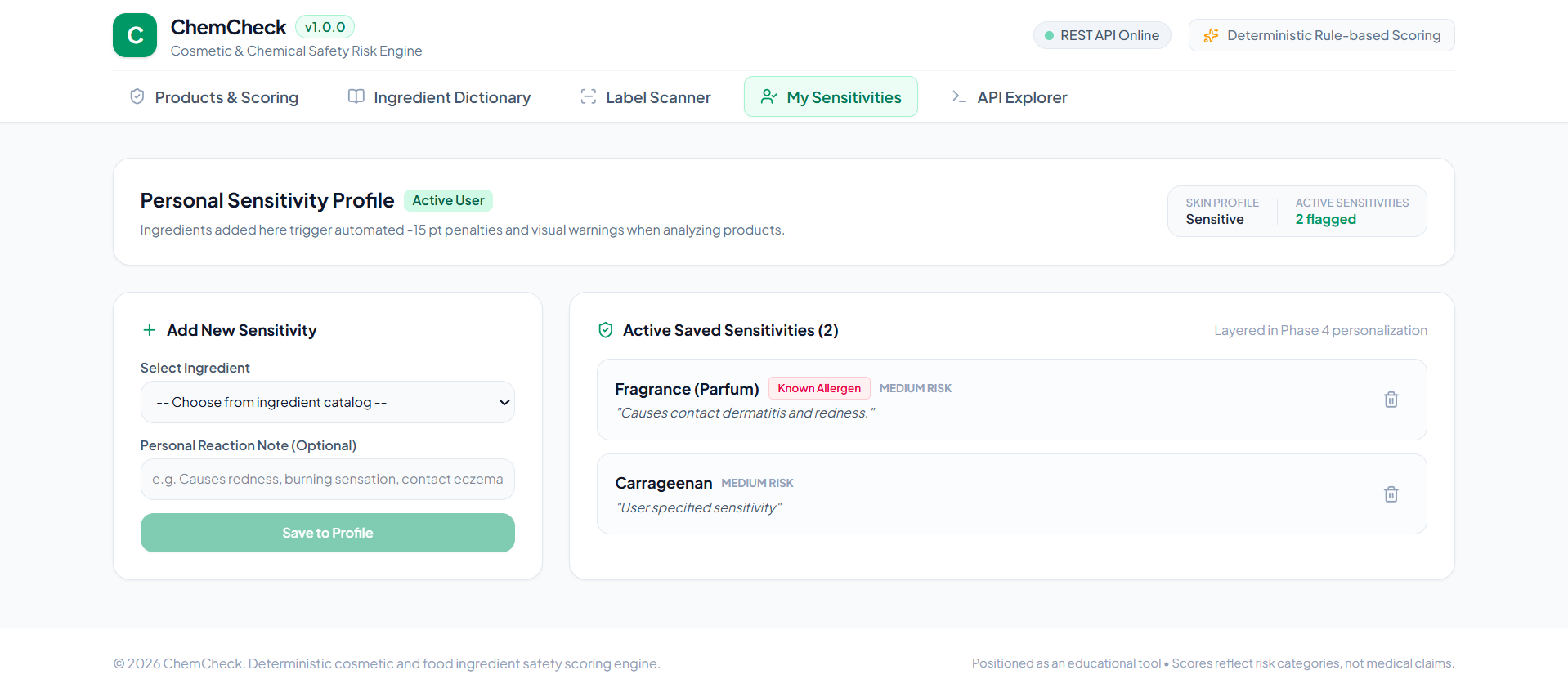
Personalized Sensitivity Profile
-
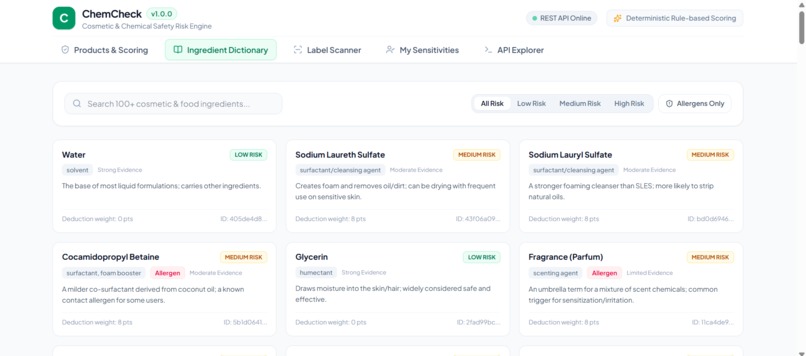
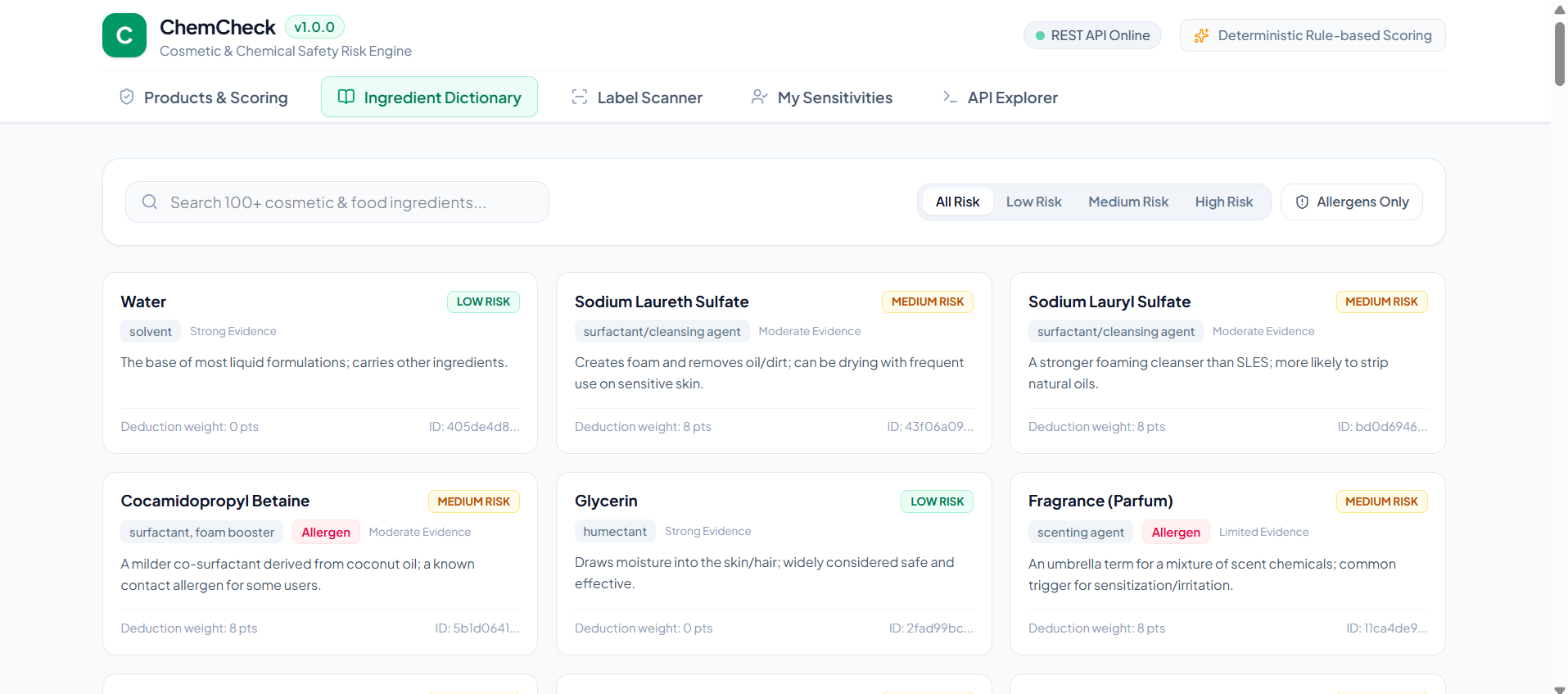
Ingredient Dictonary
Inspiration
Every day, people use shampoos, skincare products, cosmetics, and other consumer products without fully understanding the ingredients listed on their labels. Ingredient names can be complex, technical, and difficult to interpret, while reliable information is often scattered across different sources.
This inspired us to build ChemCheck — an AI-powered ingredient intelligence platform designed to make complex product information easier to understand and more relevant to individual users.
Our vision is to bridge the gap between chemistry, artificial intelligence, and consumer health information by helping people understand what is present in a product, why an ingredient may be relevant, and what factors they should consider before making a decision.
ChemCheck is designed as an educational and decision-support platform, not as a medical diagnostic system or a replacement for healthcare professionals.
What it does
ChemCheck transforms a product's ingredient information into understandable, personalized insights.
Users can provide a product name or ingredient list, and the platform can:
- Extract and identify ingredients.
- Normalize different ingredient names and variations.
- Explain the function of individual ingredients in simple language.
- Connect ingredients with information from a structured knowledge base.
- Highlight potential areas of concern based on available evidence.
- Consider user-provided preferences and previous reactions.
- Generate personalized ingredient insights.
- Suggest alternative products based on the user's requirements.
- Explain why an ingredient or product was highlighted instead of providing an unexplained score.
The core workflow is:
Product / Ingredient List
          ↓
Ingredient Extraction
          ↓
Ingredient Normalization
          ↓
Chemical & Health Knowledge Base
          ↓
AI / NLP Analysis
          ↓
Personalization
          ↓
Explainable Health Insights
          ↓
Alternative Recommendations
How we built it
ChemCheck is designed as a modular full-stack platform combining software engineering, data science, artificial intelligence, and chemistry-related knowledge.
Technology Stack
- Frontend: React / Next.js
- Backend: FastAPI + Python
- Database: PostgreSQL / MySQL
- AI & NLP: Python, NLP and machine-learning techniques
- OCR: OpenCV + Tesseract
- Ingredient Matching: Fuzzy matching and normalization
- Recommendation Engine: Rule-based and data-driven approaches
- Deployment: Docker
The system uses an ingredient knowledge layer to store information such as ingredient names, functions, relevant concerns, and supporting evidence.
The personalization layer can use user-provided information such as preferences and previously reported product reactions to generate more relevant insights.
We are also designing the system around explainability, so that users can understand the reasoning behind an insight rather than simply receiving a black-box prediction.
Challenges we ran into
Ingredient normalization
Ingredients can appear under different names, abbreviations, spellings, or scientific terminology. Mapping these variations to a consistent representation is an important technical challenge.
Reliable health information
Health-related information requires greater care than ordinary product recommendations. We need to distinguish between established evidence, emerging research, and uncertain information rather than assigning arbitrary "safe" or "unsafe" labels.
Personalization
A particular ingredient may be relevant to one person but not necessarily to another. Designing personalization without making unsupported medical conclusions is an important challenge.
Explainability
Simply showing an AI-generated result is not enough for a health-oriented application. Users should be able to understand what was identified, why it was highlighted, and what information supports the insight.
Responsible AI
We need to ensure that ChemCheck does not present itself as a diagnostic or treatment system. The platform therefore focuses on education and decision support while communicating limitations and uncertainty.
Accomplishments that we're proud of
We are proud of bringing together multiple disciplines into one healthcare-focused concept.
Our key accomplishments include:
- Designing a complete end-to-end architecture for ChemCheck .
- Combining AI, NLP, chemistry, databases, and recommendation systems.
- Designing an ingredient normalization and matching pipeline.
- Developing the concept of a structured ingredient knowledge base.
- Incorporating user history for personalized insights.
- Designing an explainable recommendation approach rather than relying on unexplained scores.
- Moving beyond a simple product-rating application toward an evidence-aware consumer health intelligence platform.
- Creating a scalable architecture that can support additional product categories and future research.
What we learned
Building ChemWise taught us that healthcare AI requires more than simply integrating an AI model.
We learned how:
- Complex chemical information can be structured into usable data.
- NLP can help process inconsistent ingredient terminology.
- OCR can convert product labels into machine-readable information.
- Recommendation systems can incorporate user-specific context.
- Explainability becomes especially important when AI is used in health-related applications.
- Evidence quality and data provenance matter when presenting health information.
- A system should clearly communicate uncertainty instead of presenting AI outputs as absolute medical facts.
- Responsible product design is essential when technology can influence health-related decisions.
Most importantly, we learned that good healthcare technology should not only provide an answer — it should help users understand the information behind that answer.
What's next for ChemCheck
Our next goal is to turn ChemCheck from a concept into a validated, research-oriented platform.
Short-term
- Build the functional web application.
- Develop the ingredient knowledge database.
- Implement ingredient extraction and normalization.
- Integrate OCR for product-label analysis.
- Develop the first recommendation engine.
- Create explainable result screens.
- Test the system with real-world product datasets.
Medium-term
- Expand the ingredient knowledge base.
- Add multilingual ingredient explanations.
- Improve NLP-based ingredient recognition.
- Introduce evidence-linked knowledge graphs.
- Improve personalization using user feedback.
- Expand into additional consumer-product categories.
Long-term
We envision ChemCheck becoming a broader AI-powered consumer health intelligence platform that connects structured chemical knowledge, scientific evidence, personalization, and explainable AI.
Future research could focus on validating the accuracy of ingredient extraction, evidence retrieval, personalization, and recommendation quality through systematic testing and expert evaluation.
ChemCheck aims to make complex ingredient information understandable, evidence-aware, and personalized — helping people make more informed consumer health decisions.
Built With
- artificial
- computer
- data
- docker
- fastapi
- healthcare
- intelligence
- language
- learning
- machine
- natural
- next.js
- ocr
- opencv
- postgresql
- processing
- python
- react
- recommendation
- science
- sqlalchemy
- tesseract
- vision

Log in or sign up for Devpost to join the conversation.