Inspiration
Chemical engineering analysis often begins with a problem described in natural language, but translating that problem into a reliable engineering calculation can take significant time and specialized knowledge.
Even fundamental tasks such as mass balances and reaction balances require engineers to identify streams and components, establish assumptions, formulate equations, determine unknowns, check units and stoichiometry, and independently verify the result.
Conventional simulation and engineering software can make the calculations easier once a model is established, but the engineer still has to translate the original problem into the specific input structure, terminology, and format required by the software. The problem also needs to be specific and clearly defined before meaningful calculations can be performed.
We wanted to explore a different approach: What if an engineer could simply describe the problem naturally, and an AI system could translate that description into an engineering model while keeping the actual calculations deterministic and verifiable?
That idea became ChemPilot.
What It Does
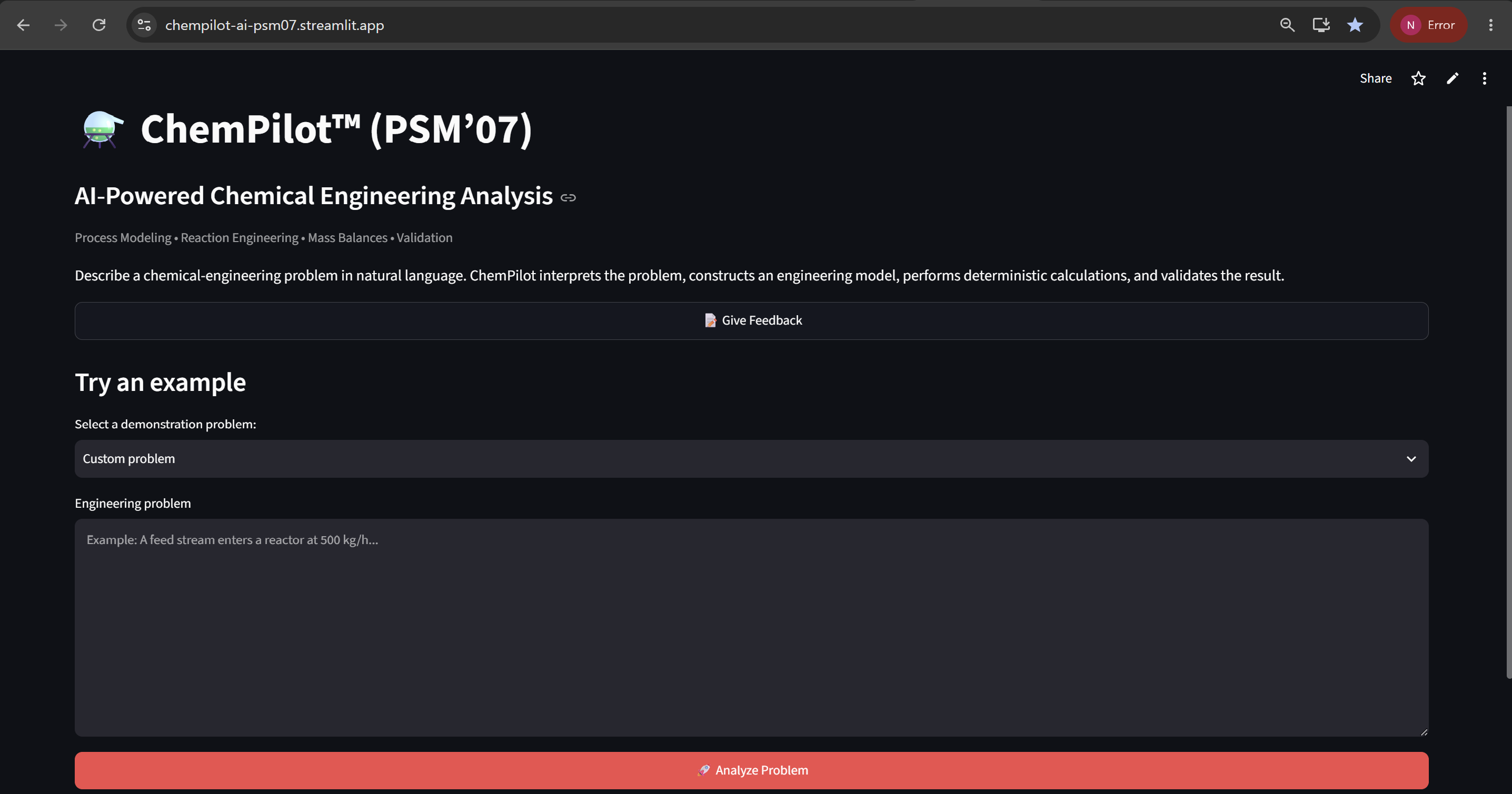
ChemPilot is an AI-powered chemical engineering analysis platform that accepts engineering problems in natural language.
The current system can interpret and construct engineering models for workflows including:
Mass balances
Reaction balances
Stoichiometric calculations
Conversion calculations
Limiting-reactant analysis
Engineering assumptions
Mass-conservation validation
Physical-feasibility checks
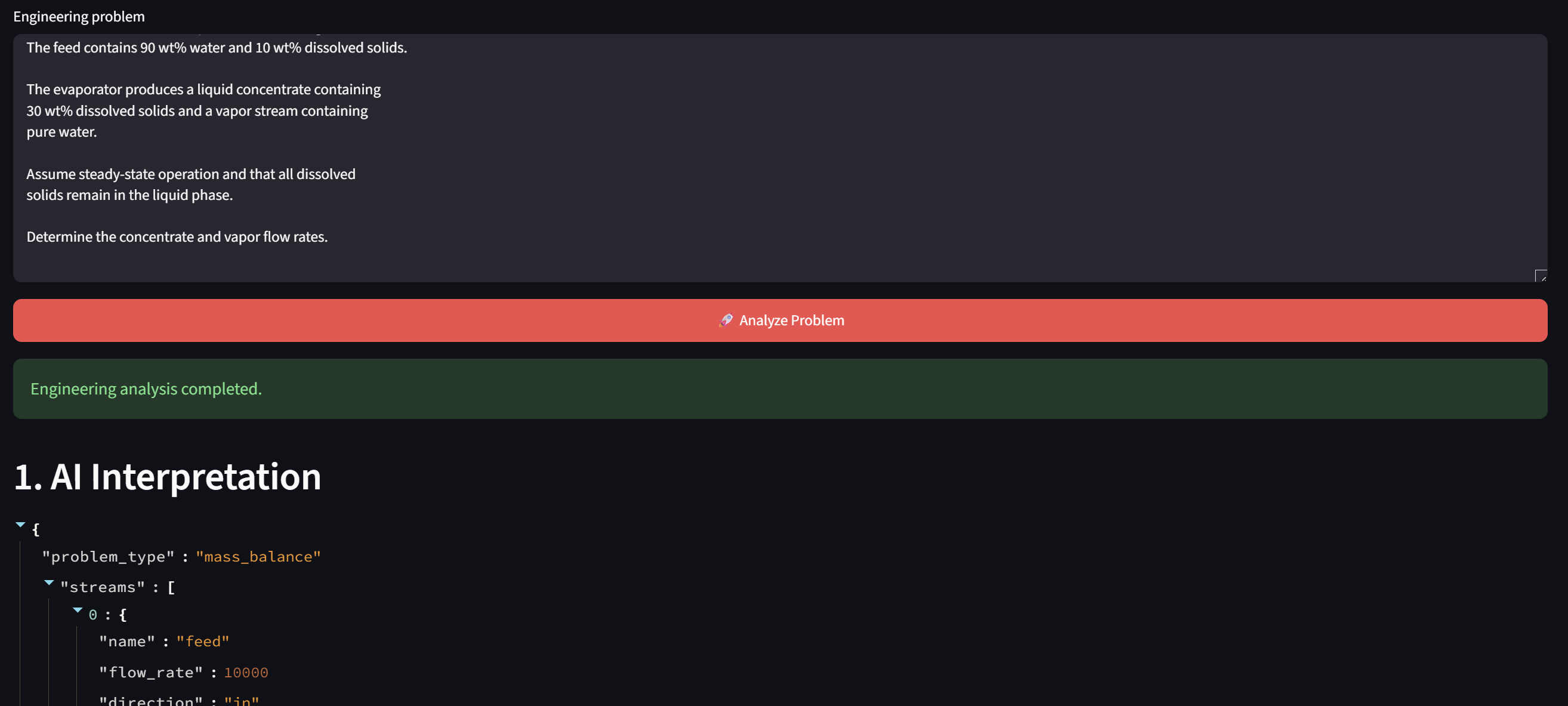
For example, a user can describe a reactor problem in ordinary language instead of first constructing a structured simulation model.
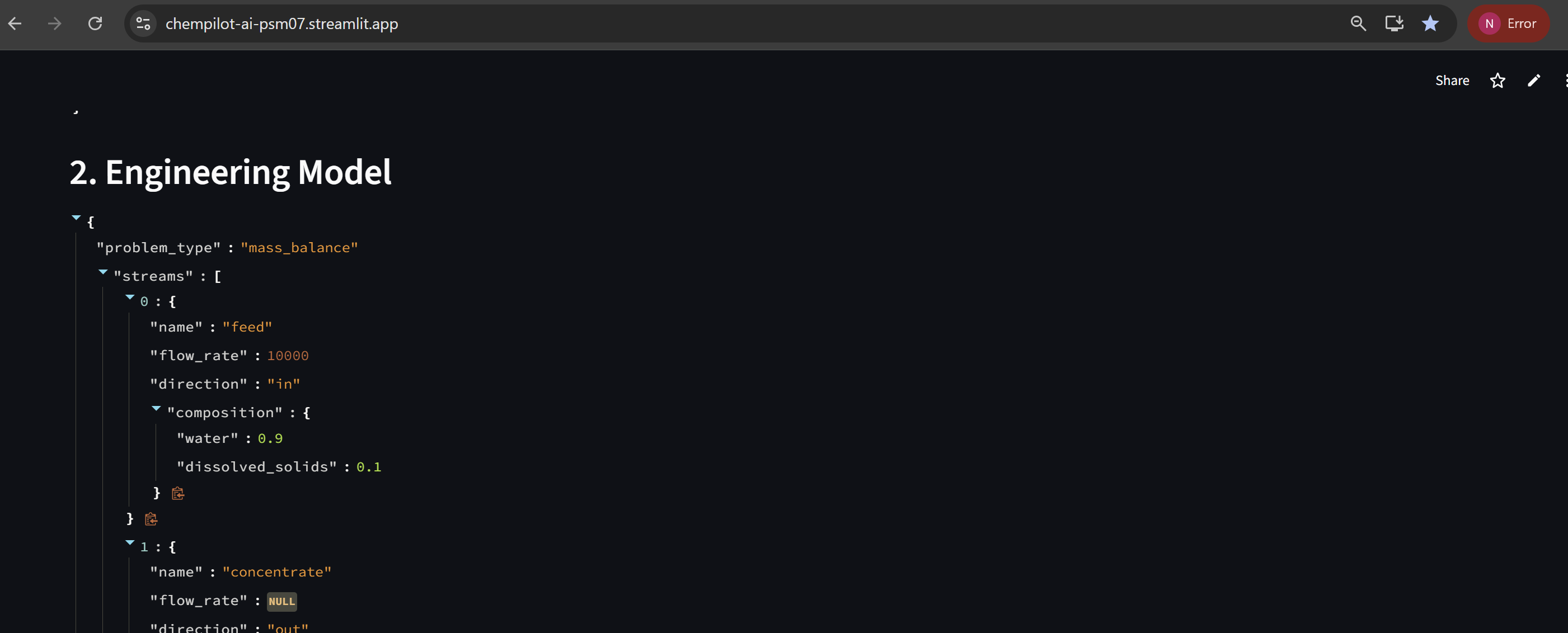
ChemPilot uses Gemini to interpret the problem and extract the engineering information required to construct a structured model. The structured model is then passed to deterministic engineering calculation engines.
This separation is intentional:
Gemini → interprets the engineering problem
Engineering engines → perform deterministic calculations
** Validation layer → checks the result
This prevents the system from relying solely on an LLM to produce numerical engineering answers.
ChemPilot can also identify physically infeasible requests. For example, if a requested conversion exceeds what the available reactants can support, the system can identify the limiting reactant and report the maximum feasible conversion instead of simply generating a plausible-looking answer.
How We Built It
ChemPilot was built as a modular engineering-AI system.
The natural-language interface is provided through a Streamlit web application, allowing users to interact with the system directly through a browser.
Gemini provides the AI interpretation layer. The interpreted problem is converted into a structured engineering representation containing information such as streams, components, compositions, reactions, stoichiometry, conversions, and assumptions.
The engineering calculation layer is deterministic and implemented separately from the AI interpretation.
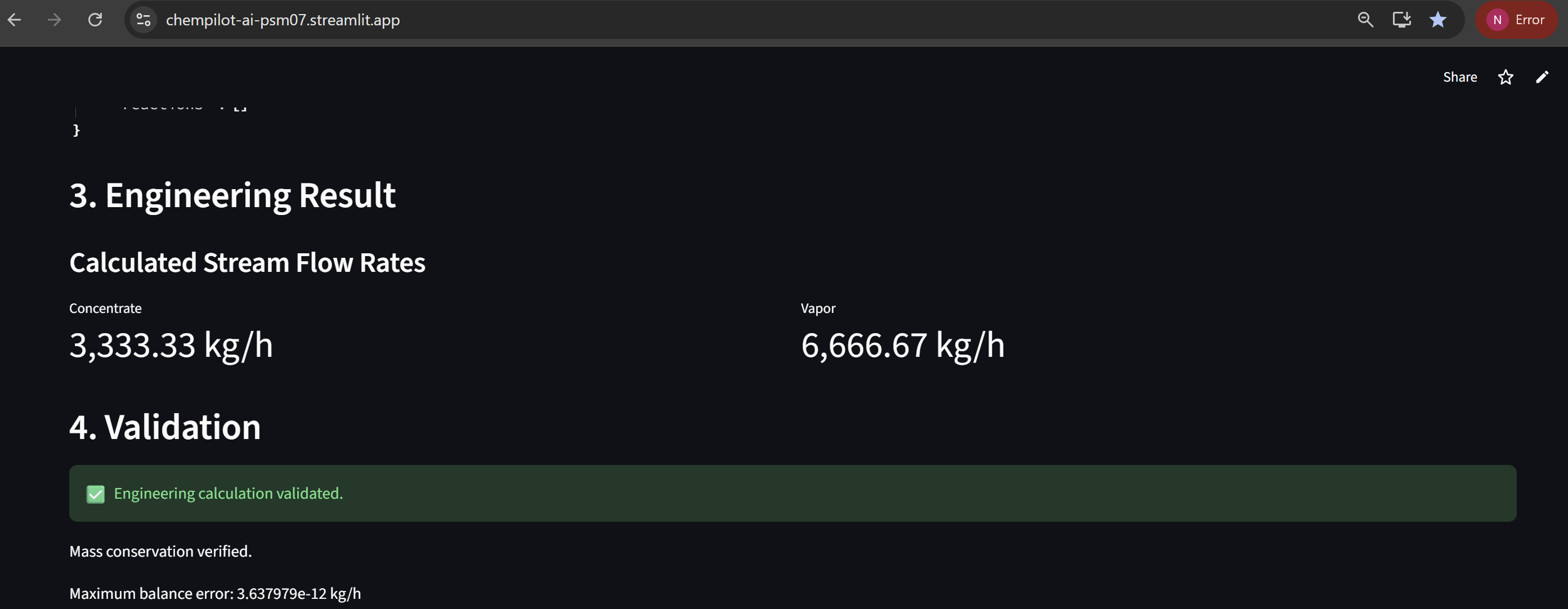
For mass balances, ChemPilot constructs and solves the underlying balance equations and validates component and overall conservation.
For reaction balances, the system calculates reaction extent, outlet flows, conversion, yield, limiting-reactant constraints, and feasibility.
The architecture allows additional engineering modules to be added without replacing the natural-language interface.
The application is currently deployed as a browser-accessible service, so users do not need Python or specialized engineering software installed locally.
Challenges We Ran Into
One of the biggest challenges was separating AI interpretation from engineering calculation.
It is relatively easy for an AI system to produce an answer that looks reasonable. It is much harder to ensure that the answer follows the actual engineering constraints.
We therefore had to build deterministic calculation and validation layers around the AI.
Another challenge was handling ambiguous or incomplete engineering descriptions. Real engineering problems do not always provide information in a perfectly structured format. ChemPilot needed to identify what information was available, determine appropriate assumptions, and recognize when a requested calculation was physically infeasible.
During development, we also encountered problems involving equation-system consistency, unknown-variable handling, result formatting, API configuration, deployment secrets, and differences between local and cloud environments.
Getting the system from local Python tests to a publicly accessible browser application was itself an important engineering and deployment challenge.
Accomplishments We're Proud Of
We are proud that ChemPilot progressed from an engineering concept into a functioning browser-based application.
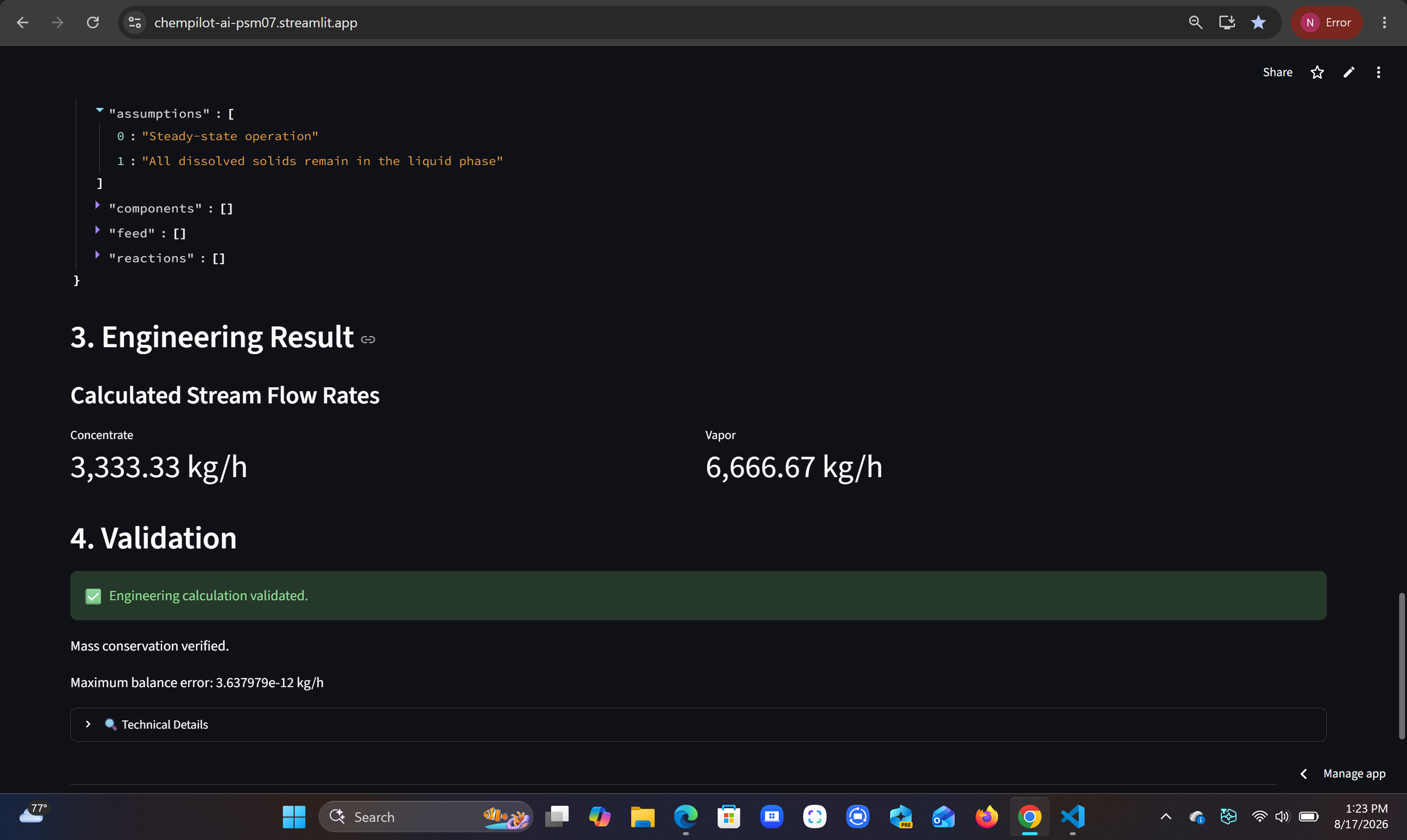
The current system successfully demonstrates an end-to-end workflow:
Natural-language problem → AI interpretation → Engineering model → Deterministic calculation → Validation → Engineering result
We successfully developed and tested independent mass-balance and reaction-balance engines and connected them to the AI interpretation pipeline.
We also implemented physical-feasibility checking so that ChemPilot can reject impossible engineering requests rather than blindly calculate them.
The application is currently deployed publicly and can be accessed through a browser without requiring users to install Python.
ChemPilot has also entered external testing, with 11 external testers/users participating in the initial validation phase and an integrated feedback workflow.
Most importantly, the project demonstrates that an LLM can be used as an engineering interface while keeping numerical engineering calculations outside the LLM and subject to deterministic validation.
What We Learned
We learned that building an AI engineering system is fundamentally different from building a general-purpose chatbot.
The most important lesson was that plausible answers are not enough for engineering.
Engineering AI needs structured models, deterministic calculations, explicit assumptions, physical constraints, and validation.
We also learned that deployment and user experience are just as important as the underlying engineering algorithms. A technically correct system has limited value if engineers cannot easily interact with it.
External testing reinforced the importance of designing ChemPilot around real engineering workflows rather than only theoretical demonstrations.
What's Next
The current mass-balance and reaction-balance capabilities are intended to become the foundation of a much broader engineering platform.
Future development is planned around:
Process simulation
Equipment sizing calculators
Heat-transfer analysis
Fluid-flow calculations
Reactor modeling
Separation calculations
Equipment and process design
Engineering standards and design checks
Automated technical reporting
Integration with established engineering software and workflows
The longer-term vision is for an engineer to move from a natural-language problem statement through engineering modeling, calculation, simulation, equipment sizing, validation, and technical reporting within one AI-assisted workflow.
ChemPilot is currently pre-revenue, with $0 revenue and approximately $25 in development expenses. Our current focus is technical validation and learning from external users before expanding the platform.
Our goal is to build an AI-native chemical engineering platform that does not simply answer engineering questions, but helps engineers move from problem definition to validated engineering analysis and, ultimately, engineering design.
Built With
- ai
- analysis
- chemicalengineering
- computing
- engineering
- gemini
- generativeai
- google-cloud
- machine-learning
- optimization
- processengineering
- processsimulation

Log in or sign up for Devpost to join the conversation.