-
-
from chemical structures to production guidelines
Inspiration
The inspiration for this project stemmed from the realization of the immense potential for AI in streamlining chemical production processes. The traditional process of translating a chemical structure into actionable production steps can be a time-consuming bottleneck. We envisioned an AI that could bridge the gap between a chemical structure and a manufacturer's actionable production guidelines. This project aims to bridge this gap by leveraging the power of AI.
What it does
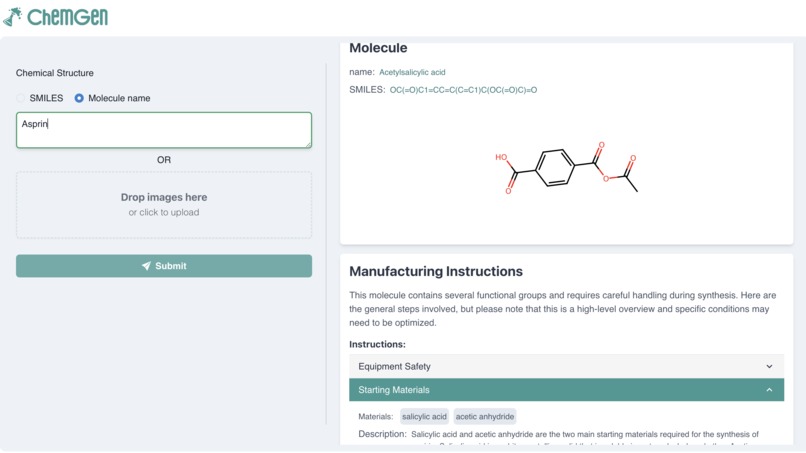
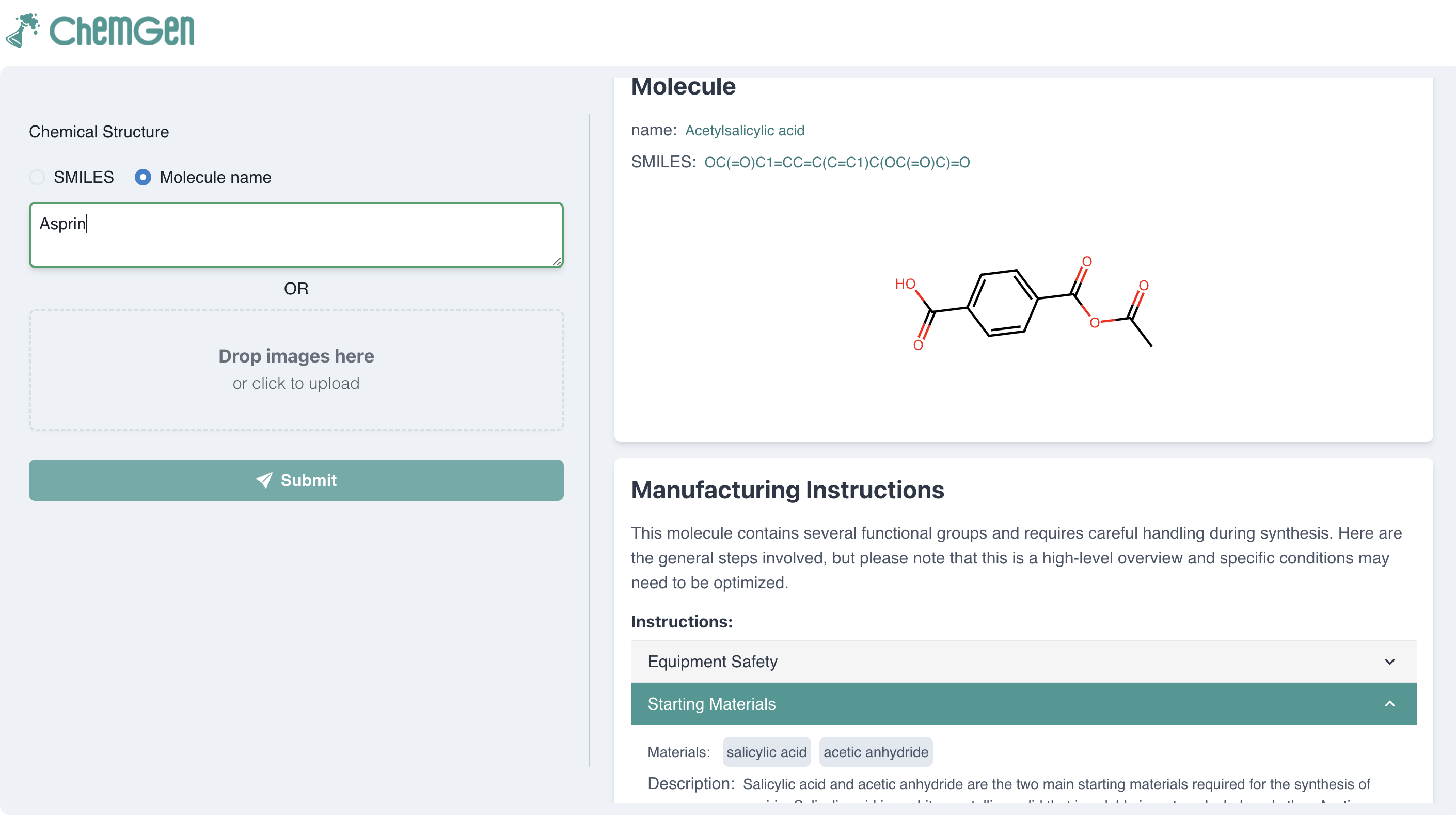
This project leverages the power of Responsible AI to transform chemical structures to actionable production guidelines. Given a chemical name, smile or image it generates the manufacturing process of the chemical.
How we built it
The project itself can be broken down into these stages:
Data Acquisition: We utilized pre-trained LLMs for content generation. Leveraged the multimodality. To ensure the information remained current, we integrated Google Search API, allowing the LLM to access and process the latest research findings directly.
Safety Integration: Responsible AI was paramount. We implemented Google's gen AI safety settings, particularly HARM_CATEGORY_DANGEROUS_CONTENT filters. This ensured the LLM wouldn't process prompts or generate production guidelines for potentially harmful chemicals.
User-Friendly Interface: We designed a simple UI where scientists could input a chemical structure (SMILE or name). The system would then analyze it through the LLM and, for safe chemicals, generate a list of actionable production guidelines.
Human Oversight: We believe in human-AI collaboration. A final review process by a chemistry expert was incorporated for added safety and regulatory compliance.
Challenges we ran into
Several hurdles arose during the development process:
- Data Quality: Getting quality responses was a challenge. We addressed this by filtering search results through reputable scientific sources.
- Preprocessing Considerations: Images of chemical structures can vary in format and size. We needed to establish the correct format to use. We resolved challenge by uploading the images to GCP first hence ensure compatibility with VertexAI while maintaining the integrity of the chemical information.
Accomplishments that we're proud of
- Developed a novel AI-powered tool: We successfully bridged the gap between chemical structures and actionable production steps, potentially accelerating scientific discovery.
- Prioritized Responsible AI: We implemented robust safety measures to prevent misuse and ensure the ethical use of AI in chemical production.
- User-centric design: The user-friendly interface empowers scientists with an easily accessible tool.
- Fostering human-AI collaboration: Our system values human expertise through the final review process, promoting trust and responsible innovation.
What we learned
This project was a fascinating exploration of the intersection of AI and chemistry. We delved into the world of SMILES, a powerful notation for representing chemical structures. We then dove into the capabilities of large language models (LLMs) and their potential to analyze and translate these structures into production sequences.
What's next for ChemGen
This project represents a significant step towards AI-powered chemical production. By leveraging AI and prioritizing Responsible AI principles, we believe this tool has the potential to:
Accelerate scientific discovery and innovation
Increase efficiency and productivity in chemical research labs
Foster collaboration between chemists and AI
Future efforts will focus on refining and optimizing the AI Model by continuously improving accuracy and efficiency.
Built With
- chakraui
- chroma-vector-database
- django
- gemini
- goggle-geneerative-ai-embedding-models
- google-cloud
- google-storage
- langchain
- python
- rdkit.js
- react
- typescript


Log in or sign up for Devpost to join the conversation.