Inspiration
Living with a dietary restriction turns every supermarket abroad into a reading test in a foreign language. The free scanner apps score "healthiness" and go blind on store brands; a translator reads the words but can't tell you whether almidón modificado matters to you. Our team lives with restrictions too, so we started with the hardest case: celiac disease, where a wrong guess isn't a bad meal but days of being ill — in Spain, where the biggest supermarket's own brand is invisible to every crowd database. If an honest, sourced answer works there, it can work for any diet, on any shelf in the world.
What it does today — the gluten-free MVP
Chekio 1.0 is deliberately narrow: one restriction, one country's shelves, done properly.
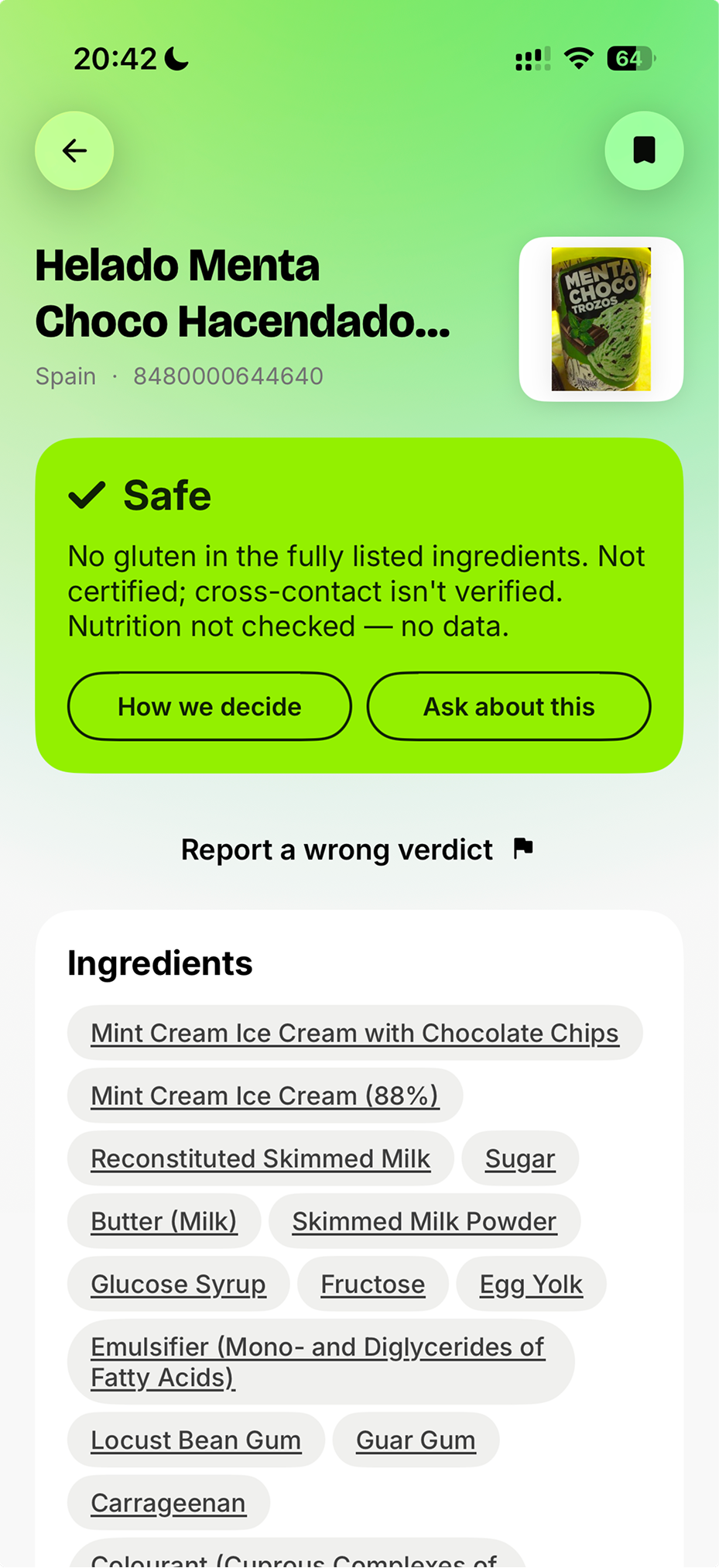
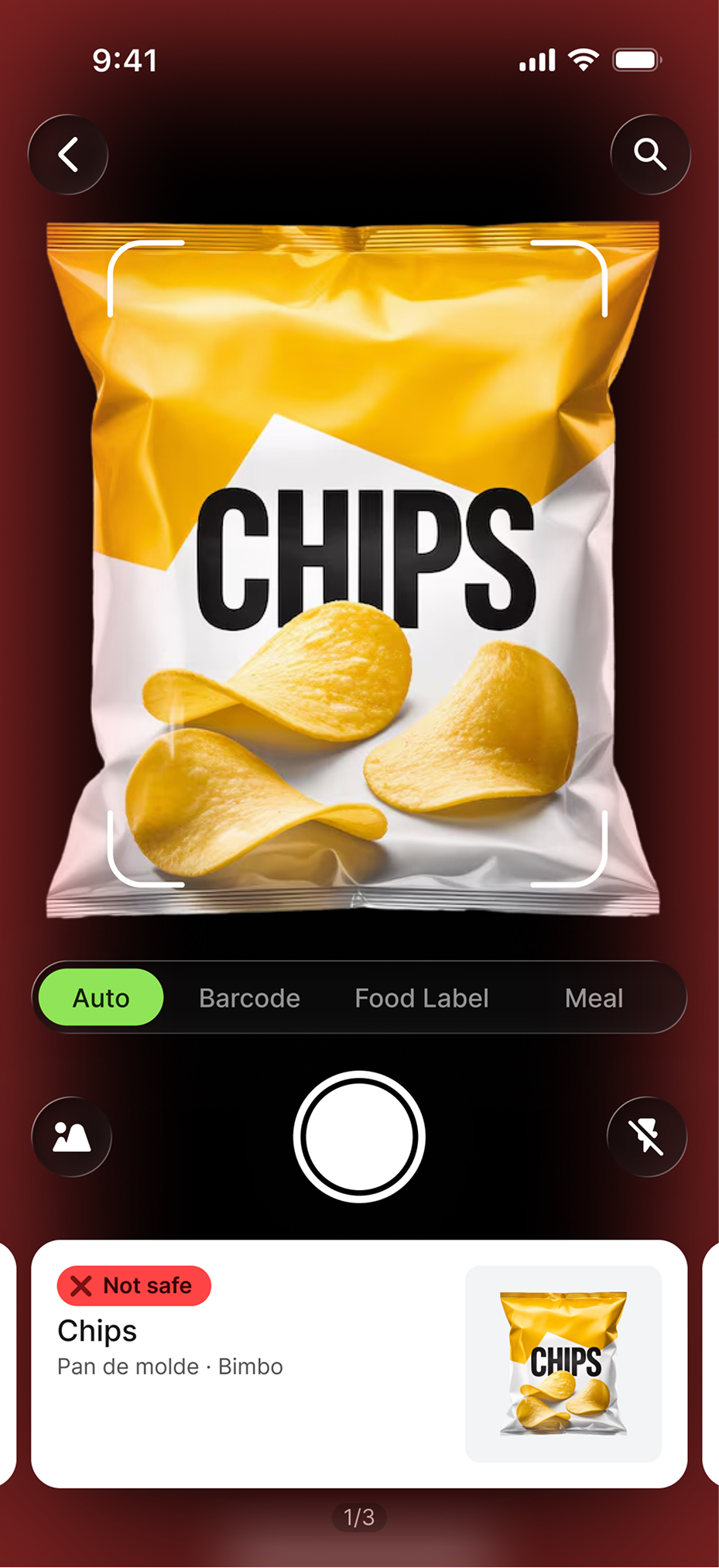
- Scan a barcode, photograph a label, or a plate → one verdict — Safe, Not safe or Risk — with the reasons shown and the triggering ingredient highlighted.
- Verdicts are deterministic, never AI. An on-device engine checks the label against the EU "gluten-free" standard (≤ 20 mg/kg, Reg. 828/2014), certification marks (AOECS / FACE) and the ingredient list itself. When it can't confirm, it says an honest Risk — never a false green light.
- Store-brand coverage where crowd databases are blind: a hand-verified catalogue for Spain's supermarket shelves plus a 2,700-entry retailer catalogue — all of it offline.
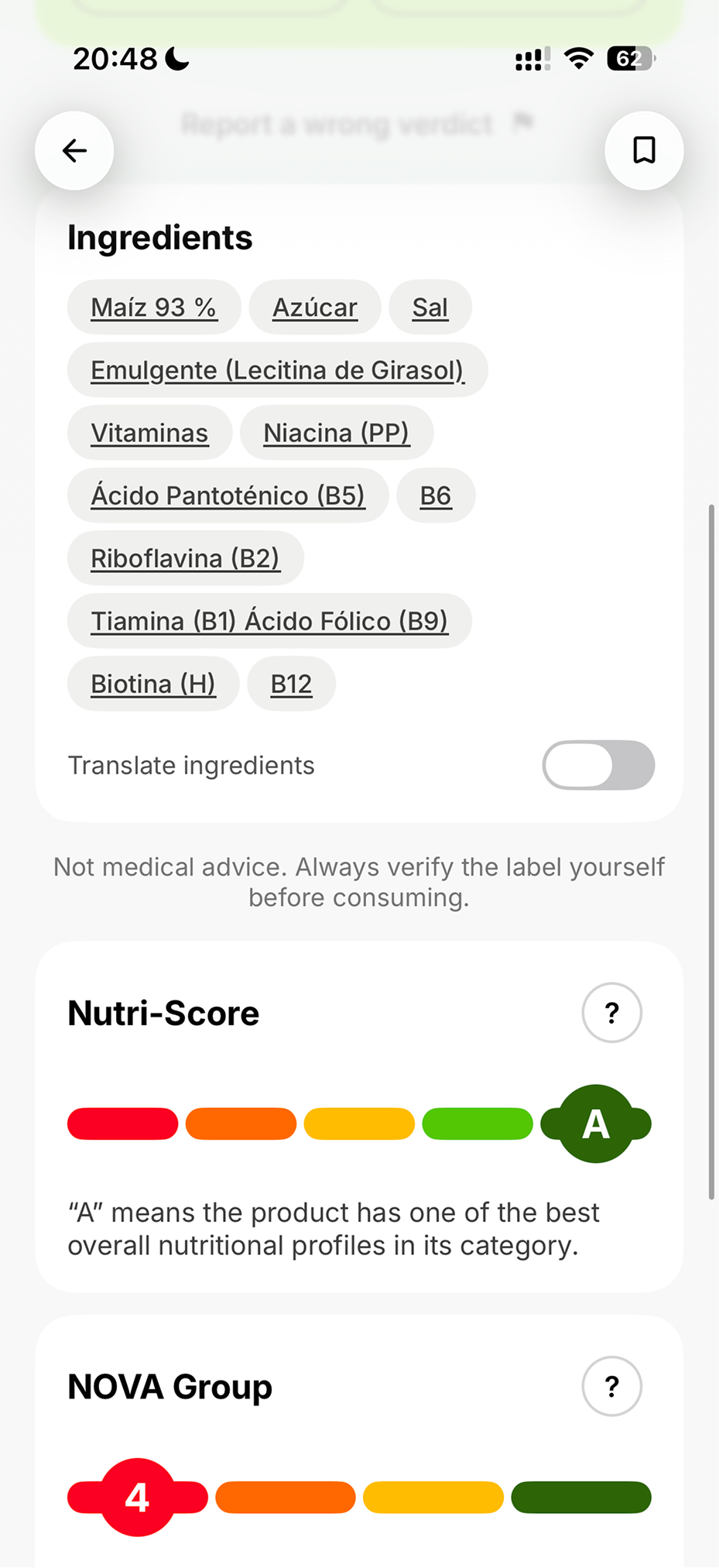
- Optional health limits (high sugar, high salt, heavily processed) on UK FSA thresholds and NOVA — information only, never blended into the safety verdict.
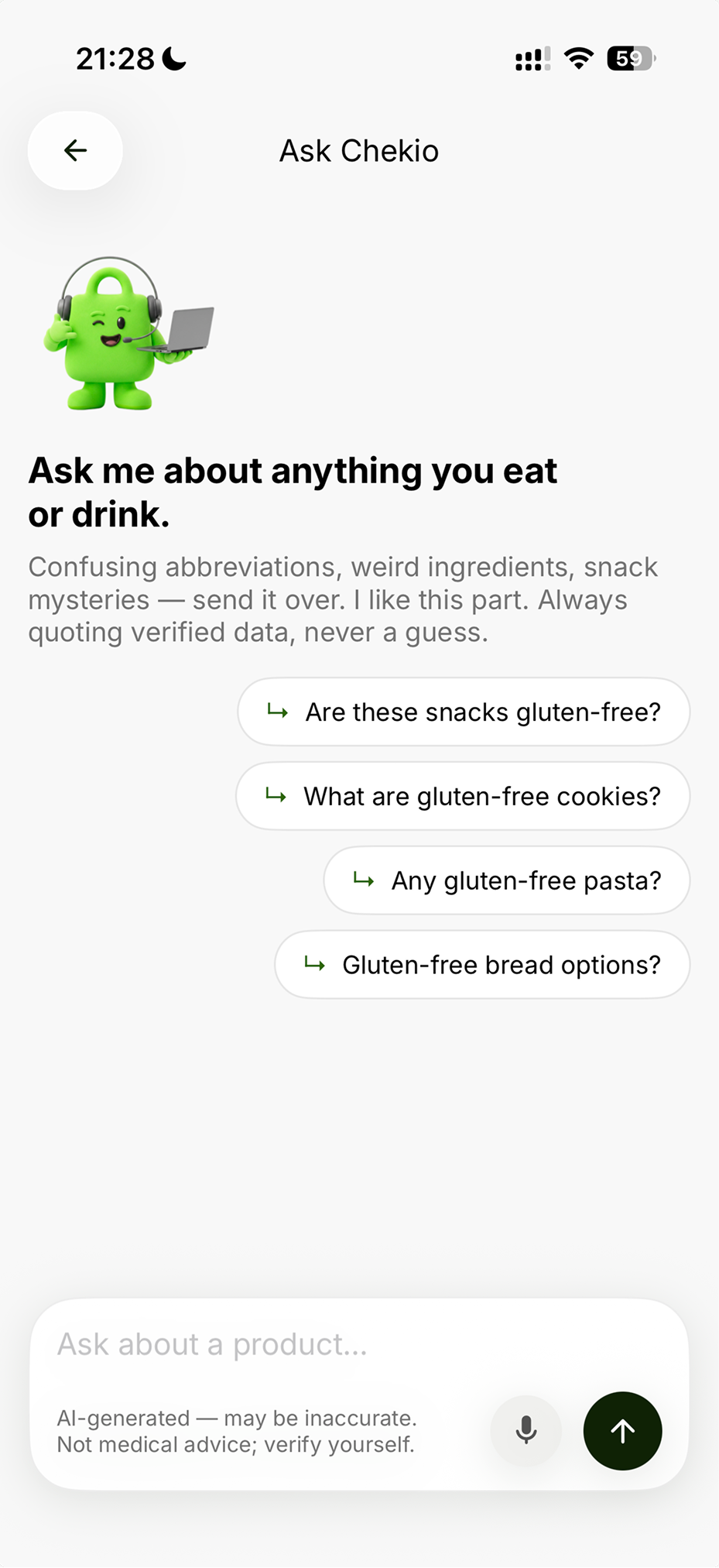
- Ask Chekio: an assistant grounded in your needs, saved products and scans. It quotes verdicts, it never invents them — and it asks permission before anything leaves your phone, naming the recipient (Google Gemini).
- Reads labels in seven languages, translates on-device, explains every ingredient in one tap, and links Sources & references for every standard it relies on.
- Report a wrong verdict from any product — the catalogue is human-verified and improves with every report.
Where it's going — one platform for every diet, anywhere
The MVP proves the hard part: an honest verdict on the products you can't verify yourself. The platform extends it in two directions.
1. Every diet, every shelf. The engine already takes two inputs — what you must avoid and what you'd rather limit — so a new restriction is a new lexicon and evidence rules, not a new app: the other EU Annex II allergens (milk, nuts, egg, soy…), lactose, vegan and vegetarian, low-sugar for people with diabetes. Per-country facts bases follow the Spain pattern: Ukraine ships already; Italy, France, Portugal, Poland and the UK are in the lexicon and get offline packs next.
2. Micro-learning, inside the scan. A verdict tells you what; a 30-second lesson tells you why — what "may contain" actually promises, what a certification mark guarantees, why this E-number matters for your diet, how the same product is labelled differently across borders. The goal is that people understand what they buy and eat in any supermarket in the world, instead of trusting a green light — and that the Saved list grows into a personal knowledge base rather than a bookmark folder.
How we built it
Swift / SwiftUI on iOS 18: Vision & VisionKit for barcodes and OCR, Apple Translation and Speech on-device, on-device FoundationModels to locate the ingredient section, SwiftData for history and the Saved list. The verdict engine and per-country lexicons are pure Swift with 1,868 unit tests. A small Cloudflare Workers + D1 backend (EU) proxies Google Gemini 2.5 Flash-Lite for photo recognition and the assistant (paid tier, no training on user data) and Open Food Facts (ODbL).
Monetization runs on RevenueCat 5.87 (StoreKit 2): one entitlement (Plus), an offering with $rc_annual and $rc_monthly packages, trial eligibility via checkTrialOrIntroDiscountEligibility, and customerInfoStream driving the live subscription status in Settings.
Chekio is built by one person with Claude Code as the engineering pair: spec → PR → local tests → merge, ~890 commits, and every product decision recorded in a decision log — including the three App Review rejections that shaped the final build.
Challenges we ran into
- Trust engineering. "No false green light" had to be structural: AI can produce a draft for a dish but can never issue a Safe verdict; the free tier gates starting a scan, never a verdict already earned.
- App Review, three times. A missing EULA link; a reviewer who couldn't reach the paywall; then third-party-AI consent and medical citations. Each round made the product more honest: a permission sheet that names Google Gemini before any request, a gate in the network client, a Sources & references screen, a doctor reminder on every verdict.
- Coverage where the data isn't. Spanish private label is invisible to crowd databases, so we built our own hand-verified catalogue and evidence rules for 284 ingredient concepts.
- Staying narrow on purpose. Every week brought a reason to add a second diet or a second country; shipping one restriction properly was harder than sketching ten.
Accomplishments that we're proud of
- From zero RevenueCat to an App Store submission in 14 days inside the Shipaton window.
- Deterministic, sourced verdicts — with citations on every screen where health information appears.
- Honest monetization: price upfront, trial only when eligible, an in-sheet confirmation with the first-charge date, and a subscription screen with Apple's own manage/cancel sheet.
- Seven-language label reading that works with no signal.
What we learned
- Honesty has to be legible to a stranger in sixty seconds: name the recipient, cite the source, put the switch next to the data.
- A hard trial gate only converts if the "aha" lands inside the free scans — so the first scan must be a store-brand win.
- People don't just want a verdict; after every Not safe they ask why. That question is the seed of the micro-learning layer.
What's next for Chekio
Spanish and Ukrainian store listings (ready), offline packs for Italy, France, Portugal, Poland and the UK, the first non-gluten restriction on the same engine, a first set of micro-lessons attached to the most common Not safe verdicts, a shareable Saved list for families, and RevenueCat Experiments on the 3-scan gate versus a value-first variant.


Log in or sign up for Devpost to join the conversation.