Inspiration
Every recipe app starts from the recipe: you search a dish, get instructions written for a generic person, and then you do the hard work — converting portions, dodging allergens, guessing whether the macros fit your goals, and juggling three pots while your phone screen dims.
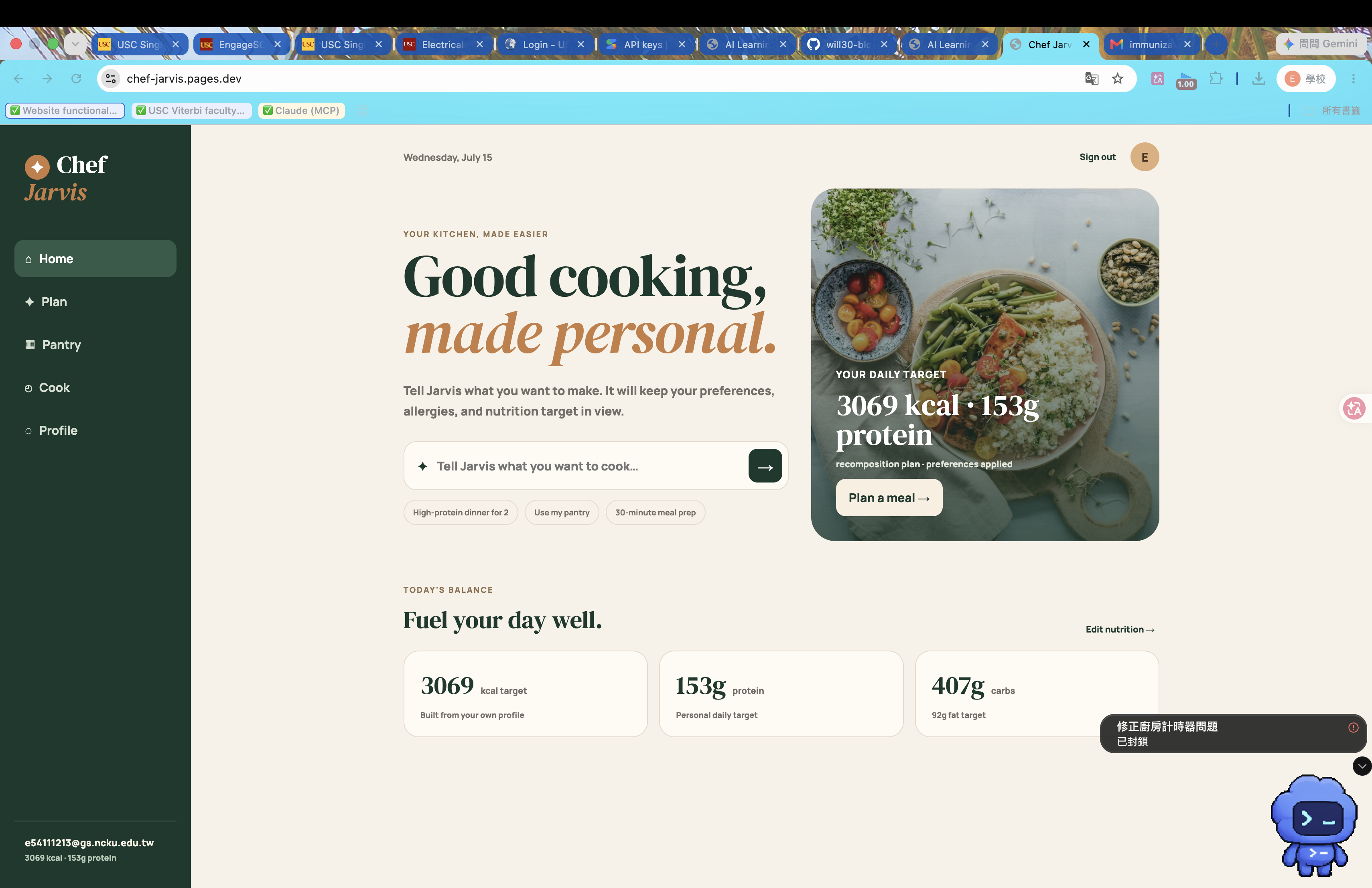
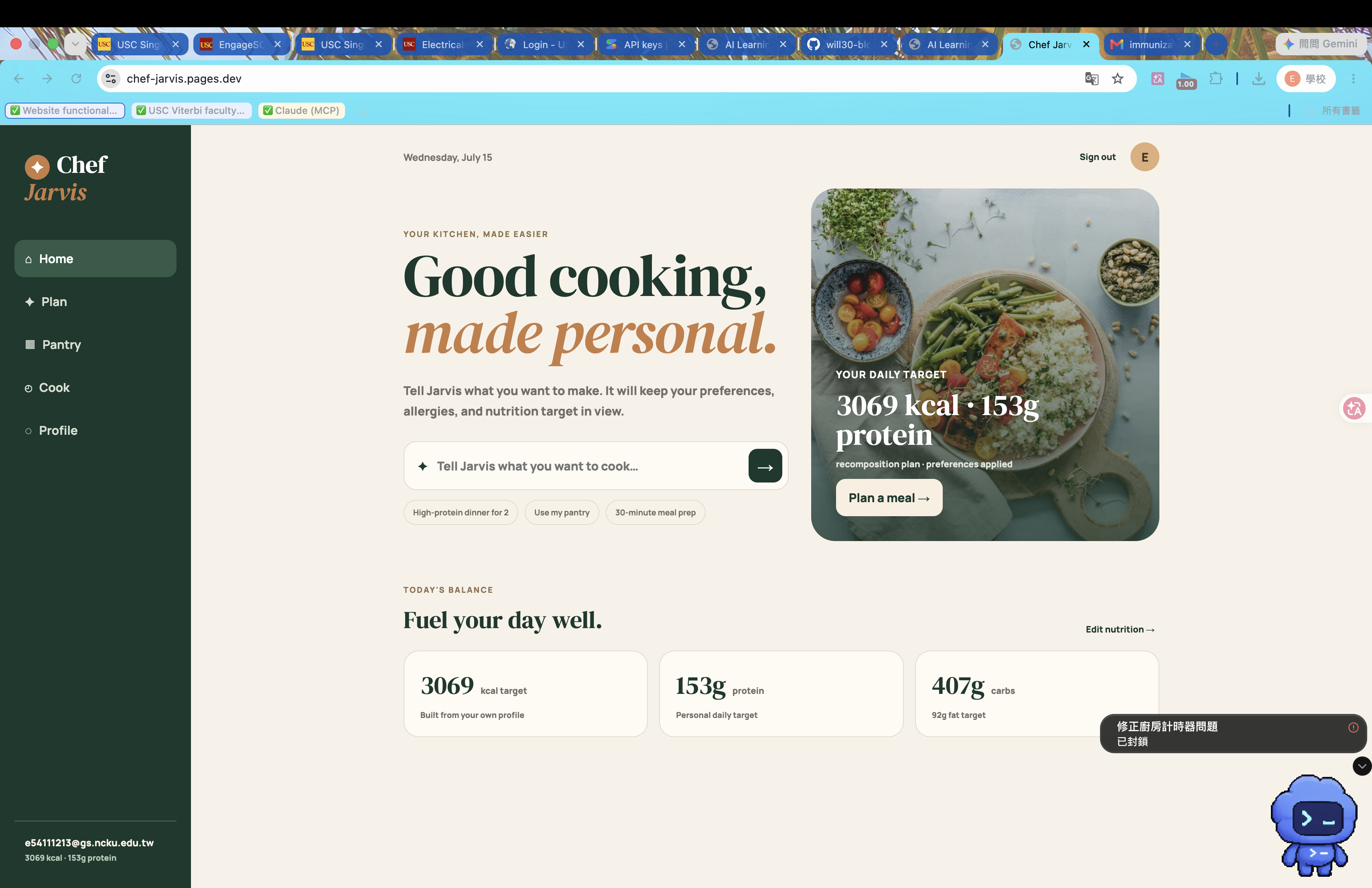
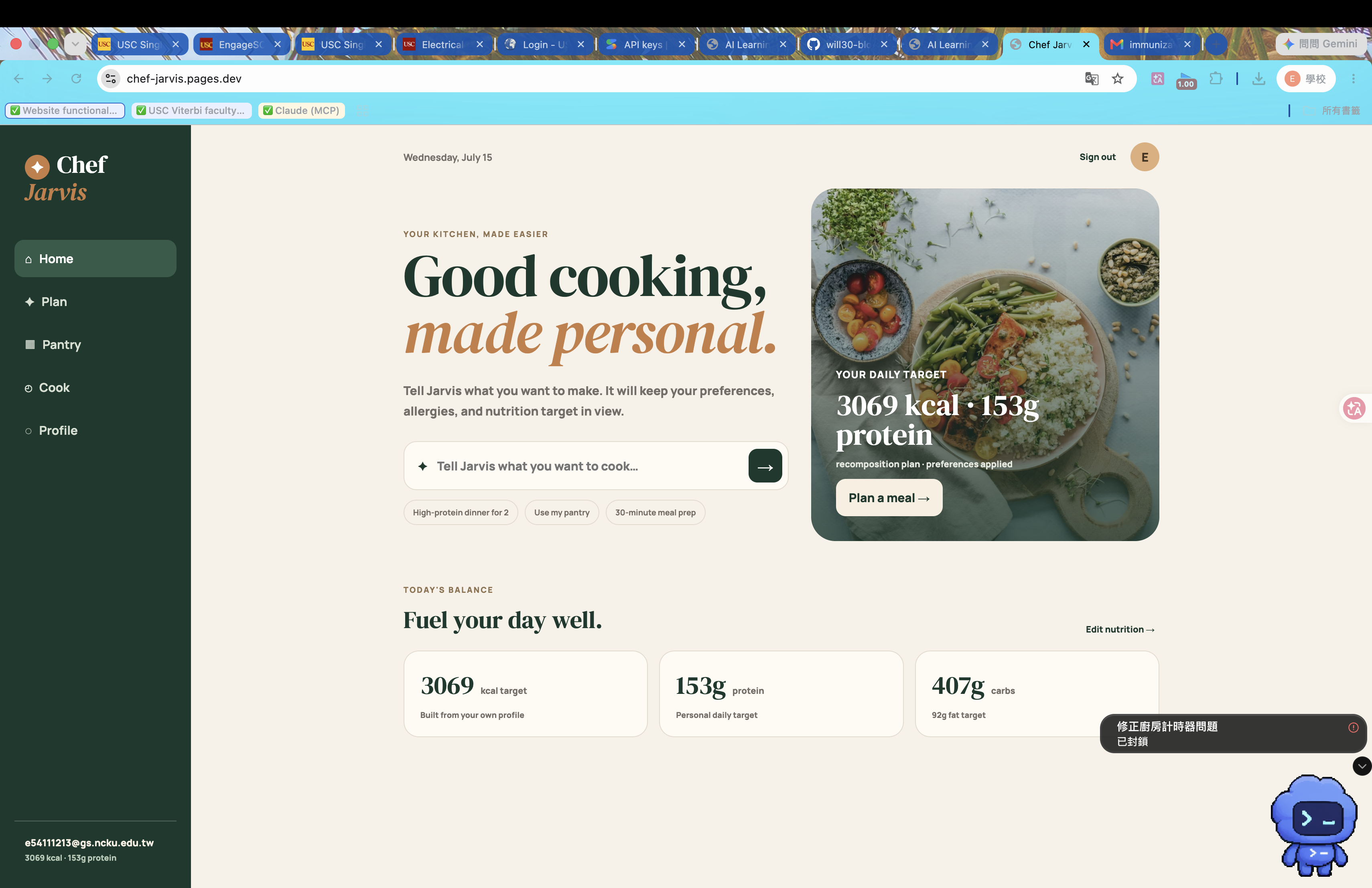
We wanted to flip that. Chef Jarvis starts with the person, not the dish. Tell it once about your body, nutrition targets, allergies, dislikes, and the equipment in your kitchen — and every meal plan, substitution, and cooking step is generated around you. The second inspiration was the act of cooking itself: it's a real-time, multi-threaded problem, so hands-free guided cooking with parallel timers became a core feature, not an afterthought.
What it does
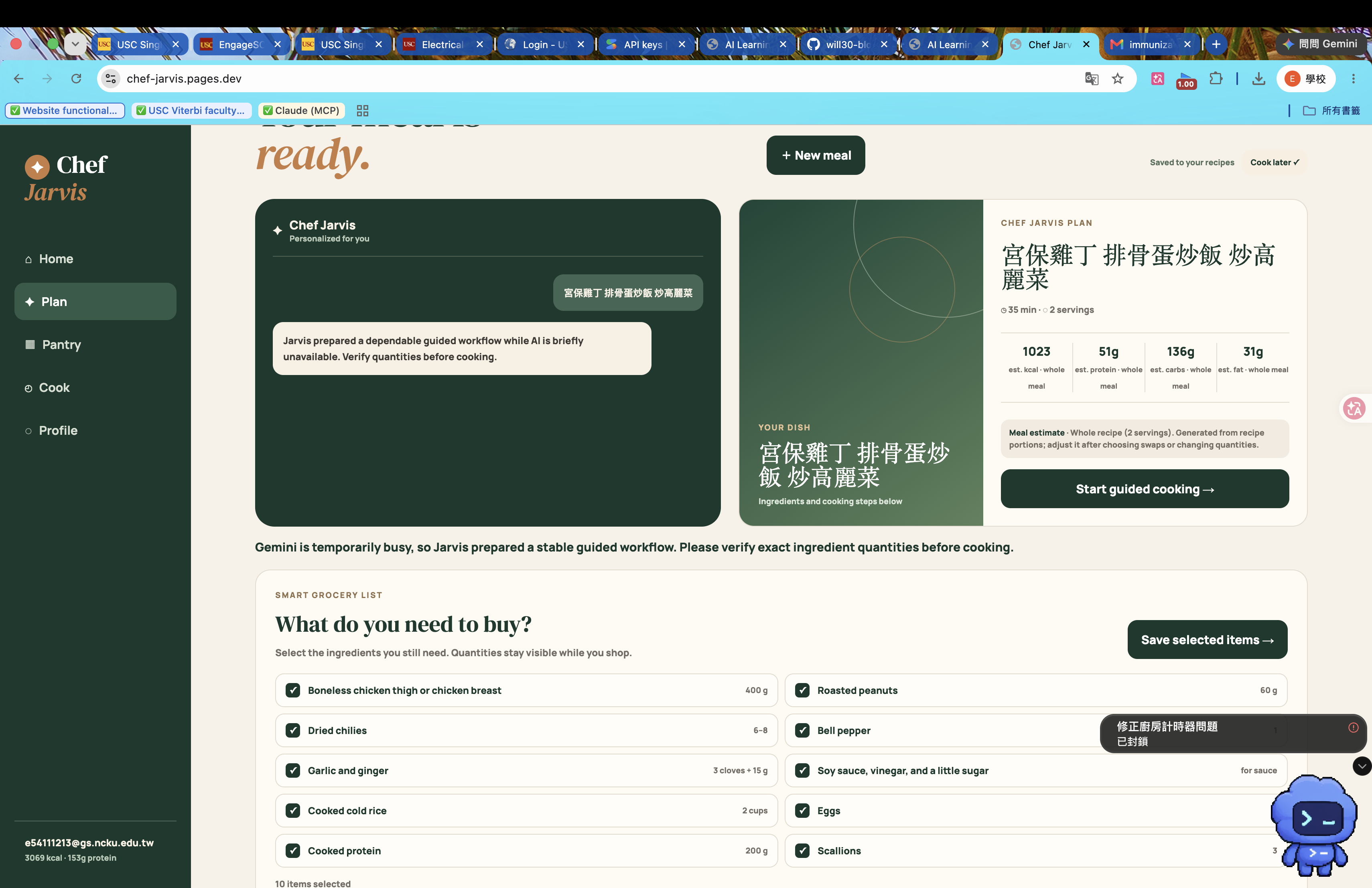
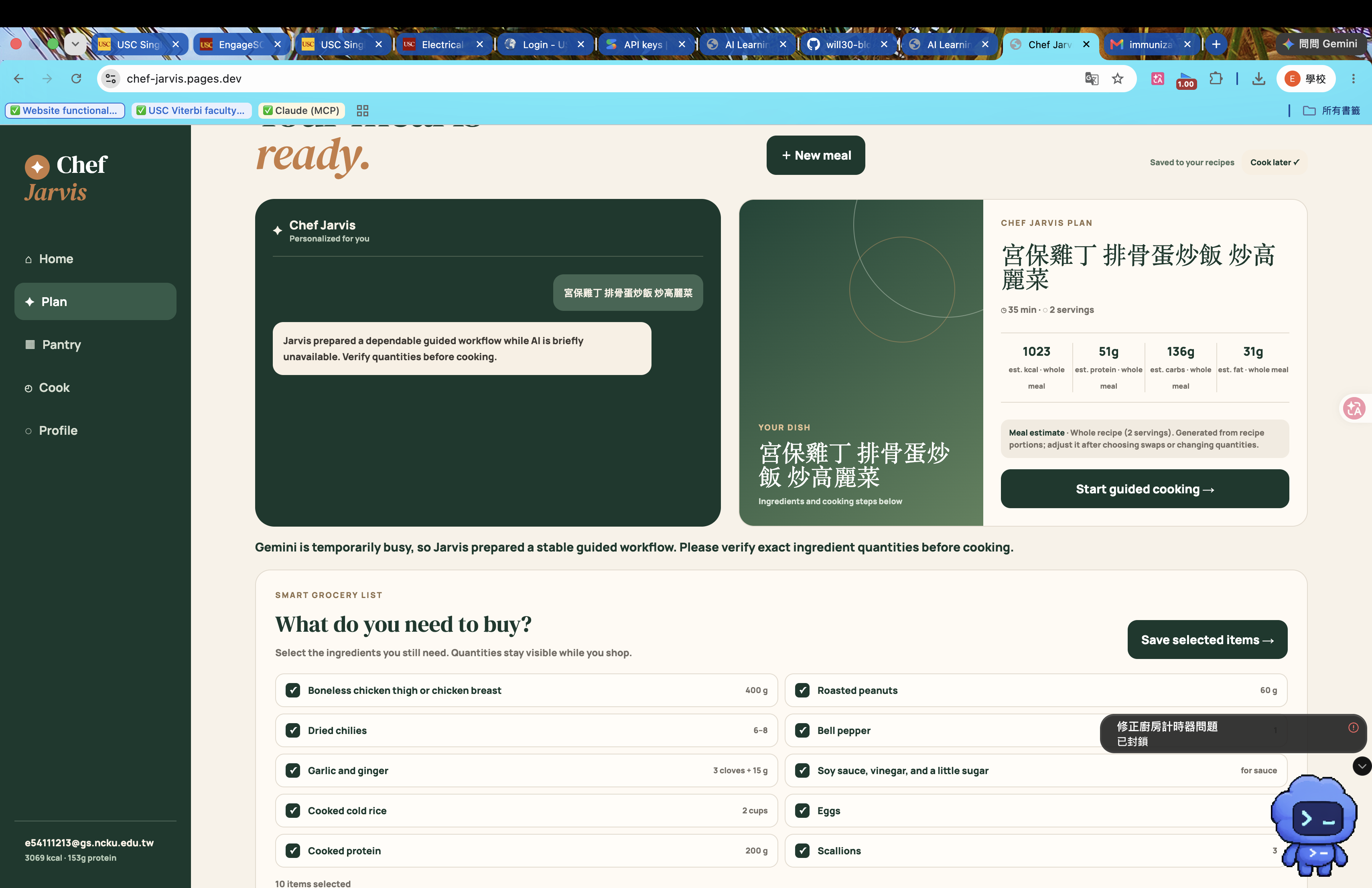
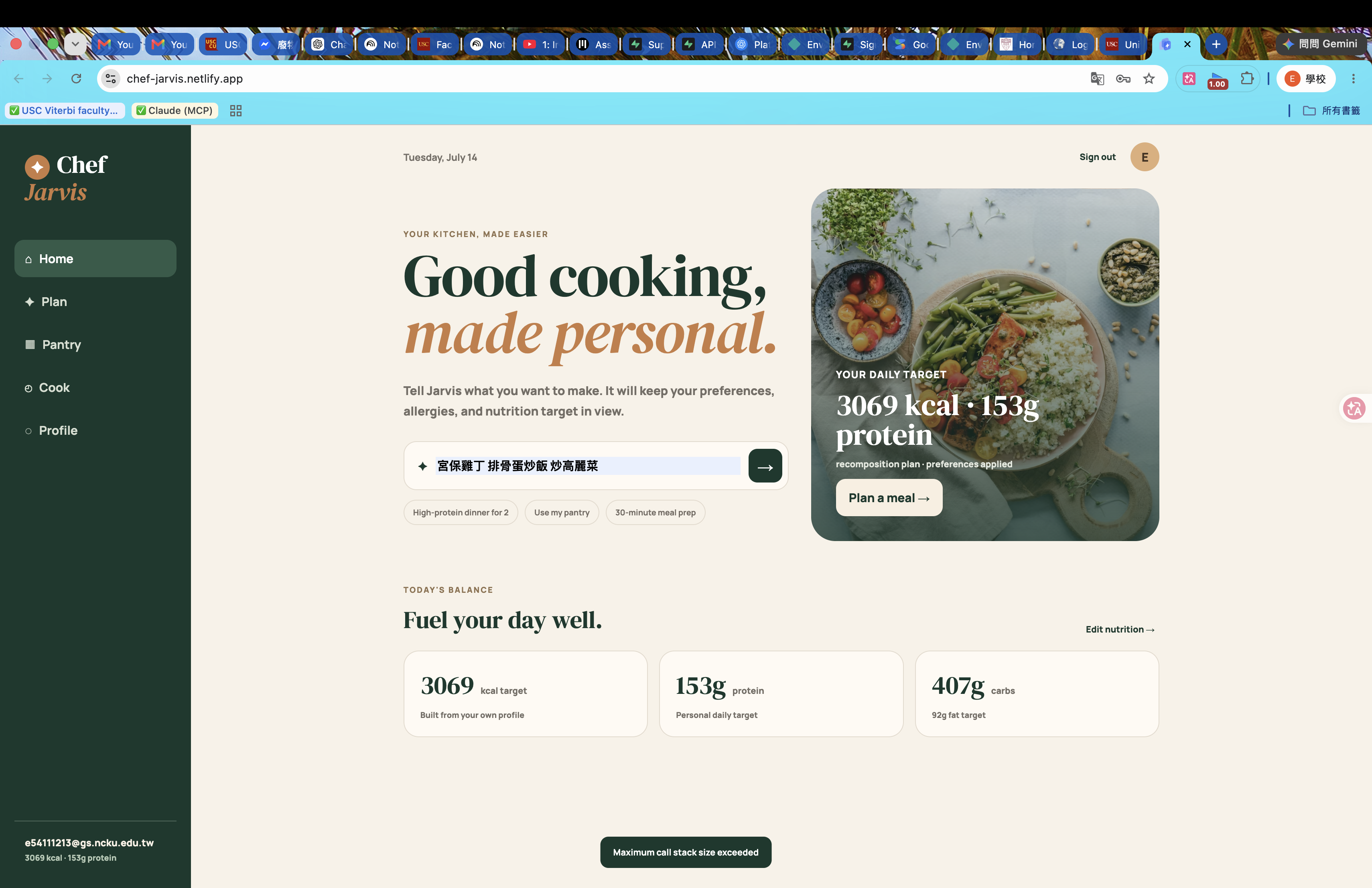
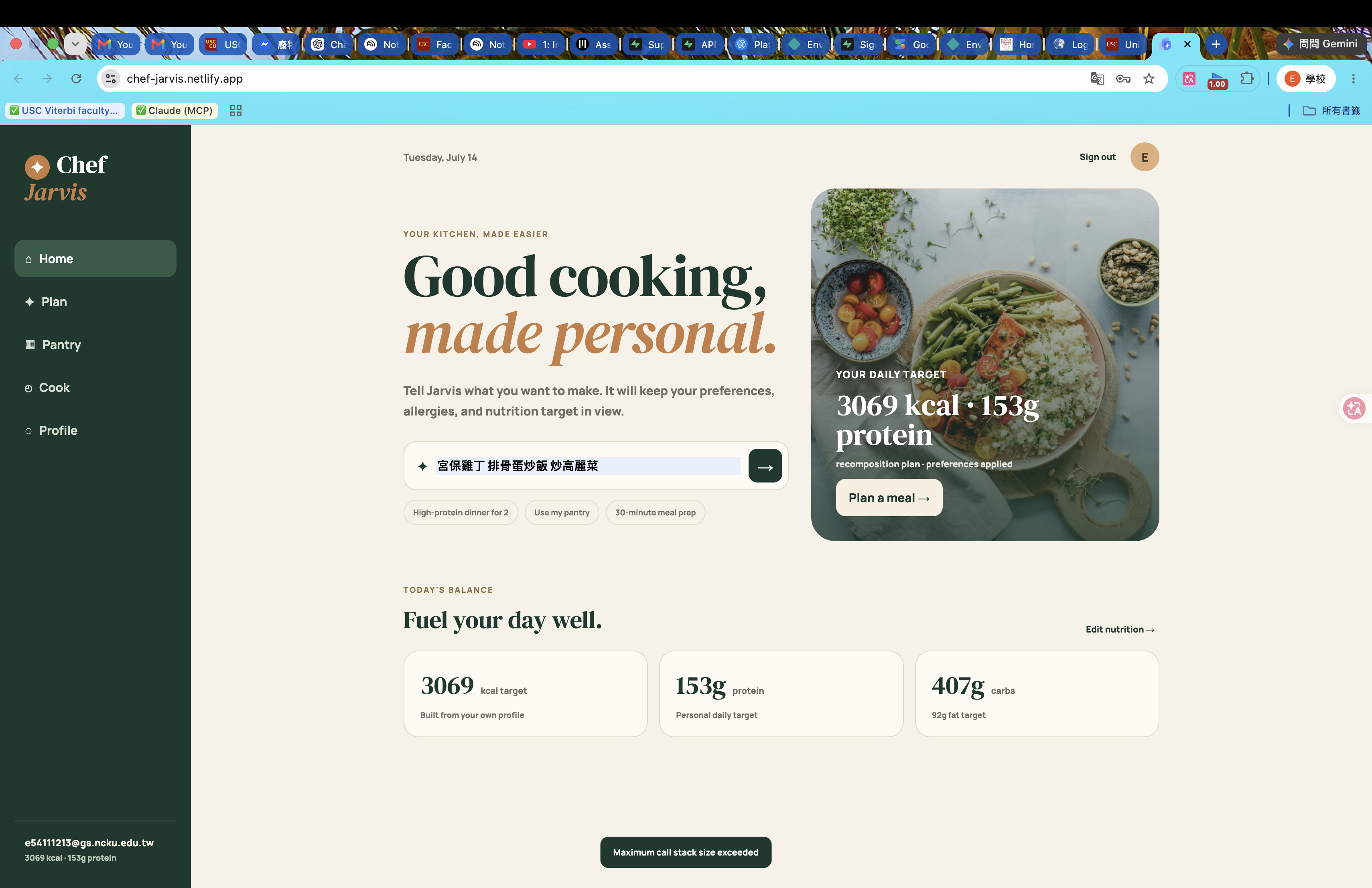
Chef Jarvis turns one sentence — "high-protein Kung Pao chicken for two" — into a complete cooking workflow:
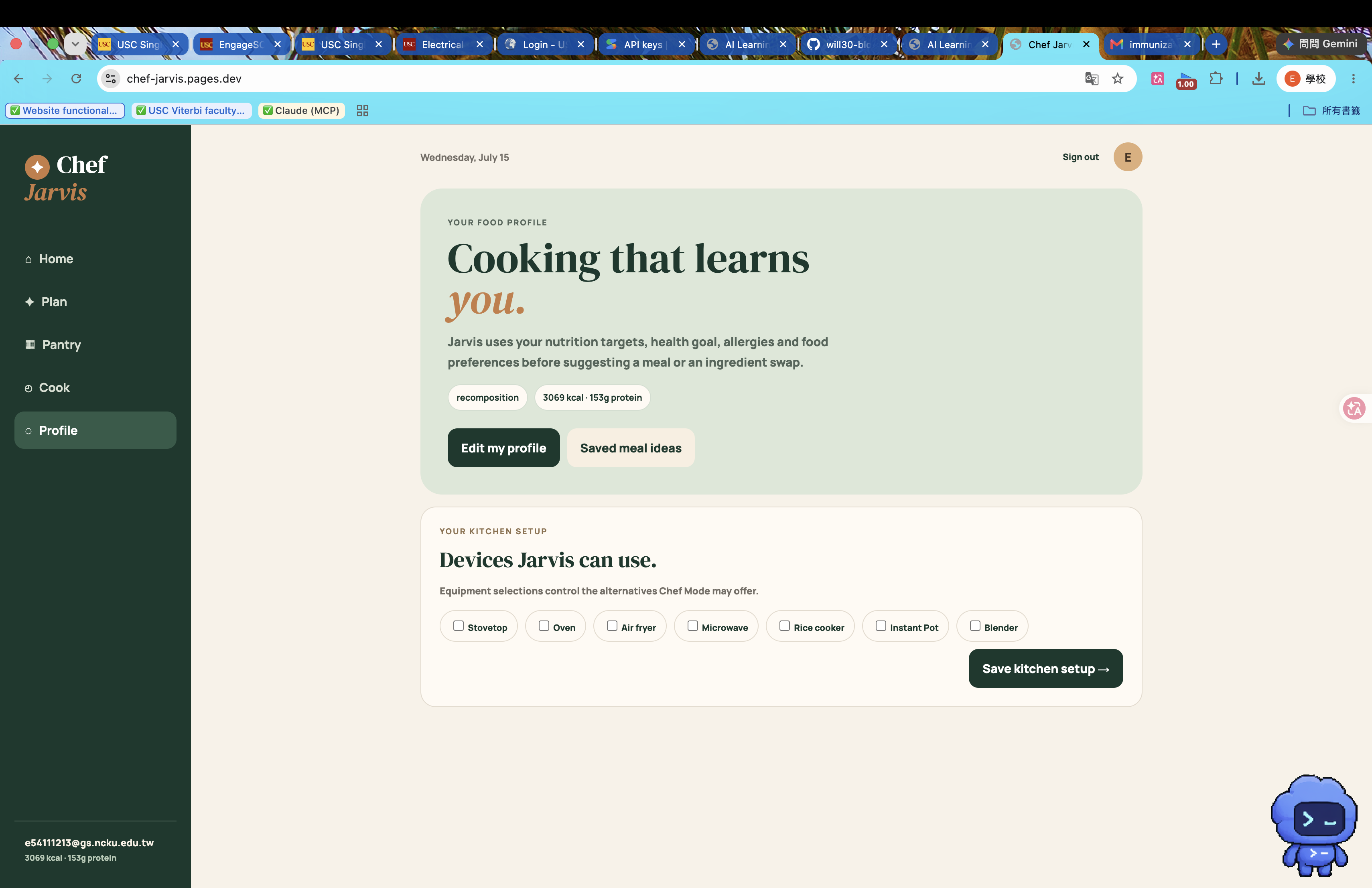
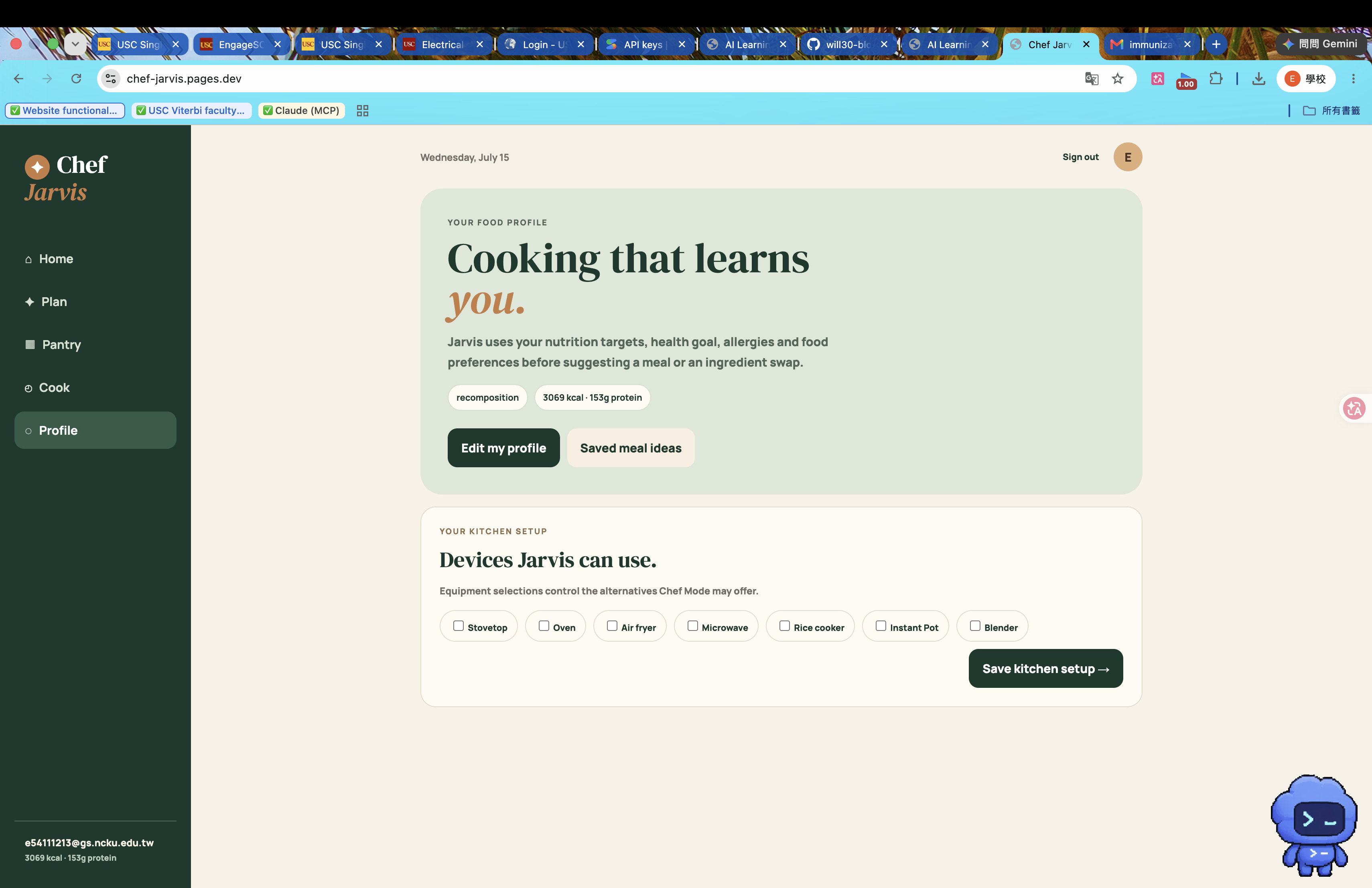
- Personal food profile — onboarding captures body data, macro targets (calculated or custom), body-composition goal, allergies, dietary needs, dislikes, and kitchen equipment.
- AI meal plan — a Gemini-powered recipe with realistic portions, macros, ingredients, and steps that respect every restriction in your profile.
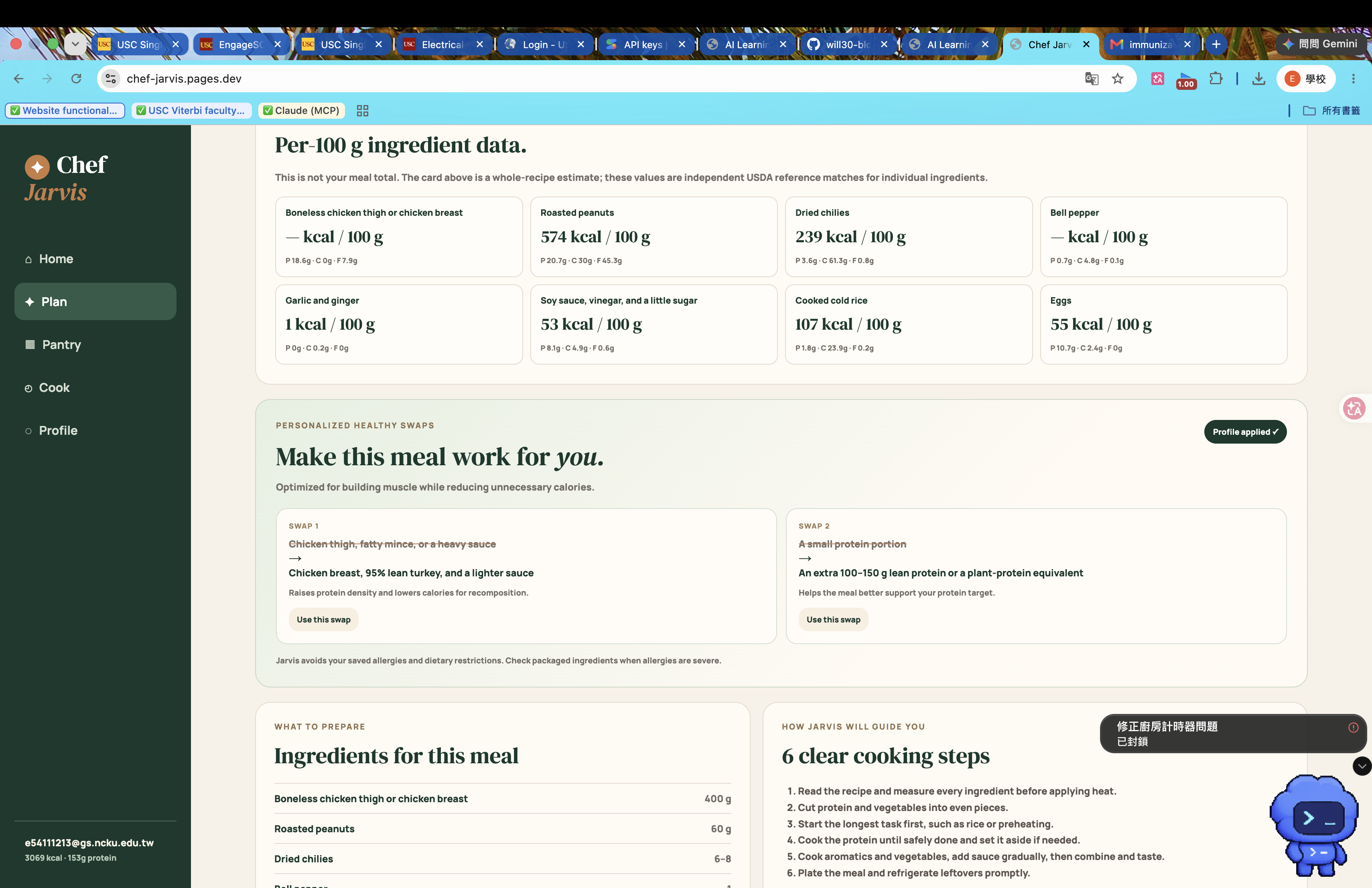
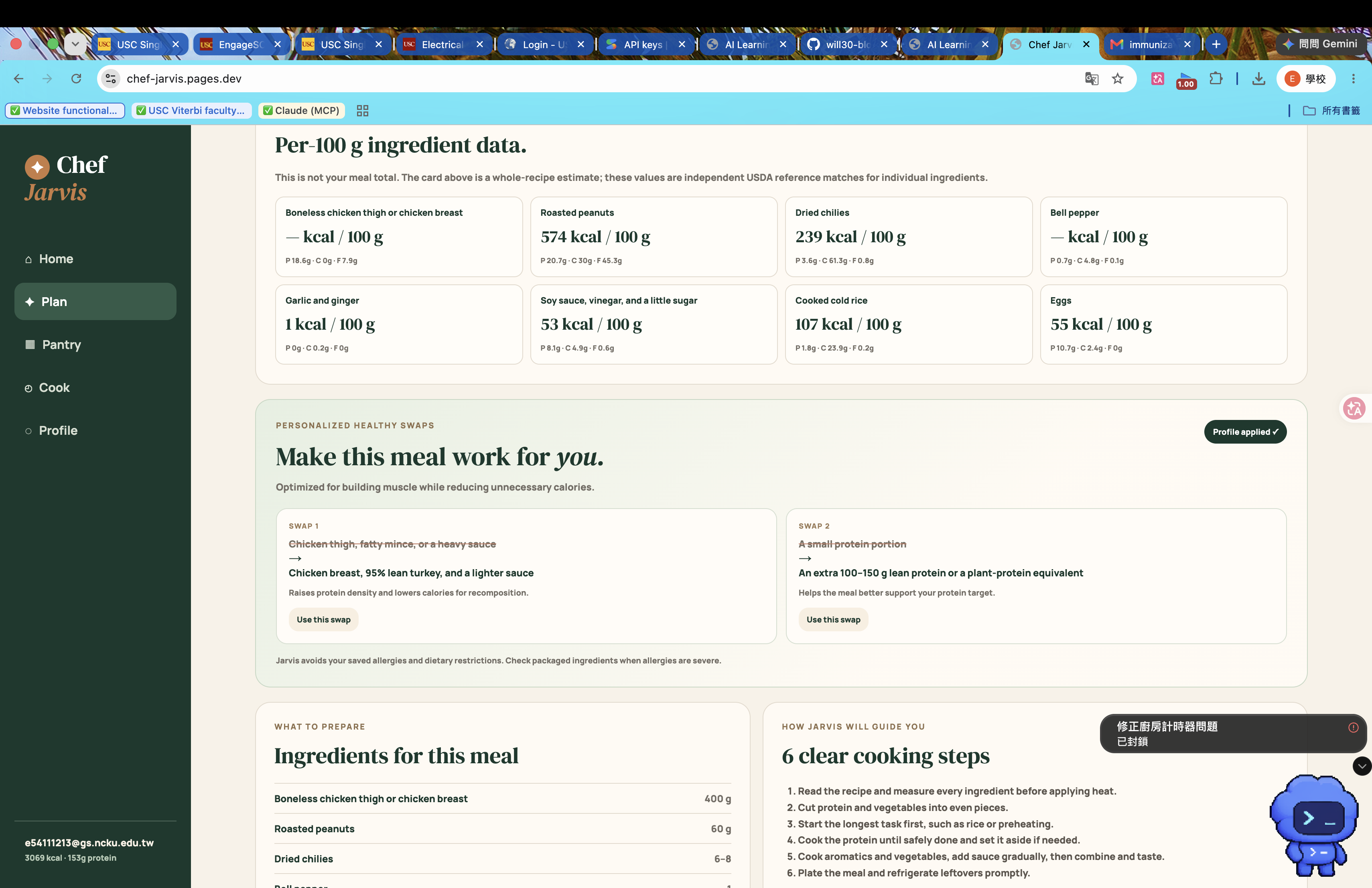
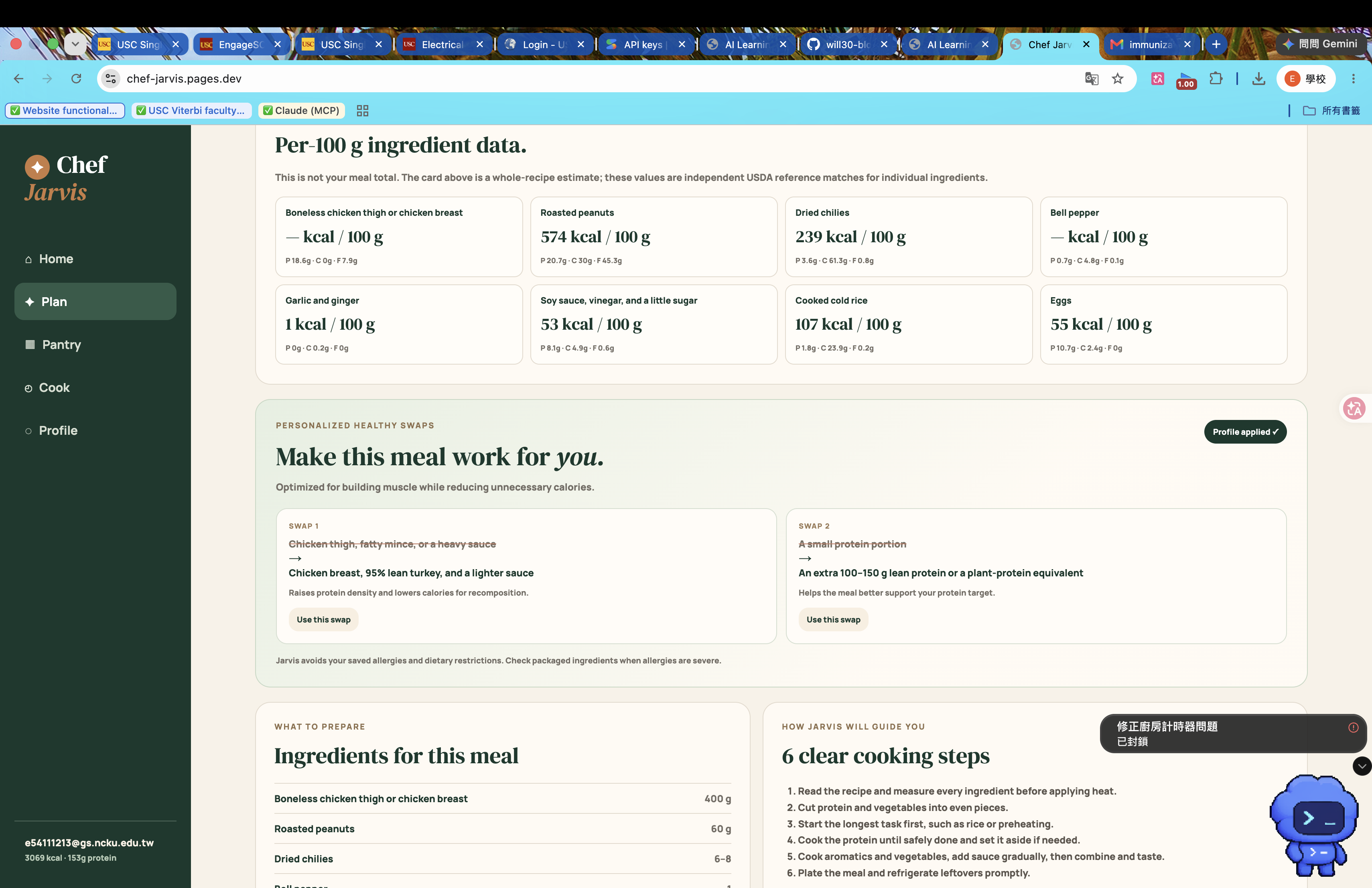
- Personalized healthy swaps — fat-loss users get leaner alternatives, muscle-gain users get protein-forward portions, and lactose/gluten/nut/shellfish restrictions are carried into every suggestion.
- Smart grocery checklist — tick off only what you need to buy; the list is saved to your account.
- USDA-verified nutrition — ingredients are matched against USDA FoodData Central in the background for per-100 g reference data.
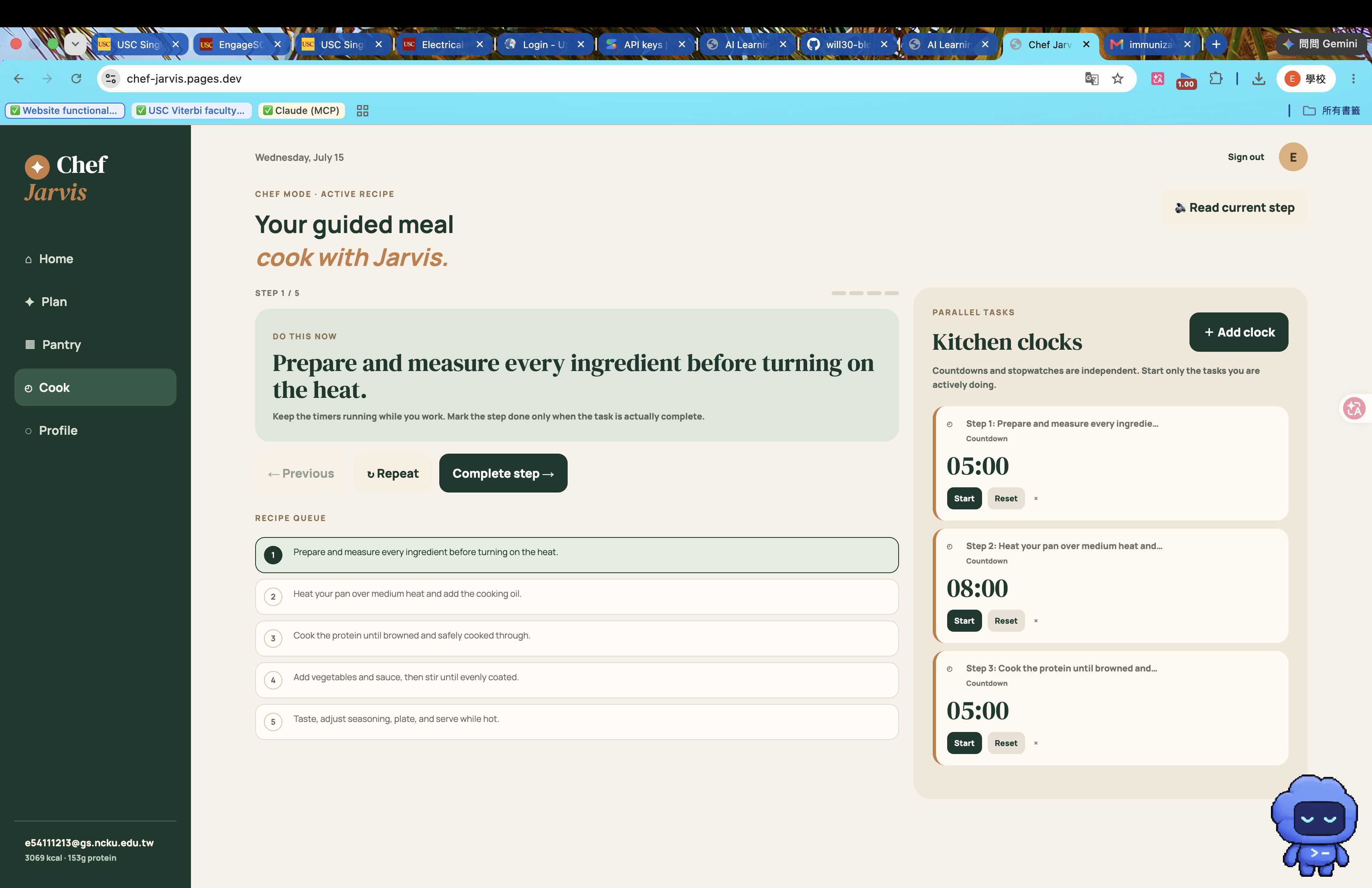
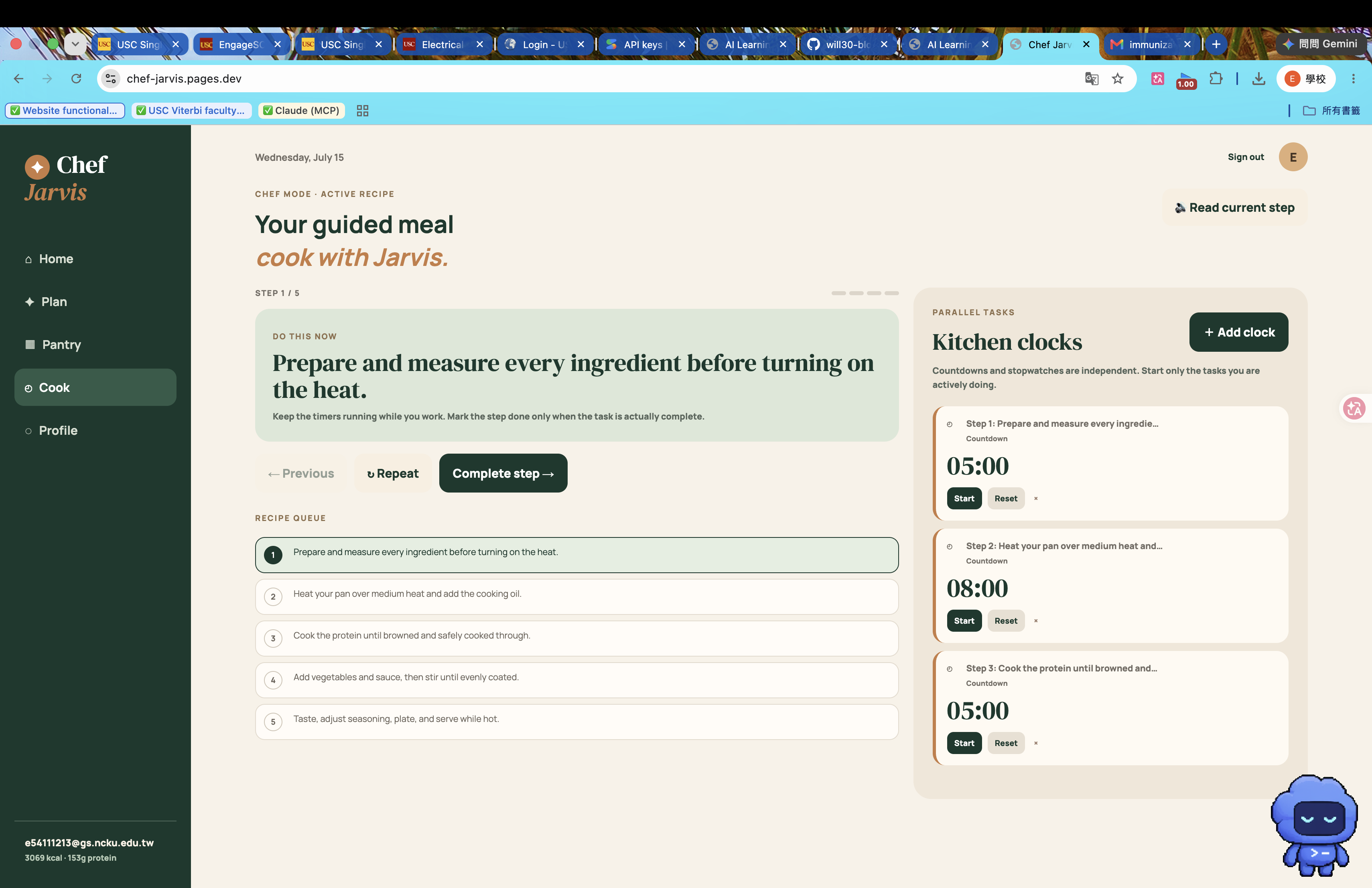
- Chef Mode — step-by-step guided cooking with spoken instructions (Web Speech API), a tappable step queue, and multiple independent kitchen clocks: countdowns and stopwatches running in parallel.
- Equipment adaptations — no wok? Jarvis only suggests alternatives using devices you actually own.
How we built it
A deliberately dependency-light static client, with all secrets and AI work pushed to the edge:
Cloudflare Pages (static web client, vanilla JS)
  └─ Supabase
       ├─ Auth (email + confirmation flow)
       ├─ Postgres with Row Level Security
       └─ Edge Functions (Deno)
            ├─ chef-meal-plan     → Google Gemini
            └─ chef-usda-nutrition → USDA FoodData Central
The browser only holds the Supabase publishable key; Gemini and USDA keys live exclusively in Edge Function secrets, and both functions verify the caller's JWT. All user data sits behind Row Level Security.
Personalization is math before it's AI. We compute basal metabolic rate with the Mifflin–St Jeor equation:
$$ \mathrm{BMR} = 10m + 6.25h - 5a + s, \qquad s = \begin{cases} +5 & \text{male} \ -161 & \text{female} \end{cases} $$
then scale by activity and shift by goal:
$$ \mathrm{kcal} = \mathrm{BMR} \times f_{\text{activity}} + \Delta_{\text{goal}}, \quad f \in {1.25, 1.45, 1.65},\; \Delta \in {-350_{\text{fat loss}},\, +250_{\text{muscle gain}}} $$
Macros are allocated protein-first ($1.8$–$2.0\,\mathrm{g/kg}$ body weight), fat at $27\%$ of calories, and carbs take the remainder:
$$ C = \frac{\mathrm{kcal} - 4P - 0.27\,\mathrm{kcal}}{4} $$
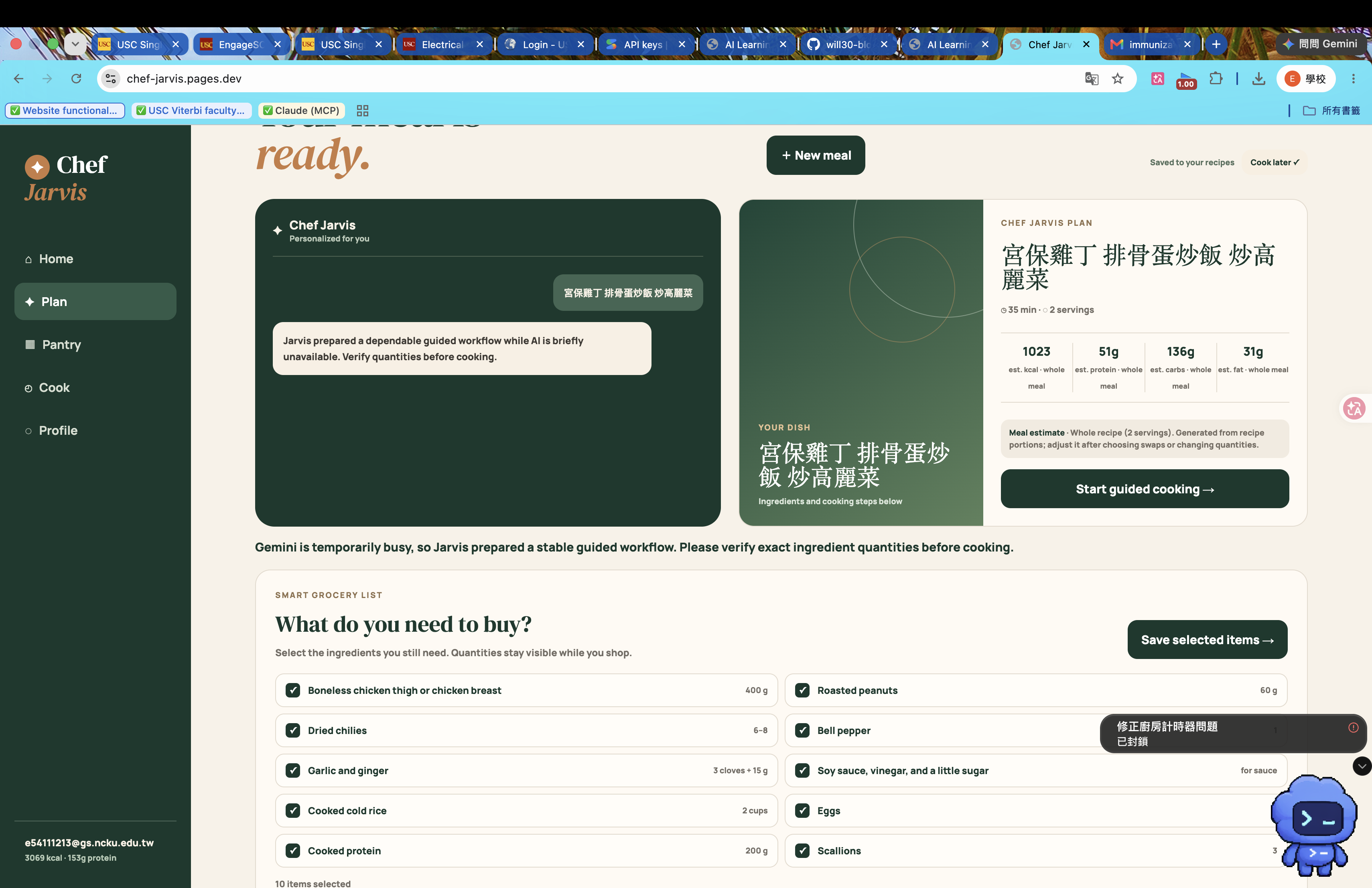
The meal-plan function prompts Gemini with a strict JSON schema, low temperature, and responseMimeType: "application/json", then defensively strips code fences and extracts the outermost {...} before parsing. It tries two models with tight timeouts and, if both fail, degrades to a hand-written fallback plan (with dish-aware templates — it even pattern-matches requests like 宮保雞丁 and 蛋炒飯), so guided cooking always works.
Challenges we ran into
- LLM output is a hostile data source. Gemini would occasionally wrap JSON in markdown fences, truncate, or drift from the schema. We ended up treating the model like an untrusted API: strict prompting, defensive parsing, a model fallback chain, and finally a non-AI fallback plan. Designing for graceful degradation was the biggest mindset shift.
- Rendering untrusted content safely without a framework. With a vanilla-JS,
innerHTML-driven UI, every AI- or user-supplied string is a potential XSS vector. We wrote a small escaping helper and had to apply it with discipline — including inside HTML attributes. - Concurrent timers are harder than they look. Independent clocks in two modes (countdown vs. stopwatch), pause/resume/reset, all surviving UI re-renders — reconciling a global tick loop with a re-rendered DOM produced subtle state bugs and taught us why separating state from view matters.
- Platform migration mid-project. We started on Netlify Functions and moved to Cloudflare Pages + Supabase Edge Functions. Porting the same logic across two serverless runtimes forced us to isolate pure logic (prompt building, parsing, fallbacks) from platform plumbing.
Accomplishments that we're proud of
- A real security model, not a demo shortcut: JWT-verified edge functions, server-side secrets only, and Row Level Security on every user-owned table — the client never sees a private key.
- The AI never leaves you stranded: two-model fallback plus a hand-crafted degraded plan means a user can always cook, even when the AI is down — and the UI is honest about which one it served.
- Honesty in nutrition data: AI estimates are clearly labeled as whole-recipe estimates, and USDA reference values are explicitly per-100 g ingredient data — no fake precision.
- Chef Mode feels like a product, not a feature: one step at a time in large type, spoken instructions, and truly parallel kitchen clocks built for messy-hands cooking.
- Shipped as a full-stack, deployed, account-based web app — auth, database, edge functions, two external APIs — with a dependency-light static frontend.
What we learned
- Personalization is a data-model problem before it's an AI problem. The magic isn't the LLM — it's a profile structured well enough (allergies, goals, equipment, dislikes) to constrain the LLM meaningfully.
- Treat AI as an unreliable dependency: schema-constrain it, time-box it, ground it with real data (USDA), and always have a non-AI answer ready.
- Security boundaries beat security effort. Putting every secret behind a JWT-verified function and every row behind RLS let the client stay simple without being scary.
- The browser platform is deep: Web Speech for hands-free cooking, FormData-driven forms, CSS custom properties as a design system — all without a framework, which also taught us exactly what frameworks protect you from.
- Real nutrition math (Mifflin–St Jeor, activity multipliers, protein-first allocation) — and the humility that these are estimates, which shaped honest UI copy: guidance, not medical advice.
What's next for Chef Jarvis
- Pantry-aware planning — feed the user's pantry inventory directly into the AI prompt so "use what I have" becomes literal.
- Weekly meal planning — one AI pass that plans 5–7 meals sharing ingredients, with a merged grocery list: "shop once, cook more" at full scale.
- A dedicated shopping-list view with in-store check-off.
- PWA + kitchen mode — installable app, offline recipes, timer sounds and notifications, and screen wake-lock so the display never sleeps mid-recipe.
- Photo-based pantry input — snap your fridge and let vision AI stock your inventory.
- Nutrition logging — mark a meal as cooked and track daily macros against your targets.
- Engineering maturity — migrate the proven product to a typed, componentized frontend (Vite + TypeScript) and add tests and CI, paving the way for a future App Store client on the same Supabase backend.
Built With
- apis
- database

Log in or sign up for Devpost to join the conversation.