Inspiration
Last-mile delivery is the final frontier of logistics — and ironically, it's still being managed with phone calls. We spoke to dispatcher operators at courier companies who described their daily reality: an order comes in, they scan a mental list of available drivers, and they start dialing. One by one. If the first driver doesn't pick up, they try the next. If someone declines, they try the next. During peak hours, this process can take 10–15 minutes per order, with multiple orders stacking up simultaneously. Dispatchers described it as "organized chaos" — and that was on a good day. What struck us wasn't just the inefficiency. It was the hidden costs nobody talks about: drivers getting called for orders they legally can't take because their license is about to expire, or they've already hit their daily kilometer limit, or their vehicle type doesn't match the order. These compliance blind spots create legal liability and erode trust with customers. We asked ourselves: what if an AI agent could do every part of this — check compliance, rank drivers, make the call, handle the conversation — faster than a human dispatcher can even pick up the phone? That question became Cheetah Express.
What It Does
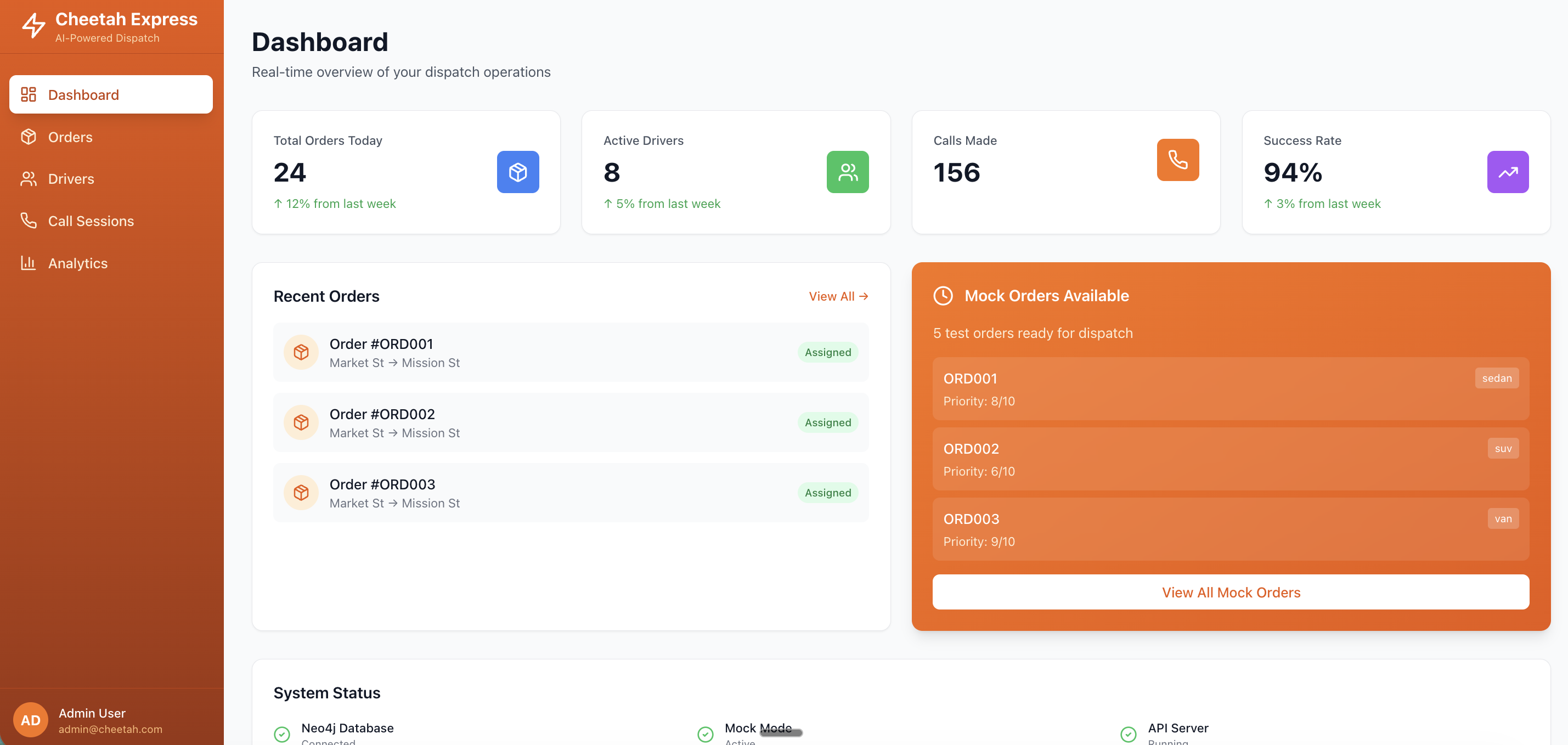
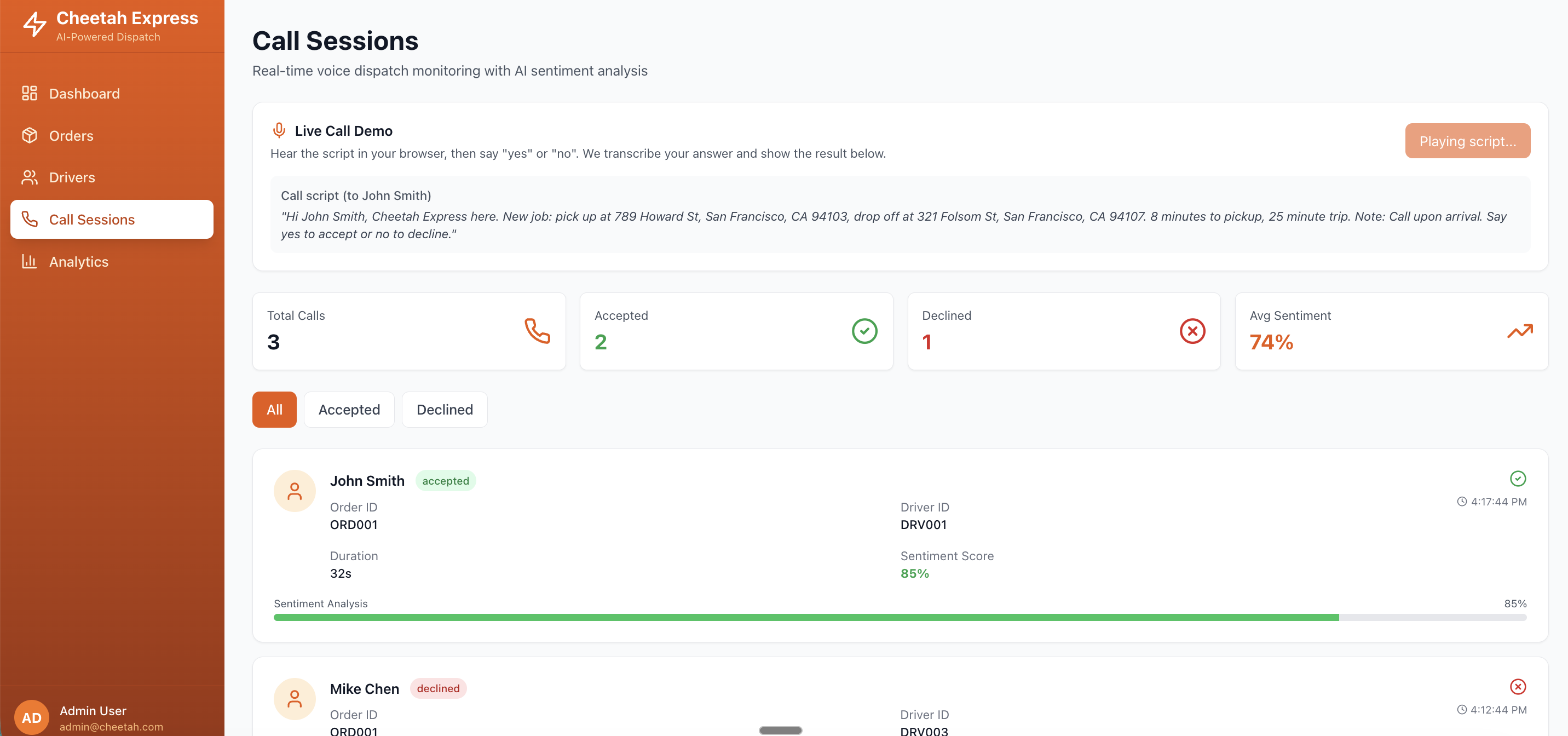
Cheetah Express is a fully autonomous AI dispatch system for last-mile courier companies. The moment a new delivery order arrives, Cheetah Express takes over completely — no human dispatcher required. It starts by simultaneously running two checks in parallel. The Driver Context Agent uses Yutori to pull live GPS locations, availability status, vehicle type, and contact information for every active driver in the fleet. At the same time, the Compliance Agent queries our Neo4j knowledge graph to verify each driver against three critical rules: whether their license is valid and not expiring imminently, whether their vehicle type matches what the order requires, and whether they have enough remaining hours and kilometers left in their shift to legally complete the delivery. Only drivers who pass all compliance checks move forward. For that eligible pool, the Routing Agent calls Google Maps via Yutori to get real-time ETAs for every driver — from their current GPS position to the pickup location, then to the dropoff. Drivers are ranked by total trip time, with compliance health used as a tiebreaker. Then the most distinctive part: Cheetah Express's voice dispatch agent, powered by Modulate, automatically calls the top-ranked driver. It introduces itself, reads out the pickup location, dropoff, and time window in natural language, and listens for the driver's response. If the driver accepts, the order is assigned and the loop ends. If they decline, the agent logs the reason and their emotional tone, then immediately calls the next driver — all without any human involvement. Every decision made throughout this process — who was filtered out and why, how drivers were ranked, what each driver said and how they said it — is written into a Neo4j reasoning graph that gives operations managers full auditability and explainability over every assignment.
How We Built It
We built Cheetah Express as a multi-agent Python backend deployed on Render, with OpenAI GPT-4o serving as the orchestrator brain that coordinates all sub-agents. For driver data and routing, we used Yutori's Browsing and Research APIs to autonomously retrieve live driver information and execute Google Maps Distance Matrix calls, giving us real-time GPS-to-route ETAs without managing separate API integrations ourselves. Neo4j serves a dual role in our architecture. Before dispatch, it acts as the compliance gate — storing driver contracts, license records, vehicle authorizations, and daily workload data, and running Cypher queries to determine eligibility in real time. After dispatch, it becomes the audit and reasoning graph, recording every agent decision as a node and relationship so the entire assignment chain is traversable and explainable. Modulate powers the voice layer. We configured a conversational voice agent with a friendly dispatcher persona that can handle natural responses — including questions, hesitations, and outright declines — and returns structured metadata including sentiment classification and emotional tone scores alongside the accept/decline outcome. The entire pipeline from order intake to driver confirmation runs asynchronously, with agents operating in parallel where possible to minimize total dispatch time.
Challenges We Ran Into
The hardest technical challenge was making the compliance queries in Neo4j fast enough to not bottleneck the pipeline. Early on, our graph queries were running sequentially per driver, which created unacceptable latency when checking a fleet of 30+ drivers. We had to redesign the queries to batch-check the entire eligible pool in a single traversal and return pass/fail results with reasons simultaneously. Handling natural conversation in the Modulate voice agent was trickier than expected. Drivers don't respond with clean "yes" or "no" answers — they ask clarifying questions, they give conditional acceptances, they go quiet. Training the voice agent to handle these edge cases gracefully, extract a reliable intent signal, and capture meaningful sentiment metadata required significant prompt iteration. Coordinating parallel agent execution — running the Driver Context Agent and Compliance Agent simultaneously, then feeding their merged output into the Routing Agent — required careful async orchestration to avoid race conditions where one agent's incomplete output would corrupt the other's input. We also underestimated the complexity of building a compelling live demo under time pressure. Getting all three sponsor tools — Yutori, Neo4j, and Modulate — to fire in a visible, interpretable sequence during a 3-minute window forced us to think carefully about what to surface on screen and when.
Accomplishments That We're Proud Of
We're proud that Cheetah Express is genuinely end-to-end autonomous. From the moment an order arrives to the moment a driver verbally confirms, no human touches the process. That's not a prototype of autonomy — it's the real thing running live. We're particularly proud of how Neo4j ended up doing double duty as both a real-time compliance engine and a post-dispatch reasoning graph. Most teams use a graph database as a passive store. We made it an active decision-maker that gates the entire pipeline, and that architectural choice makes the system meaningfully safer and more auditable than anything a human dispatcher could produce manually. The Modulate voice agent handling real, unscripted driver responses in a live demo — and still extracting clean structured metadata — was a genuinely satisfying technical achievement given the time constraints. And perhaps most importantly: we built something that solves a real problem for a real industry, with a business model that is immediately obvious, in a single day.
What We Learned
We learned that autonomous agents live and die by the quality of their data contracts between steps. The hardest bugs we hit weren't in any single component — they were in the handoff between components, where one agent's output format didn't exactly match what the next agent expected. Defensive parsing and explicit schema validation between every agent boundary is non-negotiable. We also learned that Neo4j's graph model is a genuinely powerful fit for compliance logic — representing rules, driver attributes, and order requirements as nodes and relationships makes complex multi-condition checks surprisingly readable and maintainable compared to nested SQL or imperative code. Perhaps the biggest insight was around voice AI: the emotional metadata Modulate captures is actually more operationally valuable than the accept/decline signal itself. A driver who accepts an order while sounding stressed or rushed is a risk signal worth tracking. That data, accumulated over time in the Neo4j graph, could power a reliability scoring model that makes future driver ranking dramatically smarter.
What's Next for Cheetah Express
The immediate next step is closing the assignment loop — automatically pushing the confirmed driver assignment back into the order management system so the customer gets a real-time notification with their driver's name, ETA, and live tracking link. Beyond that, we want to build the self-improvement layer fully. Right now, the Neo4j graph captures everything — decline reasons, sentiment scores, compliance outcomes, ETA accuracy. The next version uses that accumulated data to continuously retrain the ranking engine, so drivers who consistently accept orders efficiently get surfaced higher, and patterns like "Driver X always declines bike orders after 6pm" automatically adjust their ranking score for those scenarios. We also see a significant opportunity in proactive compliance alerts — using Neo4j to surface drivers whose licenses are expiring in the next 30 days, or who are approaching their weekly kilometer limits, and automatically flagging them to fleet managers before they become a dispatch problem. Longer term, Cheetah Express isn't just a dispatch tool — it's the foundation for an intelligent fleet operations platform. Every order, every driver interaction, every routing decision becomes a data point that makes the next decision smarter. That compounding intelligence is what transforms a useful hackathon prototype into a defensible, lasting product. Cheetah Express. Dispatched in seconds. Every order. Zero calls.


Log in or sign up for Devpost to join the conversation.