-
-
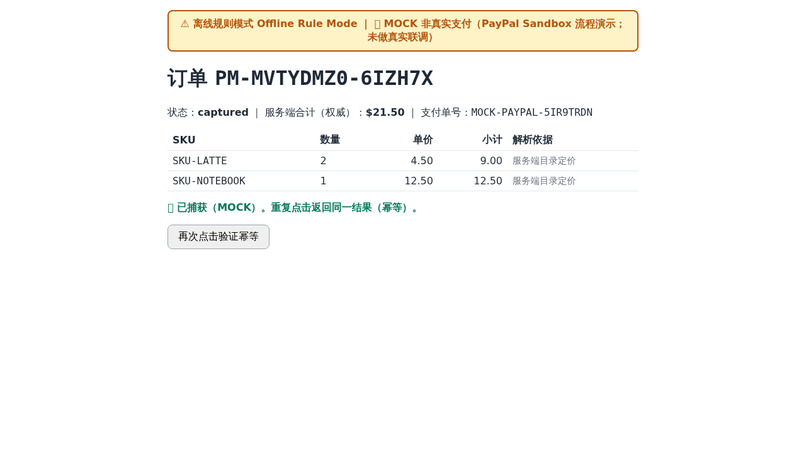
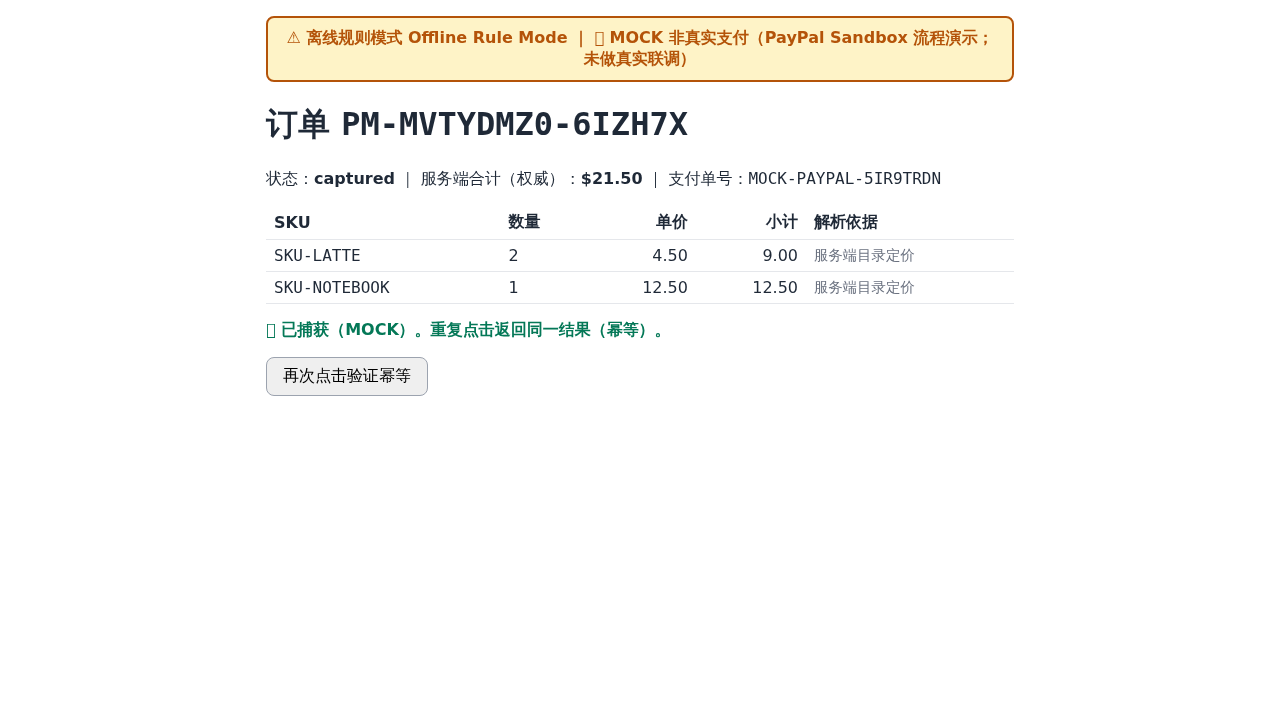
Order captured. Server recomputed $21.50 in integer cents. Repeated capture returns the same result — idempotent. Mock PayPal, labelled MOCK
-
Ambiguous request rejected with a reason. The system never guesses — no fabricated order is created.
-
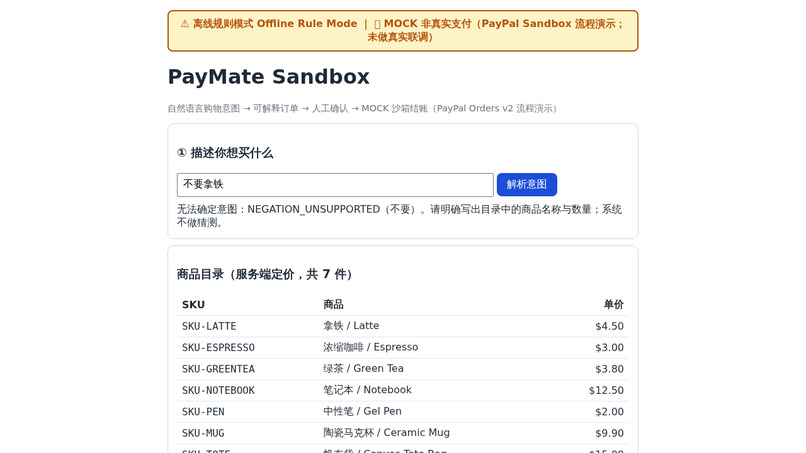
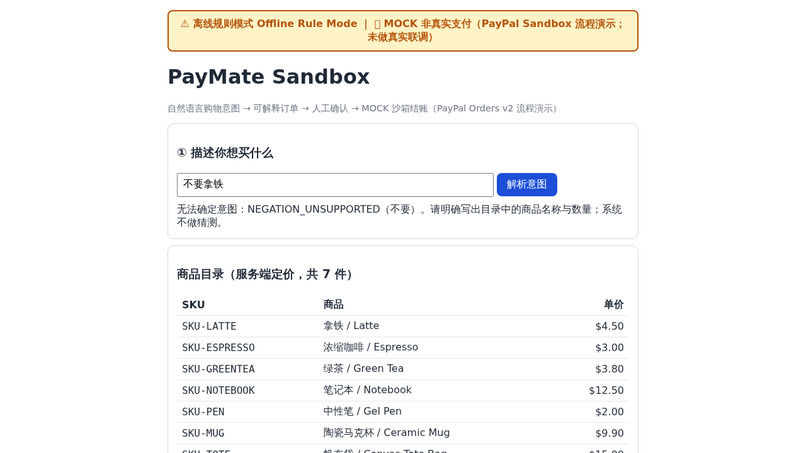
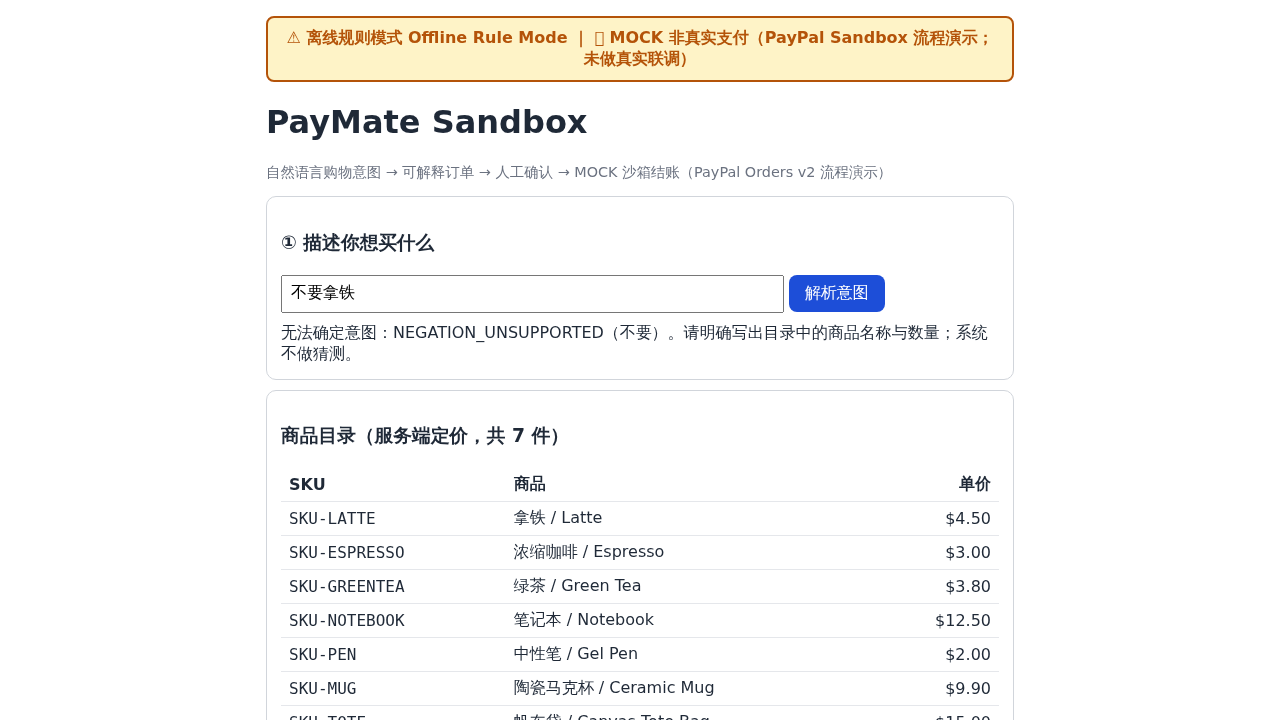
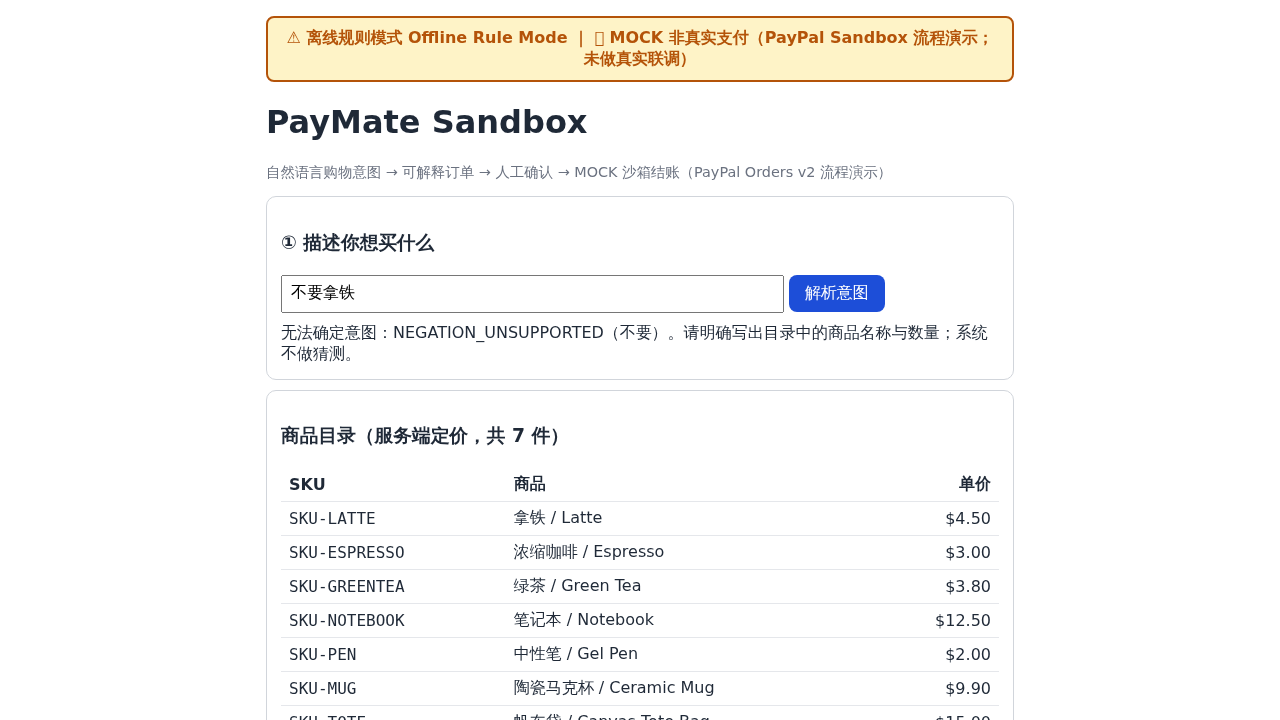
Negation detected and refused. Human confirmation is required before any payment step.
Inspiration
Teaching materials about agents rarely show the exact point where a plausible model output becomes an authorized payment. CheckoutLab makes that boundary a thing you can click, break and test — with a mock checkout that has real failure cases and no real money or customer data.
What it does
A tiny multilingual Naive Bayes classifier suggests a product class for a free-text description and shows its matched features and score separation, or abstains when evidence is thin. Students can turn a suggestion into an unconfirmed draft — the model never submits an order.
A separate, strict rule parser turns free-text input — English or Simplified Chinese, looked up against a small bilingual term table — into line items and shows why each item matched (which term, at which position). Anything ambiguous, negated, unknown or oversized is rejected with an explicit reason — the system never guesses, and never silently clamps a quantity to the limit.
Prices are recomputed server-side in integer cents against a fixed 7-item catalog; a client-claimed total is stored as audit-only and never trusted. Orders follow draft → confirmed → created → approved → captured | cancelled with distinct human confirmation, simulated buyer approval, and a capture step that is idempotent: clicking capture again returns the same stored capture id instead of charging twice. Illegal transitions (e.g. capture after cancel) return HTTP 409 and are shown in the UI, not swallowed.
How we built it
Node 22 built-ins only — node:http and node:sqlite, zero npm dependencies, binds 127.0.0.1. The payment layer is an adapter interface: a MOCK adapter that reproduces the PayPal Orders v2 state machine offline, and a PayPal Sandbox adapter (client_credentials, Orders create/approve/capture) that is off unless credentials are explicitly configured. A per-order serial lock guarantees the adapter is called exactly once even under concurrent duplicate captures, and every transition is written to the SQLite event log.
Challenges we ran into
The interesting bugs were all about trust boundaries: client-supplied totals, silent quantity clamping, ambiguous substring matching ("notebook" vs "laptop notebook"), duplicate adapter calls under a double-click, unescaped output, and origin checks. Each one now has a regression check that asserts the observable behavior — 151 local checks across five suites.
Accomplishments that we're proud of
- The refusal path is the feature, not an error page. Ambiguous, negated, unknown and oversized inputs each return a specific reason code instead of a guess, and the parser can point at the exact characters it matched — that is what makes the boundary teachable.
- A double-click cannot charge twice. Capture is idempotent, backed by a per-order serial lock; the video shows the second click returning the same stored capture id over HTTP 200.
- Illegal transitions are visible. Capture-after-cancel returns 409 in the page instead of failing silently, so a student can break the state machine and read what happened.
- 151 local regression checks across five suites, written against observable behaviour at the trust boundaries (client totals, quantity limits, duplicate adapter calls, escaping, origin checks), all green before submission.
- One real PayPal Sandbox run, disclosed honestly. Order
2UV73710NH840425Breached capture COMPLETED and is recorded in STATUS.md, while the public demo stays in MOCK mode so no credential ever appears on screen. - Reproducible from a fresh clone. Zero npm dependencies, Node 22 built-ins only, bound to 127.0.0.1 — a classroom machine needs no network and no keys.
What we learned
Probabilistic suggestion and deterministic validation have to be different components with different permissions. A model that can only propose, plus a state machine that can only advance on evidence, is testable in a way that a single "AI does checkout" flow is not.
Honest limits
This is an educational sandbox, not a payment product: no real funds, no PCI scope, no multi-user load testing. The Naive Bayes model is a teaching toy, not a measured classifier, and its scores are not calibrated probabilities. The PayPal Sandbox path was verified end-to-end once (order 2UV73710NH840425B, capture COMPLETED, recorded in STATUS.md); the video deliberately shows MOCK mode so that no credentials or tokens appear on screen.
What's next
Classroom usability testing, more teaching examples and accessibility work; an optional hosted model once its cost and privacy conditions are clear.
Full source, tests and the AI-usage disclosure: https://github.com/gfdy22888-design/paymate-sandbox
Built With
- ai
- fintech
- html5
- javascript
- node.js
- payments
- paypal
- sqlite
