-
-
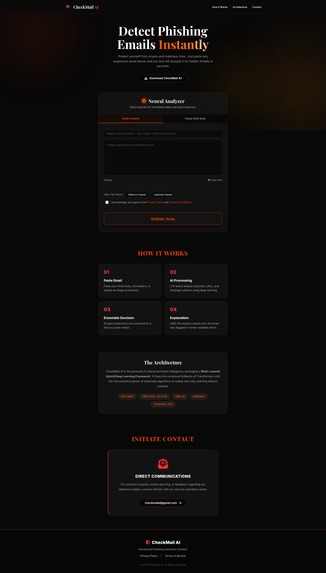
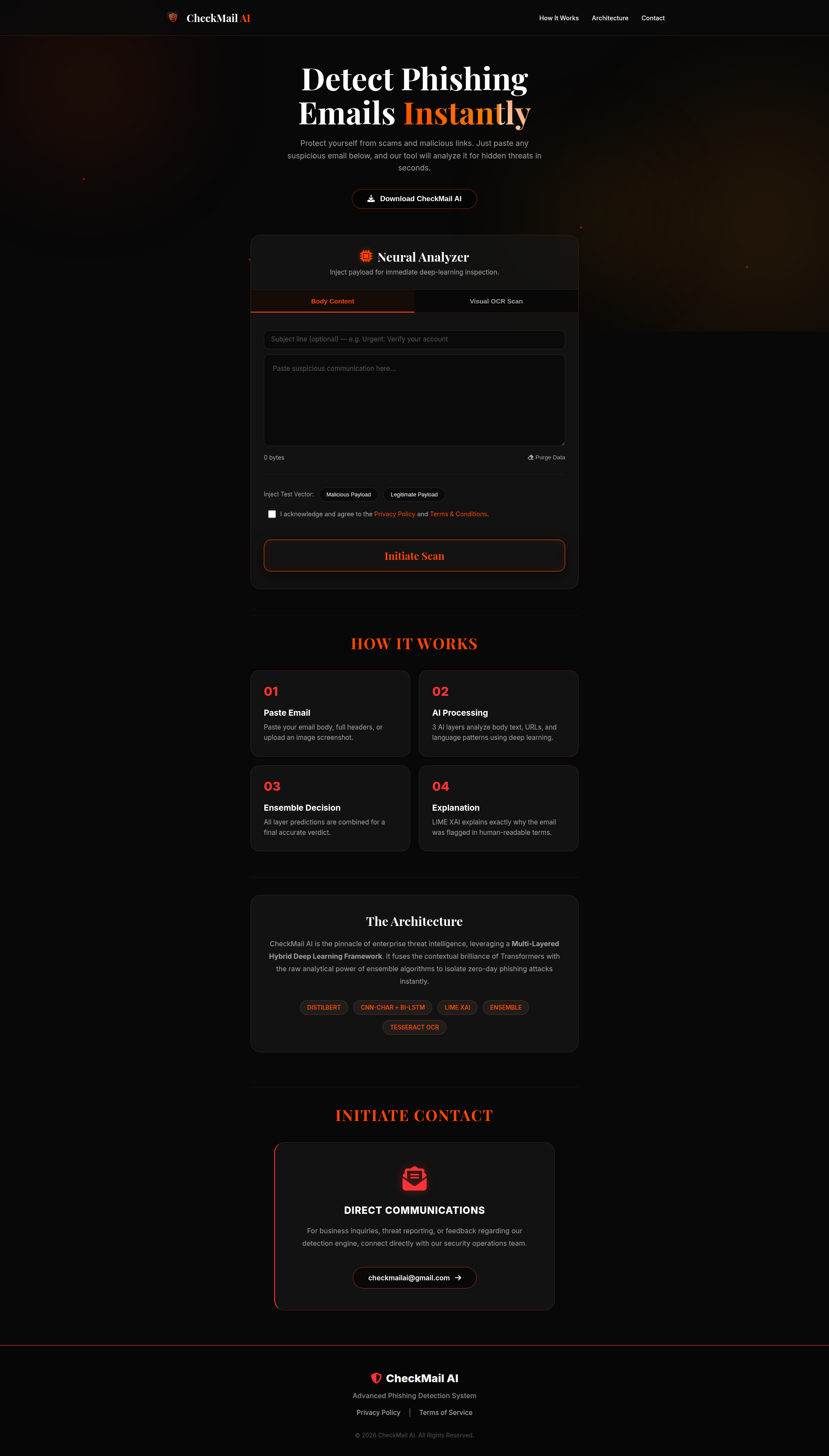
Full website
-
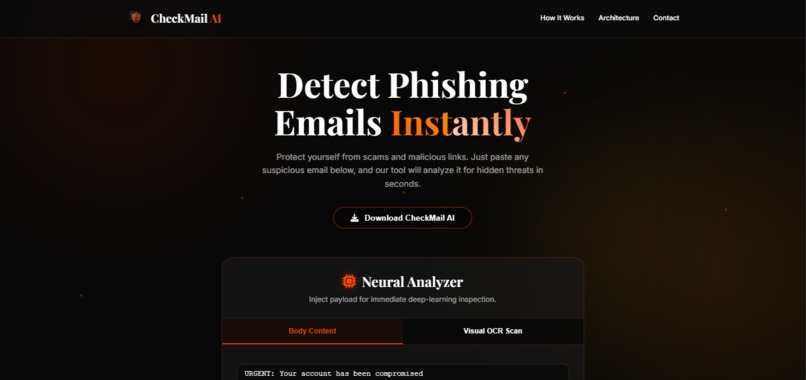
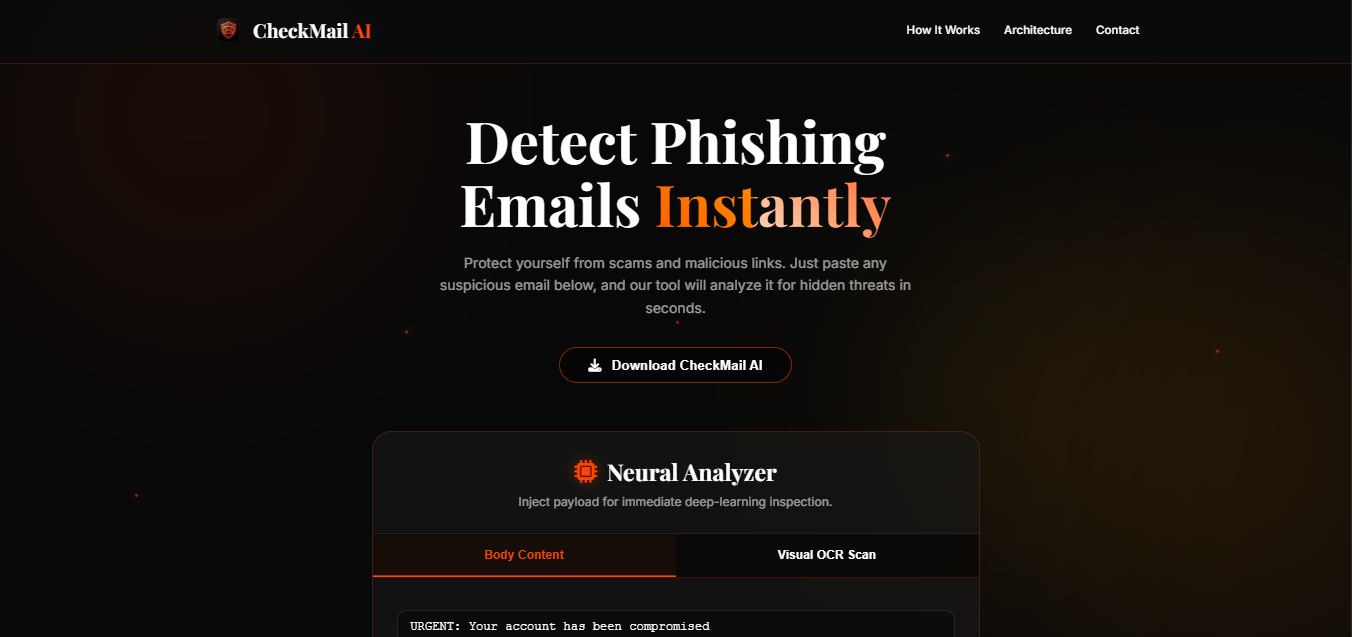
Main page of Website
-
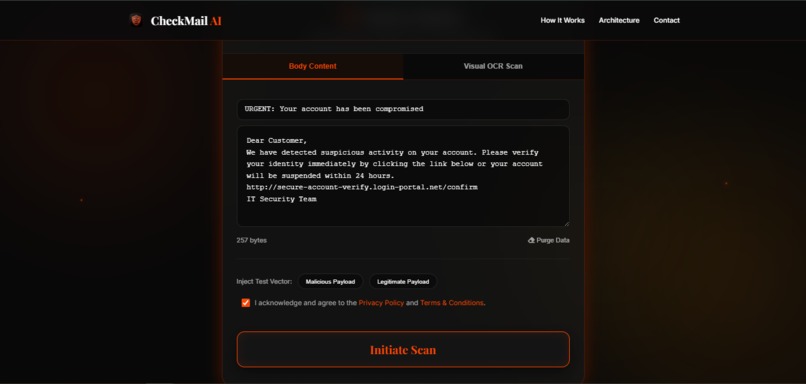
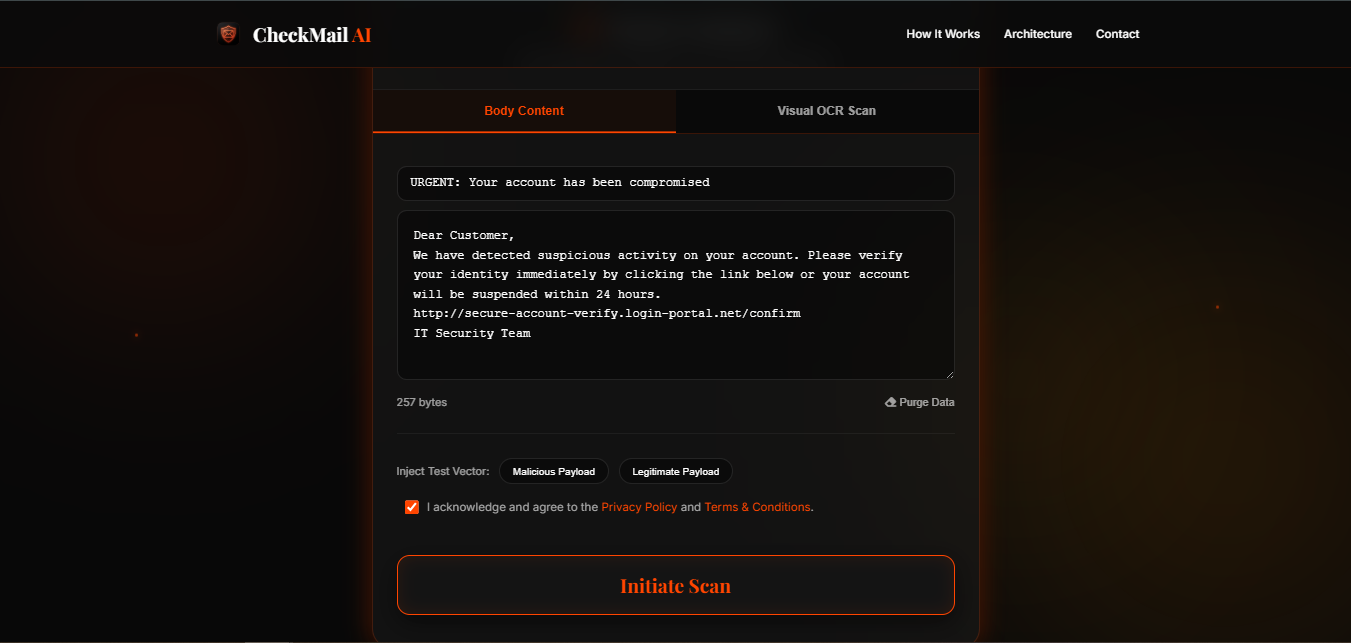
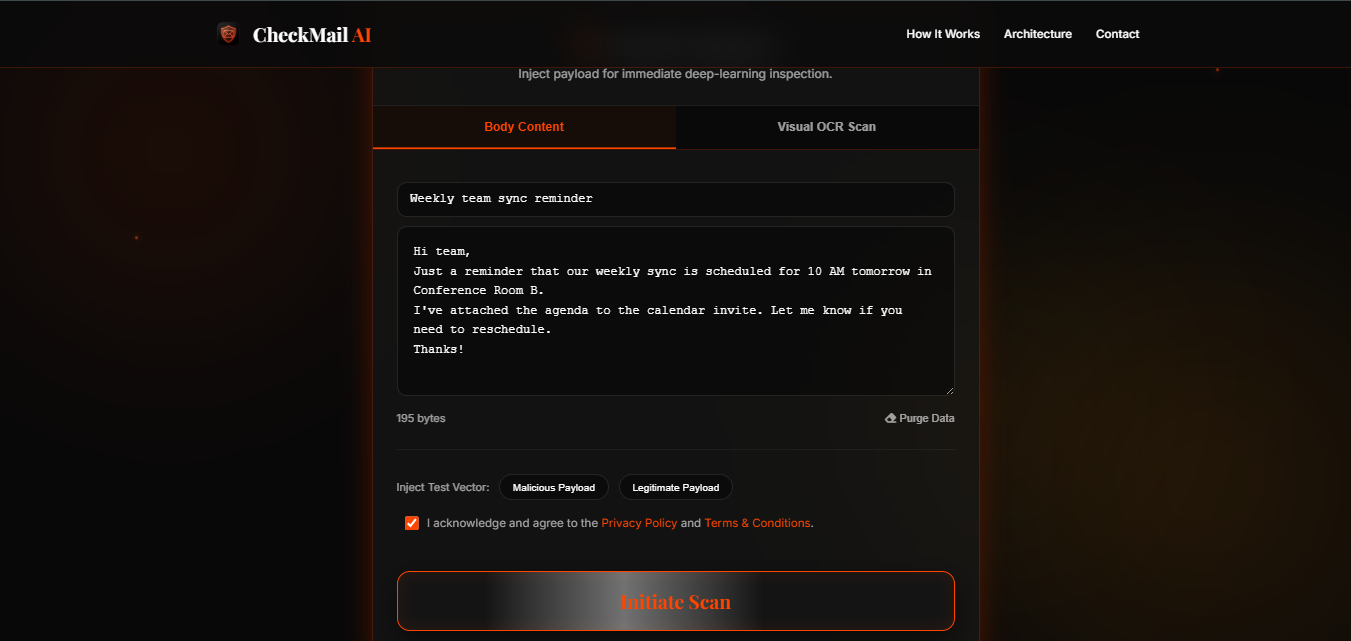
Enter Email 1 Website
-
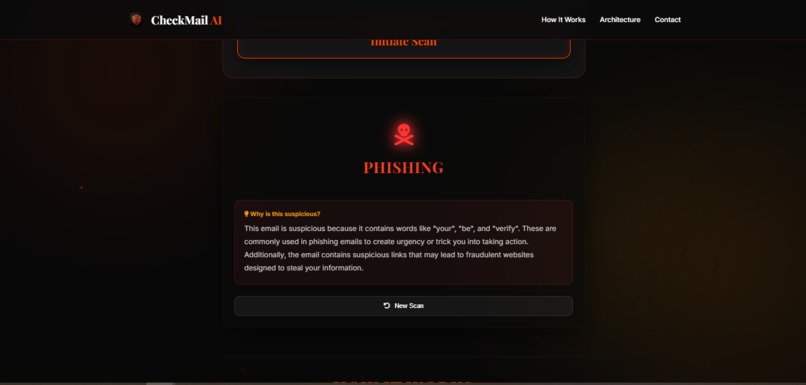
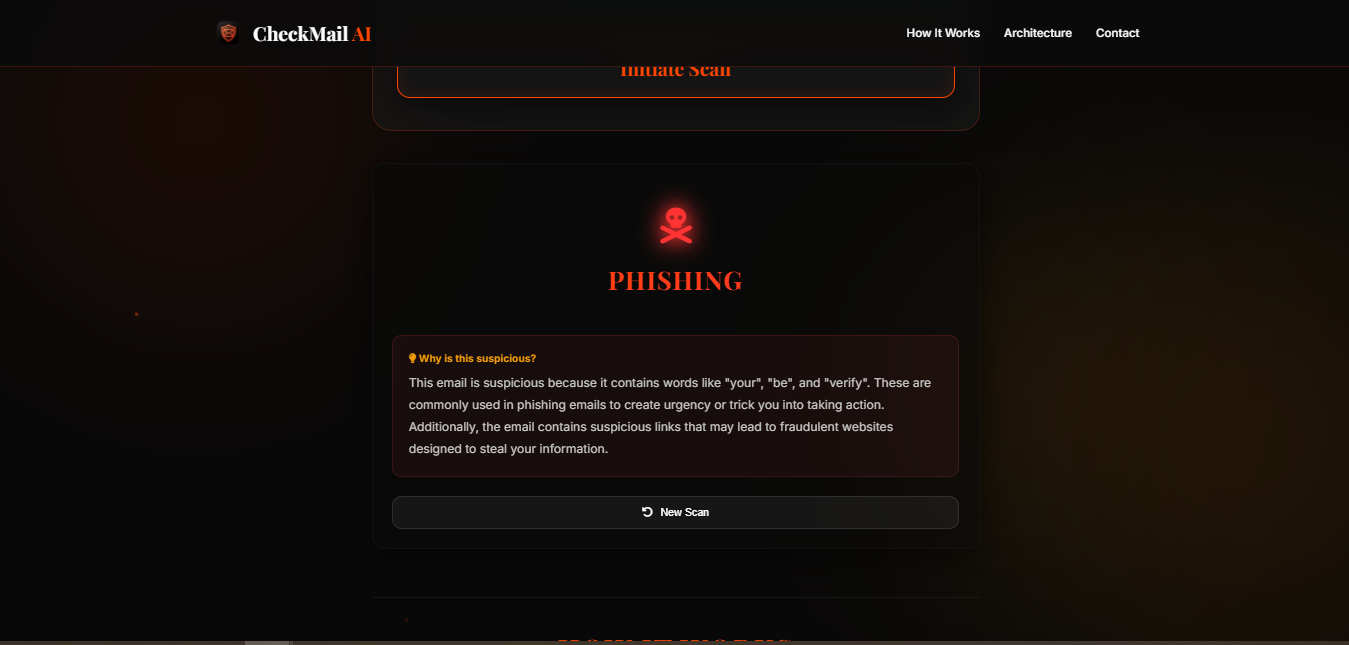
Phishing result Website
-
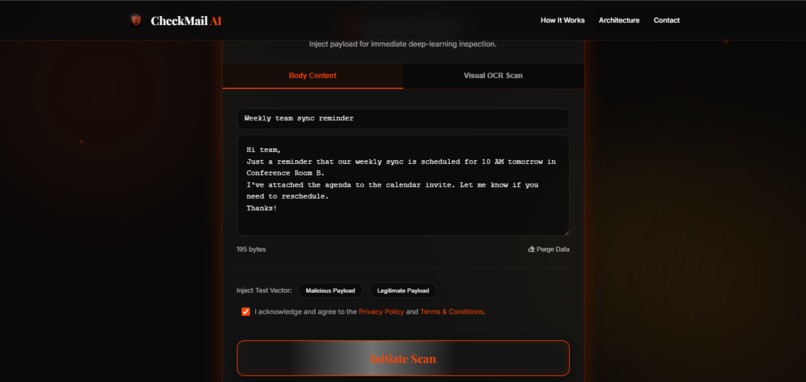
Enter Email 2 Website
-
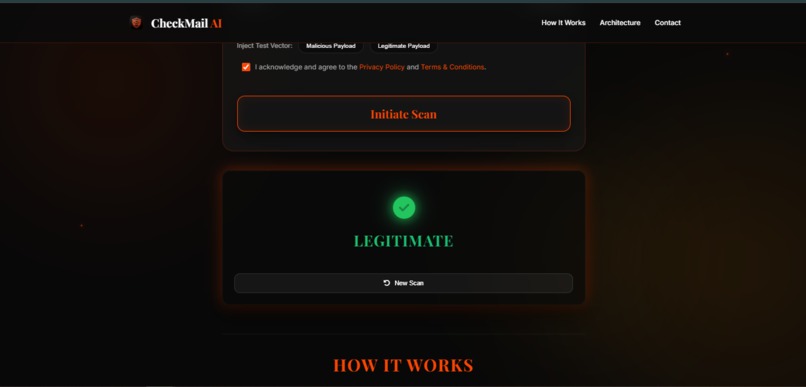
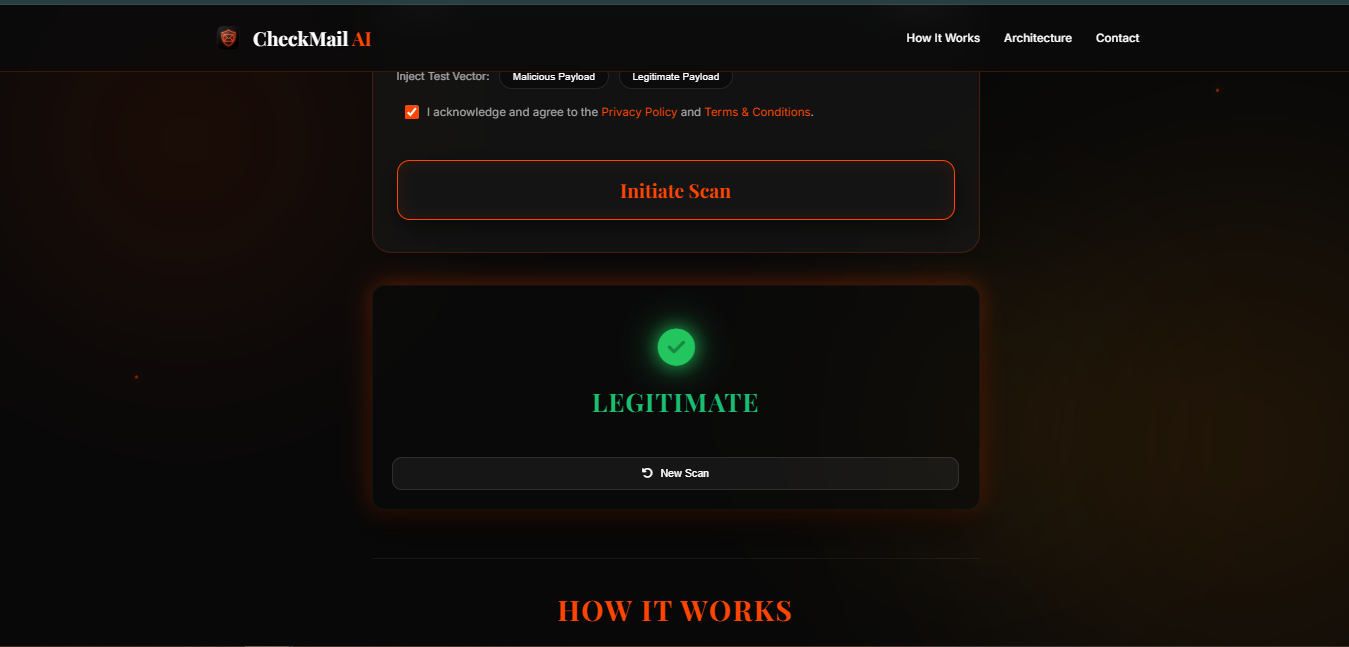
Legitimate result Website
-
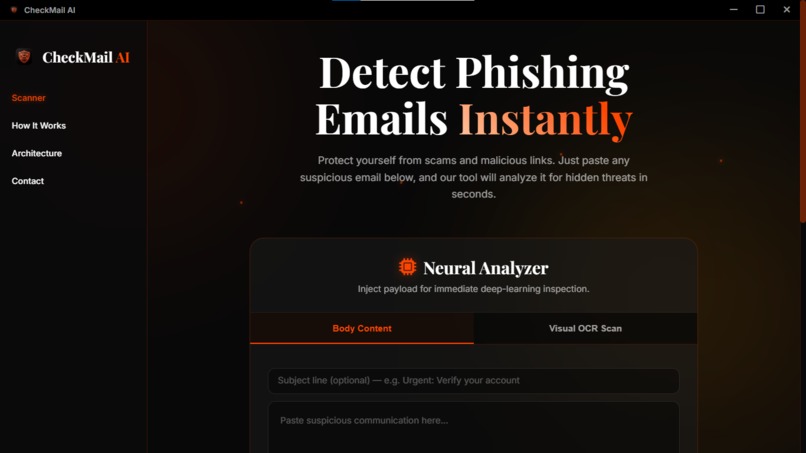
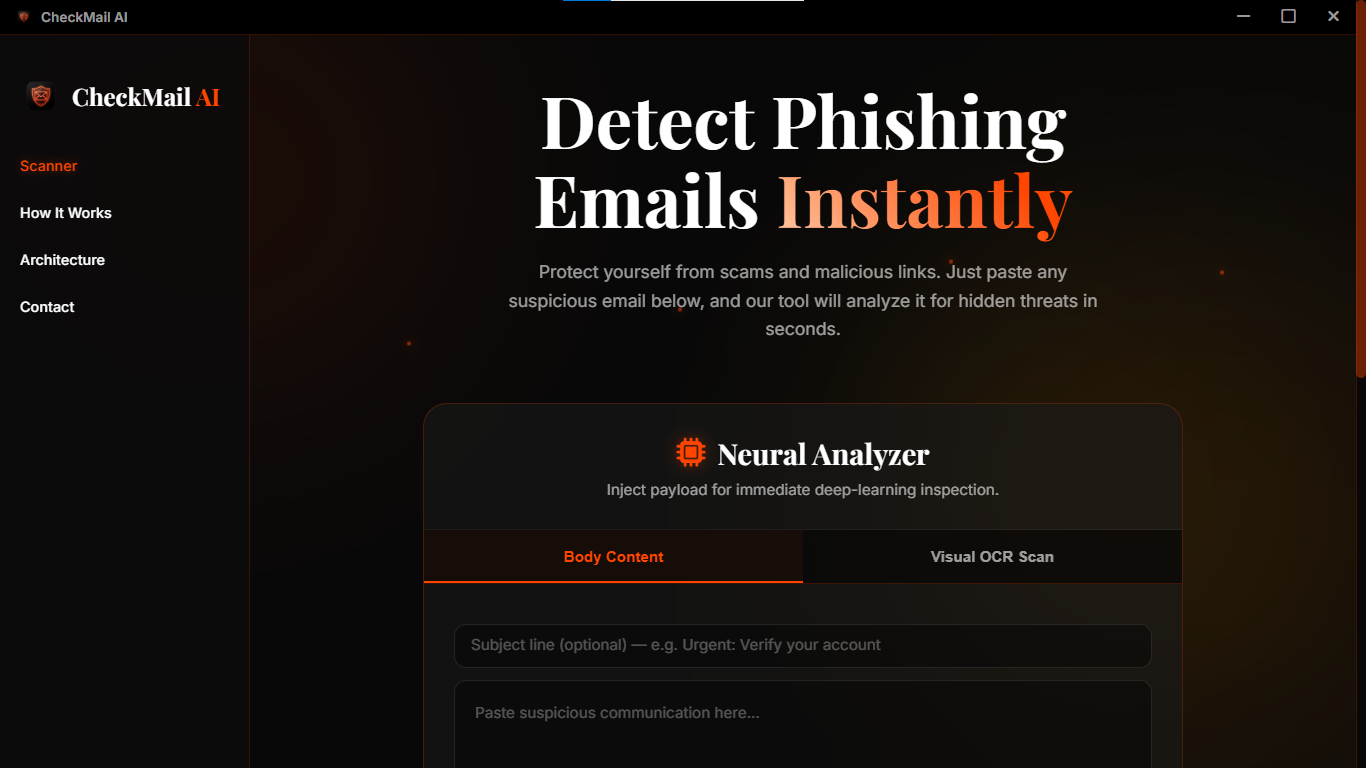
Main Software
-
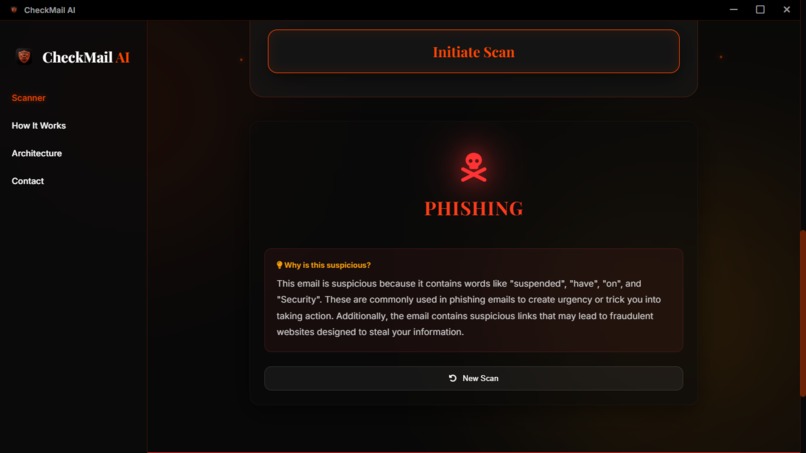
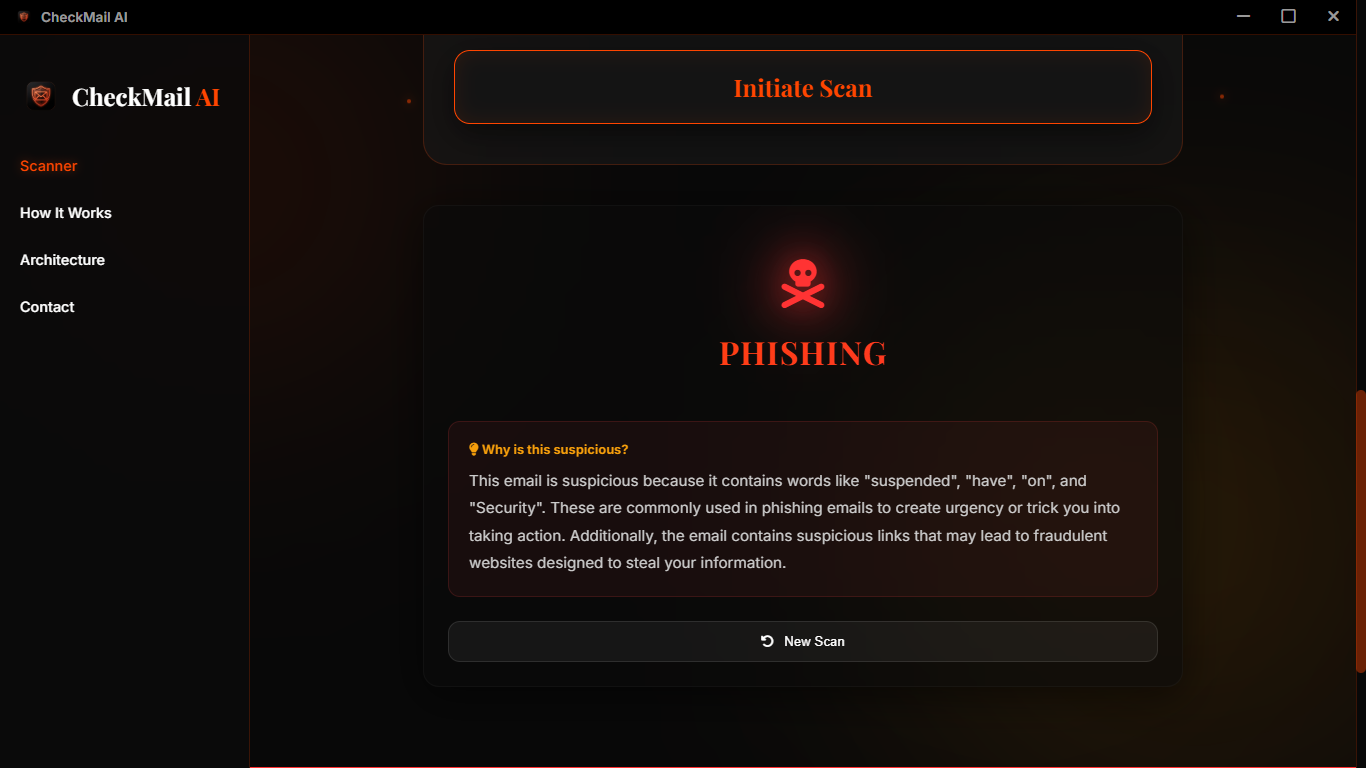
Results on Software
-
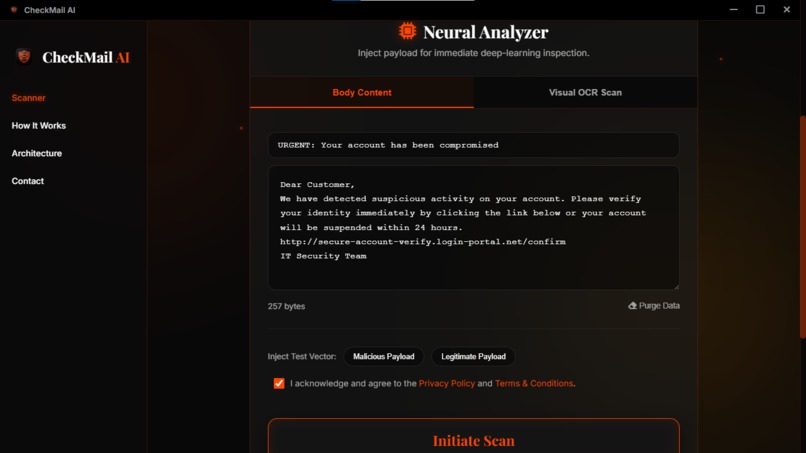
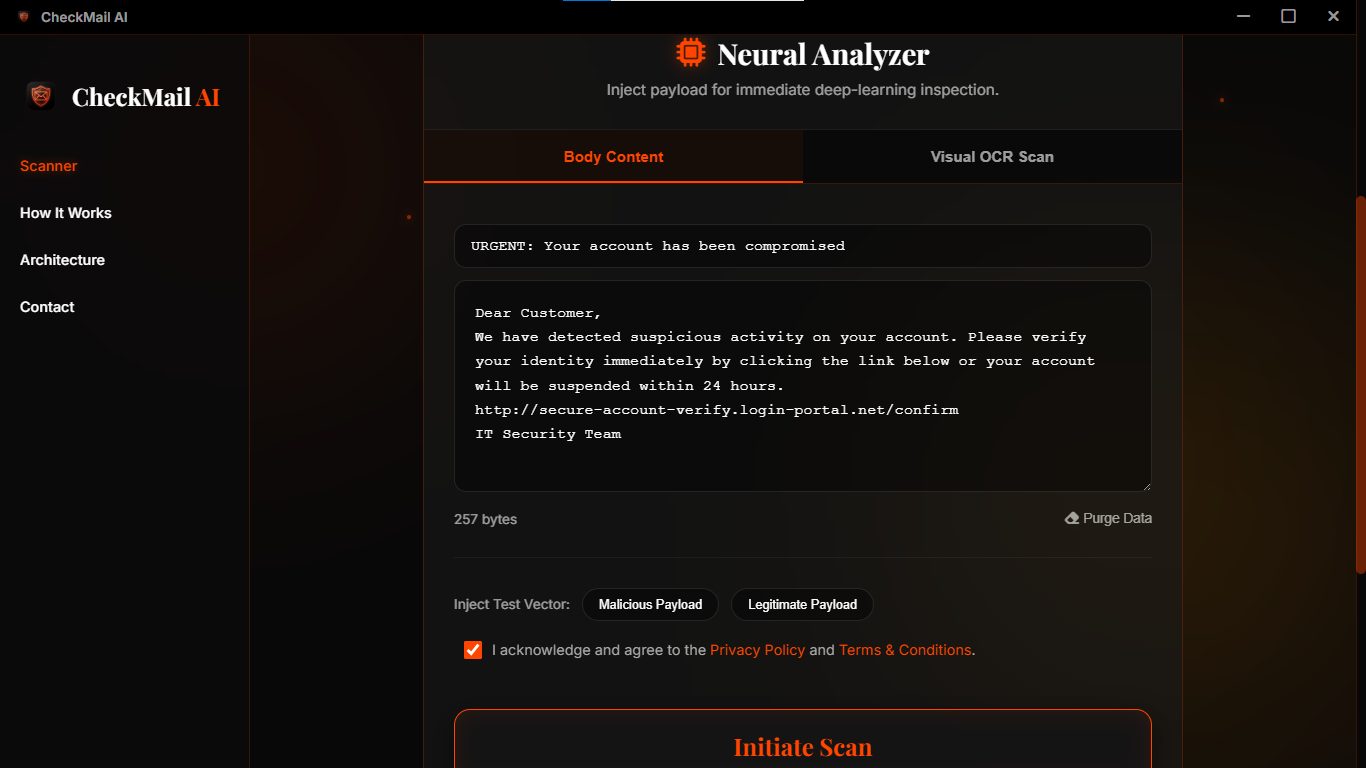
Enter Email on Software
Inspiration
Phishing emails are responsible for over 90% of successful cyber-attacks worldwide. We were inspired by the lack of transparent, explainable, and publicly accessible phishing detection tools. Most existing systems are either black-box models with no explanation, or single-modality systems that analyse only text or only URLs — never both. We wanted to build something that actually works in the real world and tells users why an email is suspicious.
What it does
CheckMailAI is a real-time phishing email detection system that analyses both email body text and embedded URLs simultaneously. It uses a dual-layer weighted ensemble:
- Layer 1 — Enhanced DistilBERT: Analyses email body and subject for deceptive language patterns (99.61% F1, 0.24% False Positive Rate)
- Layer 2 — CNN-char + Bi-LSTM: Analyses each extracted URL at character level for structural phishing patterns (97.41% F1 on 2.3M URLs)
- Ensemble: Weighted Soft-Voting (60% text + 40% URL) produces the final verdict
- LIME XAI: Explains why an email is phishing — highlights suspicious words and URL segments in human-readable language
Deployed as a live web application at checkmailai.app and as a cross-platform desktop software.
How we built it
We trained Enhanced DistilBERT on a master dataset of 135,029 emails from five public corpora (CEAS_08, Nazario, Enron, Nigerian_Fraud, SpamAssassin) using Google Colab with L4 GPU. The CNN-char + Bi-LSTM URL model was trained on 2,305,684 balanced URLs from four sources including PhiUSIIL and Razvan27.
The backend is a Flask REST API deployed on a Digital Ocean Droplet (Ubuntu 22.04, 8GB RAM, 4 vCPUs) with Nginx handling SSL termination. The frontend is pure HTML/CSS/JavaScript. The desktop app uses pywebview and is packaged as a standalone .exe via PyInstaller.
Challenges we ran into
- Balancing the dataset across five different email corpora with inconsistent schemas
- Preventing DistilBERT from memorising domain strings instead of language patterns (solved via URL masking with [URL] token)
- Running LIME on a CPU-only server within acceptable response time (solved by reducing perturbation samples to 30)
- Resolving 207 conflicting URL labels across merged datasets
Accomplishments that we're proud of
- 99.61% F1 Score with only 0.24% False Positive Rate on DistilBERT
- 97.41% F1 Score on 345,853 unseen URLs for CNN-BiLSTM
- AUC-ROC of 0.9993 — near-perfect discrimination
- Fully deployed live system accessible to real users at checkmailai.app
- Transparent XAI explanations that make AI decisions understandable
What we learned
- How to fine-tune Transformer models for domain-specific classification
- The importance of URL masking as a pre-processing step for NLP models
- How LIME works internally and how to optimise it for production CPU environments
- End-to-end ML deployment: from training on Colab to serving via Flask on cloud
What's next for CheckMailAI
- Email header analysis (SPF, DKIM, DMARC) as a third detection layer
- Multilingual phishing detection (Arabic, French, Spanish)
- Adversarial robustness testing against LLM-generated phishing emails
- GPU deployment for lower latency and richer LIME explanations
Built With
- css
- digitalocean
- distilbert
- flask
- google-colab
- html
- huggingface-transformers
- javascript
- keras
- lime
- nginx
- numpy
- pandas
- pyinstaller
- python
- pytorch
- pywebview
- scikit-learn
- tensorflow
- tesseract-ocr

Log in or sign up for Devpost to join the conversation.