-
-
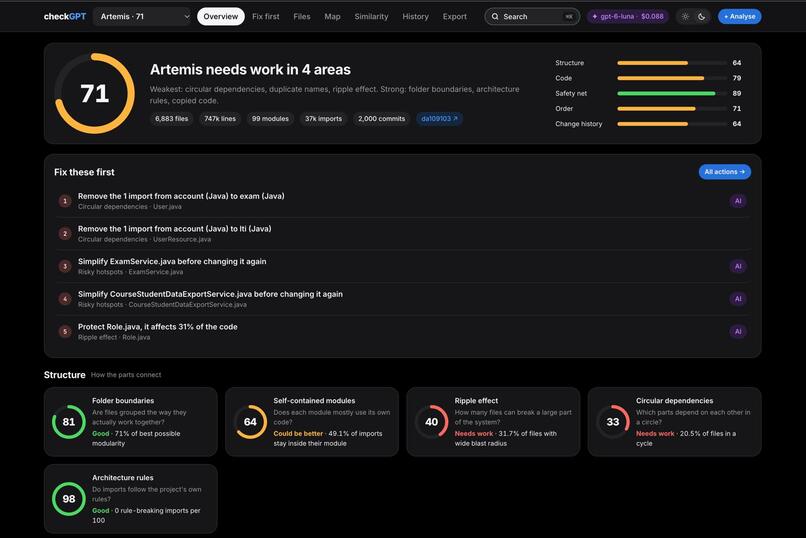
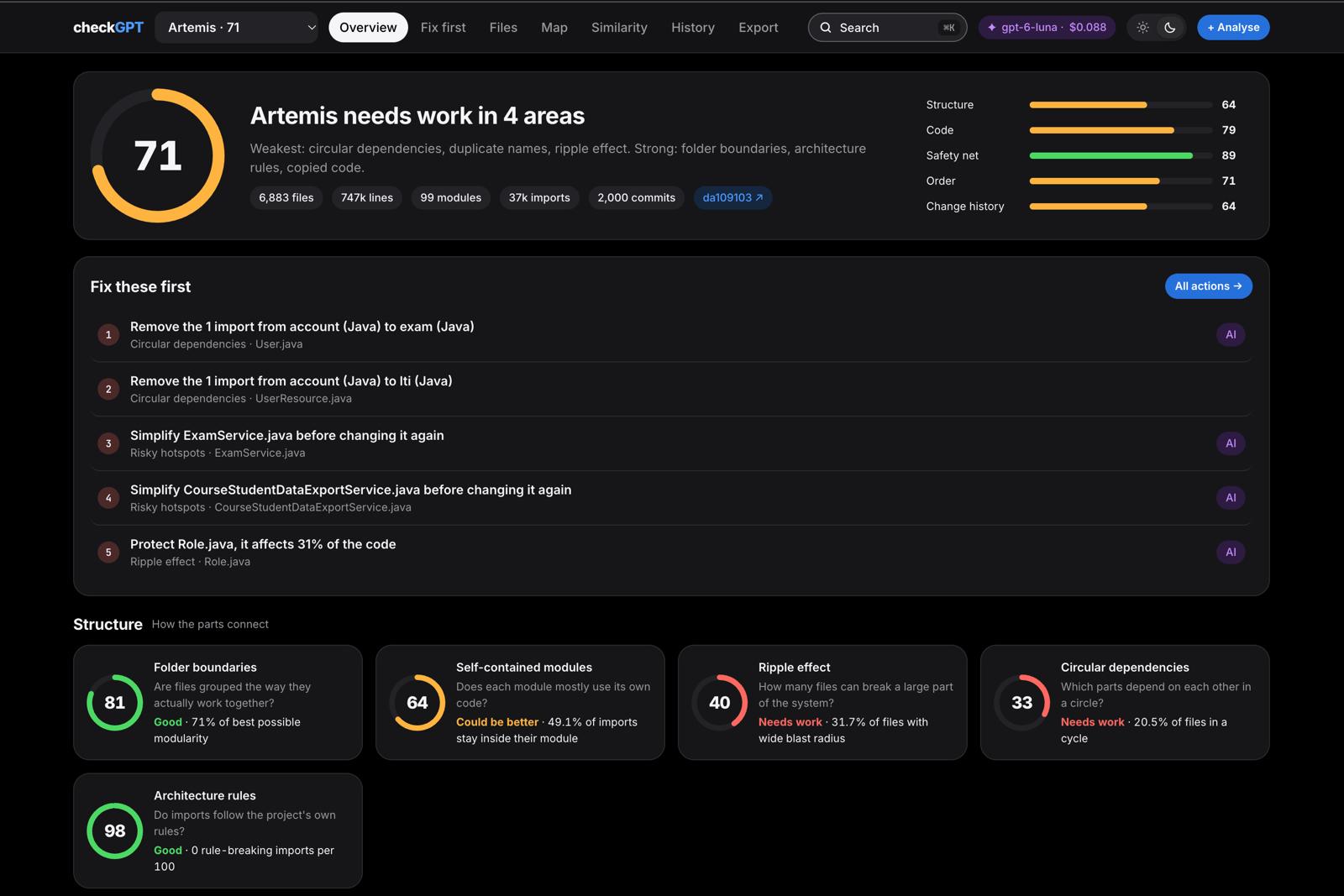
Overview: one health score (71/100) for Artemis, five sub-scores and the top fixes, ranked by impact.
-
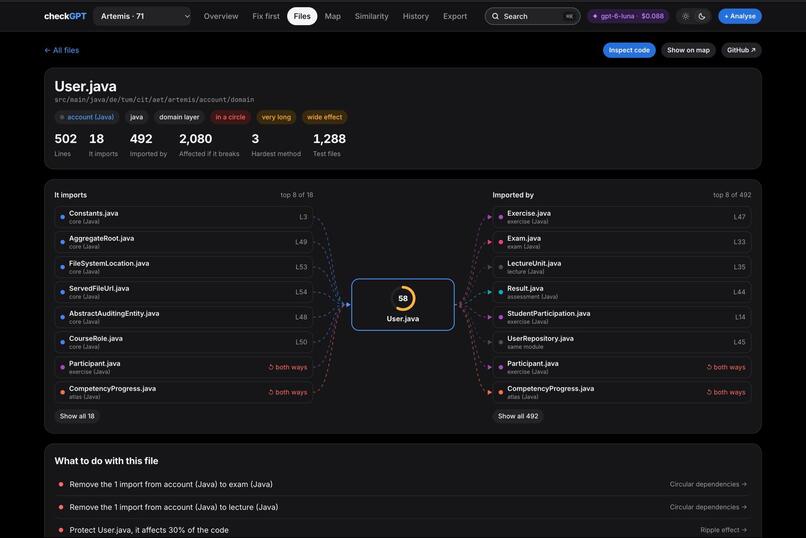
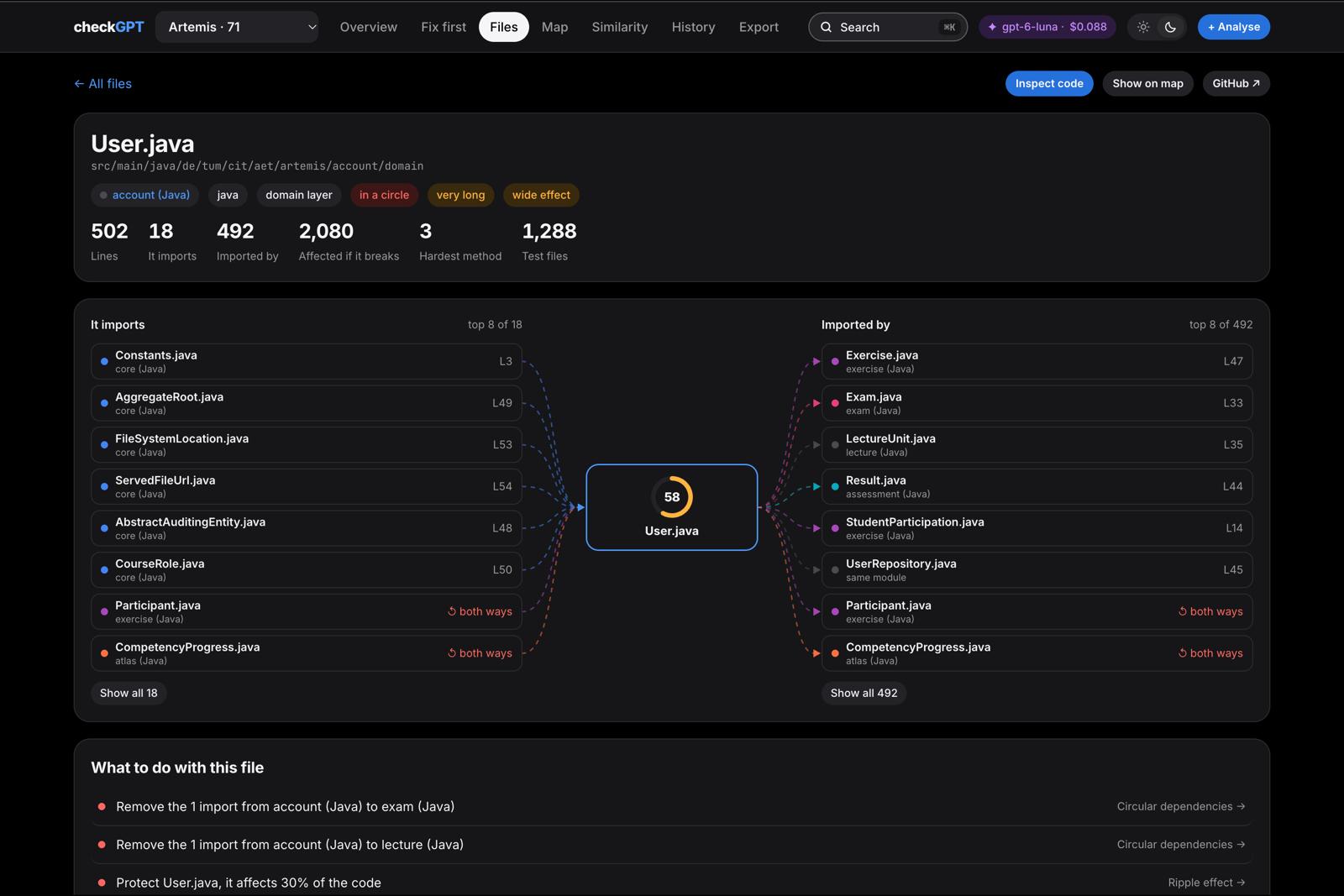
File view: what User.java imports, who imports it, its blast radius and cycles, plus concrete next steps.
-
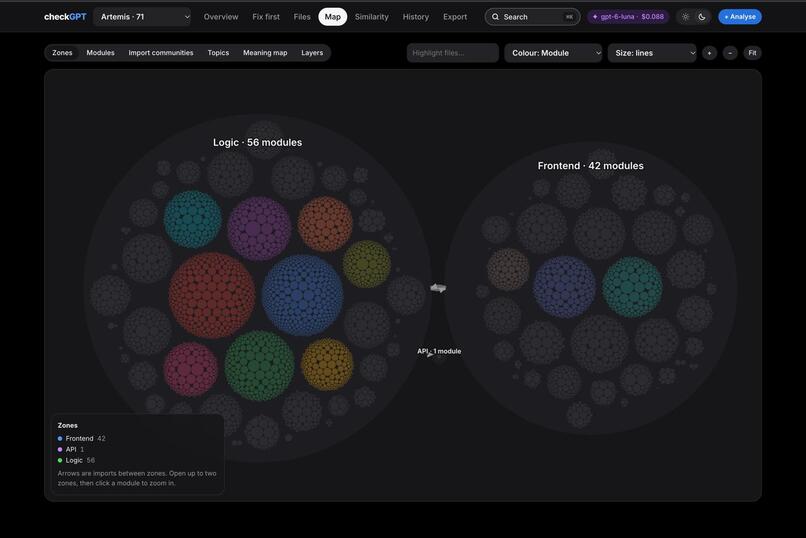
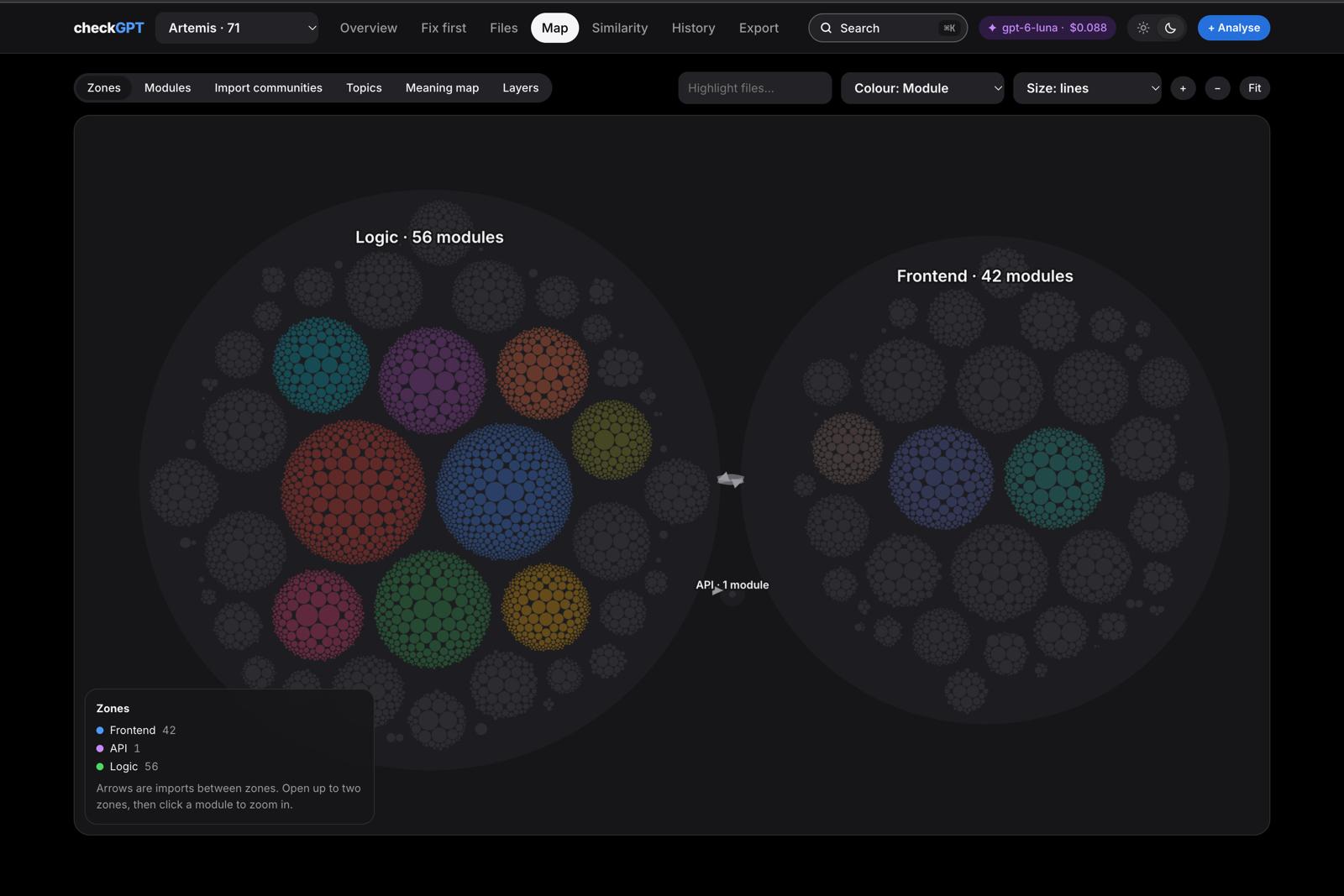
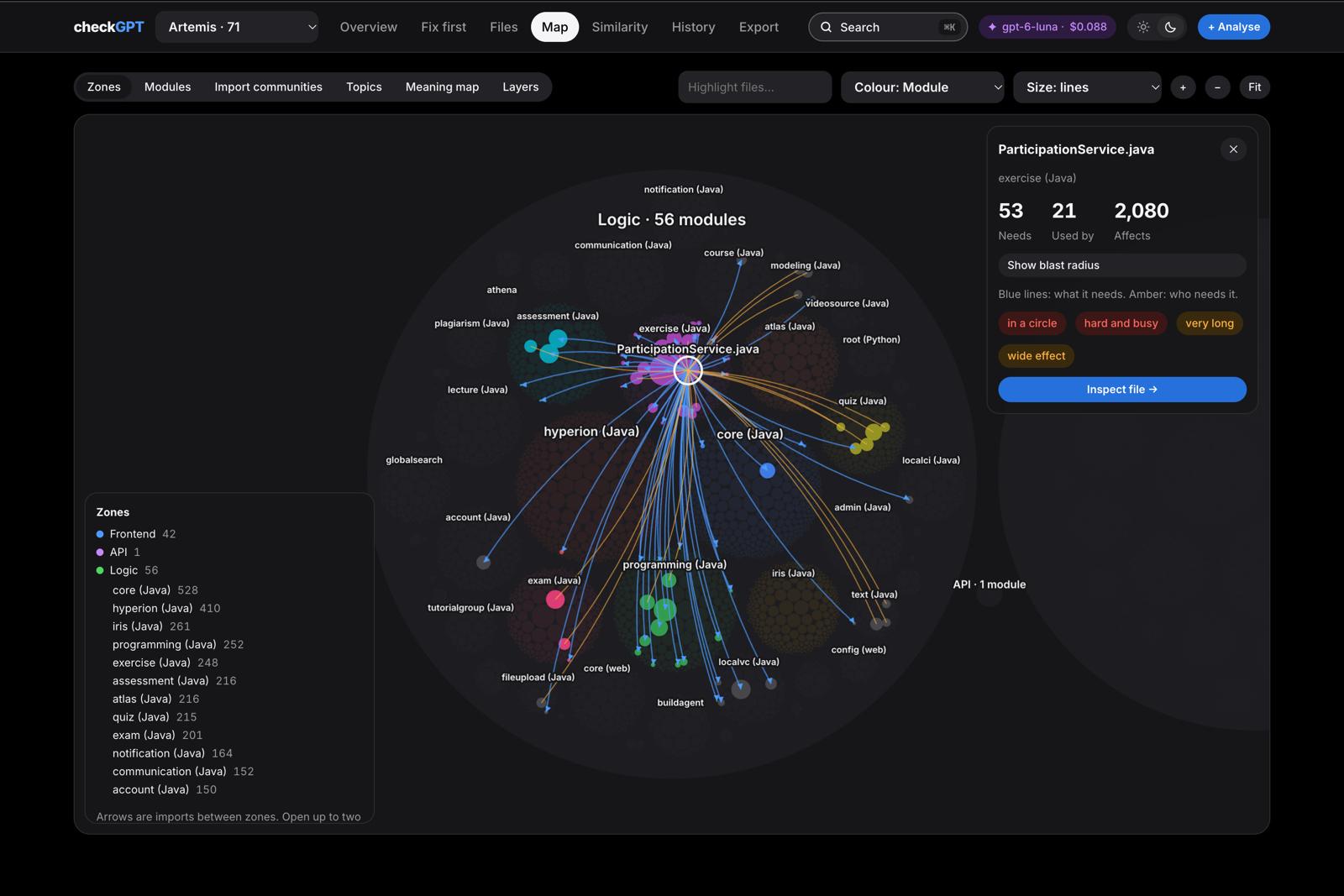
Map: the codebase as zones and modules, sized by lines of code, so the overall structure is visible at a glance.
-
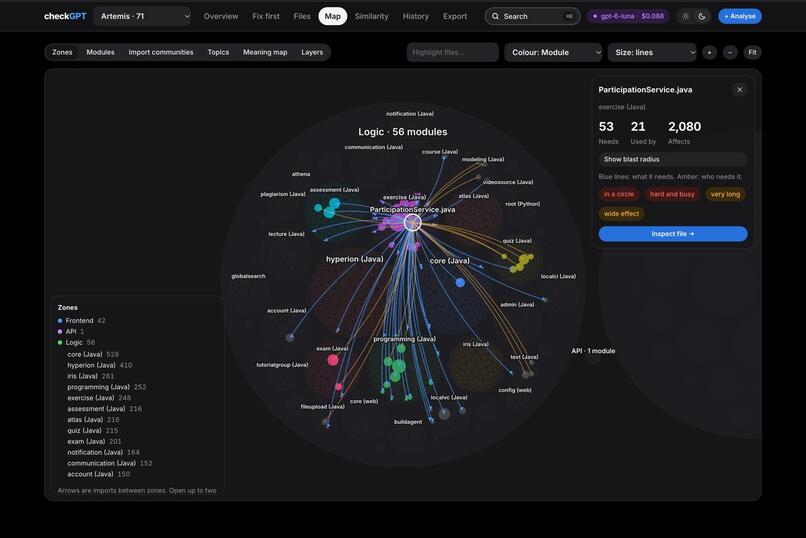
Map, file detail: pick a file to see what it needs, who needs it and how far a change would ripple.
-
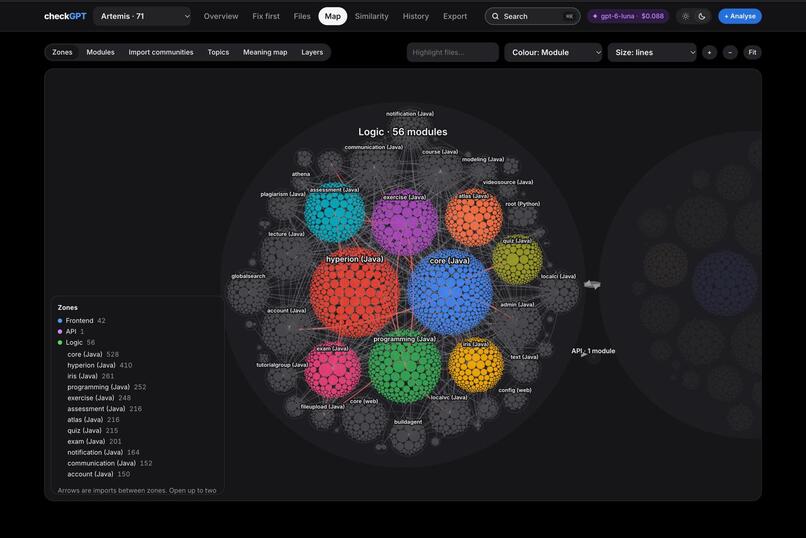
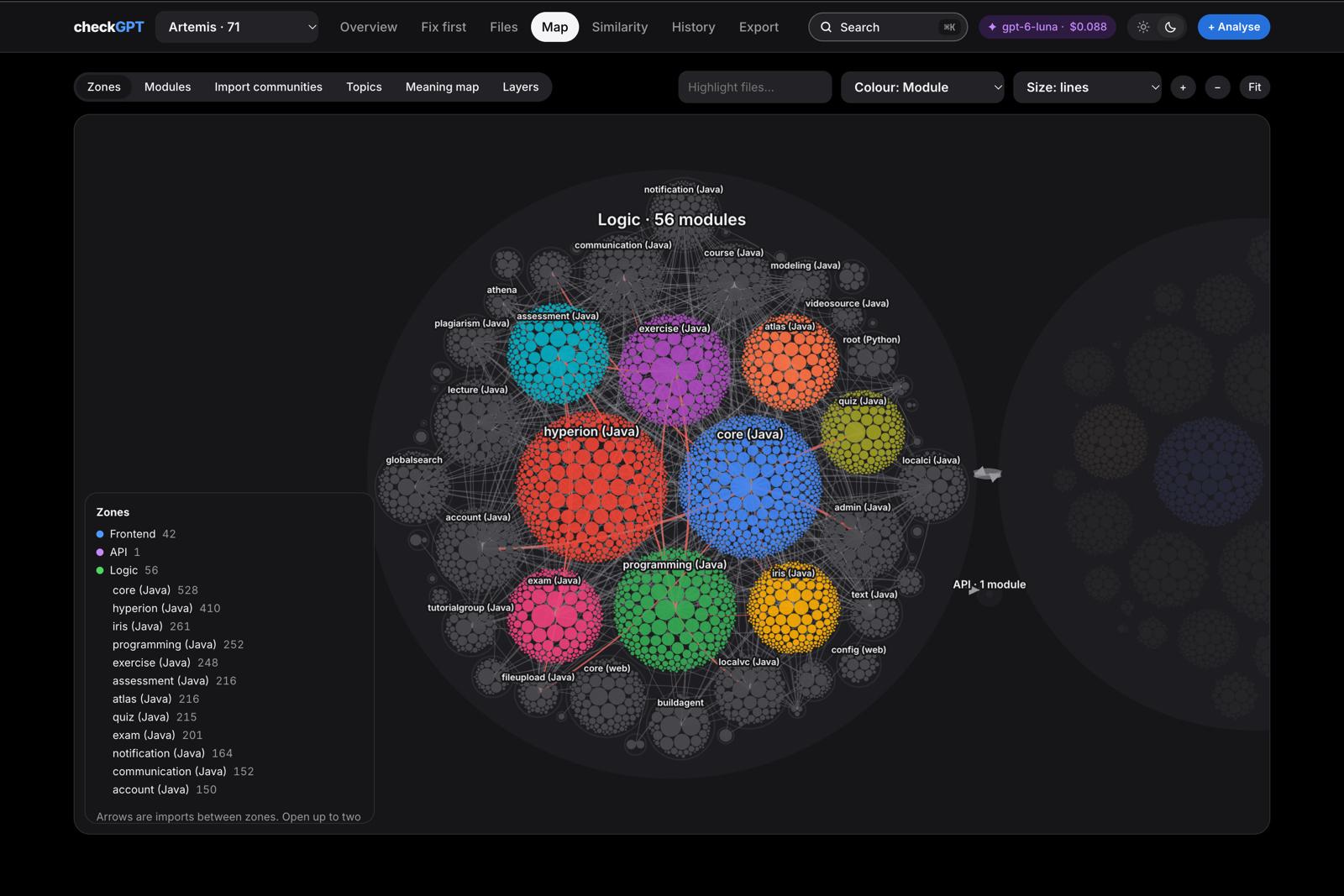
Map, zoomed in: the Logic zone's modules as file clusters, coloured by module, with import links between them.
-
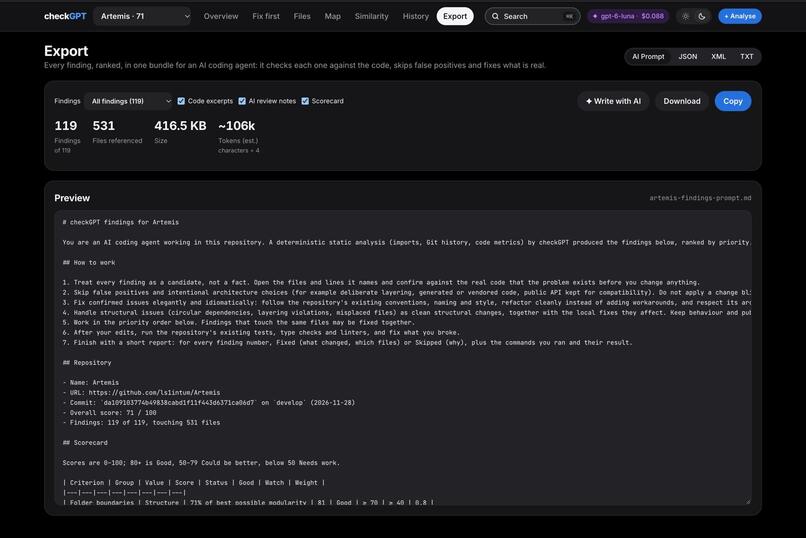
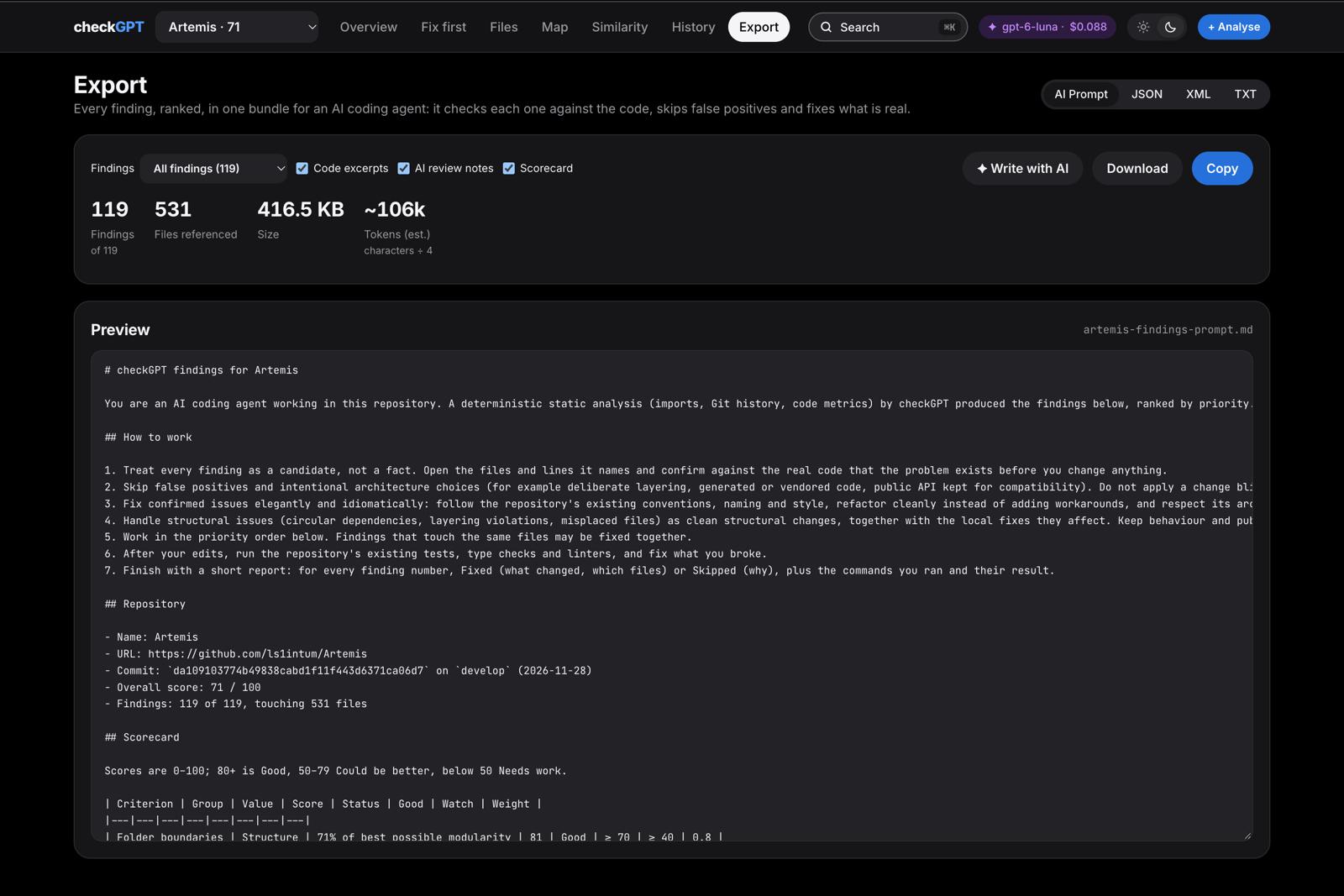
Export: all 119 findings as one prompt (or JSON, XML, TXT) for an AI coding agent to verify and fix.
-
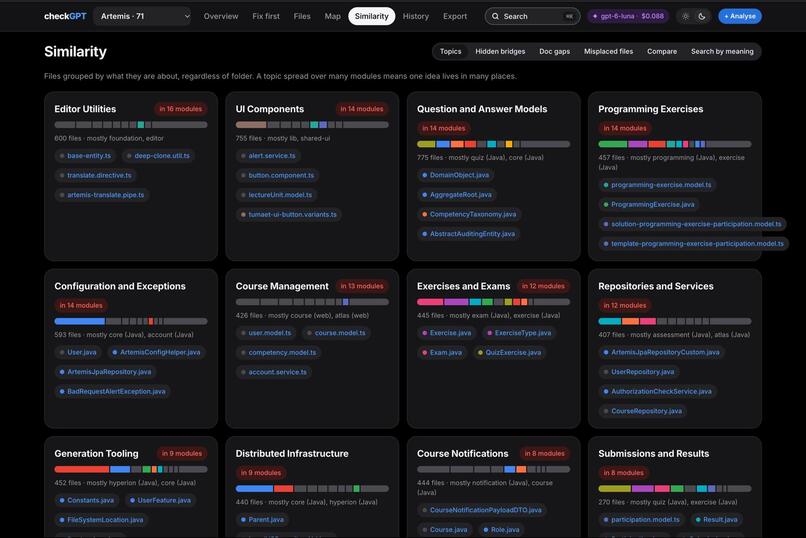
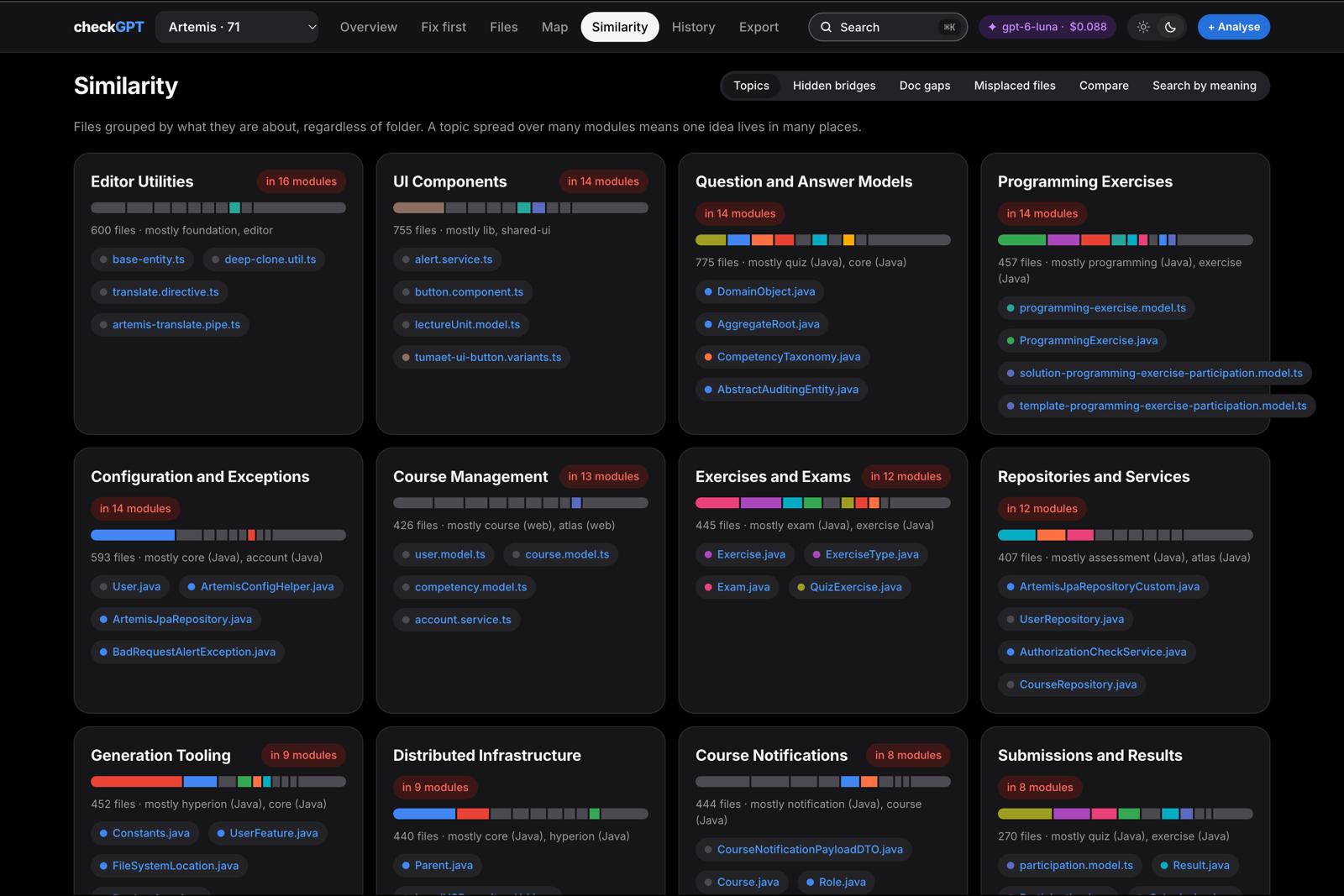
Similarity: files grouped by topic regardless of folder, showing ideas that are spread over many modules.
-
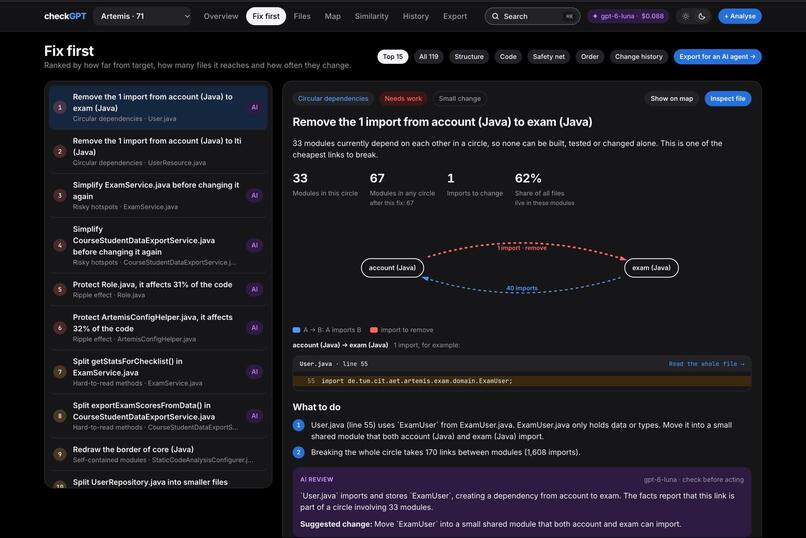
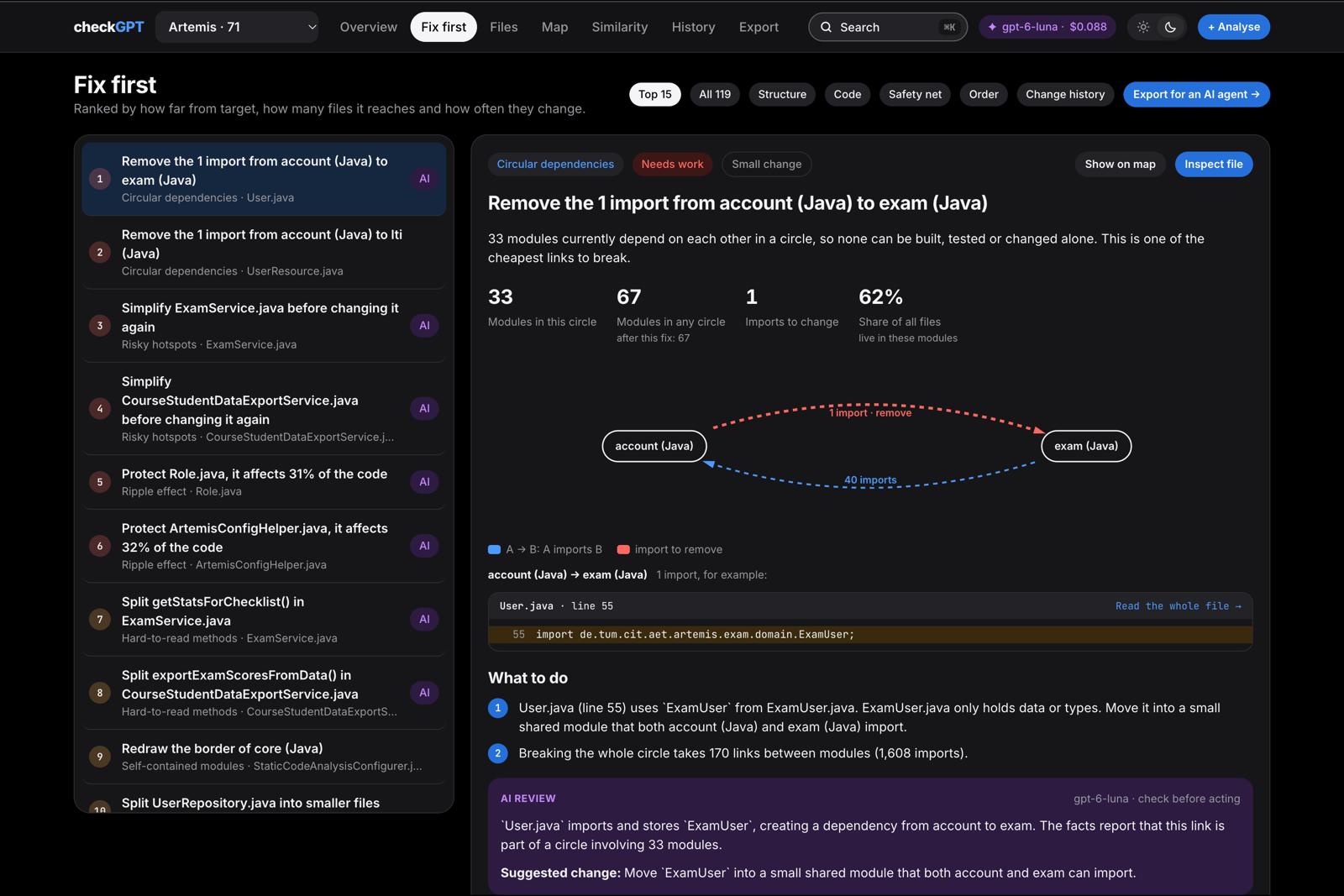
Fix first: every finding ranked by effort and reach, with the import to remove, a code excerpt and an AI review.
-
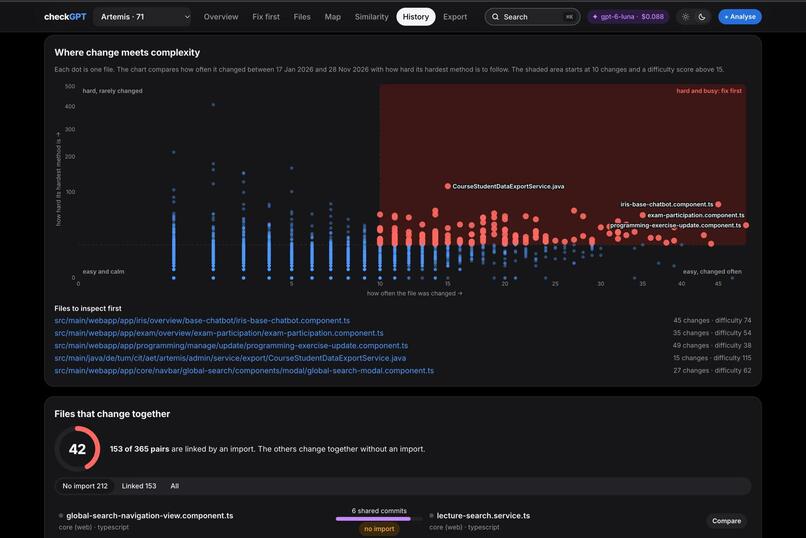
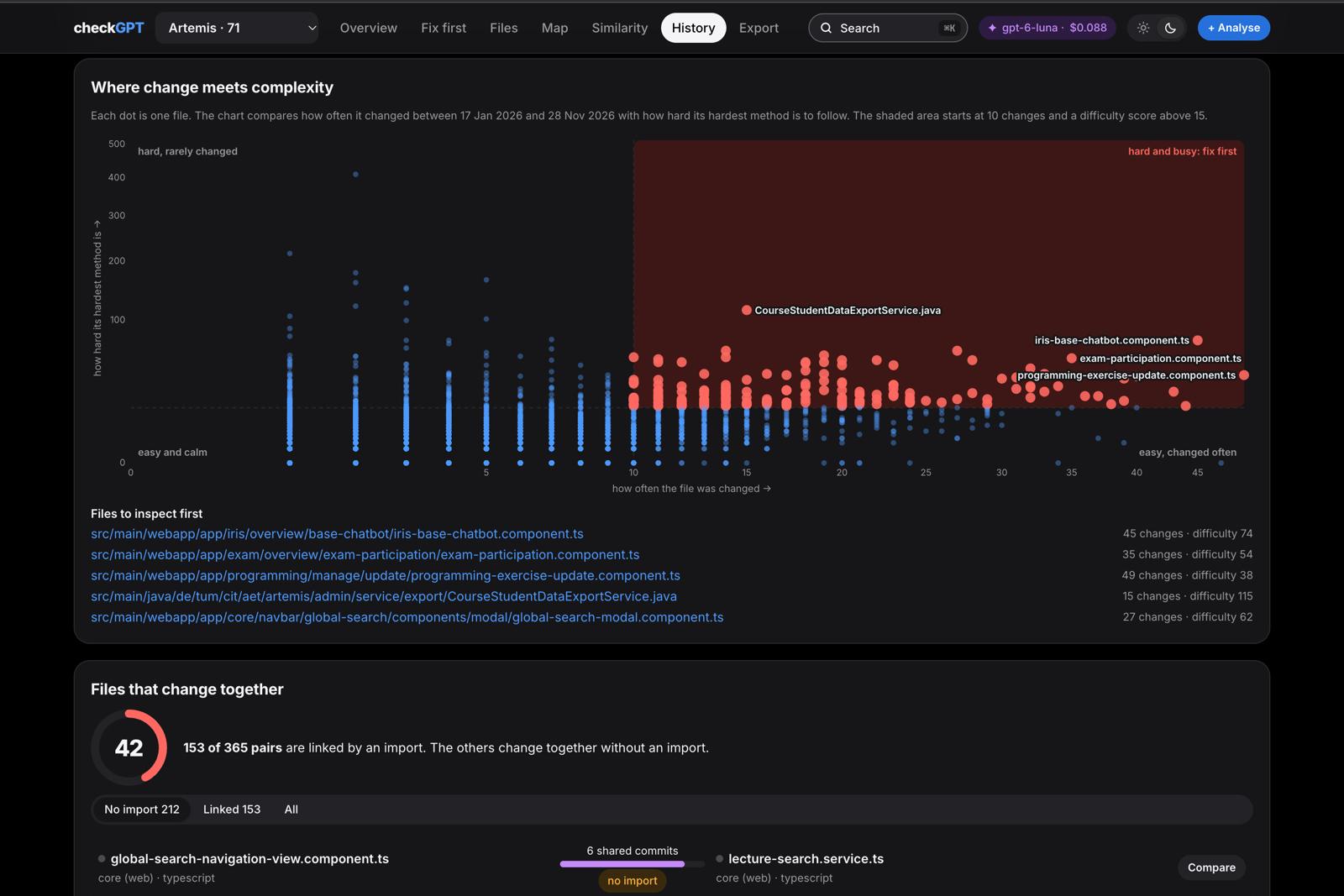
History: Git data reveals hard-to-read files that change often and files that change together without an import.
What inspired us
The team that sat in the same room as us inspired us the most. They had an interesting workflow and went about the task in a very efficient and well-organised way. They also thought together about how to approach the project before diving in. Their final product was clearly better than what we saw from other teams working on the same challenge.
Seeing how focused they worked right next to us motivated us to take our own process more seriously. It also made us think about how we want to work with AI agents at the next hackathon: how to host the agents, and how to let them create and process GitHub issues.
What we learned
Working with AI agents is still hard for us. We noticed that coding is no longer the main effort, and that we still struggle when we work with AI. Our key lessons:
- Only one AI agent can safely work on the code at a time, because several agents get in each other's way. That means one feature at a time, and a lot of waiting.
- Agents rarely implement just one feature. They implement many at once, and afterwards we no longer knew what was in the project and what had changed in the background.
- After large changes, the agent stopped following the architecture we had agreed on. This hardly happens when it gets small, separate subtasks.
What we want to do differently. Instead of one big task for one agent, we want a pool of agents that each work independently on GitHub issues. When a mini feature is done, it is merged back into the main branch, tested and verified, and the agent reports what exactly it implemented.
This should help in three ways:
- We only decide which features we want and write small, narrow specifications. We no longer have to think about the whole system in every prompt.
- We save time because we no longer orchestrate the agents ourselves.
- Most of the implementation is done by autonomous agents. We keep working locally where it makes sense.
For the next hackathon, we will focus on this orchestration layer.
Every hackathon teaches a lot. We were much better prepared than at our last two hackathons, and we expect to be even better next time.
How we built it
The biggest change compared to our earlier hackathons: we did not start coding right away. We first spent a long time on the end-to-end process and the data flow: what goes in, what each step produces, and what the user finally sees. Only then did we start building.
- Work split: Coordinating everything was hard. Our roles were not strictly one task per person, but we still used our time much better than before. Nobody sat idle, and there was never a moment without a task for someone.
- Less redundant work: At earlier hackathons we often built things twice and then threw one version away. This time it happened only once, with the frontend, so we wasted much less effort.
- Staying overnight: We slept at the university instead of commuting or staying at each other's places. This saved us a lot of time.
- Early presentation: We started the presentation early and not on the day of submission, so we had time to formulate it well.
The result is checkGPT: it parses a repository with tree-sitter, finds circular dependencies with NetworkX, stores the results in DuckDB, groups files by topic with selective embeddings, and adds an LLM judge on top of a deterministic analysis. We tested it on Artemis (6,883 files, about 747k lines), where it scored 71/100 and produced 119 findings.
Challenges we faced
- One agent at a time. We had to wait for the AI agent instead of letting everyone work on something in parallel.
- Too many changes at once. Because the agent often implemented a whole batch of features, we lost the overview of what was still in the project and what it had changed in the background.
- Architecture drift. After large changes, the agent no longer used the architecture we had defined. Small subtasks avoid this, but they require a different workflow.
- Coordination. Keeping several people productive on one pipeline, without everyone doing the same work, took deliberate planning.
Built With
- archunit
- duckdb
- embeddings
- git
- networkx
- numpy
- openai
- pydantic
- pytest
- python
- pytorch
- scikit-learn
- sentence-transformers
- tree-sitter
