Inspiration Our inspiration for Check-in Relay came from a simple but important concern: how can families stay connected with elderly members who live alone? When children or other family members move to different cities for work or education, checking on their loved ones every day can become difficult. We wanted to explore how AI assistants could help address this problem through simple, meaningful interactions. This led us to the idea of creating a system that makes daily check-ins easier and helps families stay informed, even when they are physically far apart.
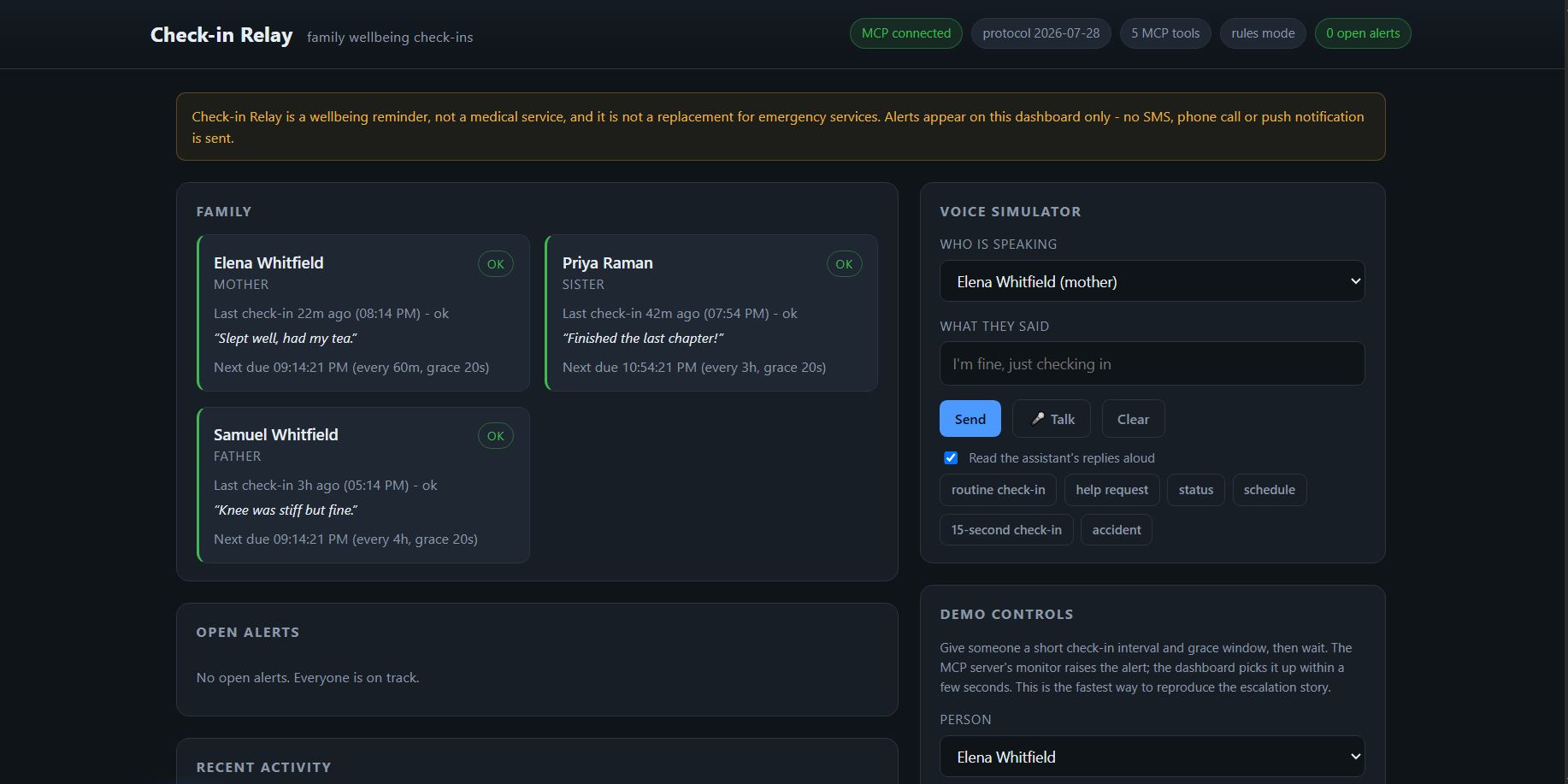
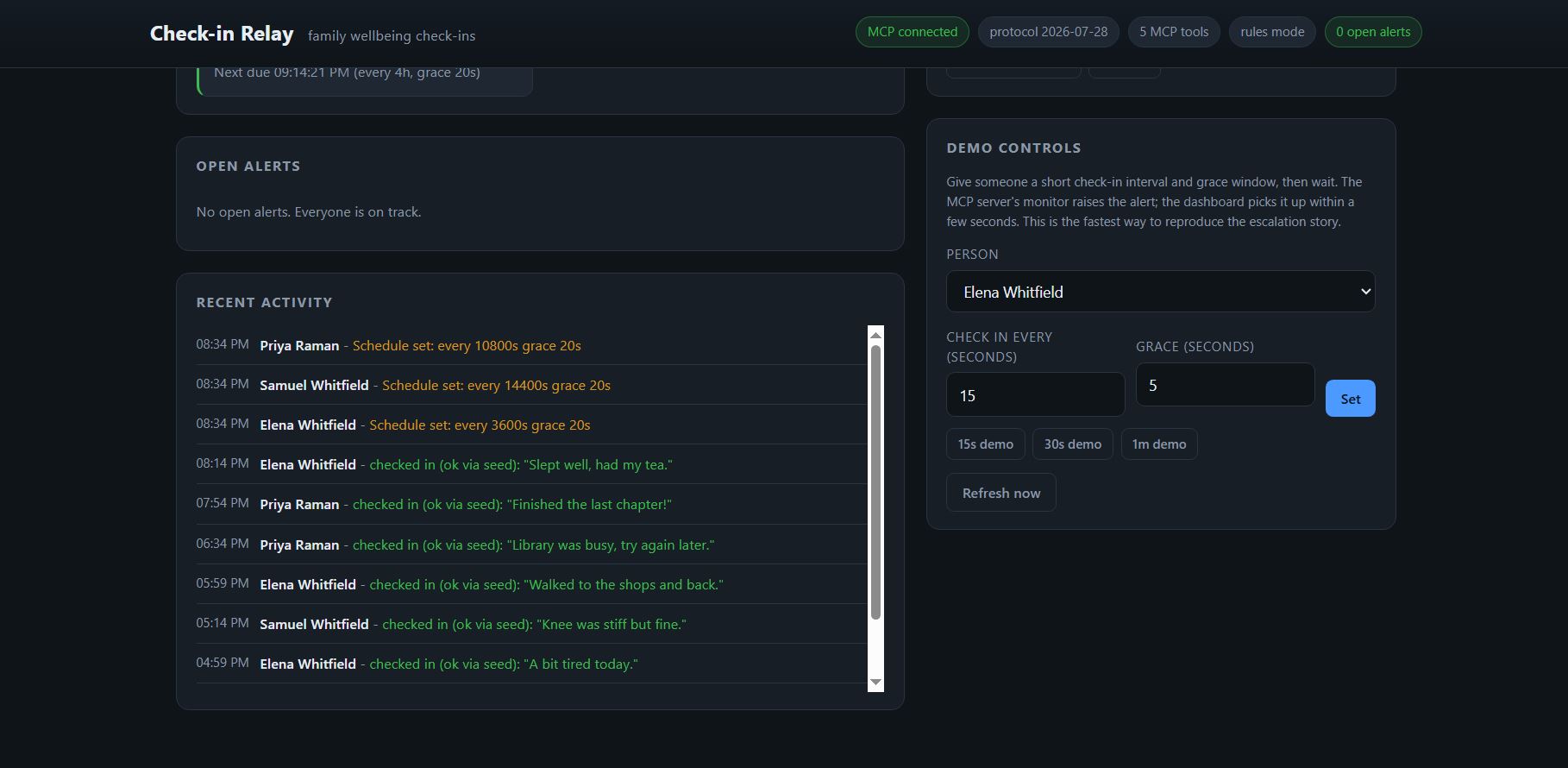
Check-in Relay is an AI-assistant-based daily check-in and alert system designed to support elderly people living alone. The assistant allows users to report how they are feeling through simple interactions, such as saying, "I'm fine today." The system records their check-ins and displays their status on a dashboard that designated family members can access. If a scheduled check-in is missed or a user requests help, the system can trigger an alert so that someone can follow up. Our goal is to make everyday communication easier and provide families with an additional layer of reassurance.
How We Built It
We are designing Check-in Relay around an Alexa+-style assistant experience connected to a backend through the Model Context Protocol (MCP). The planned architecture uses Python for backend logic, SQLite for storing check-in information, and a web-based interface for the assistant simulation and family dashboard. The MCP server exposes tools for recording check-ins, retrieving status, scheduling check-ins, and triggering alerts. These components work together to demonstrate how an AI assistant can go beyond conversation and interact with tools to perform useful tasks. Our approach focuses on building a simple, functional prototype that we can improve incrementally
One of our main challenges was identifying a project that would be both meaningful and achievable within the hackathon's limited timeframe. We needed to balance our interest in AI technologies with the practical requirements of building and demonstrating a working application. Another challenge is understanding how to connect the assistant experience, MCP tools, database, and dashboard into a single workflow. We also need to ensure that missed check-ins and requests for help are handled clearly and that the system does not treat a missed response as automatic proof of an emergency. These challenges are guiding us toward a focused design and a realistic implementation plan.
Accomplishments That We're Proud Of
We are proud to have identified a real-world problem and developed an idea that connects AI technology with a meaningful human need. Rather than focusing only on a conversational chatbot, we want to demonstrate how an assistant can interact with tools, maintain useful records, and initiate an appropriate follow-up when needed. We have also broken the concept into manageable components, including the assistant interface, backend, database, MCP server, and family dashboard. This gives our team a clear direction for collaborating, learning, and developing a practical prototype
We are designing Check-in Relay around an Alexa+-style assistant experience connected to a backend through the Model Context Protocol (MCP). The planned architecture uses Python for backend logic, SQLite for storing check-in information, and a web-based interface for the assistant simulation and family dashboard. The MCP server exposes tools for recording check-ins, retrieving status, scheduling check-ins, and triggering alerts. These components work together to demonstrate how an AI assistant can go beyond conversation and interact with tools to perform useful tasks. Our approach focuses on building a simple, functional prototype that we can improve incrementally.
What's Next for Check-in Relay?
Our next step is to build and test the core workflow: recording a daily check-in, updating the family dashboard, and triggering an alert when a scheduled check-in is missed or someone requests help. Once this basic version works reliably, we would like to improve the assistant's conversational experience, introduce configurable check-in schedules, and explore more reliable notification methods for family members. We also want to strengthen privacy protections and make the interface accessible to older adults. Our long-term vision is to make Check-in Relay a simple, thoughtful way to help families stay connected across distances.

Log in or sign up for Devpost to join the conversation.