-
-
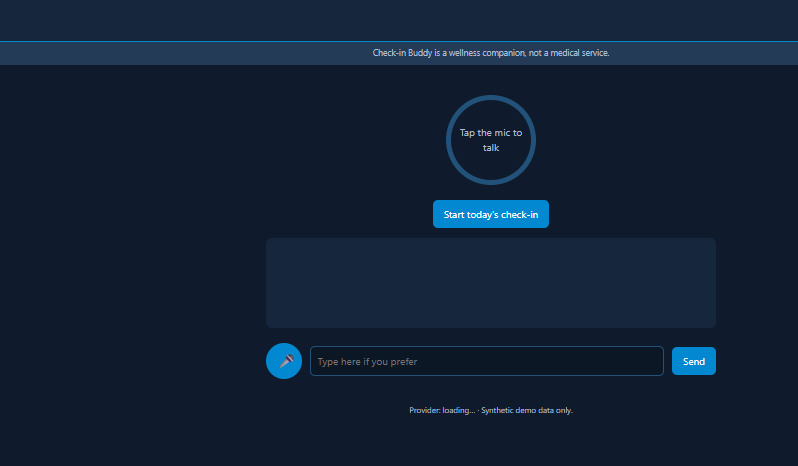
Senior Dashboard
-
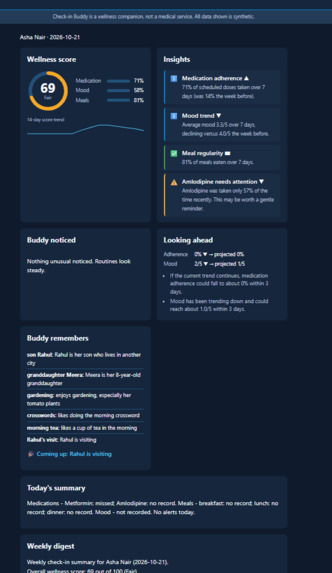
Family Dashboard
Inspiration
Many older adults live alone, and their families live far away. The worry is rarely about big emergencies. It's the small things: a missed pill, a skipped meal, a quieter voice than usual. Reminder apps depend on screens and rigid schedules, and a phone call every day isn't always possible.
Voice is the most natural interface for this group, and Alexa+ style assistants can now hold real conversations, remember context and take actions. We wanted to see whether that could become a gentle daily check-in that gives families peace of mind without being intrusive.
What it does
Check-in Buddy is a simulated Alexa+ experience in a web app. It:
- Holds a short daily voice conversation with an older adult about medication, meals, mood and activity
- Remembers previous days and refers to them naturally
- Takes actions through tools: logging medication, meals and mood, setting reminders, and notifying family
- Applies escalation rules, such as a missed medication two days in a row, so families get alerts only when they matter
- Shows a family dashboard with daily summaries, trends and alert history
It is a wellness check-in tool, not a medical device. It never diagnoses or gives medical advice, and it points users to a professional or family member when health questions come up. All demo data is synthetic.
How we built it
- Frontend: [HTML/JS or React] with the browser Web Speech API for voice input and spoken replies
- Backend: Python with FastAPI
- AI: [Amazon Bedrock ] with tool calling for medication logging, reminders and family notifications
- Memory and data: SQLite for daily logs and conversation history
- Escalation engine: rule-based checks that run over the logged data
- Evaluation: a suite of [50%] scripted conversation scenarios run through pytest, measuring correct tool use, escalation accuracy and safety behavior
Challenges we ran into
- Making speech recognition reliable enough for a smooth conversation, and what the text fallback looked like
- Getting the model to call tools consistently, and how structured outputs or retries fixed it
- Tuning escalation so it catches real concerns without false alarms
- Keeping the assistant from drifting into medical advice
Accomplishments that we're proud of
- A working end-to-end flow from voice check-in to family alert
- An evaluation suite of [10+] scenarios, with a measured [90%] pass rate on tool calls and [80%] on escalation accuracy
- A fully open-source repository that someone can run in under minutes
- Safety behavior that held up across adversarial test cases
What we learned Will be answered after the Tool comes in execution :
- Why evaluation matters as much as the demo for AI systems
- How memory changes a conversation from scripted to personal
- Designing for older adults: pacing, simple language and patience
- Where the line sits between helpful check-ins and overstepping into medical territory
What's next for Check-in Buddy
- Real Alexa+ integration if and when an appropriate path becomes available
- Multilingual support, starting with Hindi and Kannada
- Richer signals, such as changes in speech patterns or routine, with the user's consent
- Caregiver customization: choosing which alerts they receive and how
- A formal review of privacy, consent and safety with geriatric care and accessibility experts before any real-world use

Log in or sign up for Devpost to join the conversation.