-
-
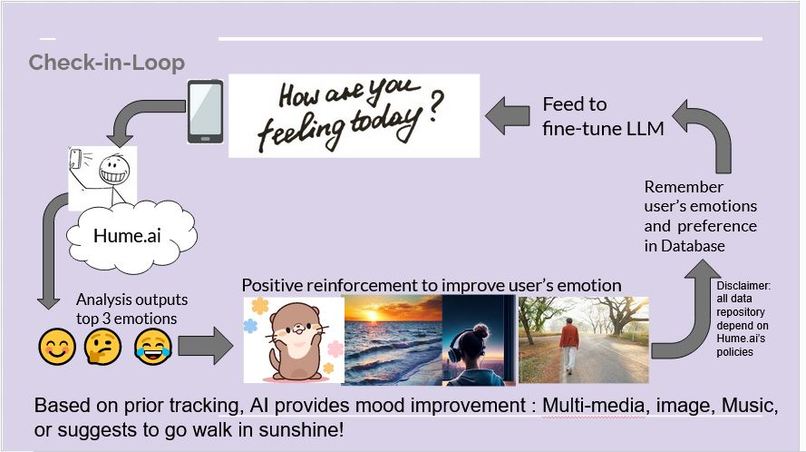
Loop for Check-in-buddy app
Final ppt called 324 Check in buddy: https://docs.google.com/presentation/d/15iNeIBGk3ZXf8Ee4bulxCXELPub8JRSIsFDrc7y0rB0/edit?usp=sharing
Git hub repo: https://github.com/MajelAi/check-in-buddy/tree/main
Inspiration
In today's fast-paced world, mental health often takes a backseat to productivity and daily responsibilities. The inspiration for Check-In-Buddy stemmed from observing the increasing number of people struggling to maintain a healthy work-life balance and the rising rates of mental health issues globally. We realized that while many tools help optimize productivity, few focus on the emotional well-being that is crucial to sustaining it. Our goal was to create an AI that not only understands but also nurtures the emotional states of its users, helping them achieve a more balanced and fulfilling life.
What it does
Check-In-Buddy is a life balance AI that monitors users' emotional states through their interactions. It analyzes text inputs using advanced sentiment analysis to gauge emotions and generates comprehensive reports. These reports help users understand their emotional trends over time, providing insights into how their feelings fluctuate in relation to their daily activities and schedules. The AI also offers suggestions and tips to improve emotional well-being and achieve a healthier work-life balance.
How we built it
We built Check-In-Buddy using Python for the backend development and React for the frontend interface. TensorFlow, along with NLP libraries like NLTK and spaCy, was employed to analyze and interpret user inputs. A custom-trained model on a diverse dataset of emotional texts was developed to accurately identify the user's current mood. The frontend was designed to be user-friendly, with a focus on simplicity and accessibility, allowing users to easily navigate through the application and understand their emotional reports.
Challenges we ran into
The project faced several challenges, including achieving accurate emotion detection, which is crucial for the core functionality of Check-In-Buddy. Emotional analysis is inherently subjective, and training a model to understand nuances in text required continuous refinement of our algorithms and expansion of our datasets. Additionally, ensuring user privacy and data security was paramount, given the sensitive nature of the data being handled. We implemented robust security measures to protect user data. Lastly, developing an "empathetic" AI that could interact with users in a caring and understanding manner was a complex aspect that needed meticulous attention.
Accomplishments that we're proud of
We are particularly proud of developing an AI that can genuinely help users manage their emotional well-being. The accuracy of our emotion detection model and the positive feedback from early users about the effectiveness of the emotional insights and recommendations stand out as significant accomplishments. Moreover, maintaining high standards for data security and user privacy from the outset has set a strong foundation for user trust and application integrity.
What we learned
Throughout the development of Check-In-Buddy, we learned a great deal about natural language processing, machine learning, data visualization, and the importance of empathy in technology. The technical skills acquired were substantial, but the insights into how technology can be used to support mental health were even more impactful. This project has also enhanced our understanding of the complexities involved in creating emotionally intelligent systems.
What's next for Check-In Buddy
Moving forward, we plan to expand Check-In-Buddy's capabilities to include voice recognition for more natural user interactions. We also aim to integrate machine learning models that can predict potential emotional declines, allowing for proactive mental health support. Additionally, expanding our user base and refining our algorithms with more diverse data will continue to be a priority. We are excited about the future of Check-In-Buddy and its potential to make a significant difference in the lives of its users.


Log in or sign up for Devpost to join the conversation.