Inspiration
The idea for CheatGuard AI came from observing how traditional CCTV systems are used during examinations. Even though cameras are installed, invigilators still struggle to manually monitor hundreds of students at once. In large classrooms with 300–500 students, it becomes nearly impossible to identify small cheating behaviors like side glances, paper passing, or hidden gestures.
This inspired us to build a smart AI-based solution that does not just record video, but actively analyzes and detects suspicious behavior in real time.
What it does
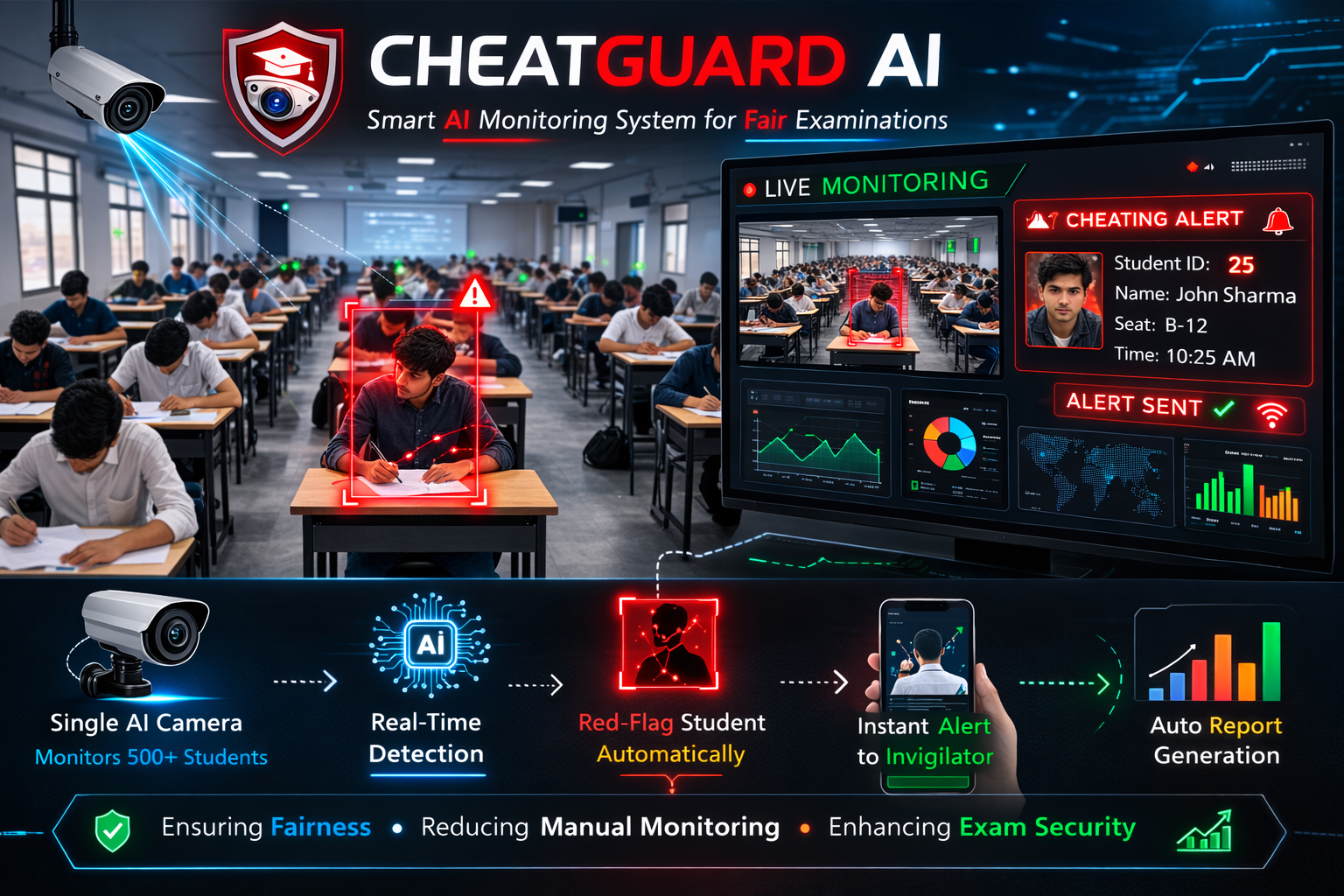
CheatGuard AI is an intelligent exam monitoring system that uses a single smart camera to automatically detect cheating in real time. Instead of just recording video like traditional CCTV, the system actively analyzes student behavior.
It:
Monitors up to 500 students simultaneously
Detects suspicious head movements, repeated side glances, and unusual hand gestures
Identifies the exact student involved
Highlights the student with a red bounding box on screen
Sends instant alerts to the invigilator via a connected dashboard or mobile app
Generates automated reports for review
The goal is to reduce manual monitoring effort and improve exam fairness.
How we built it
🛠️ How We Built It
CheatGuard AI combines Computer Vision, Deep Learning, and Real-Time Processing.
A high-resolution camera captures live video feed.
Each frame is processed using object detection models (e.g., YOLO / CNN-based models).
Face detection and tracking identify and monitor individual students.
Behavioral metrics such as head angle and gaze direction are analyzed.
For example, head tilt angle can be calculated as:
𝜃
tan − 1 ( 𝑦 2 − 𝑦 1 𝑥 2 − 𝑥 1 ) θ=tan −1 ( x 2
−x 1
y 2
−y 1
)
If abnormal behavior exceeds a threshold probability:
𝑃 ( suspicious )
𝛼 P(suspicious)>α
the system flags the student and triggers an alert instantly.
This architecture ensures fast, scalable, and intelligent exam surveillance. Challenges We Ran Into
Monitoring 500 students using a single camera.
Reducing false positives from normal movements.
Maintaining real-time processing speed without lag.
Ensuring ethical and privacy considerations.
Accomplishments That We're Proud Of
Successfully designed a single-camera AI monitoring concept.
Real-time red-flag detection system.
Automated alert and reporting mechanism.
Scalable architecture for large classrooms.
What we learned
AI accuracy depends heavily on training data quality.
Real-time systems require performance optimization.
Behavioral detection is more complex than object detection.
What's next for CheatGuard AI
Improve model accuracy with larger datasets.
Add multi-angle smart tracking.
Integrate face recognition database securely.
Deploy pilot testing in real classrooms.
Built With
- amazon-web-services
- analysis
- and
- deep
- detection
- docker
- face
- firebase
- frame
- head
- image
- learning
- look
- mediapipe
- model
- mongodb
- movement
- object
- only
- opencv
- postgresql
- processing
- programming
- pytorch
- real-time
- tensorflow
- training
- video
- yolo

Log in or sign up for Devpost to join the conversation.