Try it: live demo · shopper replay · merchant dashboard · API docs · code (MIT). Payments run in the PayPal sandbox; check out with any sandbox personal account.
Built with PayPal (Orders v2, JS SDK, Pay Later messaging, signature-verified webhooks) and AI (calibrated intent and uplift models, SHAP explanations, Gemini summaries and a merchant copilot).
Inspiration
About 70% of online carts are abandoned, and the top reason shoppers give is extra costs (Baymard Institute). Most merchants respond with a blanket discount. That gives margin away to people who would have paid full price, and it treats price as the only lever. Often a hesitant shopper needs something much cheaper for the merchant: seeing they can split the payment, free shipping, or a small add-on.
What it does
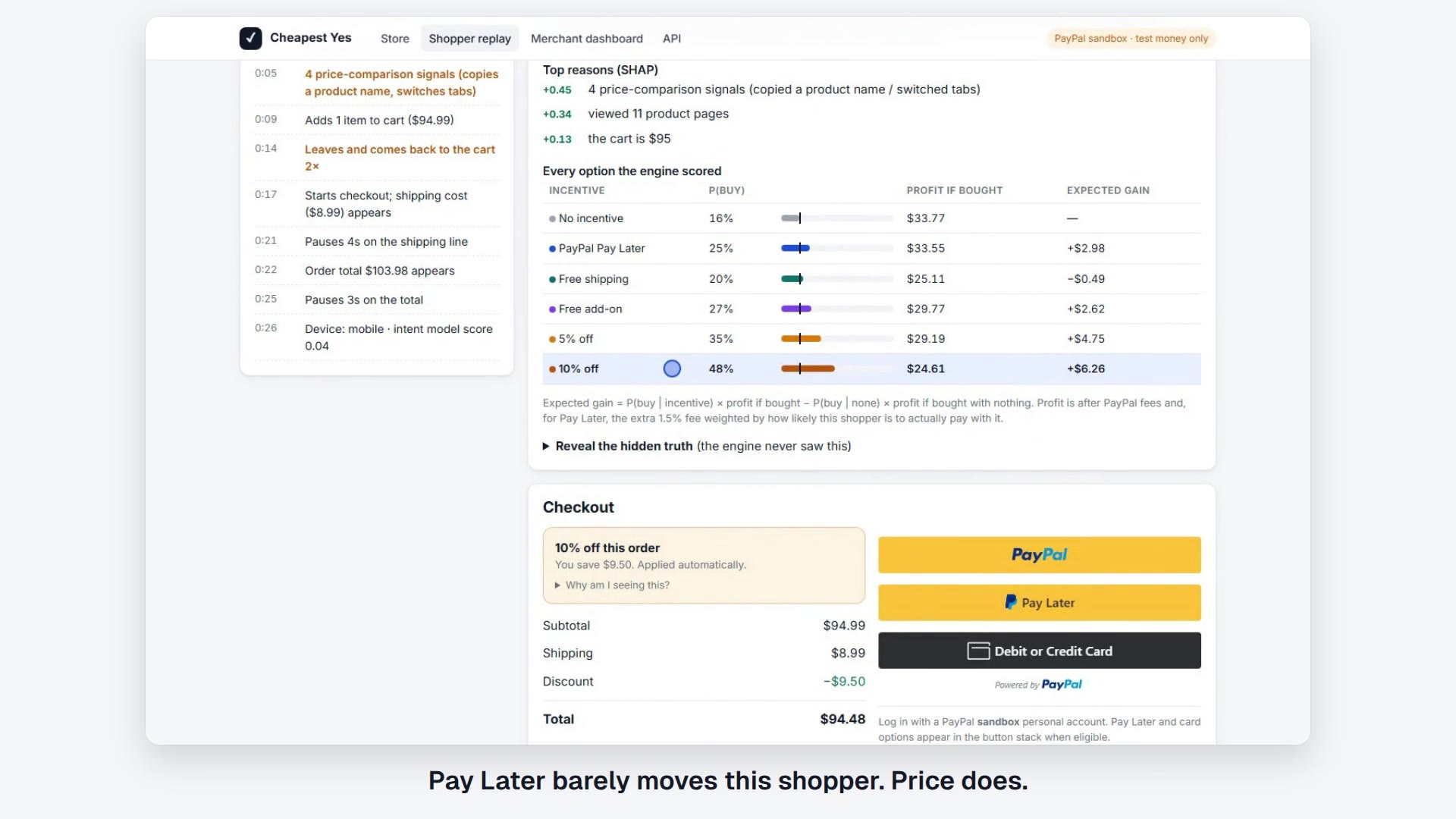
At checkout, Cheapest Yes looks at session behaviour only: cart size, time on page, returns to the cart, price-comparison signals, and pauses after the shipping cost and the total appear. No demographics, no location. It then picks one incentive, or none, to maximise the merchant's expected profit after incentive cost:
- PayPal Pay Later messaging with the exact instalment amounts for this cart
- free shipping
- a free add-on
- 5% or 10% off, as a last resort
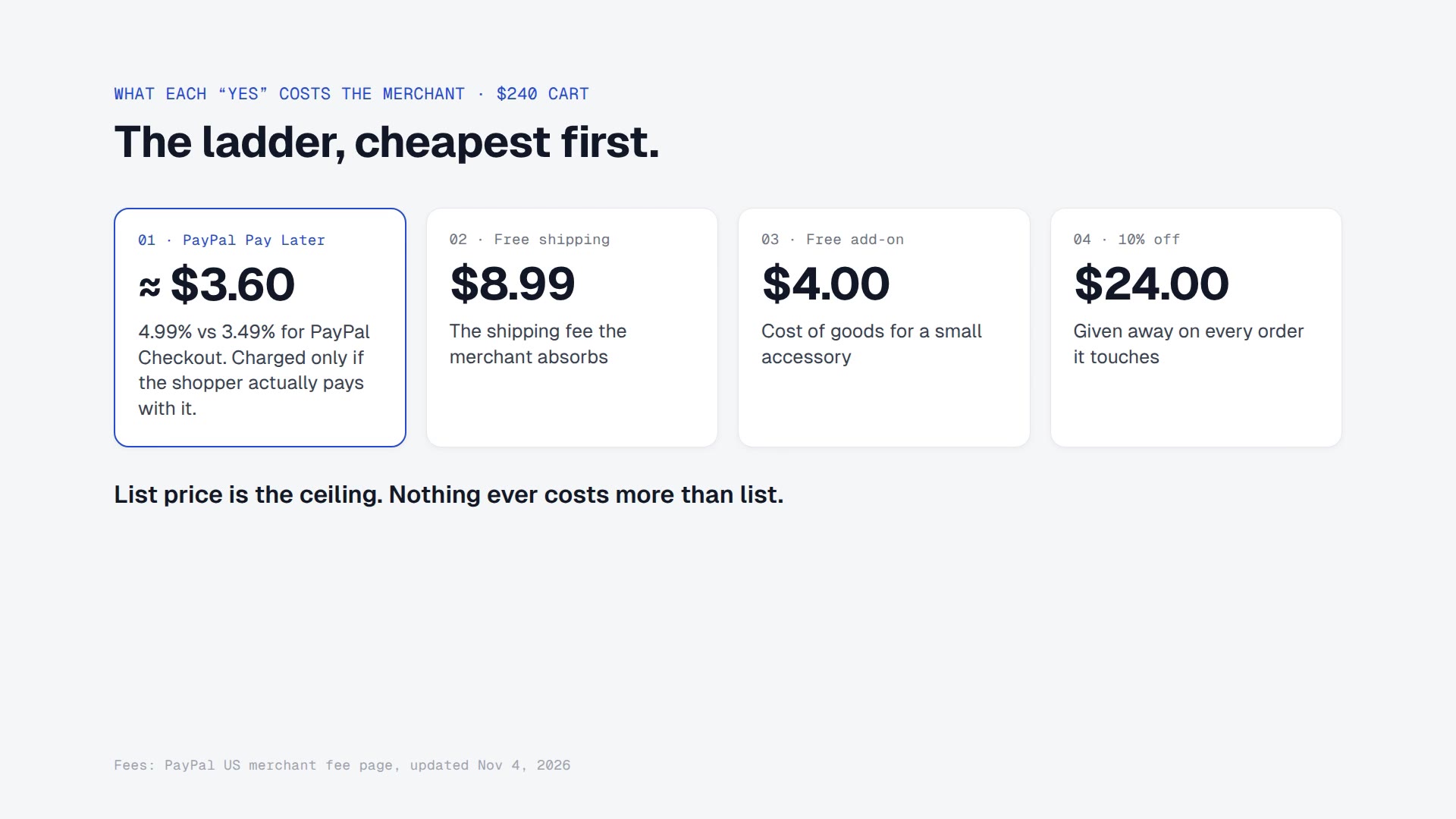
List price is the ceiling. Nobody ever pays more than list price. It's enforced in code and covered by tests.
Three ways to try it:
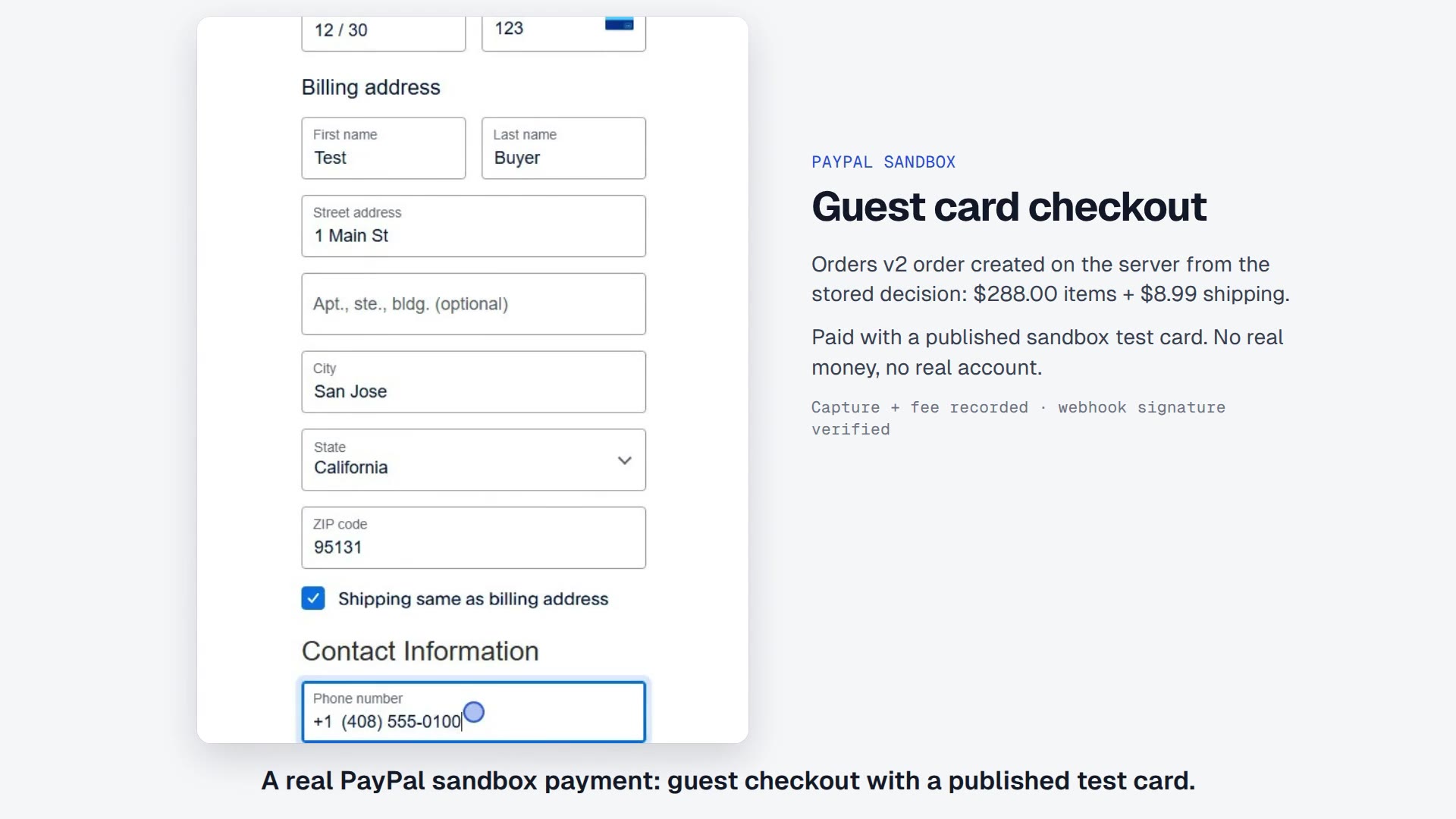
- Demo store: real products from Channel3; check out with PayPal in the sandbox.
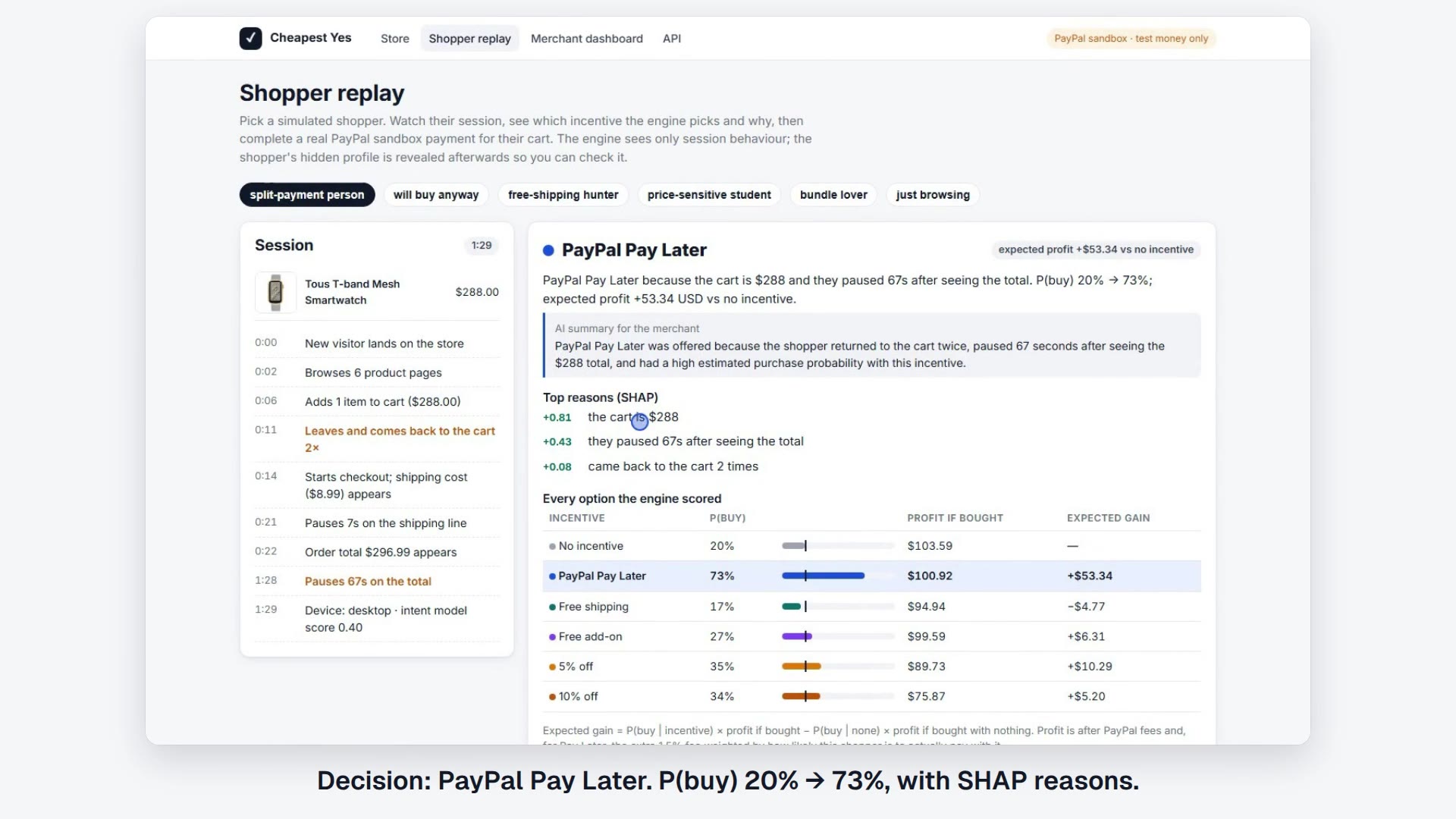
- Shopper replay: pick a simulated shopper ("split-payment person", "will buy anyway", "price-sensitive student"…), watch their session, see the decision with its reasons, and pay with PayPal.
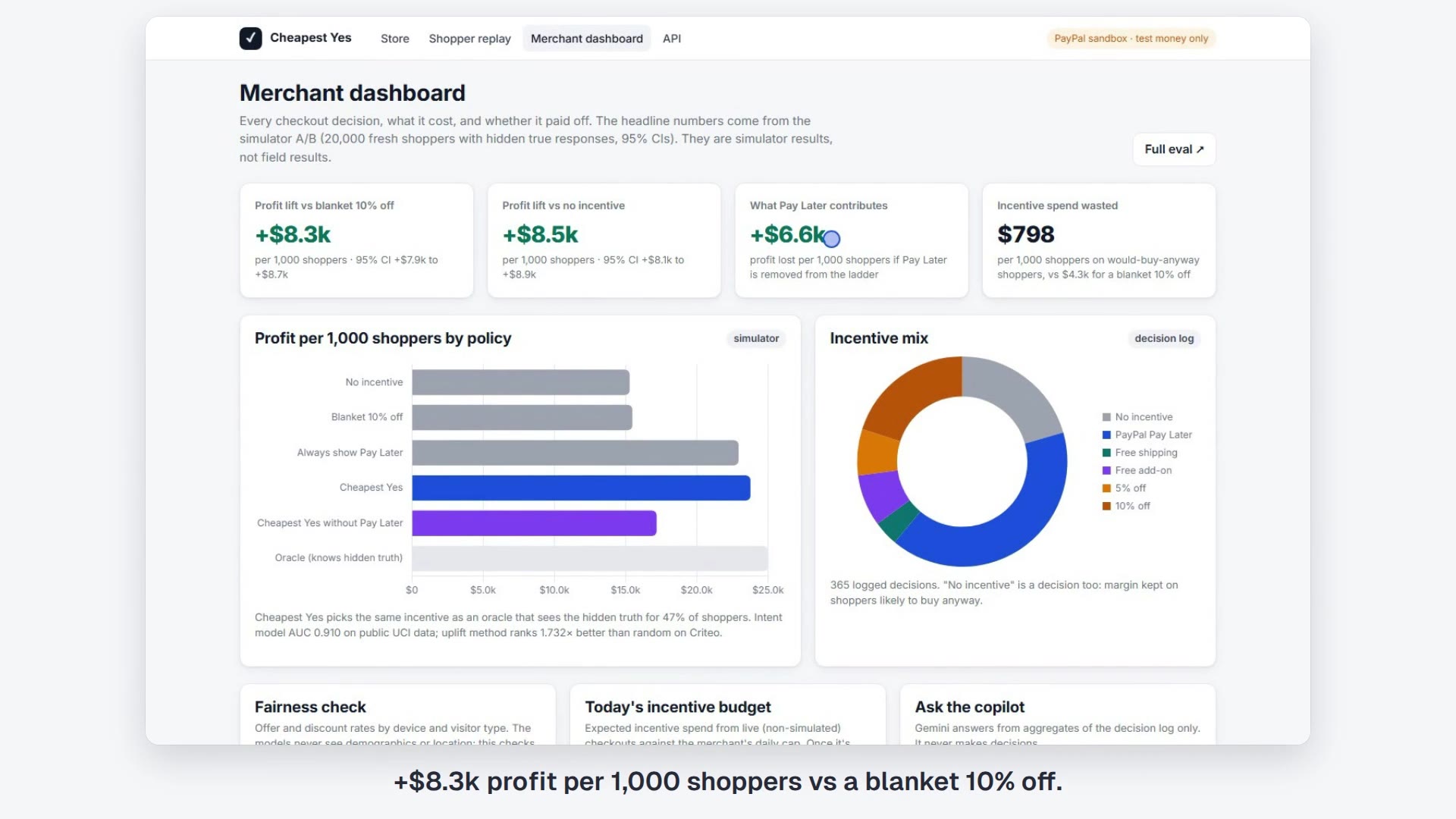
- Merchant dashboard: an AG Grid log of every decision with its PayPal order and capture IDs; profit lift against a blanket discount; the incentive mix, a fairness panel and the daily budget; and a Gemini copilot that answers questions from the decision log.
How we built it
PayPal
- Orders v2 with
amount.breakdown: the discount indiscount, free shipping asshipping: 0, the free add-on as a $0 line item, and acustom_idtying each order to its decision. Amounts are rebuilt on the server; the browser only sends a decision id. - JS SDK buttons with Pay Later enabled, and Pay Later messaging with the cart amount.
- Server-side capture, recording PayPal's actual fee from
seller_receivable_breakdown. - Webhooks (
PAYMENT.CAPTURE.COMPLETEDand others), each checked withverify-webhook-signaturebefore it's recorded.
AI
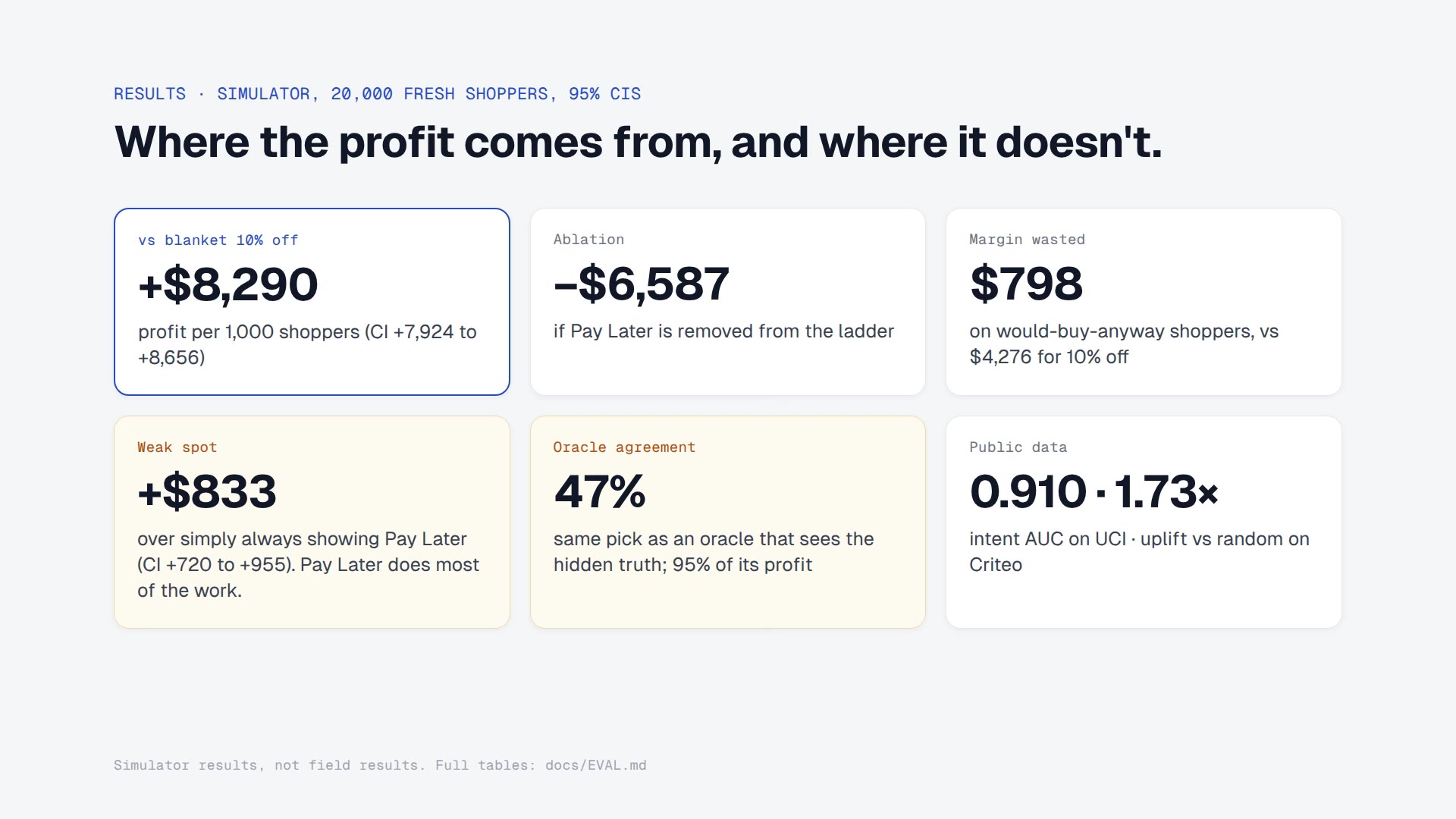
- A calibrated LightGBM purchase-intent model trained on the public UCI Online Shoppers dataset (test AUC 0.910).
- One calibrated response model per incentive (a T-learner) for P(buy | incentive). We validated the same recipe on Criteo's real randomized uplift data: AUUC 1.73× random targeting.
- A model for how likely a shopper is to actually pay with Pay Later, which sets Pay Later's real cost.
- TreeSHAP reasons on the uplift, e.g. "they paused 67s after seeing the total".
- Gemini turns those reasons into one plain sentence and powers the merchant copilot. The LLM never makes the decision; the engine is deterministic given the model outputs.
The decision
gain(o) = P(buy|o) × (margin − cost(o)) − P(buy|none) × margin, with PayPal fees folded in.- Pick the largest gain, and nothing unless it beats doing nothing by at least $0.50.
- Guardrails: the list-price ceiling, the merchant's maximum discount, a daily incentive budget, and at most 2 paid offers per shopper per week, so repeat abandoning doesn't farm discounts.
Sponsor tools
- Channel3 supplies the real product catalog.
- AG Grid runs the merchant decision log.
- Render hosts the app and API.
- APIMatic validated our OpenAPI spec and generated the Python and TypeScript SDKs for
POST /decide, which is how another merchant would plug it in.
Challenges we ran into
- Pay Later isn't free. We started from the claim that Pay Later costs merchants nothing extra. PayPal's current US fee page says otherwise: 4.99% + $0.49 against 3.49% + $0.49 for standard checkout. So the engine prices it honestly, at 1.5% of the order times the chance the shopper actually uses it. On a $240 cart that's about $3.60, against $24 for 10% off.
- Evaluating without real experiments. You can't measure true profit lift from a live store in a weekend. We built a simulator whose shoppers have hidden true responses, grounded each one in a real UCI browsing session, trained only on a randomized exploration log, and scored every policy on fresh shoppers with confidence intervals.
Accomplishments that we're proud of
Simulator A/B on 20,000 fresh shoppers, profit per 1,000 shoppers:
- No incentive: $15.3k
- Blanket 10% off: $15.5k
- Always show Pay Later: $22.9k
- Cheapest Yes: $23.8k, which is +$8.3k vs a blanket 10% off (95% CI +$7.9k to +$8.7k)
Taking Pay Later out of the ladder costs $6.6k per 1,000 shoppers, so most of the value is the cheap nudge. Incentive spend wasted on would-buy-anyway shoppers is $0.8k per 1,000 shoppers, against $4.3k for a blanket discount.
These are simulator results, not field results; the README says exactly which numbers come from public data and which from the simulator.
What we learned
- The cheapest incentive depends on the cart. On a $56 cart, 10% off ($5.60) is cheaper than $8.99 free shipping, and the engine picks it.
- "Always show Pay Later" is a strong baseline on its own. The engine's extra value (+$833 per 1,000 shoppers, 95% CI +720 to +955) comes from spending on paid incentives only where they pay off.
What's next for Cheapest Yes
- A randomized exploration mode for real stores, so the response models learn from live data.
- Per-merchant settings for margin and the incentive ladder.
- Pay Later economics for more markets (the UK rate is +1.0 point).
Everything in the repository was built during the hackathon; two small patterns (a SHAP-explanation model wrapper and a plot style) were adapted from the author's earlier pricing project.
Built With
- ag-grid
- apimatic
- channel3
- chart.js
- css3
- fastapi
- gemini
- html5
- javascript
- lightgbm
- openapi
- pay-later
- paypal
- paypal-js-sdk
- paypal-orders-v2
- paypal-webhooks
- playwright
- python
- render
- scikit-learn
- shap
- sqlite
