-
-
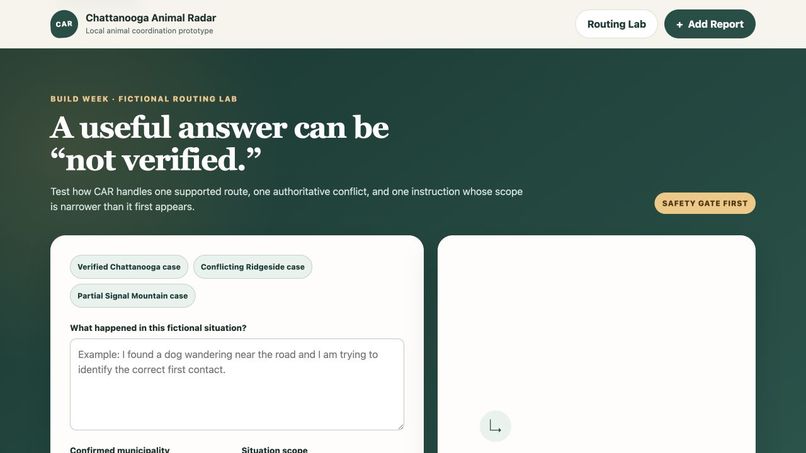
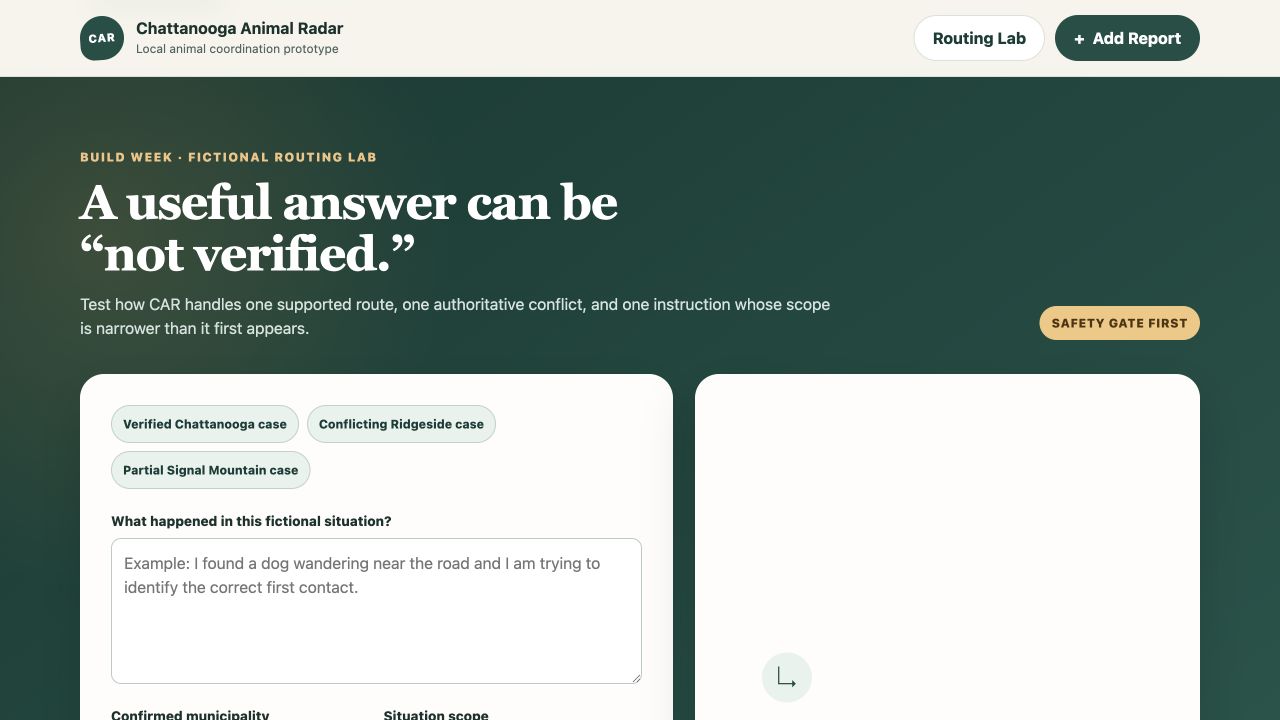
Routing Lab overview: fictional cases are processed through evidence-aware safety gates.
-
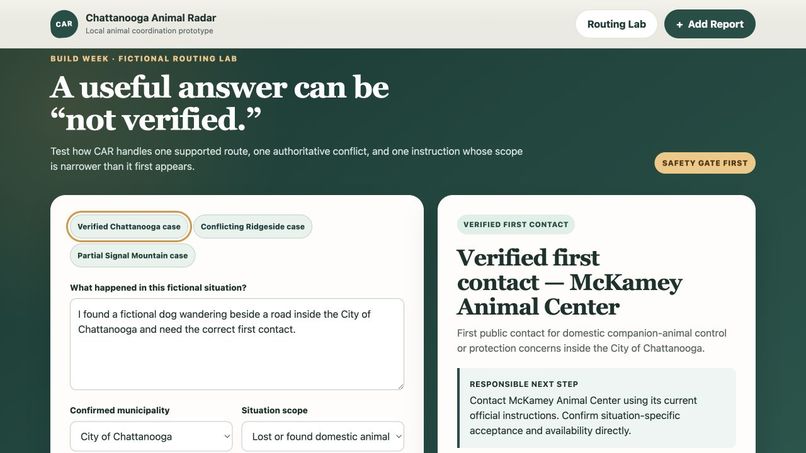
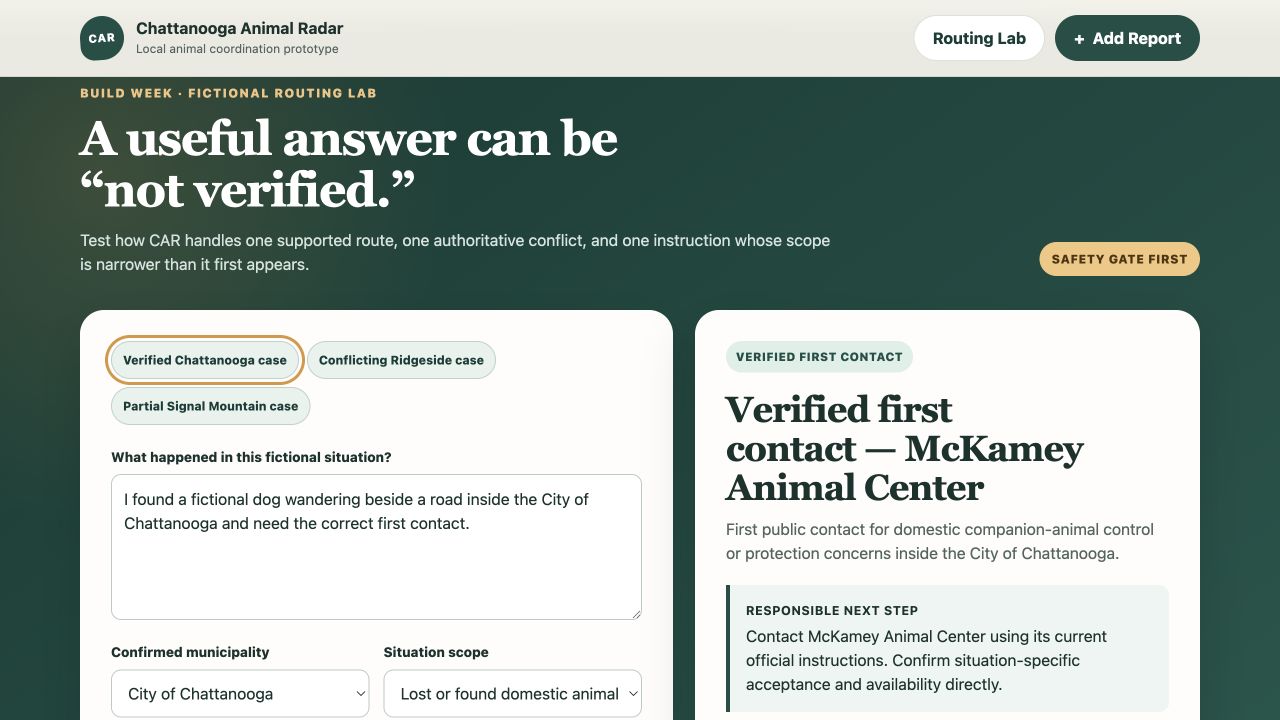
Verified route: narrow scope, limits, claim state, and evidence stay visible.
-
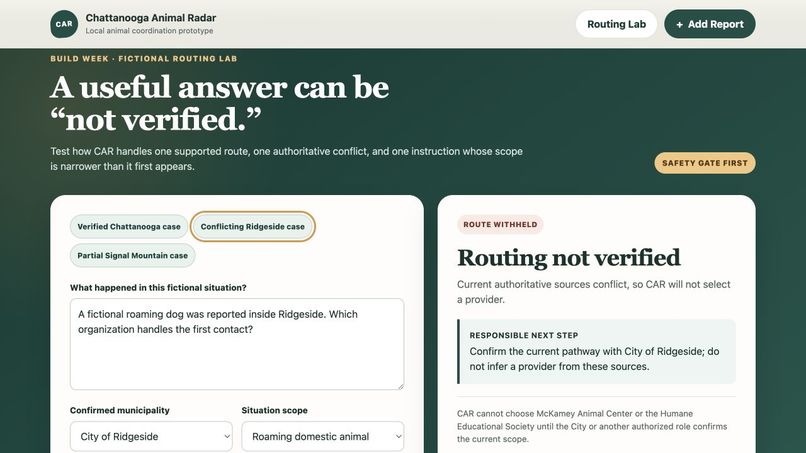
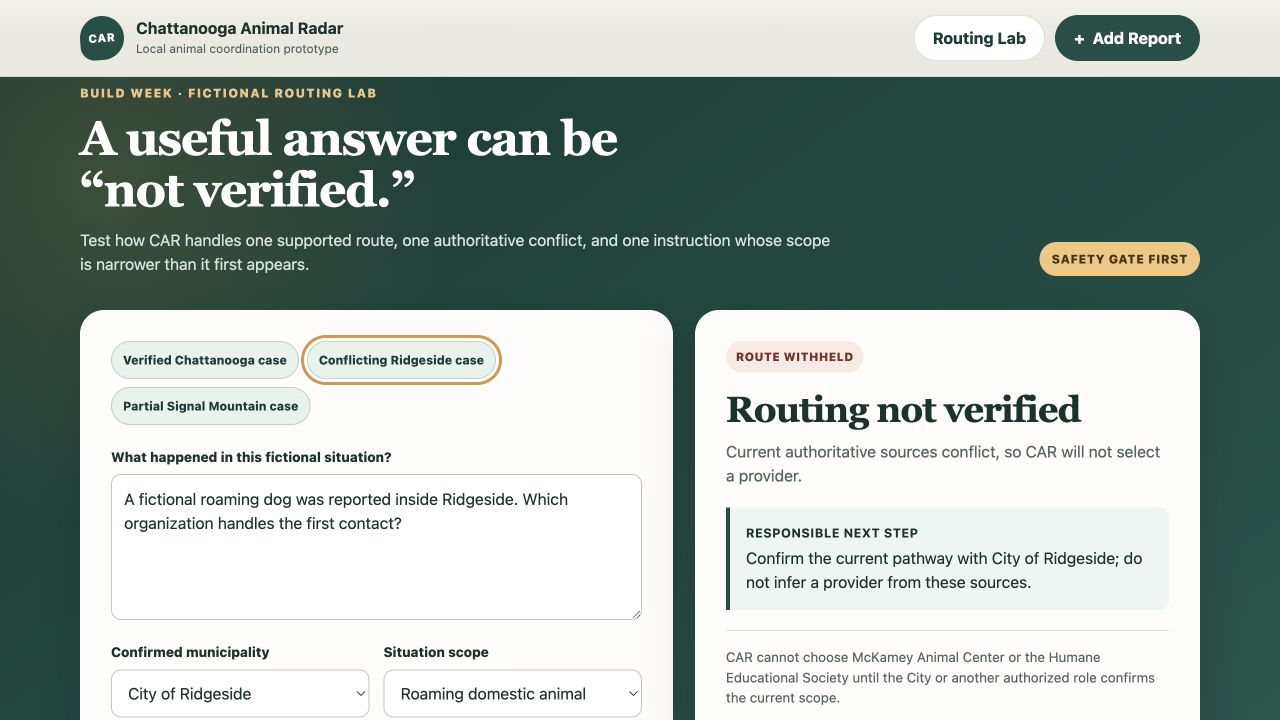
Conflict state: contradictory official sources withhold the operational route.
-
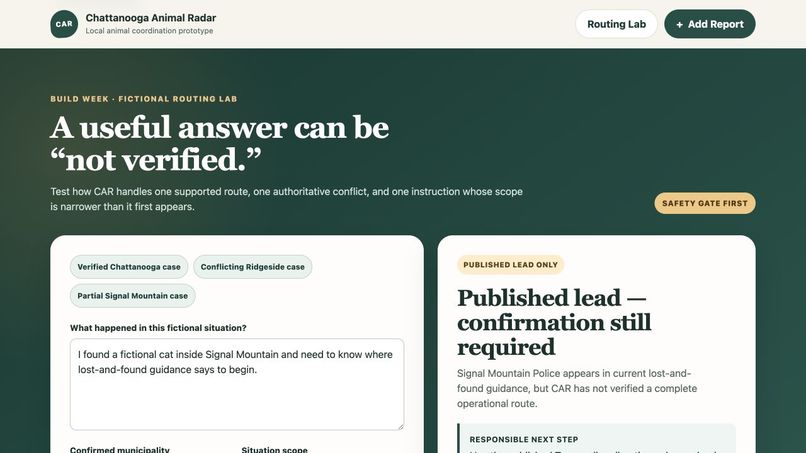
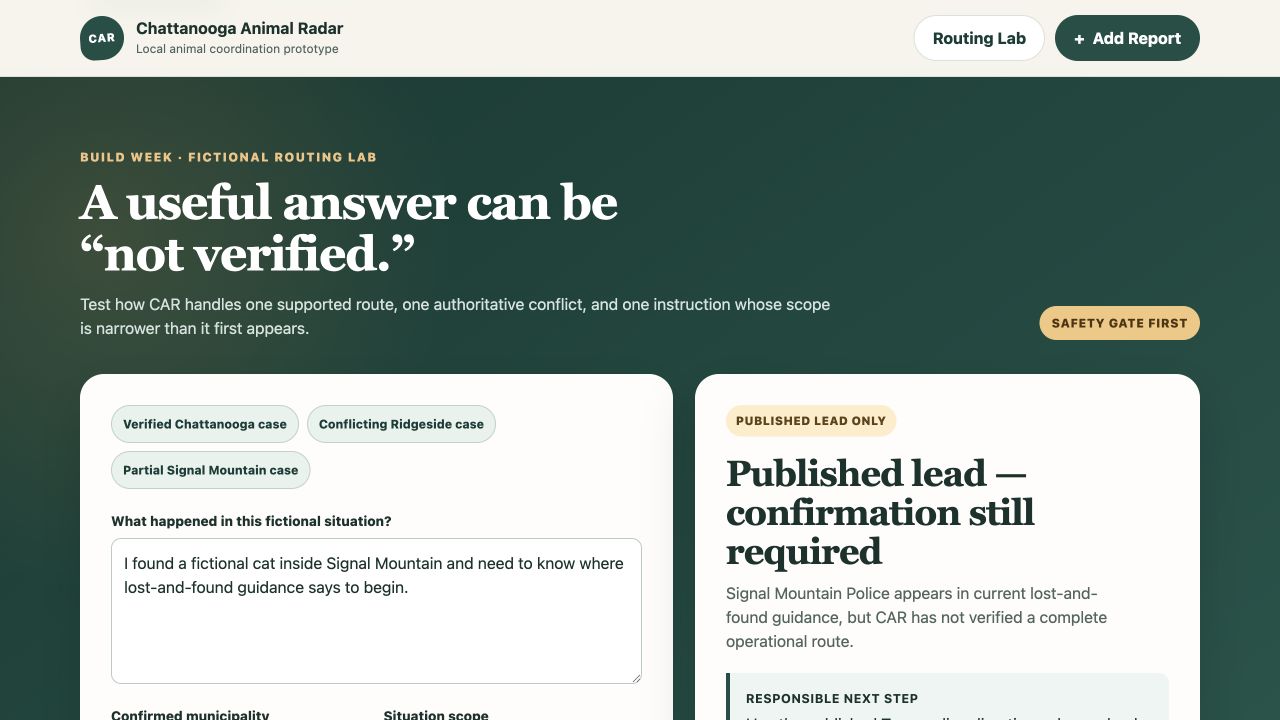
Partial lead: a published first-contact clue is not broadened into a full pathway.
Inspiration
Residents often assume that one county has one animal-control pathway. In Hamilton County, Tennessee, municipal boundaries and provider roles differ, a mailing address may not identify the governing jurisdiction, and current official sources can disagree. A polished but unsupported answer may waste time, expose information to the wrong recipient, or imply that an organization accepted responsibility it never confirmed.
Chattanooga Animal Radar began as an animal-first, organization-neutral way to make that uncertainty visible and help a resident find the next responsible step without pretending the evidence says more than it does.
What it does
The Build Week Routing Lab turns fictional animal-welfare accounts into one of three honest outcomes drawn from CAR's reviewed routing research:
- a verified first contact for the City of Chattanooga;
- a withheld route for Ridgeside because current authoritative sources conflict; or
- a narrow published lead for Signal Mountain that is not broadened into a complete animal-control pathway.
Every result shows its supported scope, limits, claim state, evidence links, observation date, and next-review date. CAR never promises pickup, intake, capacity, treatment, placement, or outcome.
How we built it
Before Build Week, CAR already contained the local research, documentation, verification workflow, and early prototype. During Build Week, we added a visibly separate fictional Routing Lab with:
- a dependency-free HTML, CSS, and JavaScript interface;
- a pure JavaScript routing core shared by the UI and executable tests;
- a loopback-only Python server with an allowlisted static surface;
- strict schema-constrained extraction through the OpenAI Responses API;
- deterministic claim-state gates and provenance-preserving evidence receipts; and
- a manual safe fallback when model access is unavailable.
The public demonstration uses fictional data only. It does not collect, publish, store, or transmit real animal reports.
How GPT-5.6 is used
GPT-5.6 handles the language problem, not the authority problem. It may extract only the animal category, narrow situation scope, timing, immediate-danger wording, location wording, a short summary, and explicit unknowns from a fictional narrative.
Its schema contains no provider, municipality, jurisdiction, authority, phone number, service guarantee, capacity, or outcome field. The local server validates the structured output again, and CAR's deterministic gate applies only reviewed routing claims. Missing extraction, unresolved scope, extraction mismatch, conflicted claims, and over-broad claims all block the route.
How Codex helped
Codex helped turn CAR's existing documentation and jurisdiction matrix into a bounded product slice. It implemented the Routing Lab interface, routing engine, loopback server, strict extraction schema, adversarial regression checks, responsive and accessible behavior, captioning, and submission materials while preserving CAR's evidence and privacy rules.
Challenges
The hardest design problem was resisting false certainty. A language model can produce a plausible answer even when official sources conflict, but plausible is not the same as authorized or current. We therefore separated flexible language understanding from provider selection and municipal authority.
A second challenge was keeping the Build Week work demonstrable without turning CAR into a public intake system. The Lab is intentionally fictional and isolated from CAR's reporter-record workflow.
Accomplishments
- Three distinct evidence states are visible instead of collapsed into one recommendation.
- Conflicted and over-broad routes remain withheld under adversarial tests.
- The browser never receives the API key.
- Model requests use
store: false. - The local server is loopback-only and serves an allowlisted file surface.
- The interface works at desktop and iPhone-sized widths, supports keyboard and screen-reader workflows, and includes configurable text size, spacing, contrast, reduced motion, and dyslexia-friendly font choices.
- The narrated demonstration includes timed English captions and a complete text transcript.
- Automated checks cover deterministic routing, server/schema safety, and important accessibility semantics.
- Live GPT-5.6 extraction passed for all three fictional fixtures while the deterministic gate preserved verified, withheld-conflict, and confirmation-lead outcomes.
What we learned
“Not verified” can be a useful product result. GPT-5.6 is most valuable here when it preserves what a person actually said and exposes unknowns, while current, scoped, reviewable evidence retains authority over the operational answer.
What's next
Next steps are to broaden the reviewed Chattanooga-area pathway map carefully, add authoritative geographic resolution, and continue provider verification without allowing a contact route to become an implied promise of acceptance, capacity, custody, or outcome.
Built With
- css3
- gpt-5.6
- html5
- javascript
- openai
- python
- responses


Log in or sign up for Devpost to join the conversation.