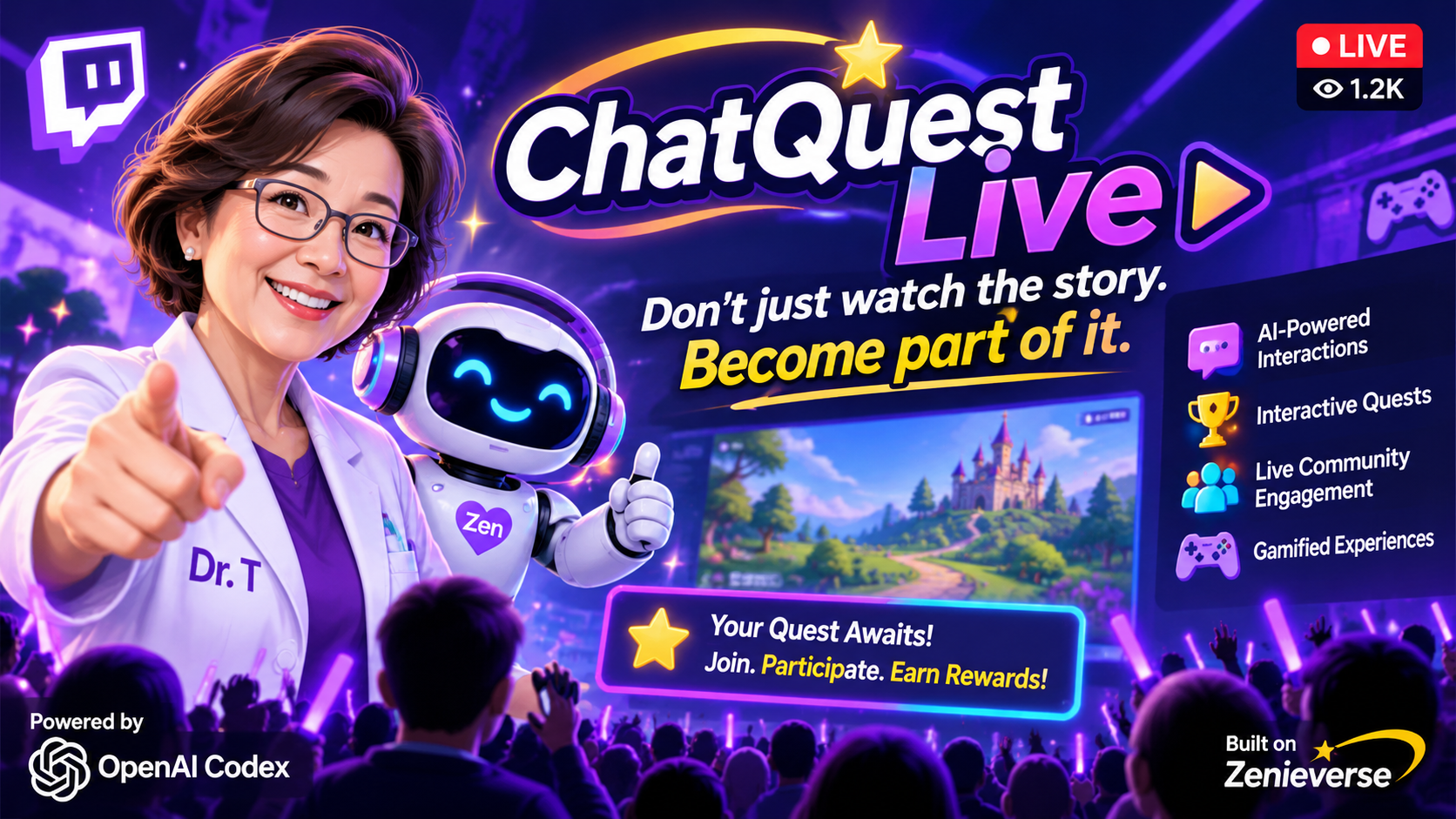
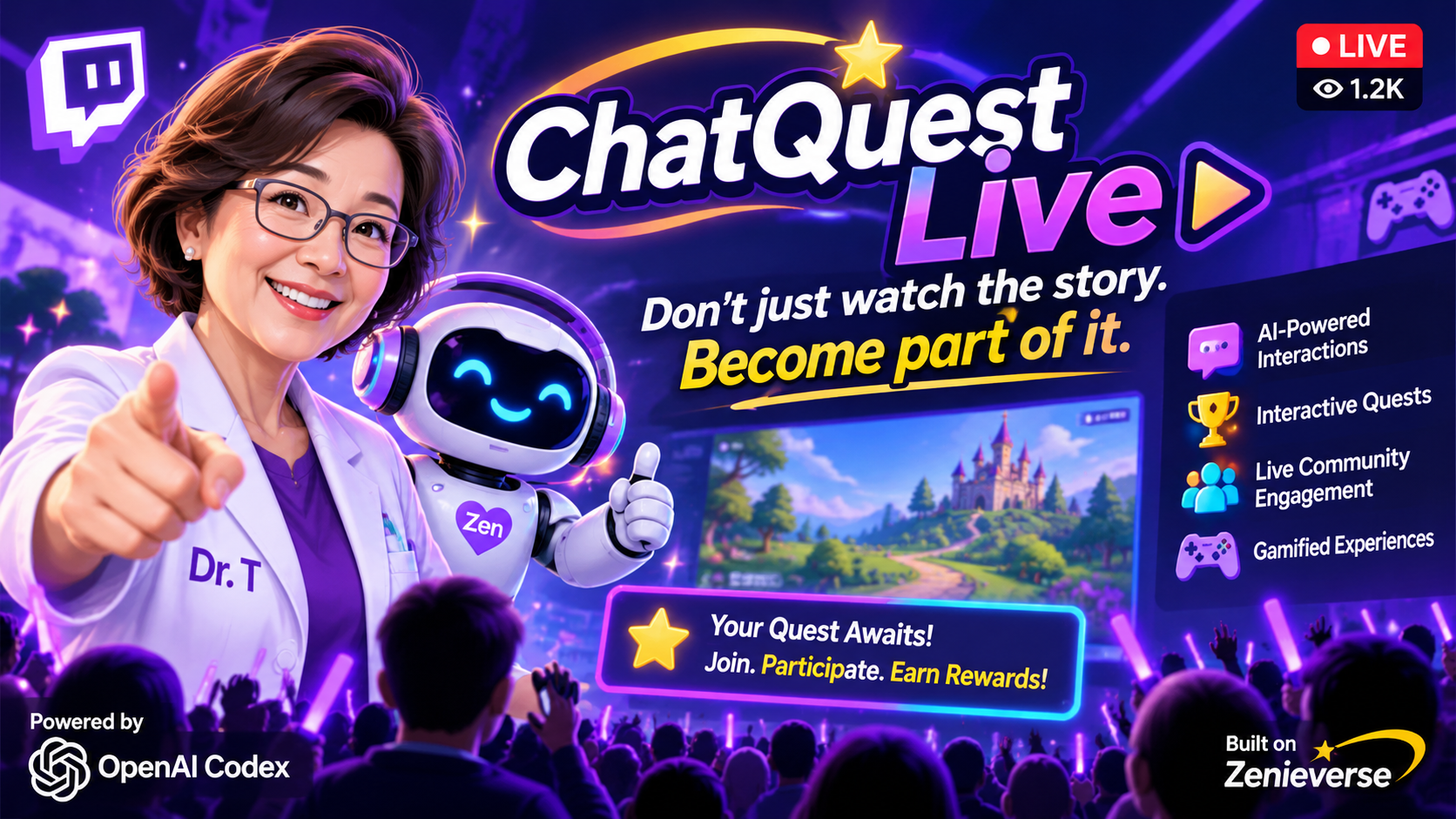
ChatQuest Live Inspiration
Live streaming is at its best when audiences are not just watching but participating, creating, and connecting.
We were inspired by the opportunity to transform Twitch livestreams from one-way broadcasts into interactive community experiences. Streamers work hard to build communities, but keeping audiences engaged, welcoming newcomers, managing conversations, and creating memorable shared moments can be challenging.
We envisioned ChatQuest Live: an AI-powered experience that turns audience participation into an adventure, helping streamers and communities connect through interactive quests, challenges, and collaborative experiences.
Our goal is simple: make every viewer feel like they are part of the story.
What it does
ChatQuest Live transforms livestream participation into an interactive community adventure.
The platform is designed to bring streamers and viewers together through:
AI-powered interactions: Make livestream participation more dynamic through intelligent, context-aware experiences. Interactive quests: Give audiences opportunities to participate in shared challenges and community activities. Live community engagement: Encourage viewers to interact, collaborate, and become active contributors. Gamified experiences: Turn participation into meaningful moments that encourage continued engagement. Streamer-focused experiences: Help creators build stronger communities and make their livestreams more memorable. Scalable architecture: Build a foundation for expanding interactive experiences and integrations. ChatQuest Live is more than a chat experience. It is a way to make the community part of the content.
How we built it
We built ChatQuest Live within the existing Zenieverse Dr. T platform, extending its application architecture rather than creating an isolated prototype.
We used OpenAI Codex as an AI-powered development partner to support implementation, code exploration, debugging, integration, and production hardening.
Our development approach focused on:
Integrating ChatQuest Live into the existing application. Preserving existing platform functionality while introducing a dedicated experience. Building the interactive experience around livestream community engagement. Developing the supporting application and integration architecture. Improving reliability through implementation reviews, testing, and release verification. Preparing the project for a real-world deployment and demonstration. Our philosophy was to build on working infrastructure, reuse existing capabilities, and create a product that can evolve beyond a hackathon.
Challenges we ran into
One of our biggest challenges was integrating a new interactive experience into an existing, evolving platform without disrupting its other features.
Other challenges included:
Translating the broad idea of AI-powered community engagement into practical user experiences. Designing interactions that feel natural rather than automated or repetitive. Maintaining a balance between audience participation and streamer control. Integrating new functionality while preserving existing application architecture. Improving reliability and ensuring that the experience is suitable for further real-world testing. Distinguishing implemented functionality from features that still require additional integration or validation. We approached these challenges incrementally, prioritizing integration, maintainability, and a clear path toward a production-ready experience.
Accomplishments that we're proud of
We are proud to have developed ChatQuest Live as an extension of an existing platform rather than just another standalone hackathon concept.
Our accomplishments include:
Establishing ChatQuest Live as a dedicated project within Zenieverse Dr. T. Developing an AI-assisted implementation workflow using OpenAI Codex. Advancing the project through implementation, integration, and release-hardening work. Preserving the existing platform while developing a new interactive experience. Creating a foundation for more engaging, collaborative livestream communities. Bringing together AI, community interaction, and gamification under one product vision. Most importantly, we are proud of the idea that technology should make communities more human, not less.
What we learned
We learned that building an AI-powered product is not simply about adding an AI model to an application.
The real challenge is designing useful experiences around people.
We also learned the importance of:
Using AI coding agents as development collaborators while retaining human oversight. Maintaining clear architecture when extending an existing application. Prioritizing real functionality over attractive demonstrations. Testing integrations and validating release readiness. Designing AI experiences that support human creativity and community participation. Codex helped us explore a more iterative development workflow, where ideas can move into implementation, review, and refinement more efficiently.
What's next for ChatQuest Live
We see ChatQuest Live as the beginning of a broader vision for interactive digital communities.
Our next steps include:
Deeper Twitch integration: Continue developing and validating live-stream connectivity and real-time audience interactions. Smarter AI experiences: Expand context-aware interactions and intelligent quest generation. Creator tools: Give streamers greater control over quests, challenges, community activities, and engagement settings. Community progression: Develop richer gamification, achievements, and collaborative experiences. Safety and moderation: Strengthen community safeguards and responsible AI interaction. Production validation: Expand testing, deployment verification, and real-world streamer feedback. Ecosystem expansion: Explore how the experience can support additional creator communities and interactive platforms. Our long-term vision is to make every livestream an opportunity to participate, discover, collaborate, and belong.
ChatQuest Live — Don't just watch the story. Become part of it.
Built With
- agents
- ai
- api
- artificial
- codex
- community
- development
- engagement
- gamification
- generative
- intelligence
- interactive
- javascript
- language
- large
- live
- media
- models
- node.js
- openai
- react
- streaming
- twitch
- typescript
- web
