-
-
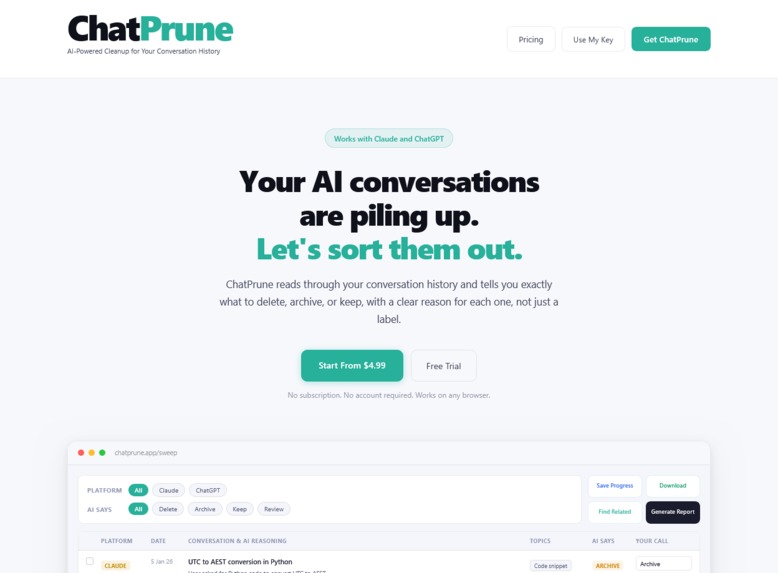
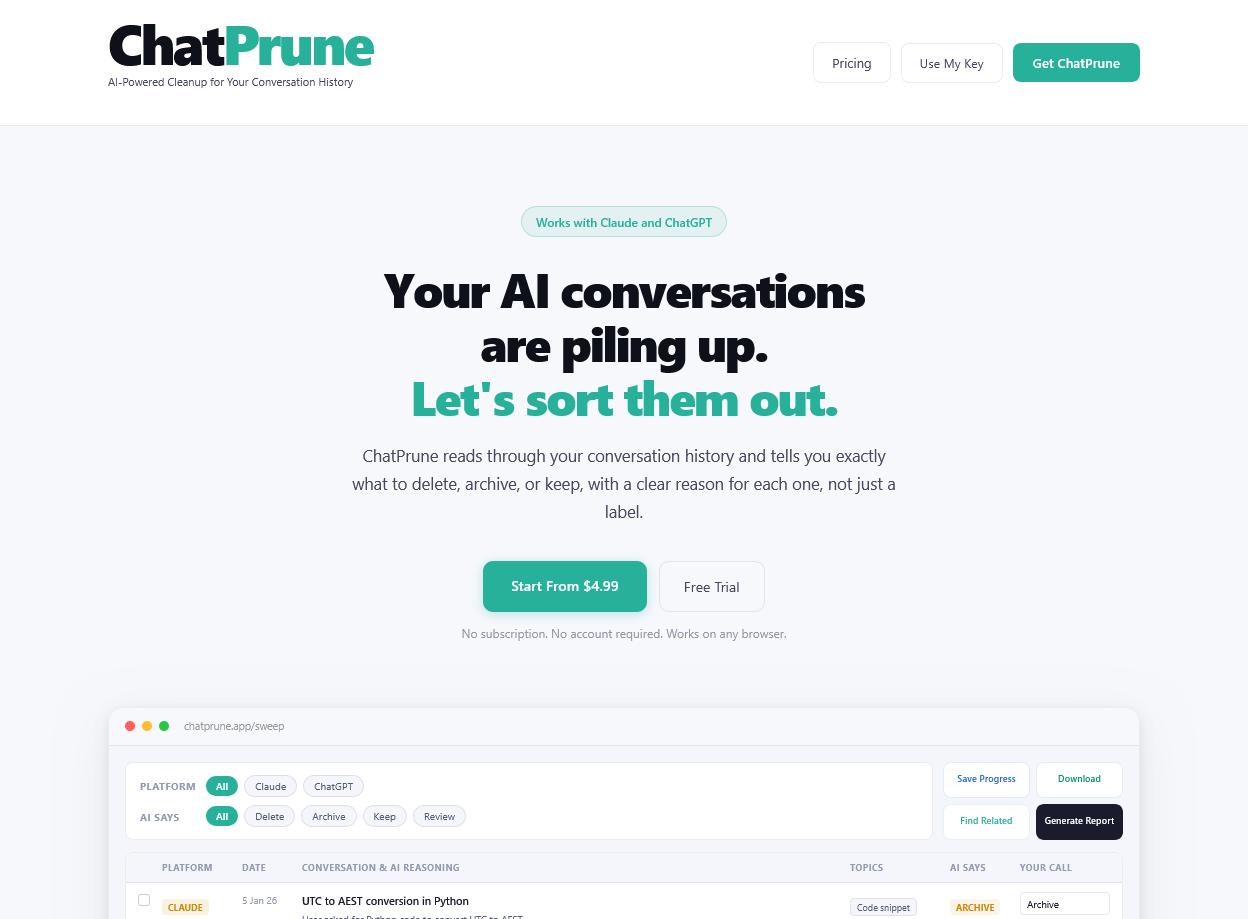
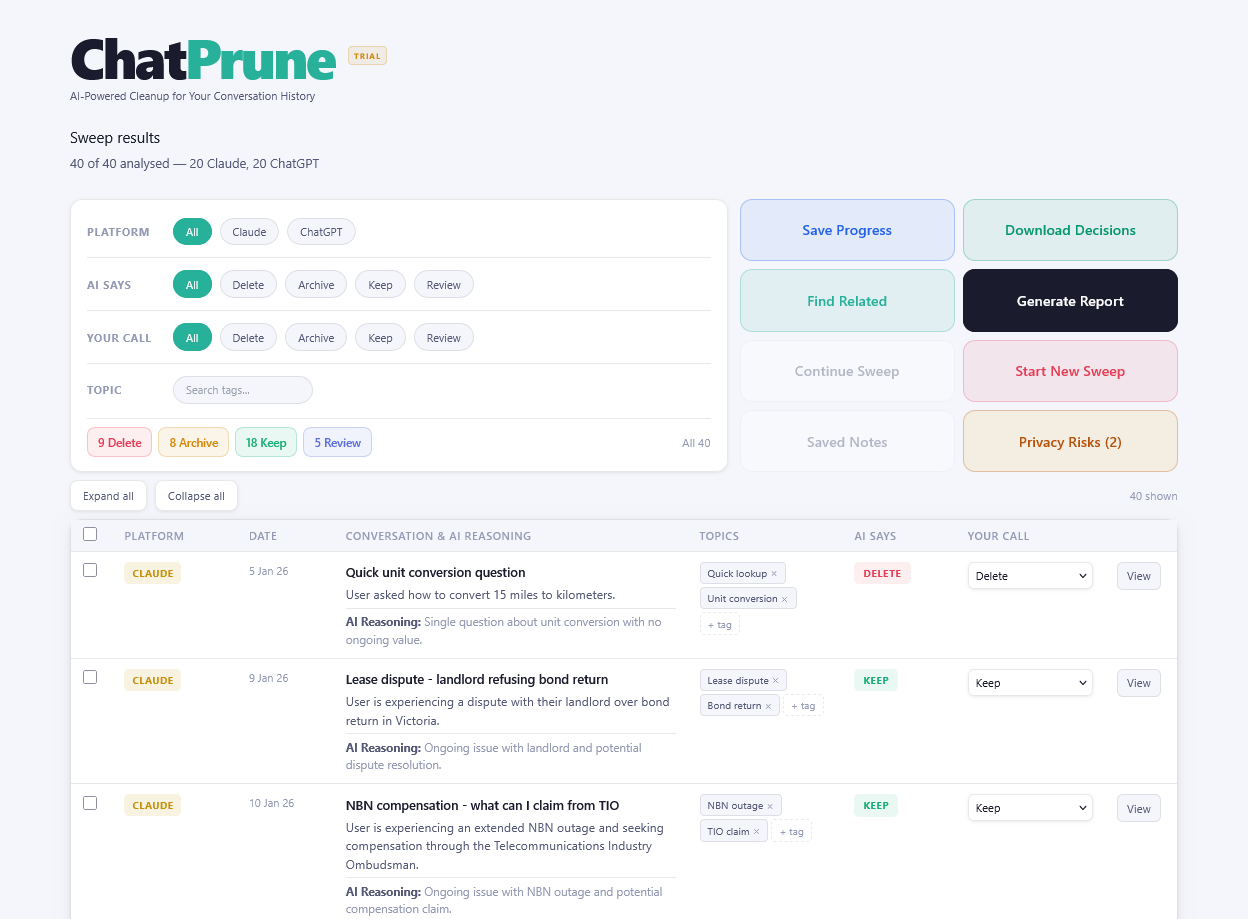
ChatPrune reads your Claude and ChatGPT history and tells you what to delete, archive, or keep, with a real reason for each one.
-
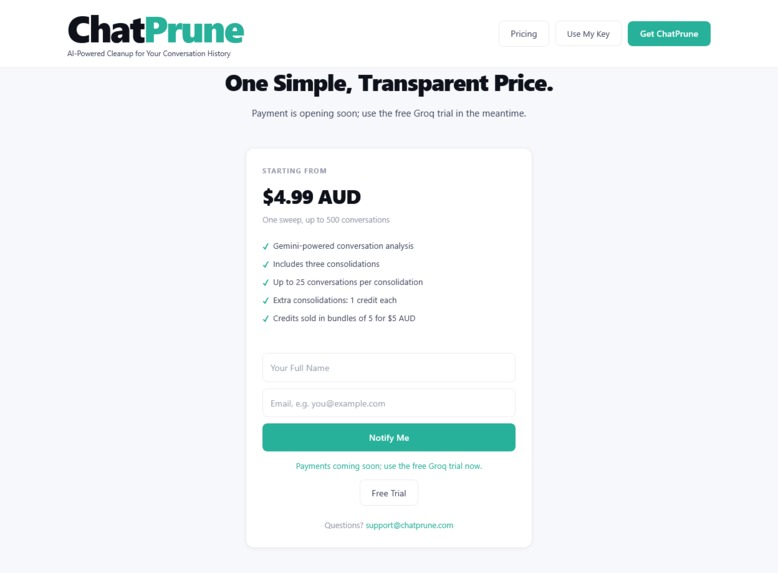
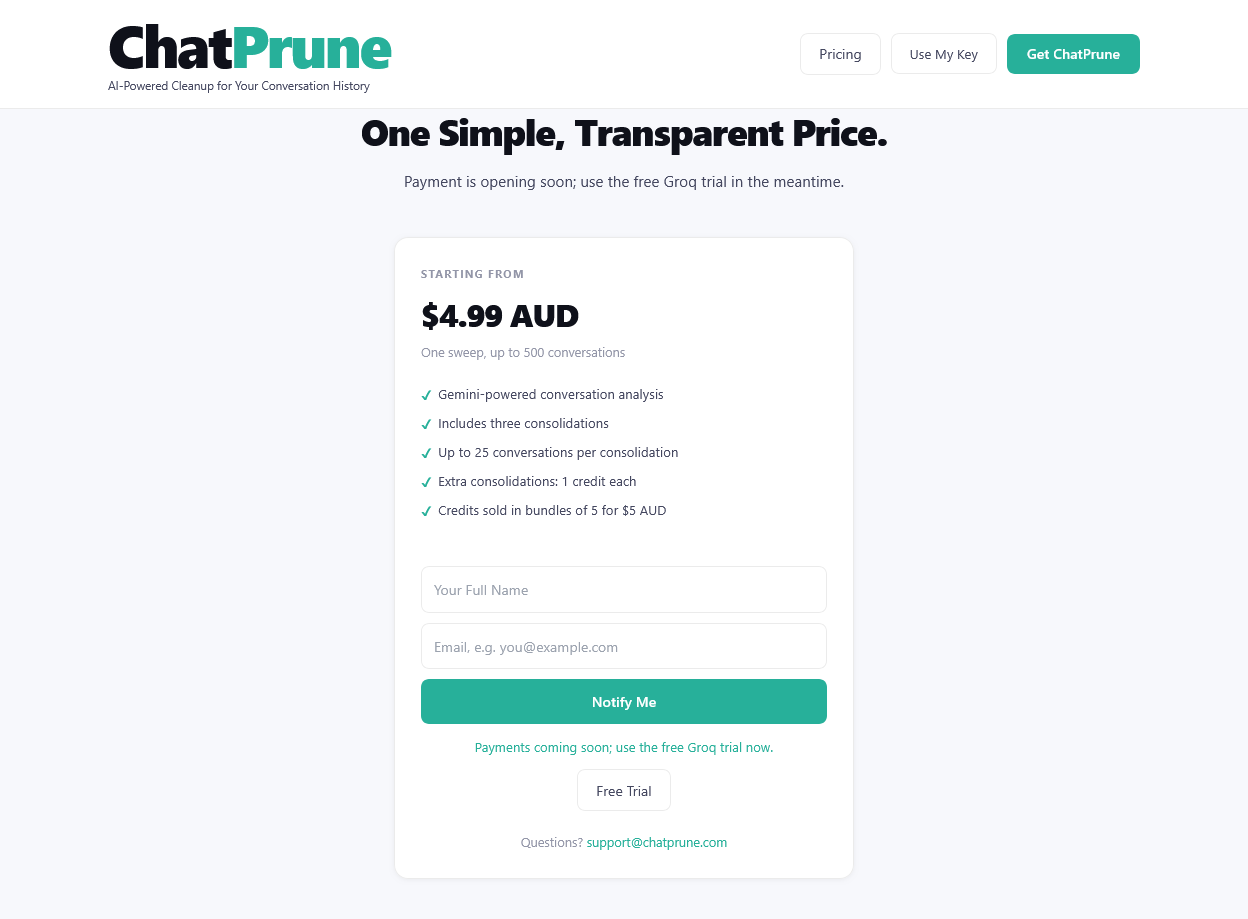
One simple $4.99 sweep, up to 500 conversations, includes 3 conversation consolidations. No subscription required.
-
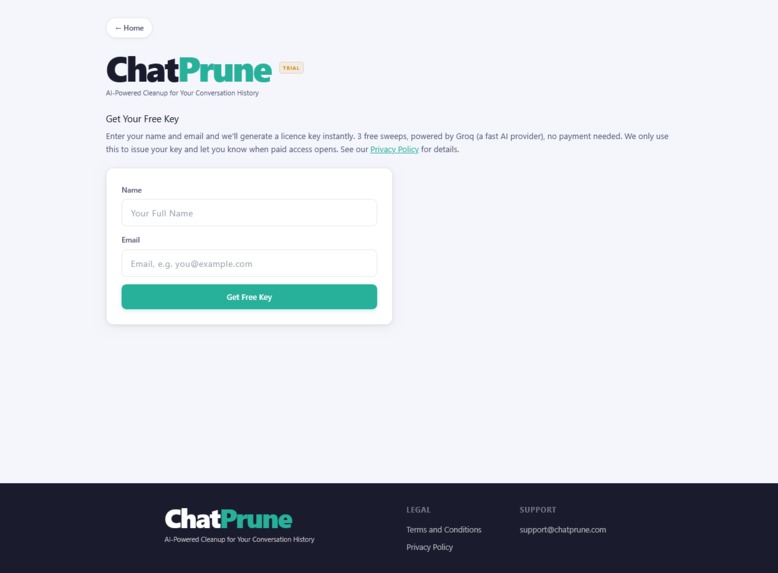
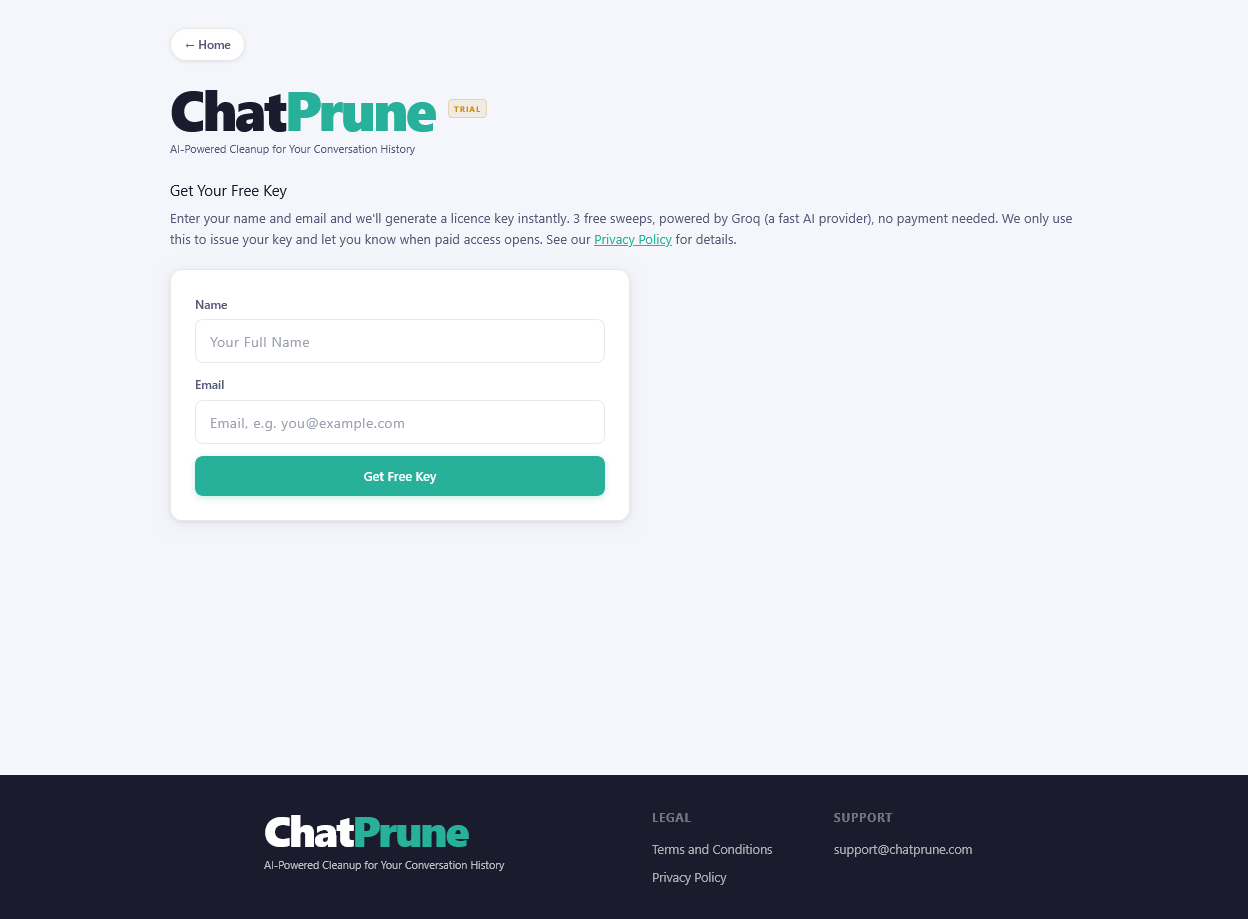
Get a free trial key instantly with just your name and email. 3 free sweeps powered by Groq, no payment needed.
-
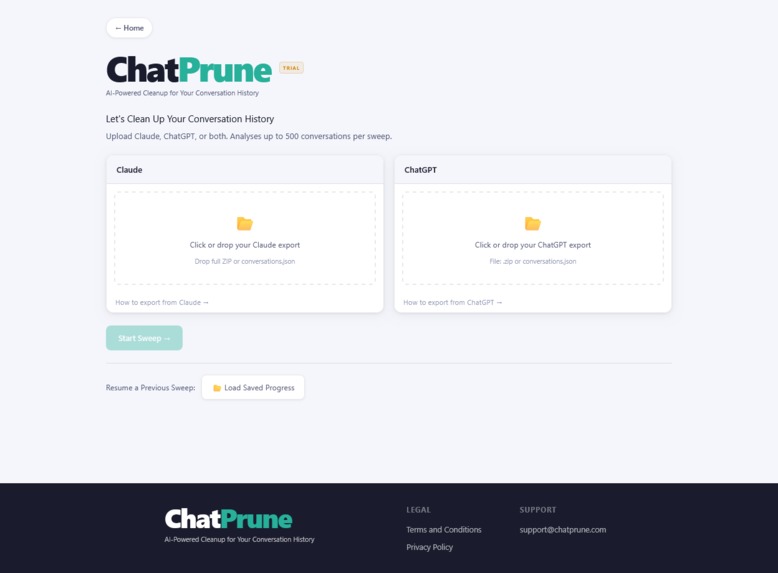
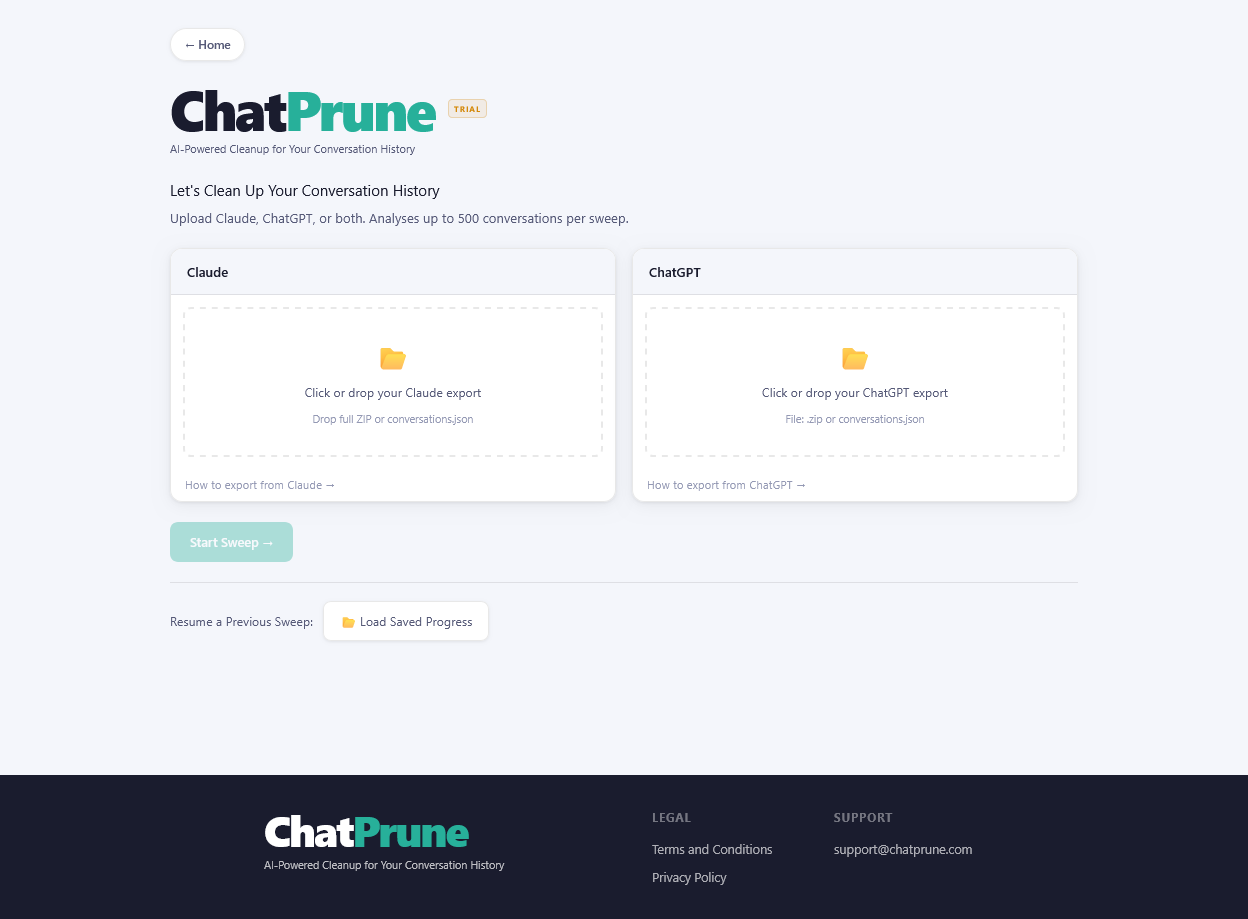
Upload your Claude and/or ChatGPT export files directly, no account login or platform access required.
-
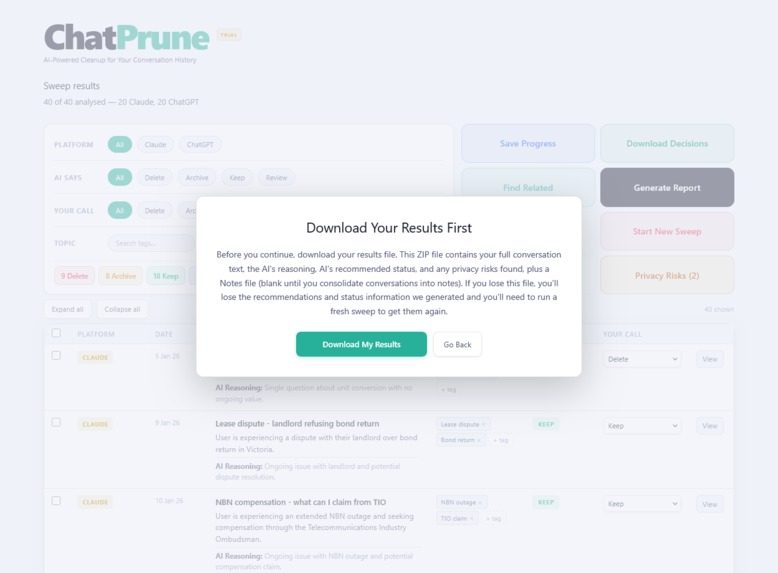
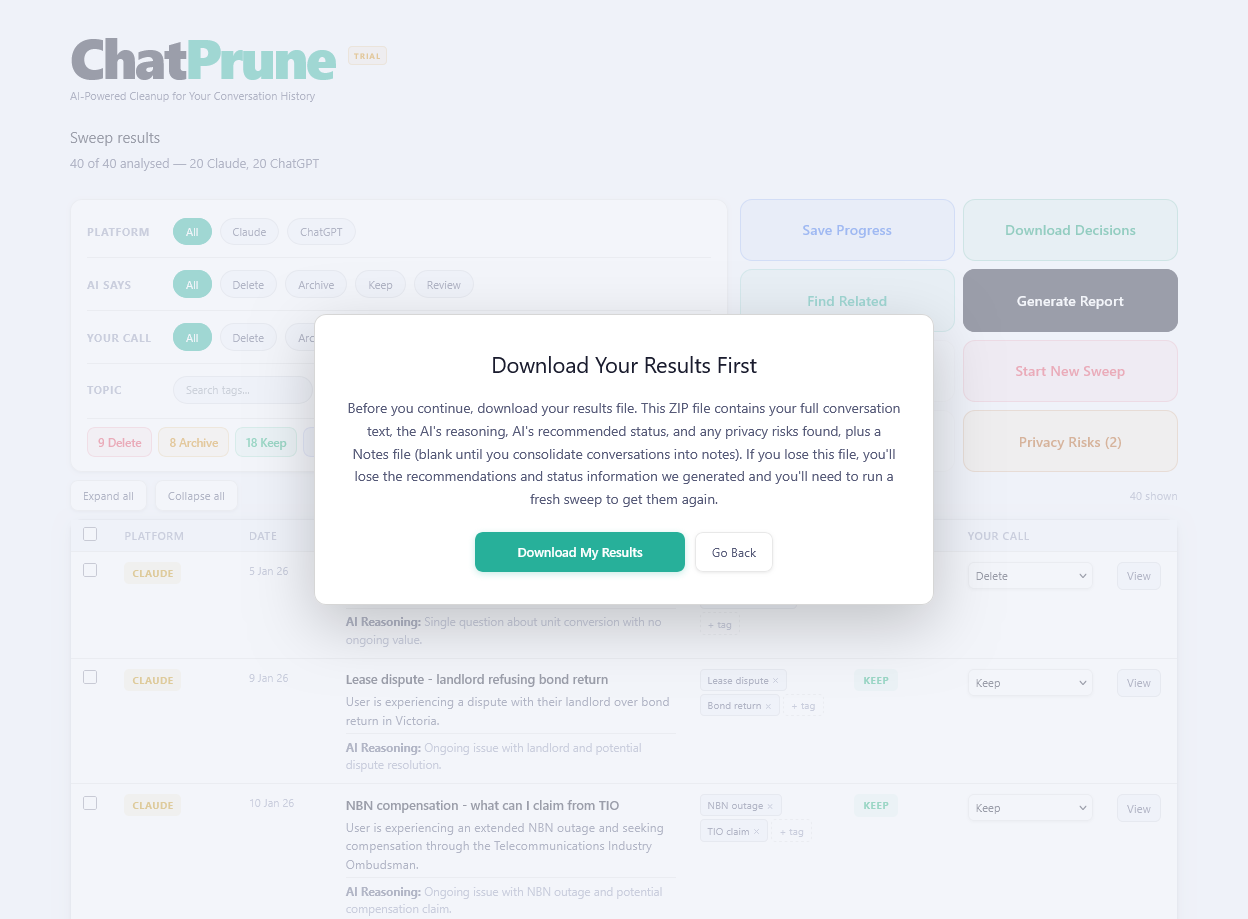
Before you see anything, download your results. Your conversation data lives on your device, never on our servers.
-
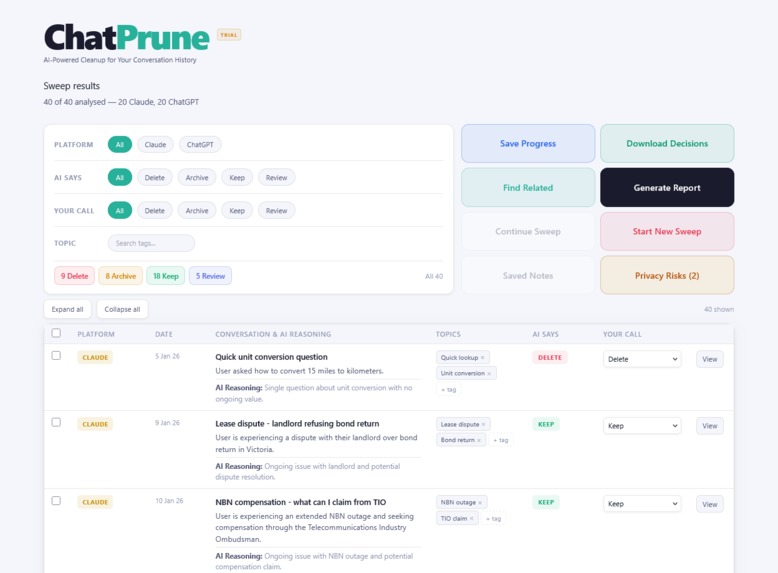
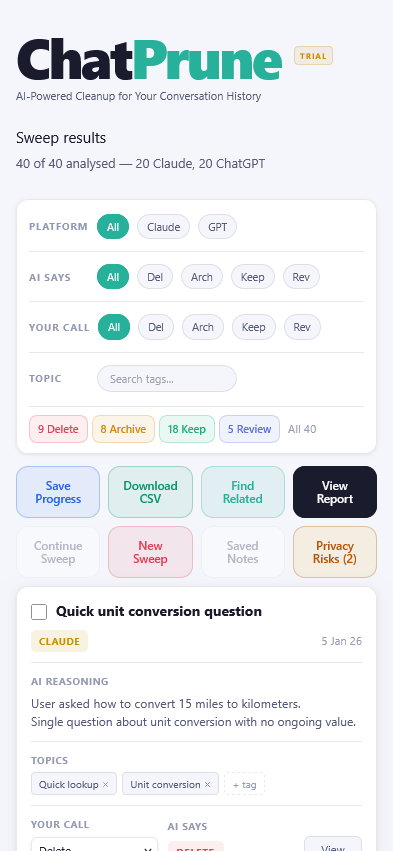
Every conversation gets a clear recommendation and a written reason, not just a Delete or Keep label.
-
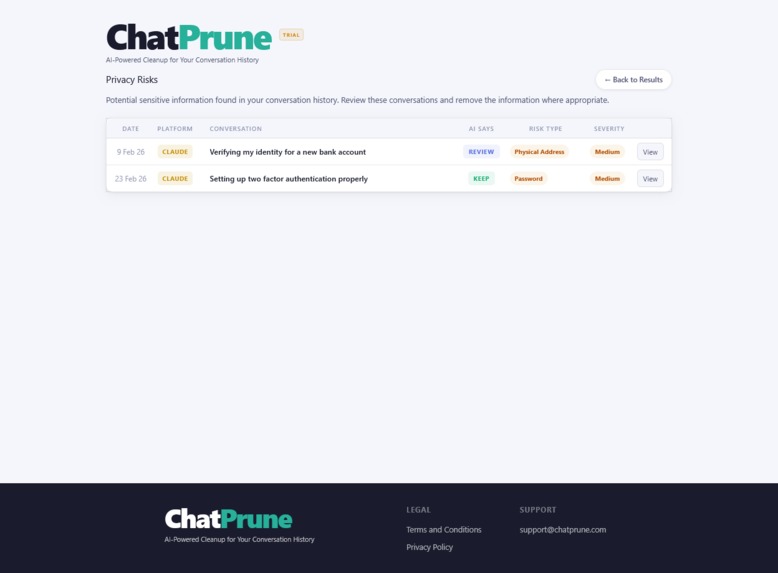
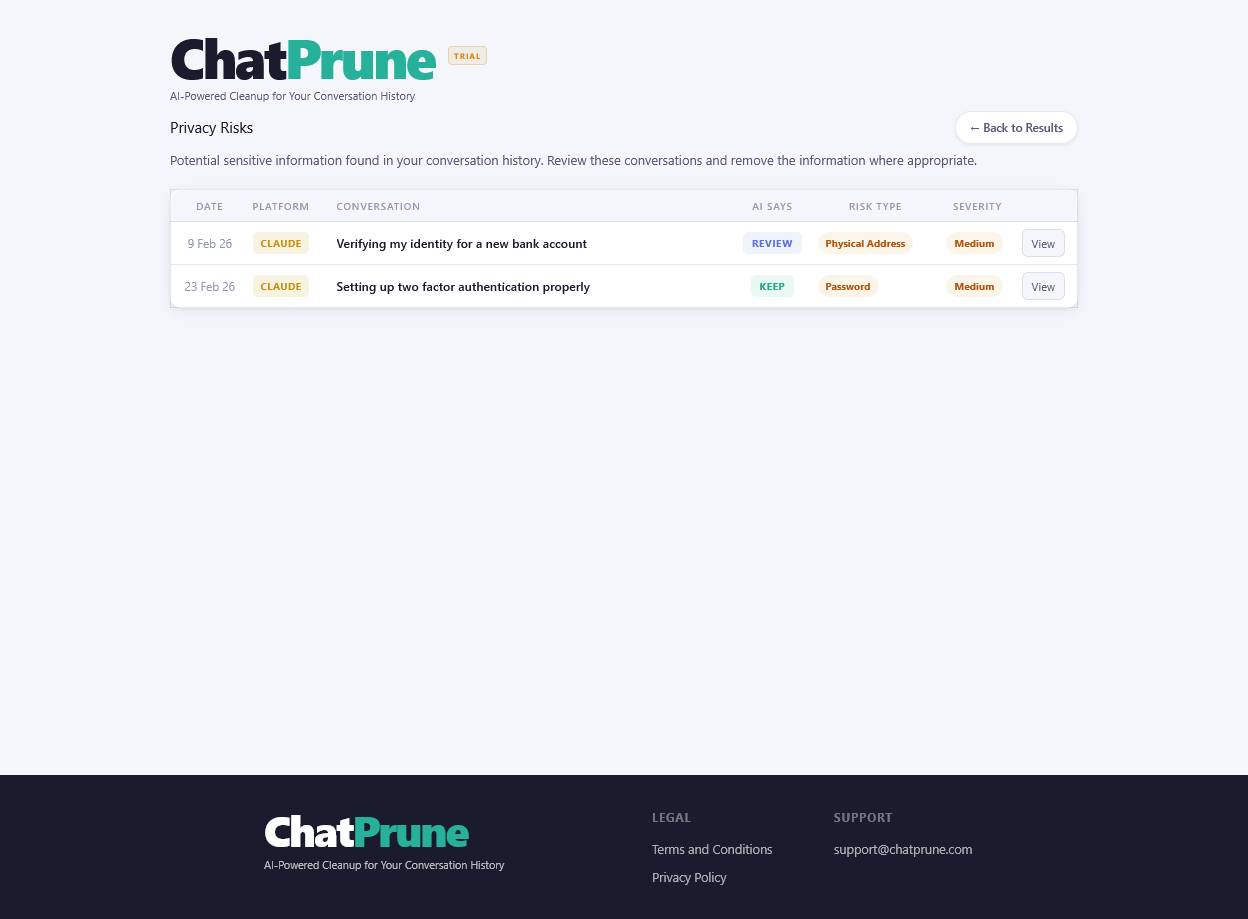
ChatPrune scans every conversation for accidentally shared API keys, passwords, and other sensitive information.
-
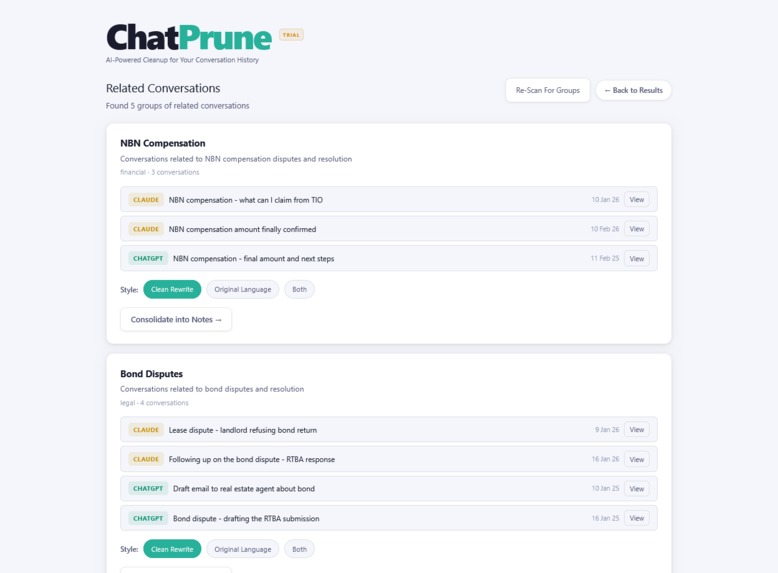
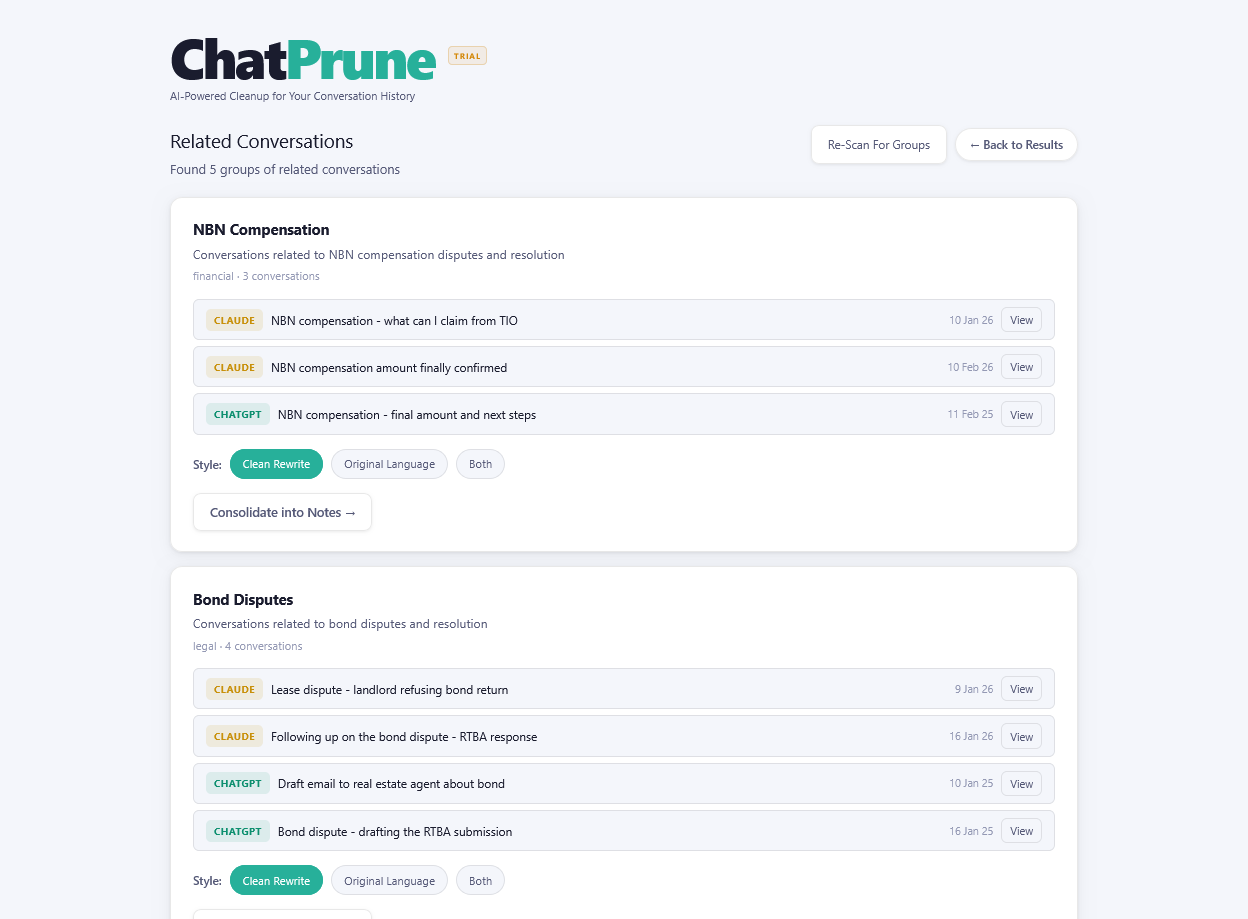
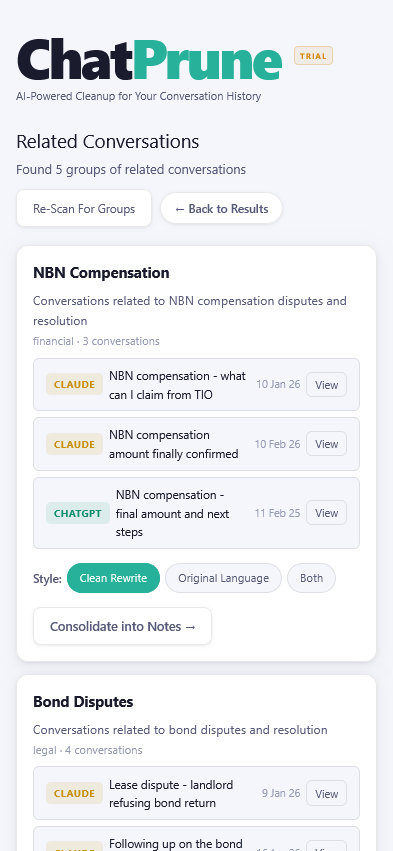
Find Related groups conversations discussing the same topic across platforms and months apart.
-
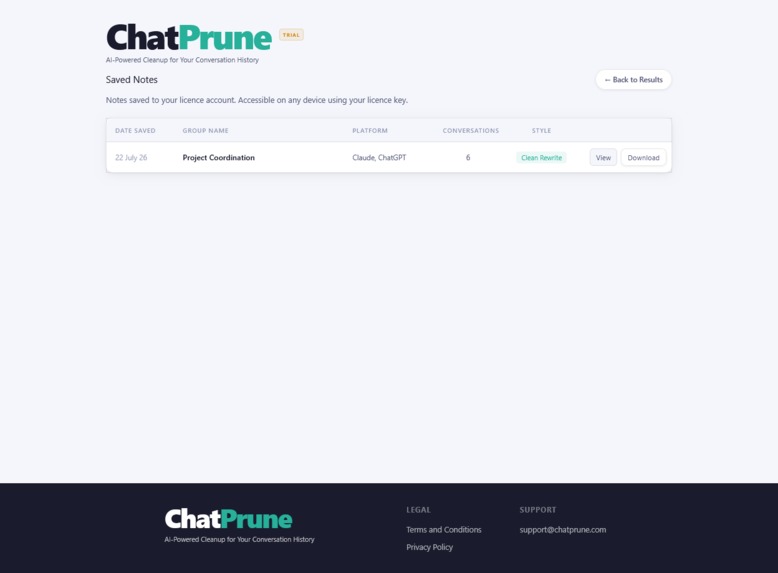
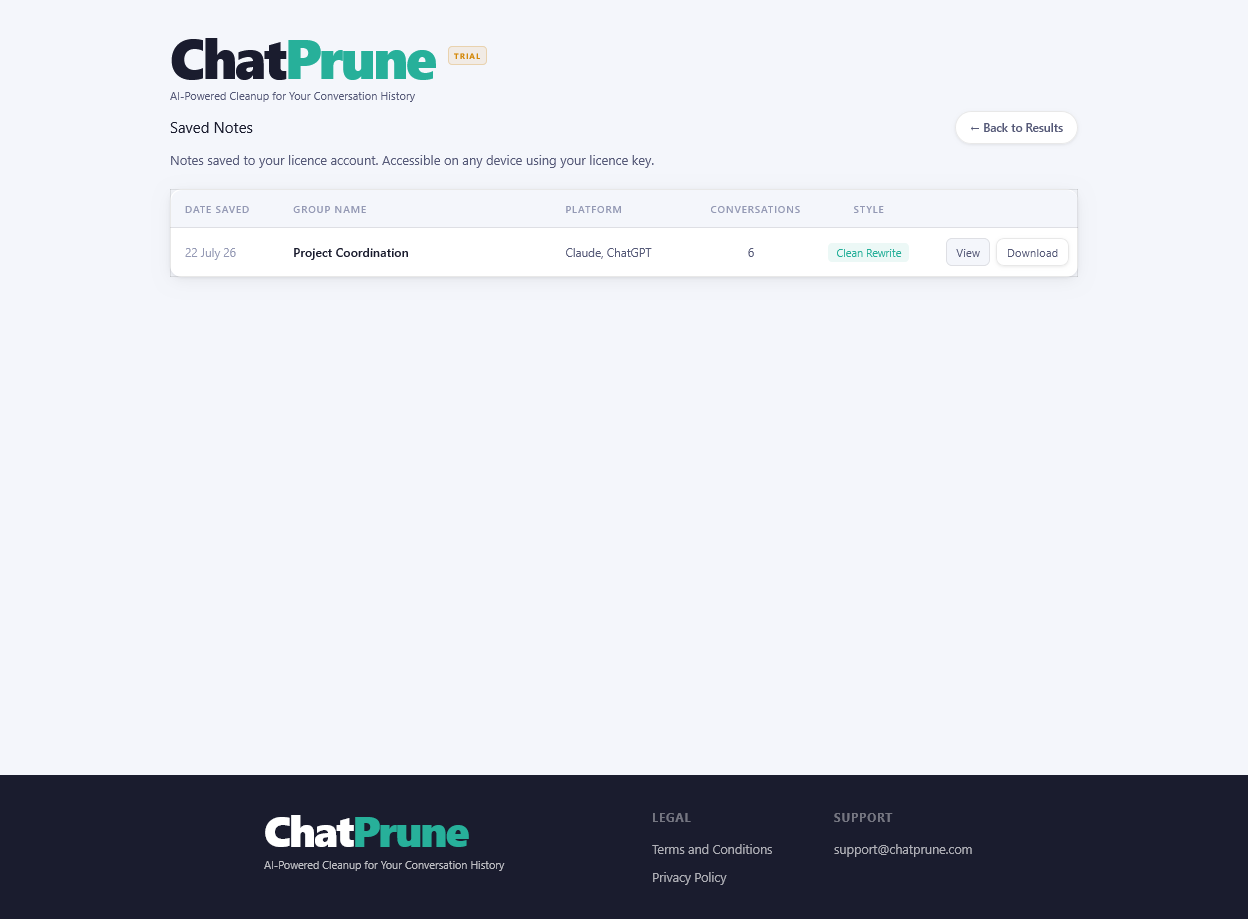
Turn related conversations into one clean document, a Complaint Brief, Legal Notes, or Project Notes, ready to use.
-
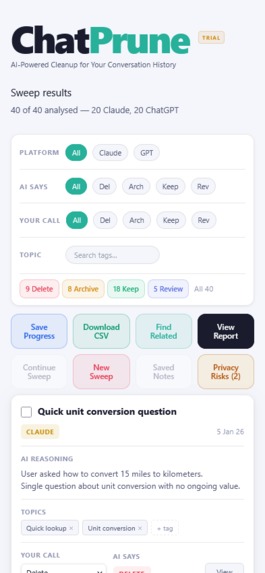
Full mobile support with a card-based results view, built specifically for smaller screens.
-
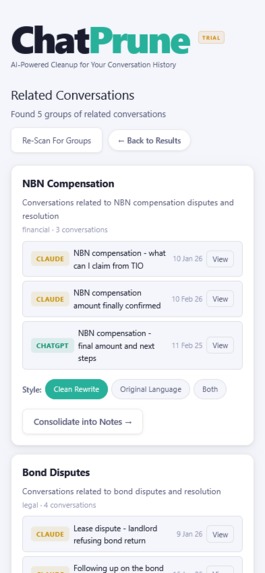
See a related conversation topic across multiple chats? Group them and consolidate into one clean document, right from your phone.
Inspiration
I have a young family, and I went through a long stretch of unemployment, sending out over 500 job applications and getting back only a handful of interviews. That period of unemployment took a real toll, and I went through a period of genuine mental health struggles, the kind that makes you think a lot more than you actually do. I am not a technical person by background, but I care a lot about doing things properly, and I care a lot about people's data actually being theirs, not just a line in a privacy policy nobody reads.
Out of that period, I started building AI powered tools as a way to actually do something, not just think about doing something. That grew into a real business, and along the way, I ended up having real product and business discussions with Claude and ChatGPT across dozens of separate chats, for months. Pricing decisions in one conversation. A bug fix in another. A naming discussion somewhere else entirely. Things would get discussed, decided, and then buried, because nothing was actually shaping up into one clear picture.
I tried using folders and projects to keep things organised, but that only goes so far when the real problem is finding a specific decision buried in a conversation from three months ago, or realising the same topic had been discussed five separate times without anyone, including me, noticing the overlap.
Finding a specific conversation again had become a genuine nightmare. ChatPrune is the tool I actually needed: something that reads through everything, tells me plainly what still matters and what doesn't, and pulls related conversations together so I stop discovering the same problem twice.
What it does
- Upload a Claude and/or ChatGPT conversation export
- ChatPrune analyses every conversation and recommends Delete, Archive, Keep, or Review, with a written reason for each
- Scans conversations for accidentally shared sensitive information (API keys, passwords, phone numbers, addresses, card numbers) and flags them separately as Privacy Risks
- Finds conversations related to each other, even across platforms and months apart, and lets you consolidate them into a single clean document (Complaint Brief, Legal Notes, or Project Notes)
- Nothing is stored on our servers except your email, licence key, topic tags, and your final decisions. Full conversation content and generated notes only ever exist in a file you are required to download at key points, such as after the sweep completes, and again after adding notes
How we built it
This project started as an earlier hackathon build (H0). During the Build Week Submission Period, it was substantially rebuilt and extended using Codex, working from plain English task descriptions rather than writing code directly myself.
The pattern that worked best throughout: test something myself, find a real problem, describe exactly what was wrong, and have Codex investigate the actual cause before applying a fix, rather than guessing. This caught several root causes that a surface fix would have missed. For example, conversations getting stuck showing an AI recommendation of "Review" with no reasoning turned out to be a Groq daily token limit being hit silently, not the AI genuinely being uncertain. That led to building a five model Groq fallback chain, so a free sweep keeps working even if one provider's daily limit is exhausted.
Over the course of the Submission Period this added up to more than thirty real commits: a full pricing and free trial rebuild, a Privacy Risk Detection feature built from scratch, a complete data persistence and download architecture (including a forced download step, since conversation content is never stored on our servers), sweep reliability fixes, and a full mobile specific layout rebuild converting results tables into a card based mobile view.
Challenges we ran into
The process was not always smooth. A number of times GPT 5.6 in Codex made a change on its own that I had not explicitly asked for, and I had to catch the issue, undo the bug, and ask for the change to be redone properly. The back and forth required a lot of testing and investigation work. At times GPT 5.6 within Codex found bugs and issues I was not seeing at all on screen, genuine edge cases. This back and forth was a real part of the process, and part of what made the final result solid rather than just plausible looking.
The most technically interesting challenge was the Groq rate limiting. What looked at first like a simple "slow down the requests" problem turned out to have three separate layers: a per-minute request limit, a per-minute token limit, and a completely separate daily token limit, each of which failed differently and needed different handling. Working through that with GPT 5.6 through Codex, including checking real Groq usage logs to confirm the actual cause rather than assuming, is what led to the fallback chain design.
Accomplishments that we're proud of
Getting the privacy architecture right without compromising it under pressure. It would have been easy to quietly store more than intended to fix a bug faster, but every storage decision was made deliberately, with the motto of "your data belongs to you" checked against what the code actually did, not just what the policy said.
Rebuilding the entire results interface into a proper mobile card layout, including a floating selection bar and consistent navigation, without breaking the existing desktop experience at any point.
Catching the Groq rate limiting issue by actually reading provider logs instead of guessing, which led to a genuinely more resilient five model fallback system rather than a one-off patch.
What we learned
Testing your own product properly, and describing bugs precisely rather than vaguely, makes a real difference in what an AI coding tool can actually fix. "It's broken" gets a guess. "Here's the exact sequence, here's what I expected, here's what actually happened" gets a real diagnosis.
What's next for ChatPrune
The data architecture and privacy model built during this window carries forward directly into a full production launch, on proper hosting and a permanent database, with real payments and account login added on top of what already works here. See the Roadmap section on the live site for what other features are planned next.
Built With
- aws-dynamodb
- codex
- gemini
- gpt-5.6
- groq
- next.js
- react
- resend
- tailwind-css
- typescript
- vercel


Log in or sign up for Devpost to join the conversation.