-
-
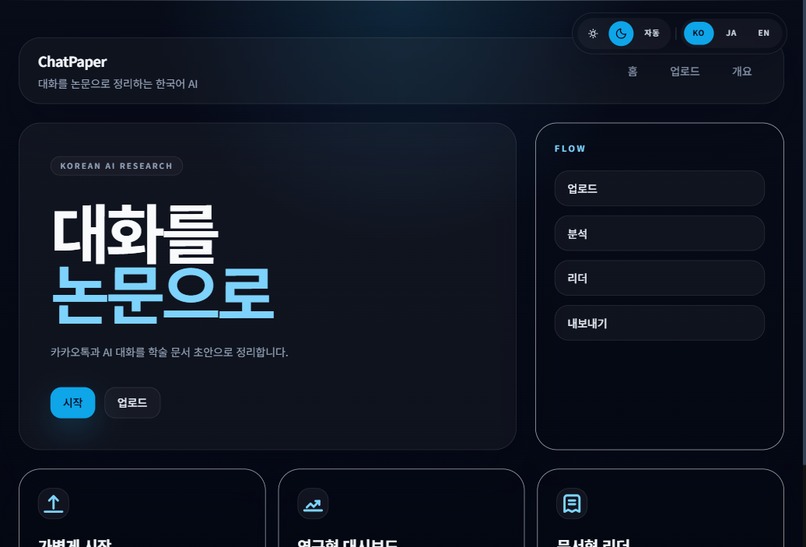
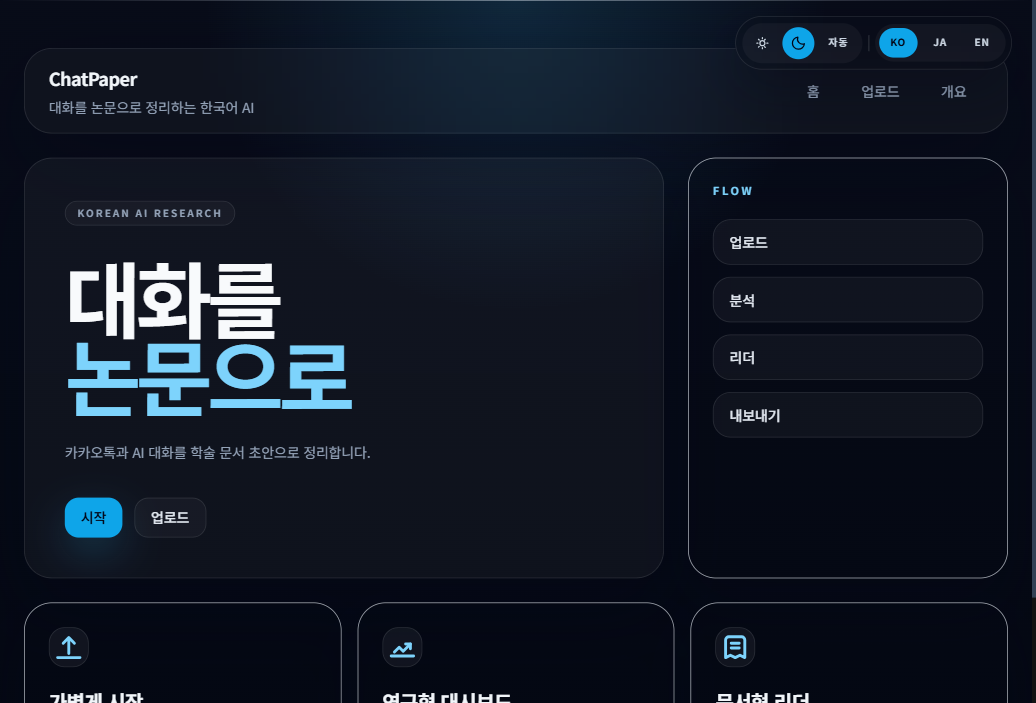
ChatPaper landing page — Upload → Analyze → Read → Export flow
Inspiration
Every day, millions of meaningful conversations happen on KakaoTalk — study groups debating research ideas, teams solving complex problems, friends exchanging deep insights. Yet these conversations disappear, unrecognized as the intellectual work they truly are.
We asked: what if a chat log could become a citable academic paper?
What We Built
chat-paper-platform is a Korean-first SaaS platform that transforms KakaoTalk and AI chat exports into fully structured academic papers — complete with abstract, methodology, results, and references.
The pipeline works in 6 stages:
- Parse — Extract speakers, timestamps, and message threads from raw
.txtexports - Detect — Identify language and conversation structure
- Analyze — Topic clustering and sentiment scoring using NLP
- Generate — Feed structured data into a 6-step LLM prompt pipeline (GPT-4o)
- Format — Render as a proper academic document
- Export — Download as PDF or DOCX
The sentiment score per speaker is modeled as:
$$S_i = \frac{1}{N} \sum_{j=1}^{N} \text{sentiment}(m_{ij}) \in [-1, 1]$$
How We Built It
- Frontend: Next.js 14 App Router + TailwindCSS + shadcn/ui
- Backend: Next.js API Routes + Prisma ORM + PostgreSQL (Neon)
- AI: OpenAI GPT-4o with a 6-stage prompt pipeline
- NLP: Custom KakaoTalk parser, language detection, topic clustering
- Export: PDF and DOCX generation with multilingual font support
- Privacy: Local anonymization — names and contacts masked before any data leaves the device
Challenges
- KakaoTalk format parsing is undocumented and changes across app versions — building a robust parser required handling dozens of edge cases
- Academic tone generation in Korean required careful prompt engineering to avoid machine-translation artifacts
- Privacy by design — ensuring personal data never hits the server unmasked was a non-trivial architectural constraint
What We Learned
Conversations have latent academic structure — argument, evidence, counter-argument, conclusion. LLMs are surprisingly good at surfacing it, given the right scaffolding.
The biggest insight: the hardest part wasn't the AI. It was the parser.
Built With
- docker
- docx
- next.js-14
- nextauth.js
- node.js
- openai-gpt-4o
- pdf-generation
- postgresql-(neon)
- prisma-orm
- redis-(upstash)
- shadcn/ui
- tailwindcss
- typescript
- vercel
- zerve


Log in or sign up for Devpost to join the conversation.