-
-
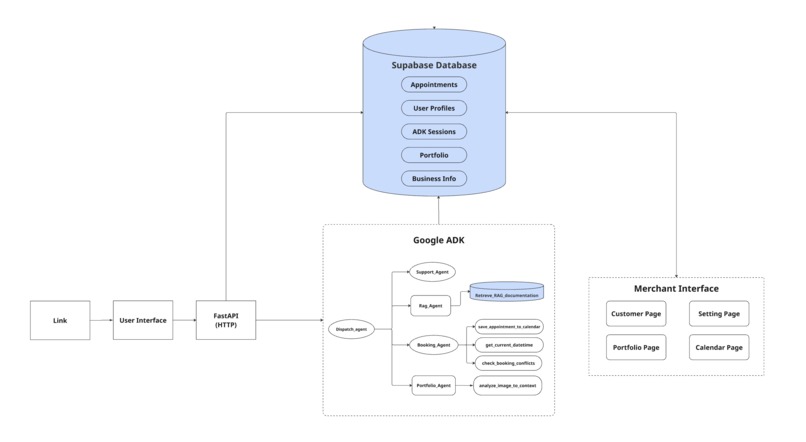
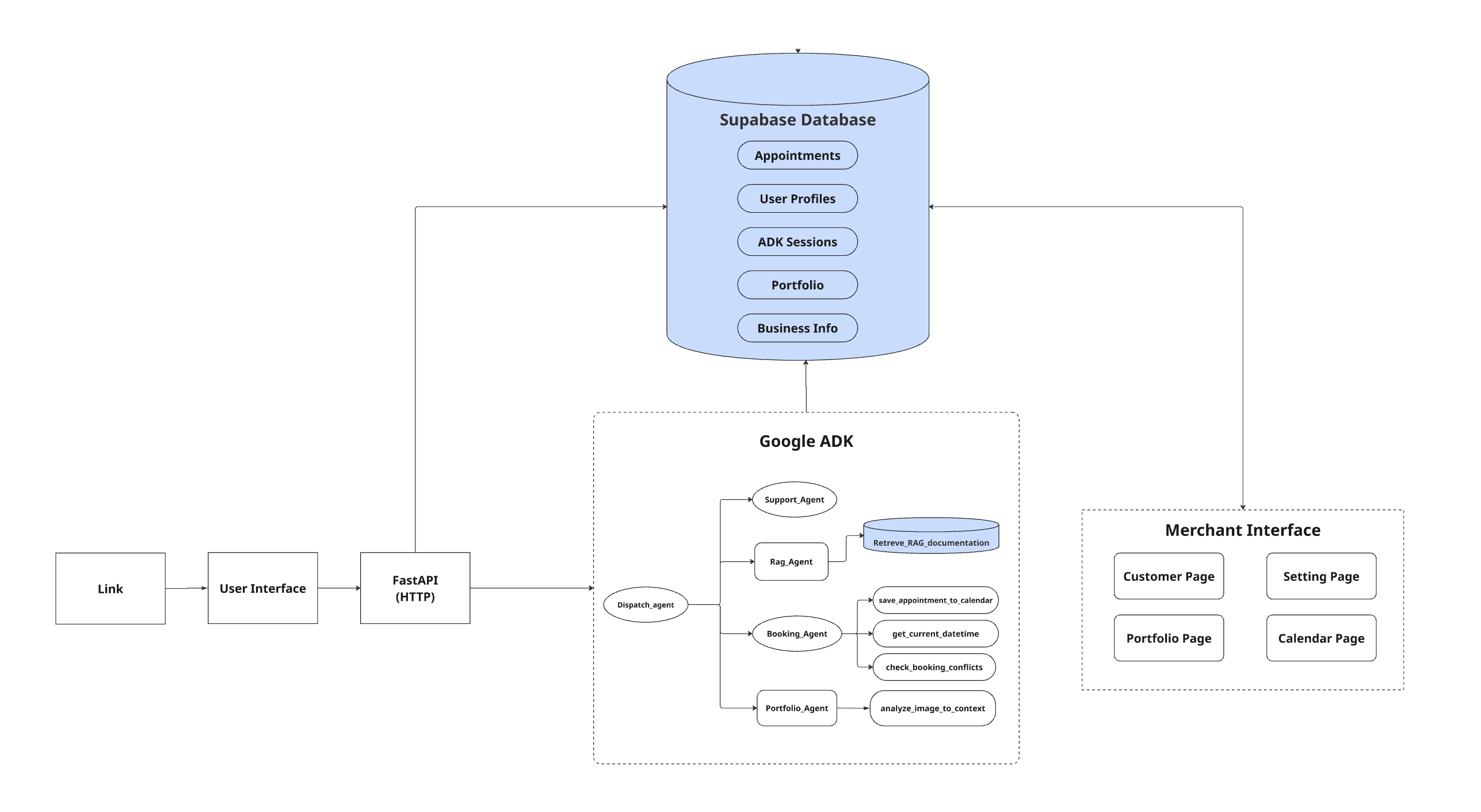
architecture diagram
Inspiration
Because every seller deserves an AI agent. Millions of solo sellers and small service providers still handle client communication manually across different platforms like Instagram, TikTok, and YouTube. They respond to messages late at night, juggle bookings, and repeat the same FAQs — all without a support team. We wanted to build an AI-powered solution that gives these everyday entrepreneurs the same automation power as big businesses.
What it does
ChatNap is a multi-agent AI assistant that helps solo sellers automate customer engagement and backend operations. It combines two key components:
Dual Interfaces
- Customer Interface
A chat widget that supports text, image, and voice input. It can be shared via link or QR code across bios, websites, or posts, allowing customers to inquire and book with ease. - Merchant Dashboard
A control panel that gives business owners full oversight of their AI assistant through four modules:- Customers – View real-time conversations, platforms, and summaries
- Calendar – Manage bookings in daily, weekly, or monthly views
- Settings – Upload FAQs, pricing, and documents to power AI replies
- Portfolio – Upload and tag past work to enable image-based service matching
- Customers – View real-time conversations, platforms, and summaries
Multi-Agent AI System (Powered by Google ADK)
Tasks are routed to specialized agents:
- Booking Agent – Handles scheduling and conflict detection
- Portfolio Agent – Matches customer-uploaded images to past work using visual embeddings
- RAG Agent – Answers questions using Retrieval-Augmented Generation from uploaded documents
- Support Agent – Acts as fallback for general or unclassified queries
How we built it
- Frontend: Next.js, React, Tailwind CSS, TypeScript
- Backend: FastAPI (Python), Supabase (PostgreSQL)
- AI/ML:
- Google ADK for multi-agent orchestration
- Vertex AI for LLM capabilities
- Visual embeddings for image matching
- Google ADK for multi-agent orchestration
- Demo Data: The current prototype uses mock merchant-uploaded documents (e.g., service descriptions, FAQs, and pricing files) to simulate RAG-based responses.
Challenges we ran into
- Learning Curve: This was our first time working with multi-agent systems and ADK. Everything was new.
- Rapid Changes: Google ADK is updated frequently during development, requiring us to adapt to shifting toolsets.
- Time Constraints: As a two-person team, we had to prioritize core features and simulate others using mock data.
Accomplishments that we're proud of
- Built a working multi-agent AI assistant in two weeks
- Successfully integrated booking logic, document-driven Q&A, and visual matching prototypes
- Designed a full-stack system from scratch with scalable architecture
- Learned to work fast and iterate in a constantly changing AI environment
What we learned
- How to build with Google’s ADK and manage multi-agent workflows
- How fast AI tooling evolves — and the importance of staying agile
- That AI can empower real people, not just tech giants
- End-to-end full-stack experience: from backend logic to frontend UI/UX to AI orchestration
What's next for ChatNap-AI-Powered Customer Operations Assistant
- Complete backend integration for custom FAQs, business profile syncing, and image matching
- Add real-time chat takeover with socket support
- Fully integrate all existing UI components with backend logic, ensuring a complete, end-to-end experience across both the customer interface and merchant dashboard.
Built With
- adk
- fastapi-(python)
- google-vertex-ai
- next.js-(react)
- supabase
- tailwind
- typescript


Log in or sign up for Devpost to join the conversation.