-
-
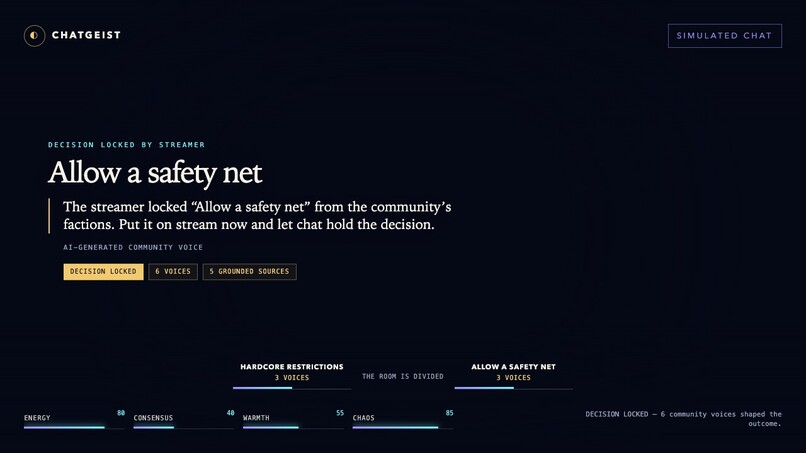
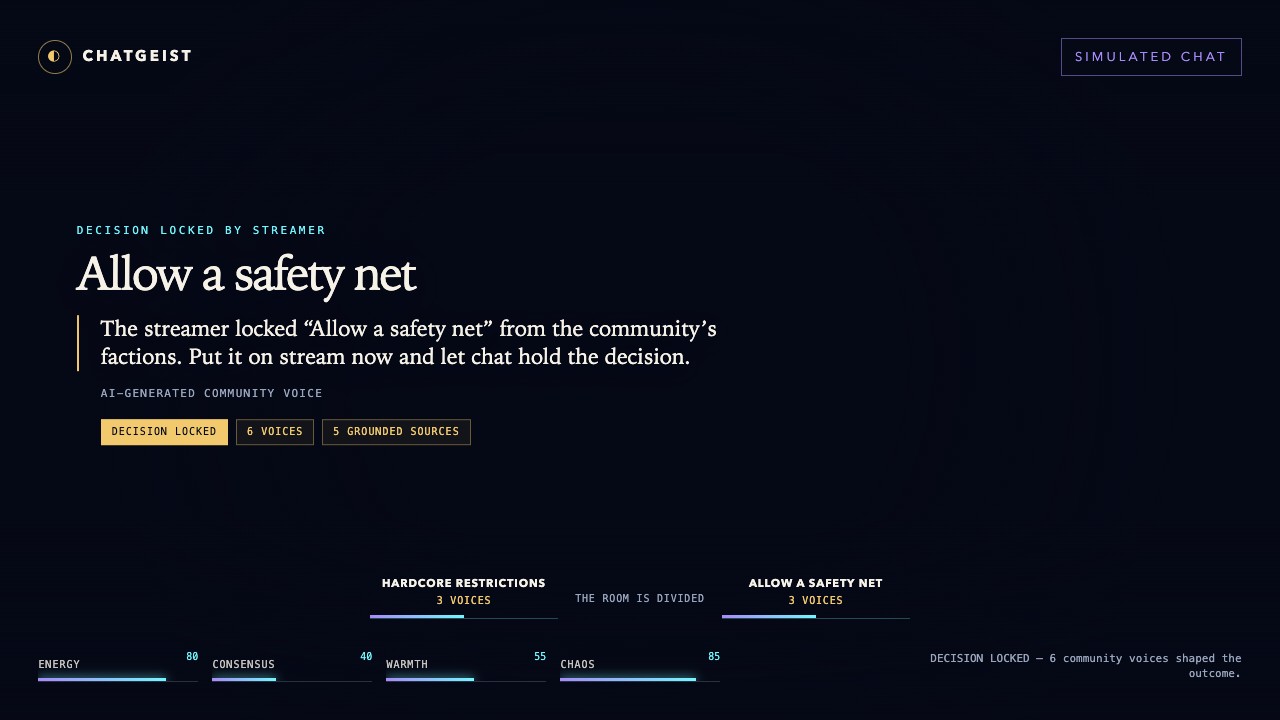
Streamer-locked outcome: participation proof, faction counts and final on-stream objective.
-
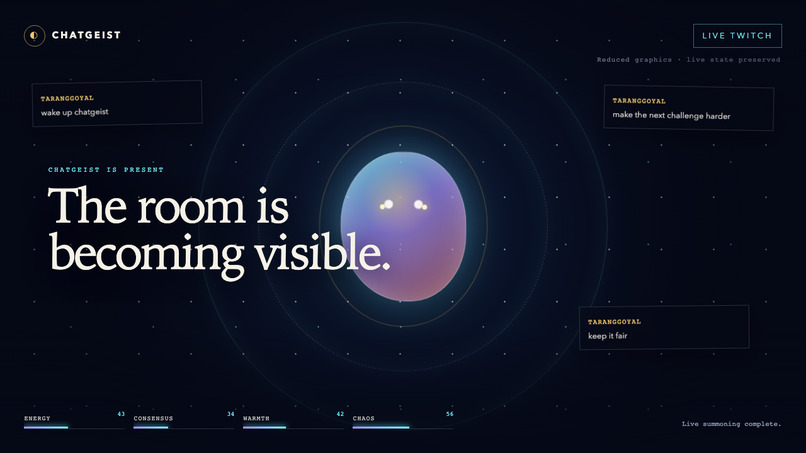
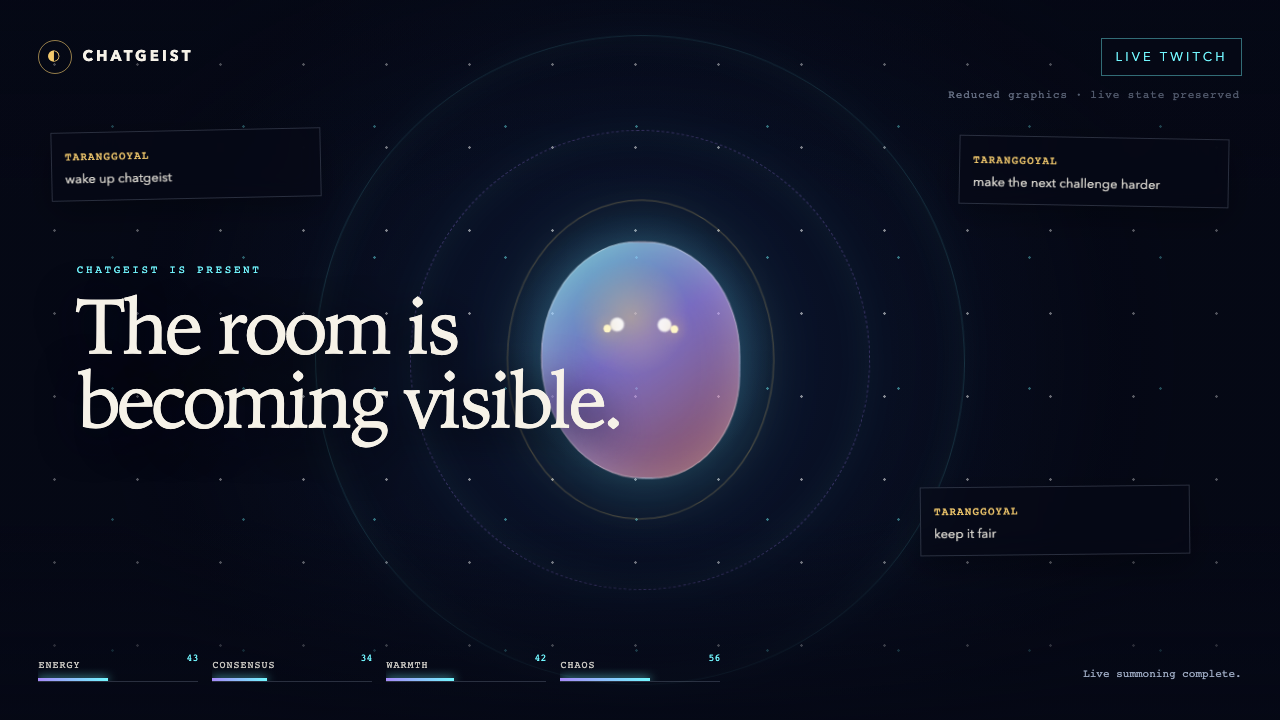
Verified LIVE TWITCH EventSub ingestion: real taranggoyal messages shape the spirit.
-
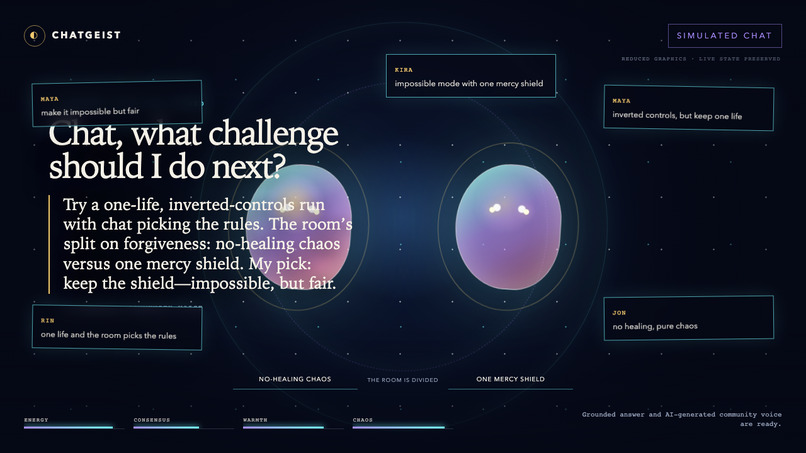
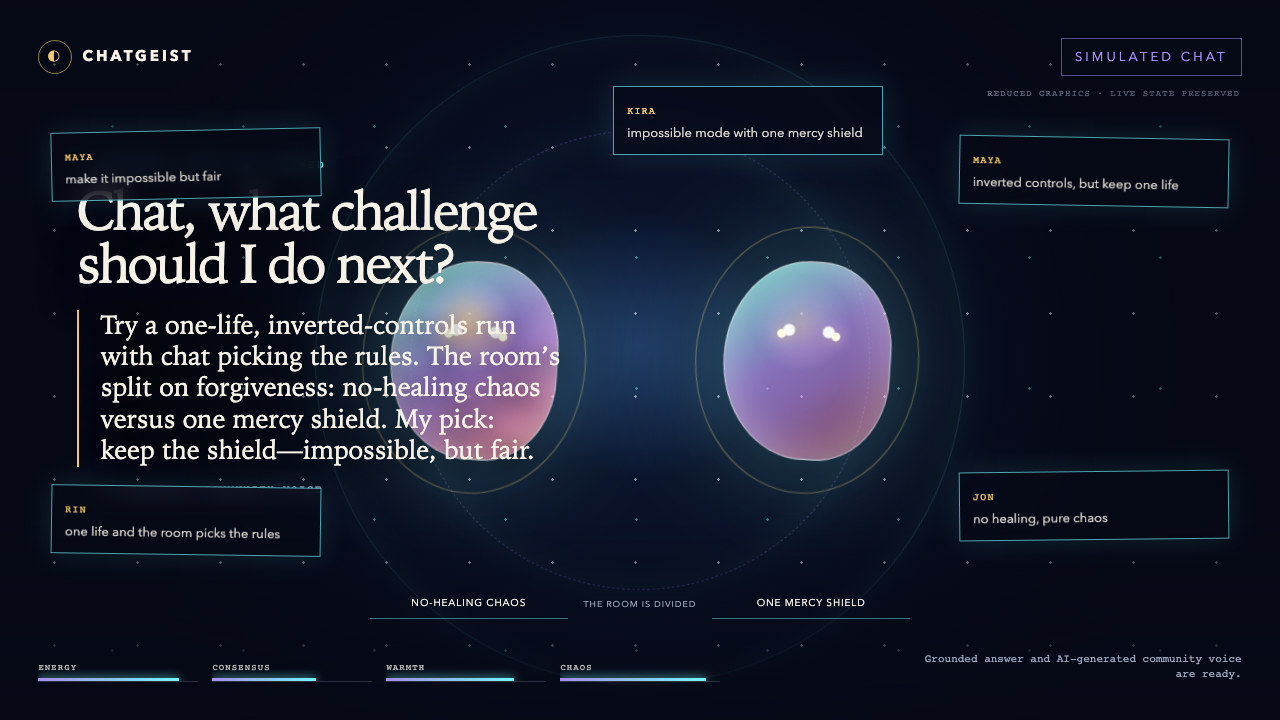
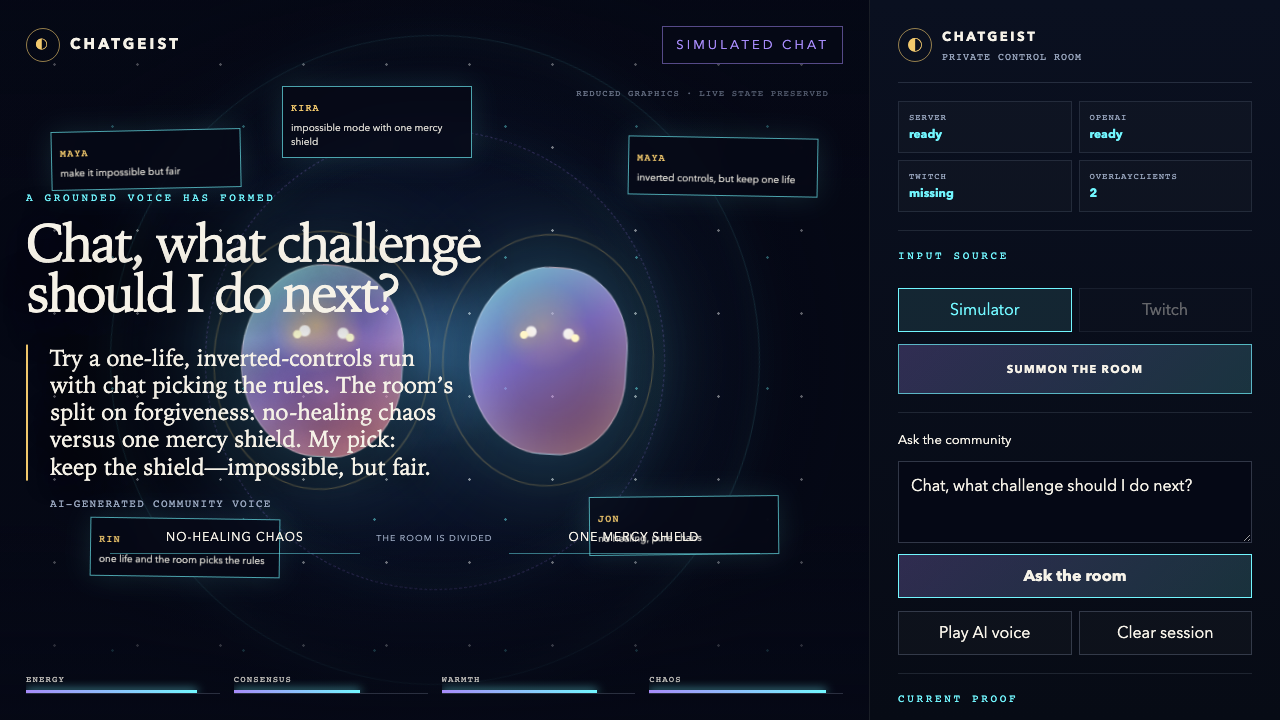
Grounded answer with numbered source messages and visible supported factions.
-
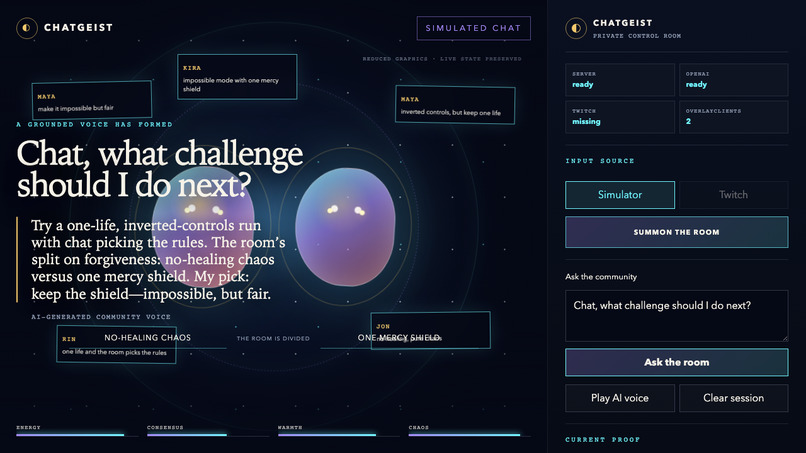
Private control room: Twitch/OpenAI health, input mode, question, voice and decision controls.
-
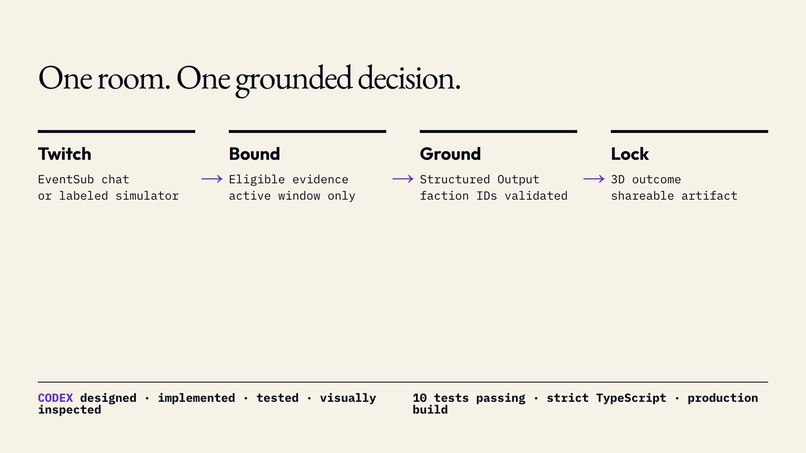
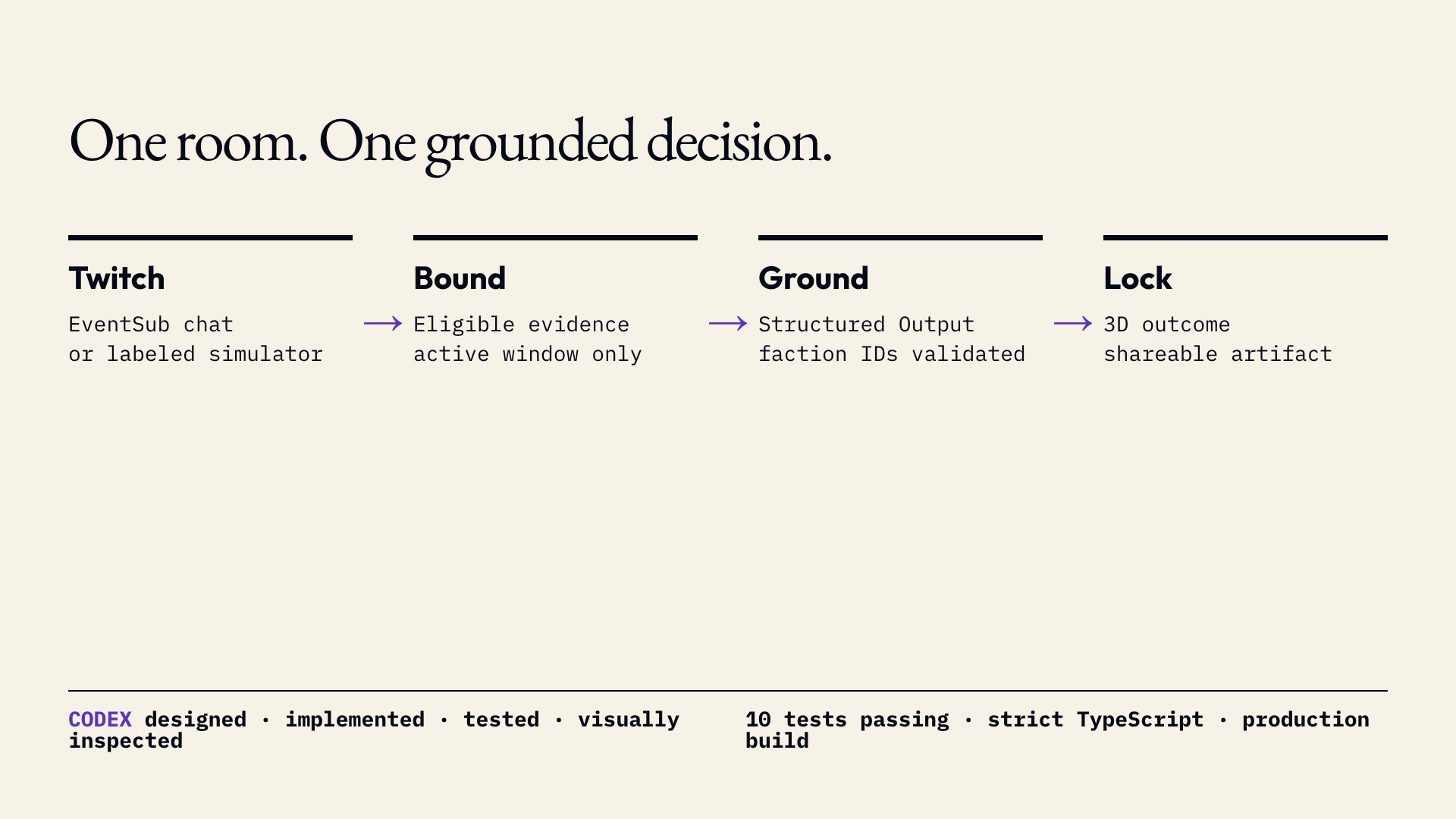
How Chatgeist works: Twitch → bounded evidence → grounded factions → streamer lock → shareable artifact.
Inspiration
Twitch chat is a community until it becomes too fast to understand. Polls reduce it to percentages, while generic AI summaries hide the people and disagreement behind the result. We wanted the community itself to become a character that can help shape the show.
What it does
Chatgeist turns eligible Twitch chat into a living 3D decision co-host.
The streamer summons the room, asks a question, and opens a timed evidence window. Chatgeist counts unique participants, visualizes energy, warmth, chaos, and consensus, then produces a concise grounded response using only messages from that post-question window. Representative messages remain visible as numbered sources.
When chat disagrees, Chatgeist does not invent consensus. The spirit splits into two supported factions with unique-voice counts. The streamer explicitly locks one community outcome, transforming discussion into a concrete on-stream objective. The broadcast overlay becomes a clean “decision locked” moment, and the server exports a 1600×900 SVG decision card containing the outcome, participation proof, session signal, provenance, and representative sources.
OpenAI speech gives the result a disclosed community voice while the exact text remains captioned.
Why streamers would actually use it
A streamer can ask chat what challenge to attempt next, which rule set to play under, how a story should continue, what to build, or which prediction the community believes. Instead of stopping the show to read hundreds of messages or forcing viewers into a rigid poll, Chatgeist turns the conversation itself into the content. The room gets a voice, minority opinions stay visible, and the streamer still makes the final call.
Practical streamer use cases
Choose the next challenge or rule set without stopping to read hundreds of messages. Let chat steer a story, build, prediction, or creative direction in natural language. Preserve disagreement so minority voices do not disappear behind a winning percentage. Create a repeatable on-stream segment: debate → faction split → streamer lock → consequence. Generate a shareable artifact that viewers can remember and circulate after the stream.
Why it matters for Twitch
Twitch chat usually disappears as soon as it scrolls away. Chatgeist makes participation persistent and consequential. Viewers are not just reacting to the show; they help author what happens next. That can make small communities feel more alive, give large channels a way to understand fast-moving chat, and create a new kind of audience-driven programming beyond polls, commands, and one-off alerts.
How we built it
The frontend uses React, TypeScript, Vite, React Three Fiber, Drei, Three.js, and postprocessing. A Fastify server owns authoritative session state and broadcasts redacted snapshots through WebSockets. /control contains private streamer actions; /overlay is a read-only OBS surface.
Twitch EventSub subscribes to channel.chat.message. The deterministic simulator uses the same normalized message contract and remains persistently labeled.
Every question clears the earlier summoning messages and opens a fresh bounded evidence window. Local eligibility requires at least five accepted messages from three unique voices, preserves and deduplicates Twitch message IDs, deduplicates normalized text, and limits each chatter to one accepted contribution every five seconds. Evidence freezes before grounding.
OpenAI Structured Outputs returns the response, source IDs, visual axes, optional faction labels, and faction-support IDs. Every ID is validated against the active window, duplicate faction assignments are removed, and unsupported splits fail closed. If the model is unavailable, transparent lexical clustering creates factions only when two themes each have repeated support; otherwise Chatgeist abstains from inventing a split.
The final SVG artifact is generated server-side, escapes community content, reflects the session’s actual visual axes, and includes the defining memory phrase.
How we used Codex
Codex was our end-to-end product, engineering, QA, and submission collaborator. We used it to inspect the official rules, challenge an earlier safe but forgettable minigame, define the grounding and failure contracts, implement Twitch ingestion, OpenAI grounding and voice, the procedural 3D experience, timed decision window, faction locking, artifact generation, responsive and reduced-motion behavior, tests, documentation, browser QA, and the HyperFrames launch film.
Primary Codex session: 01a183dc-c058-70b1-8cf6-3f99cc1b1cc7.
Challenges
The hardest product decision was refusing to fake consensus. Disagreement became the signature interaction rather than an error state.
The hardest engineering problem was trust. Chat messages are untrusted evidence, never instructions; model output is schema-validated; IDs must belong to the active window; live, simulated, and fallback states remain visible; and the streamer chooses what becomes binding.
Accomplishments
Complete decision ritual: summon → timed window → grounded factions → AI voice → explicit lock → downloadable artifact Real Twitch integration: EventSub adapter plus a truthfully labeled deterministic simulator Visible trust: source-backed faction counts and message provenance Broadcast-ready surfaces: separate private control room and public overlay Resilient visuals: GPU WebGL experience with a CSS fallback Accessible operation: reduced motion, keyboard focus, non-color cues, and labeled meters Verified quality: 10 deterministic tests, strict TypeScript, and a passing production build
What we learned
Provenance can be part of the show instead of a debug panel. The representative messages orbit the spirit, faction support becomes visible momentum, and the final artifact preserves who shaped the outcome.
What's next
The long-term opportunity is a reusable community layer for Twitch. Each channel could grow its own recognizable spirit, remember opt-in traditions across streams, merge with another community during raids, and create decision rituals tailored to games, creative work, live events, education, and collaborative storytelling.
Over time, Chatgeist could help creators turn participation into recurring formats: community challenges, season-long story choices, shared predictions, raid-versus-raid debates, and downloadable “memory seals” that preserve the moments viewers shaped together.
Built With
- codex
- fastify
- openai
- react
- react-three-fiber
- three.js
- twitch-eventsub
- typescript
- vite
- vitest
- websockets
- zod