-
-
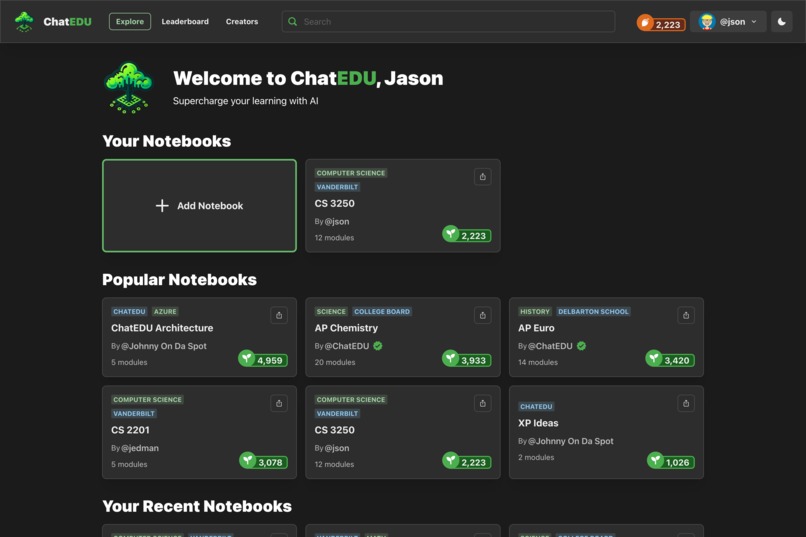
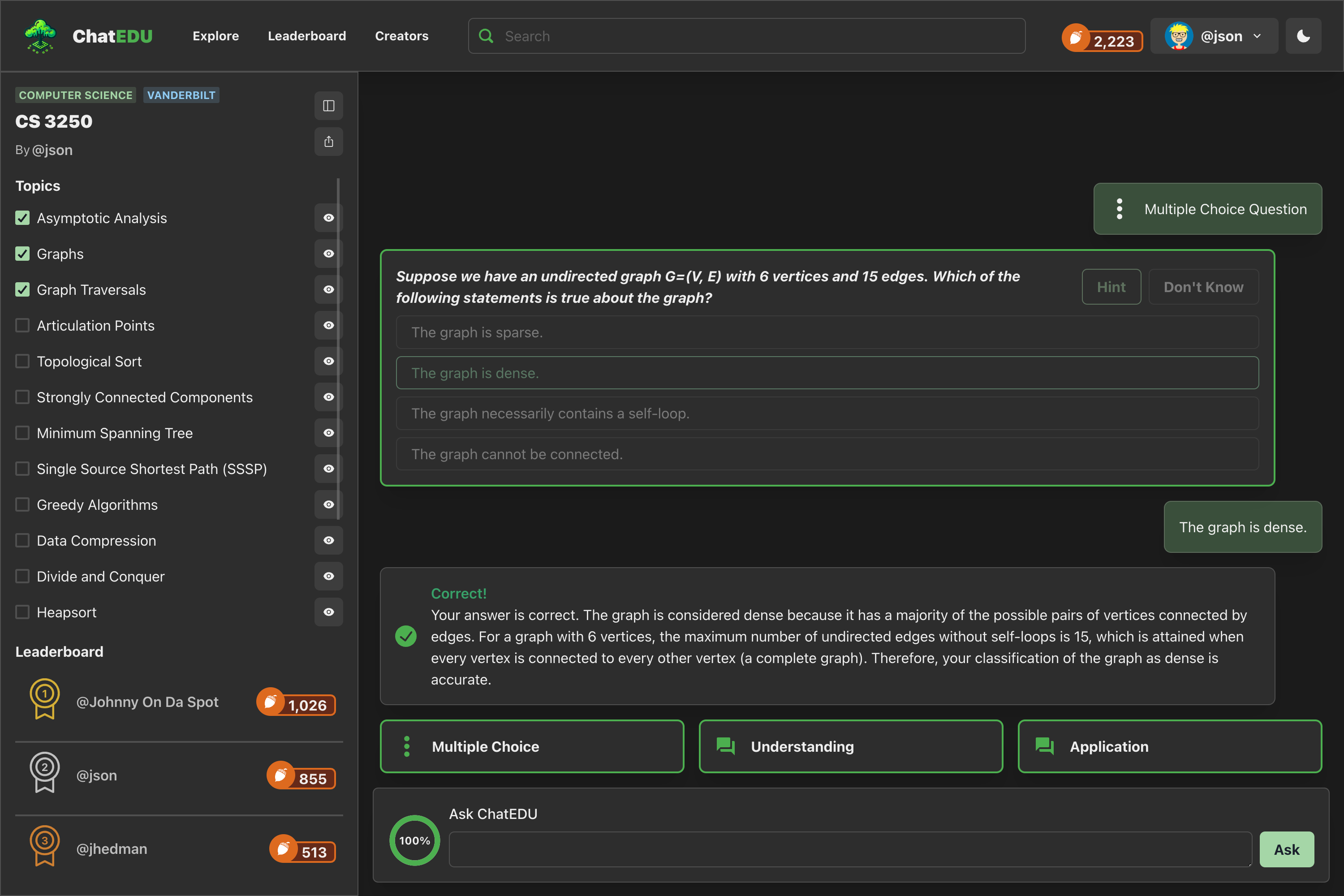
Explore Page
-
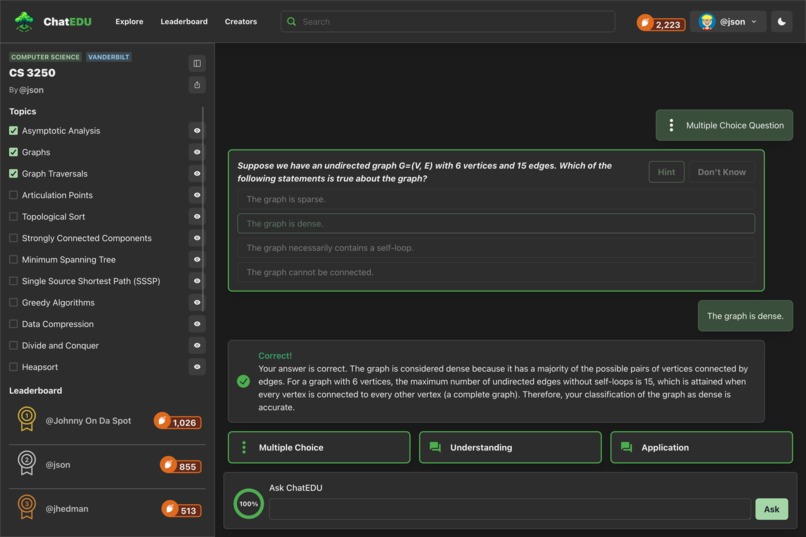
Learn Page
-
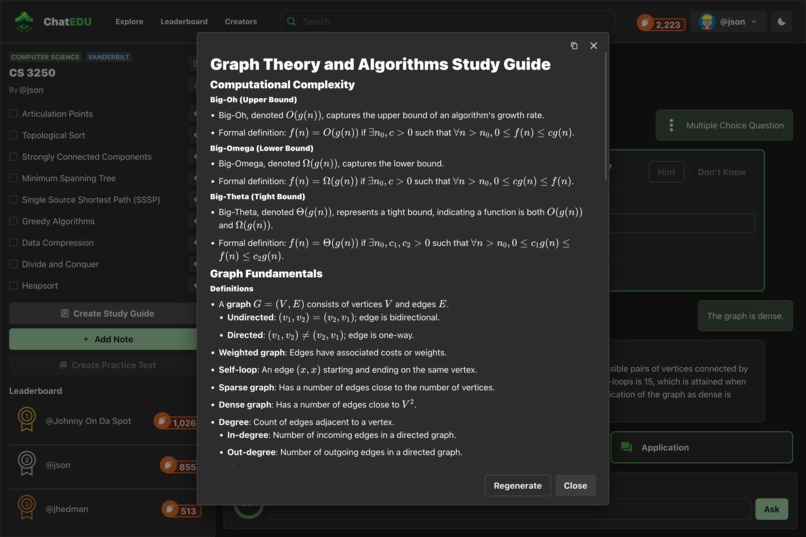
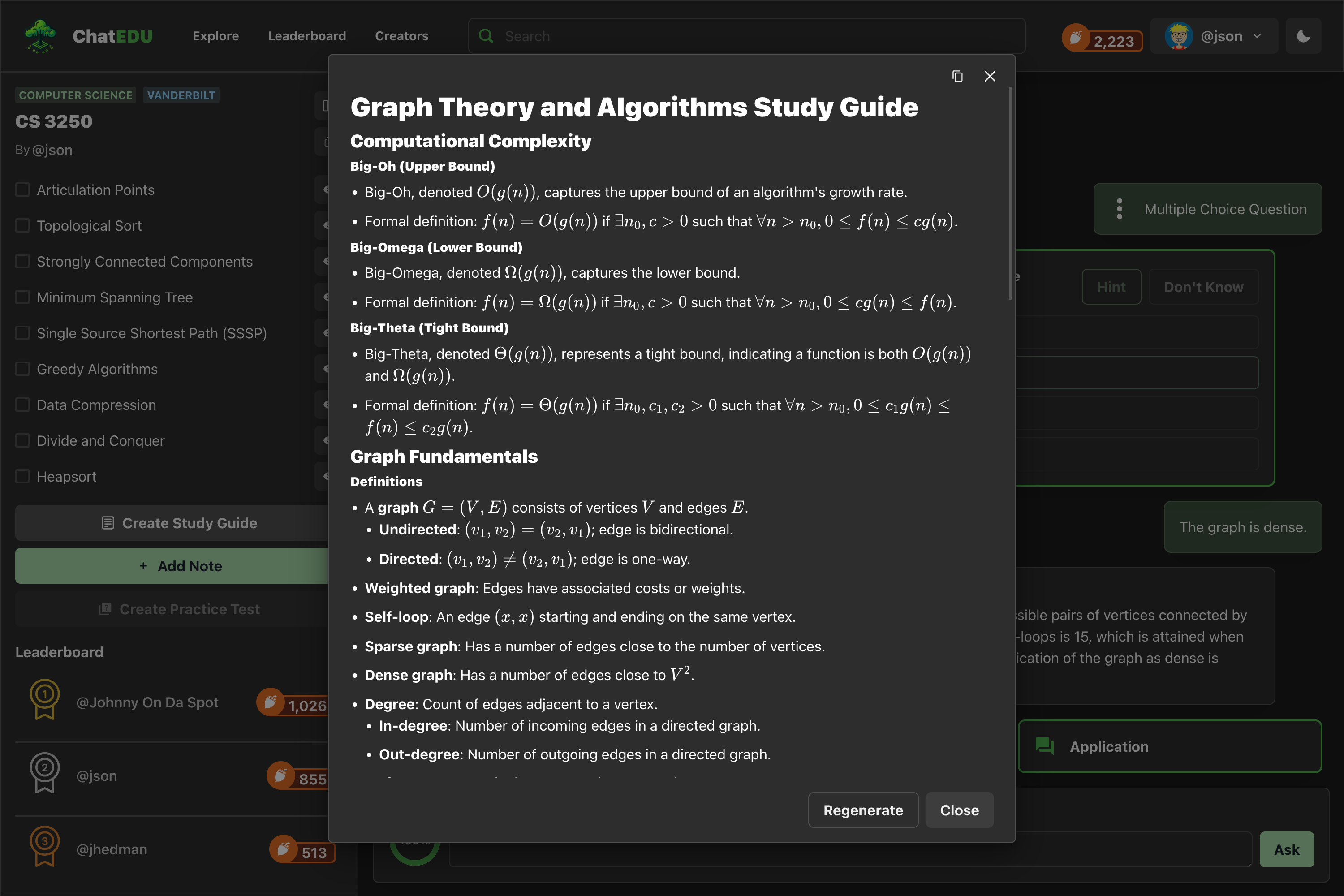
Study Guide Generation
-
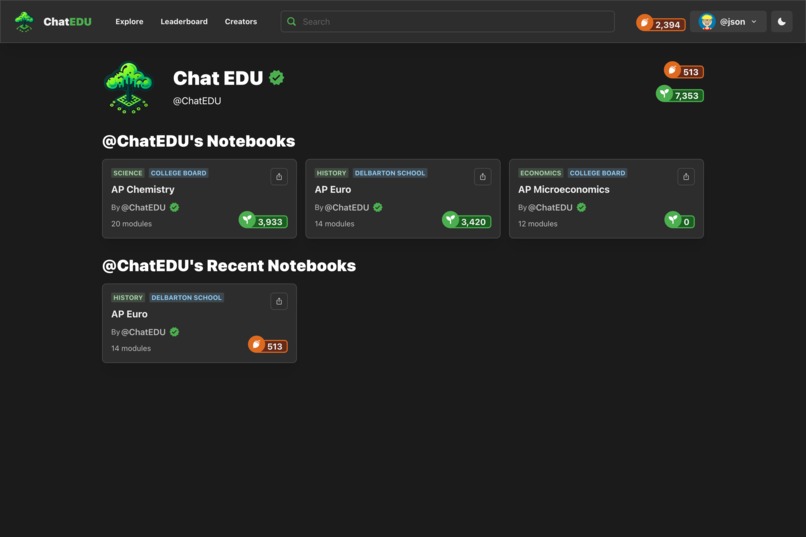
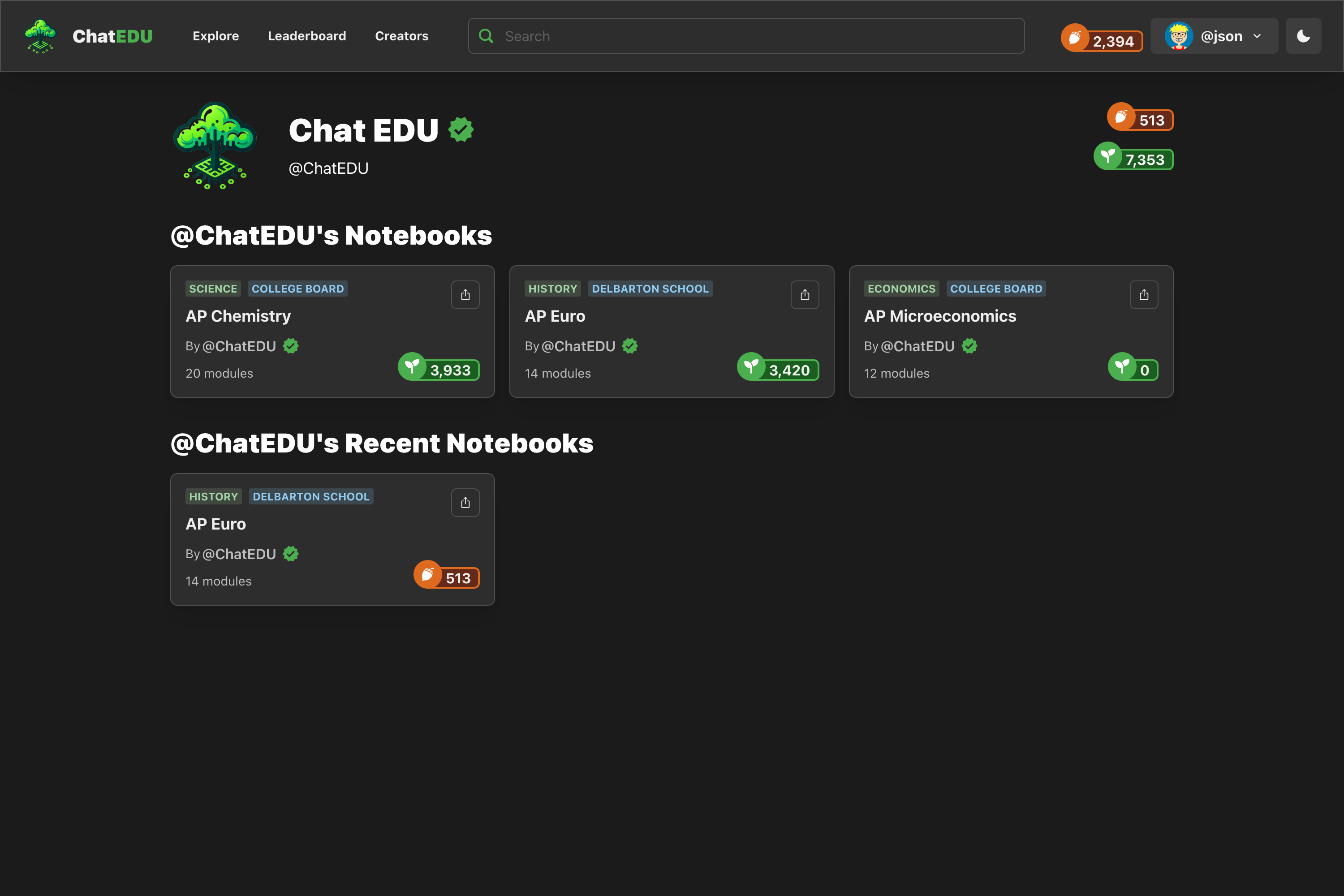
Profile Page
-
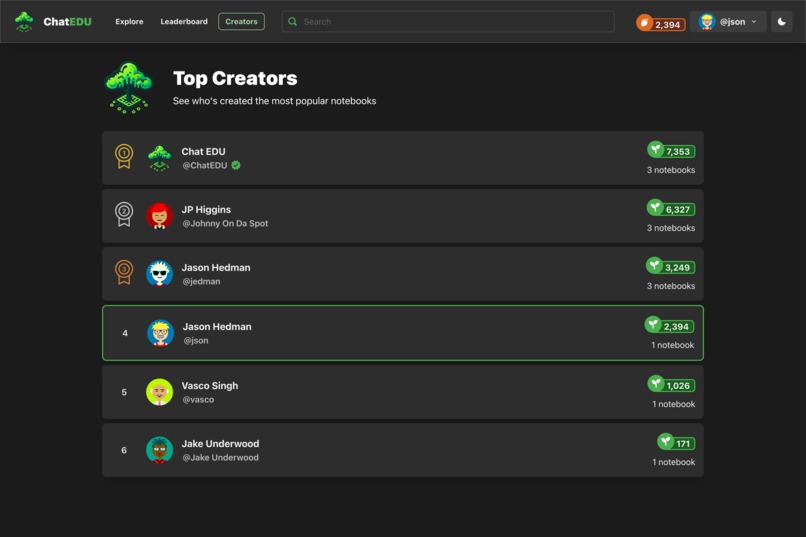
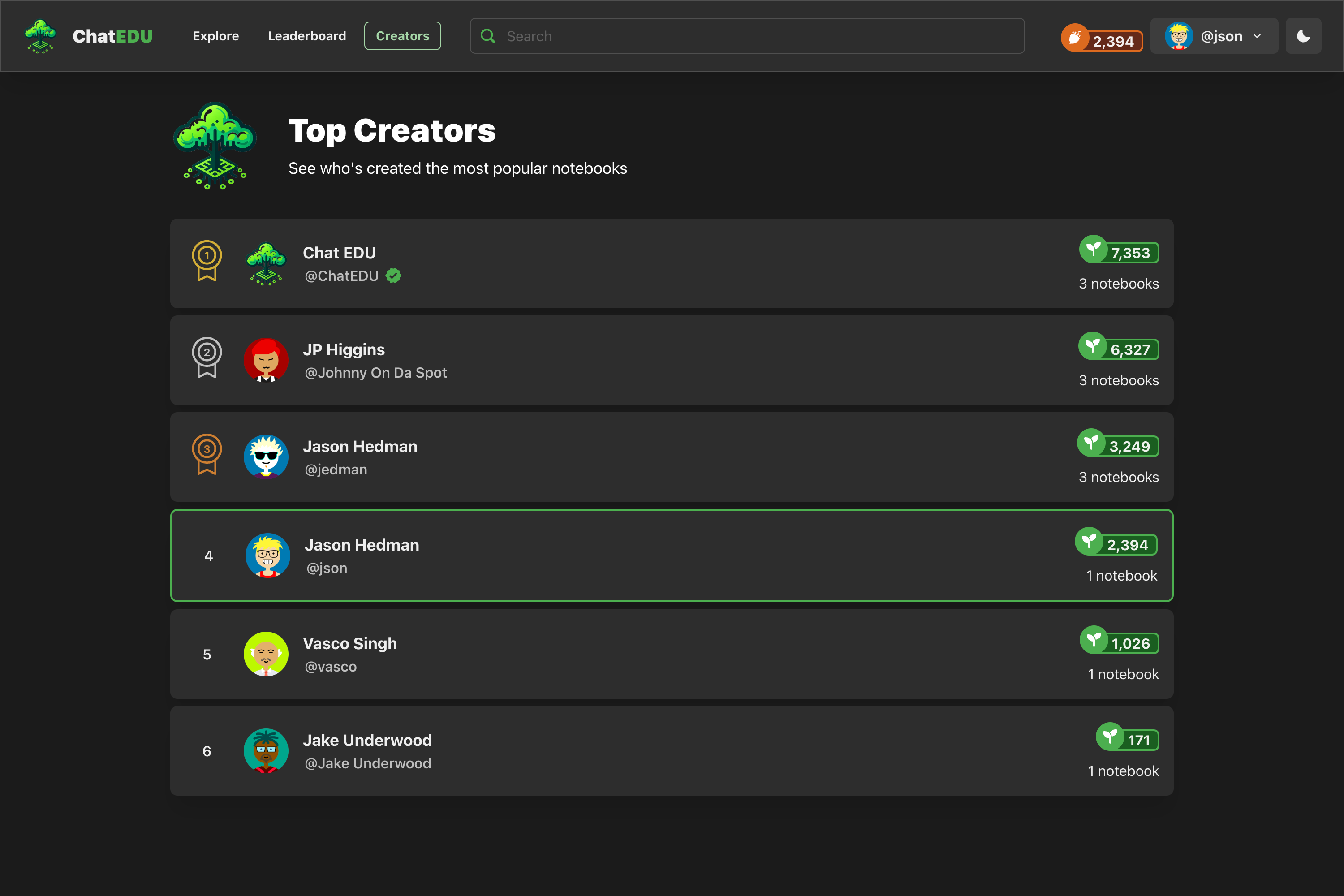
Creator Leaderboard
-
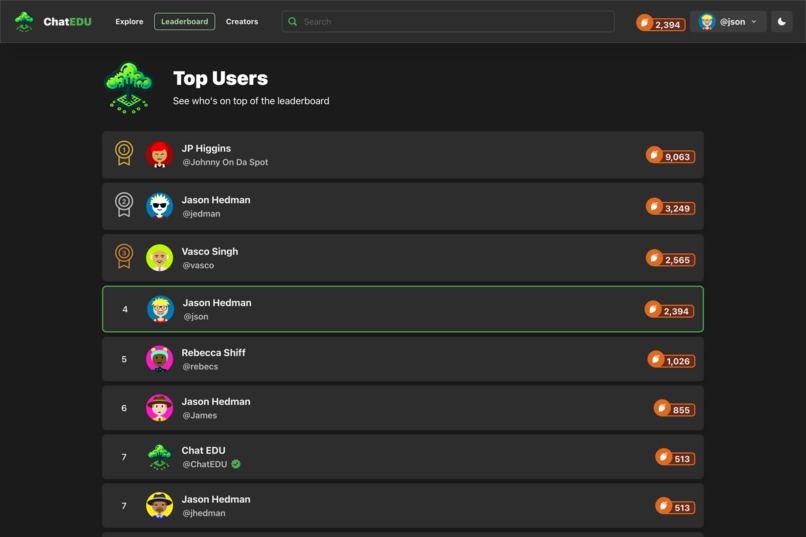
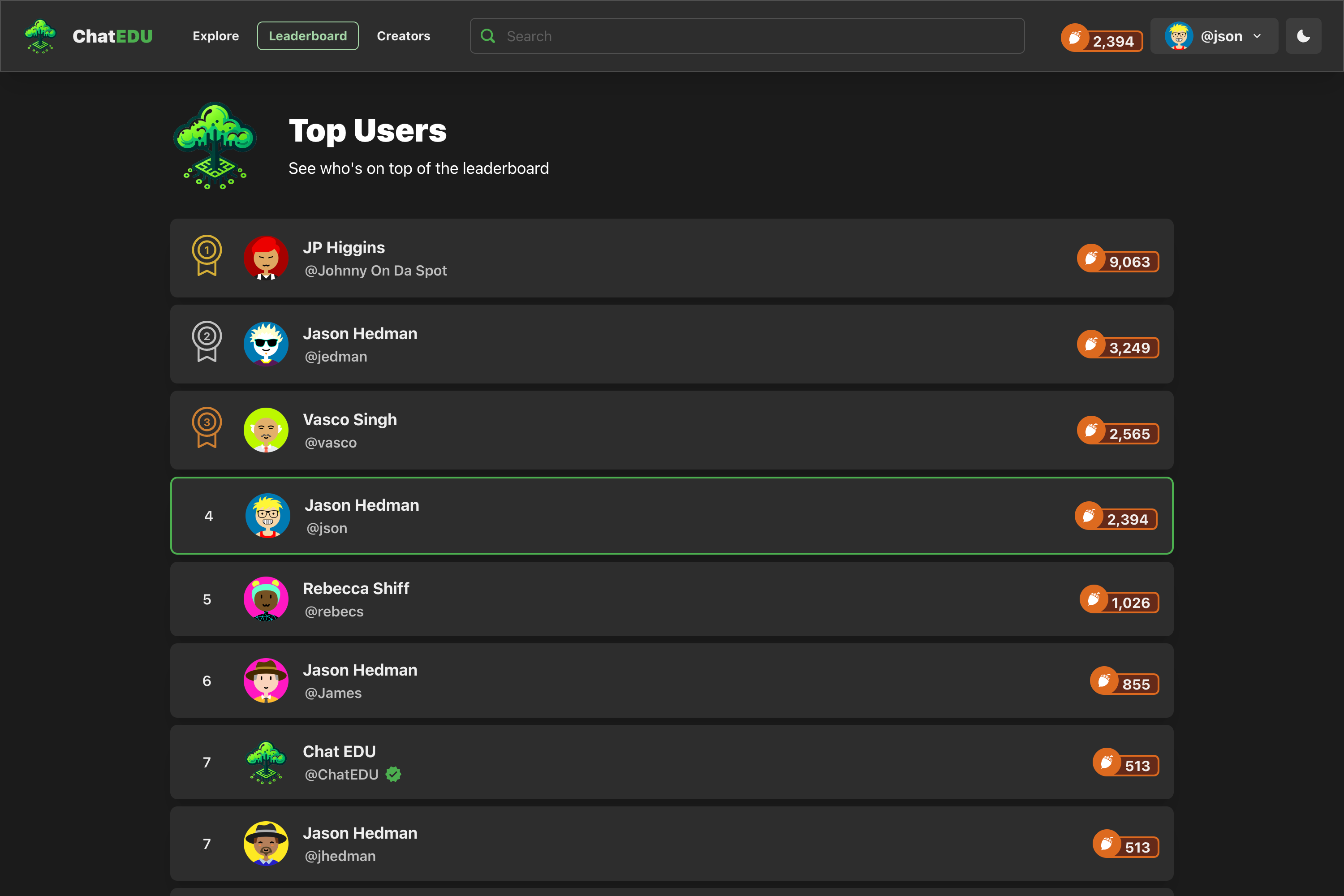
User Leaderboard
-
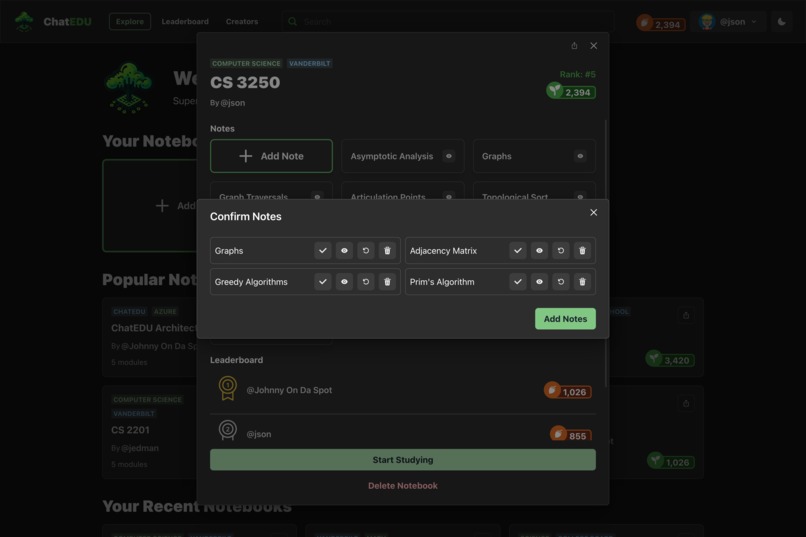
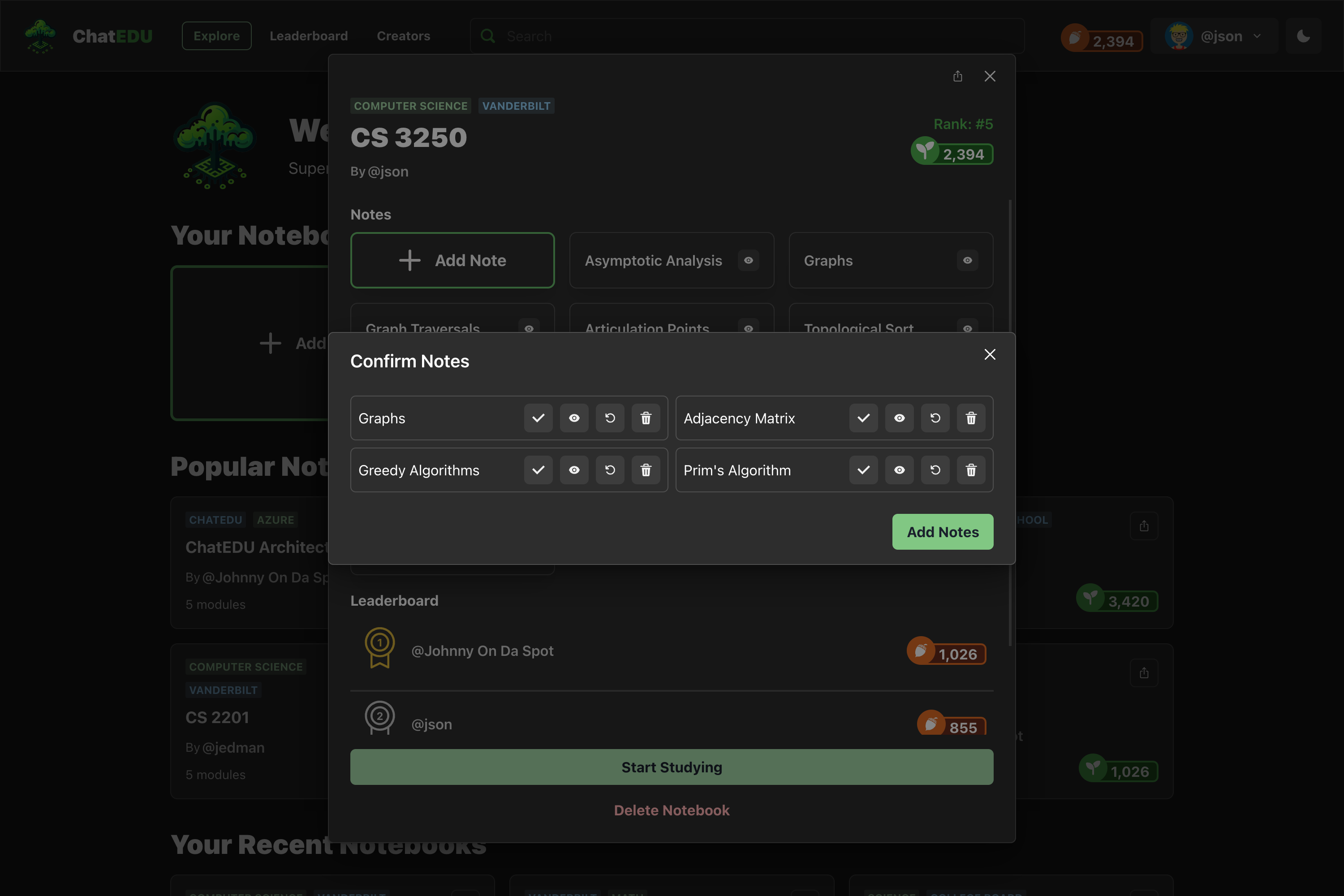
Note Generation
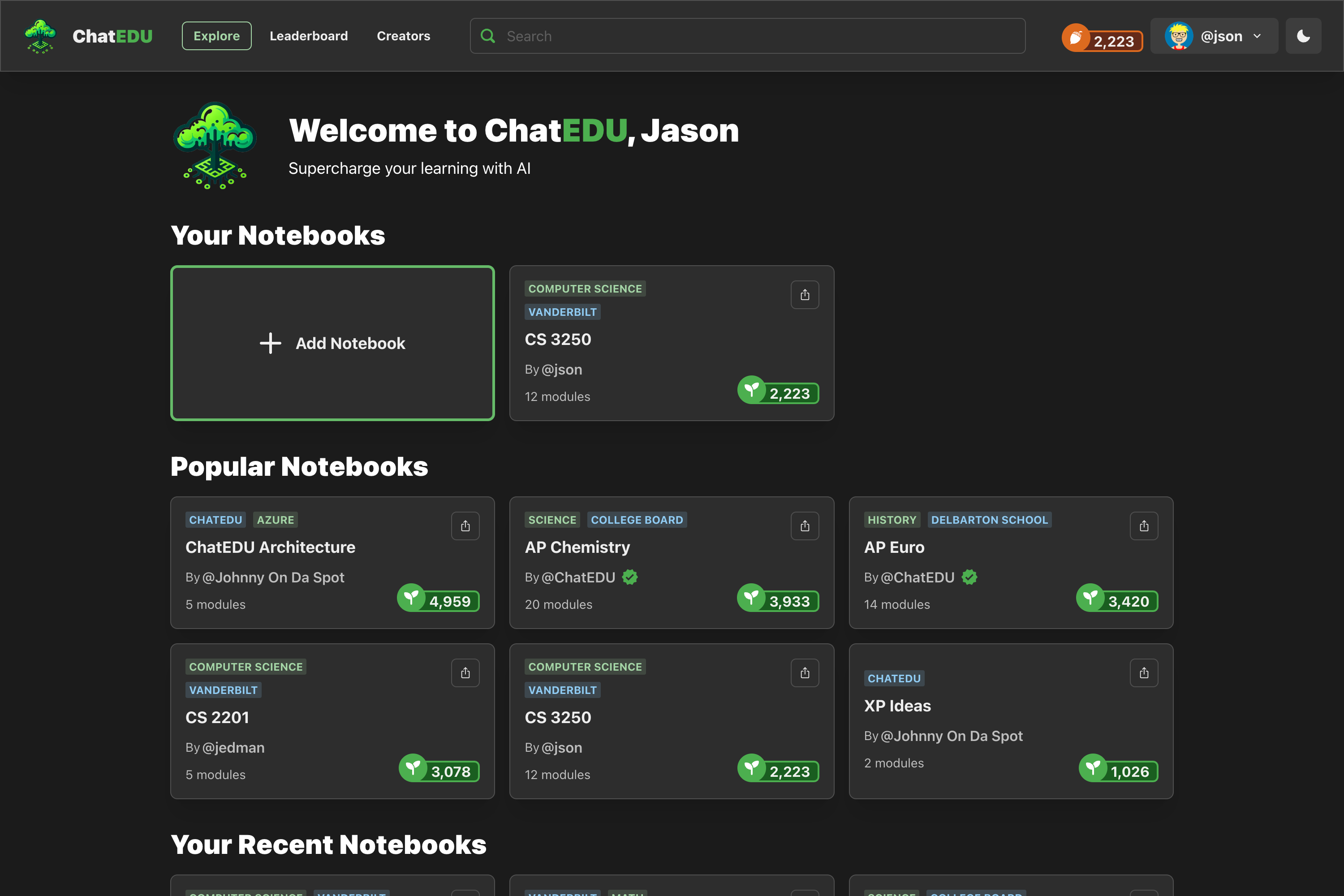
ChatEDU: Revolutionizing Education with Azure AI
Overview
ChatEDU is not just an educational tool; it's a revolution in learning. By harnessing the power of Azure AI, including GPT-4 and Azure's diverse databases and services, we transcended traditional learning methods. Our platform transforms any text or file into an immersive tutoring experience, offering personalized study guides, multiple-choice tests, long answer formats, and context-driven sessions. This is education reimagined.
How it Works
In ChatEDU, a notebook refers to a personalized digital space where users can create and manage their educational content. A note is an individual piece of content within a notebook, such as a text excerpt, a summary, or a user-uploaded document. Study sessions are interactive learning experiences generated by the app, which uses the content from notes to create personalized study guides, quizzes, and other learning materials.
These sessions adapt to the user's input and performance, providing a tailored educational experience that leverages Azure AI's capabilities to transform notes into dynamic, context-driven learning opportunities.
Getting Started
Try out ChatEDU by visiting https://azure.chatedu.io/, where you can explore the various notebooks we have already created. If you want to create your own notebook, start by logging in with your Microsoft or Google account. From there, you can create a notebook, add your notes, and kickstart your interactive learning experience!
Technical Architecture
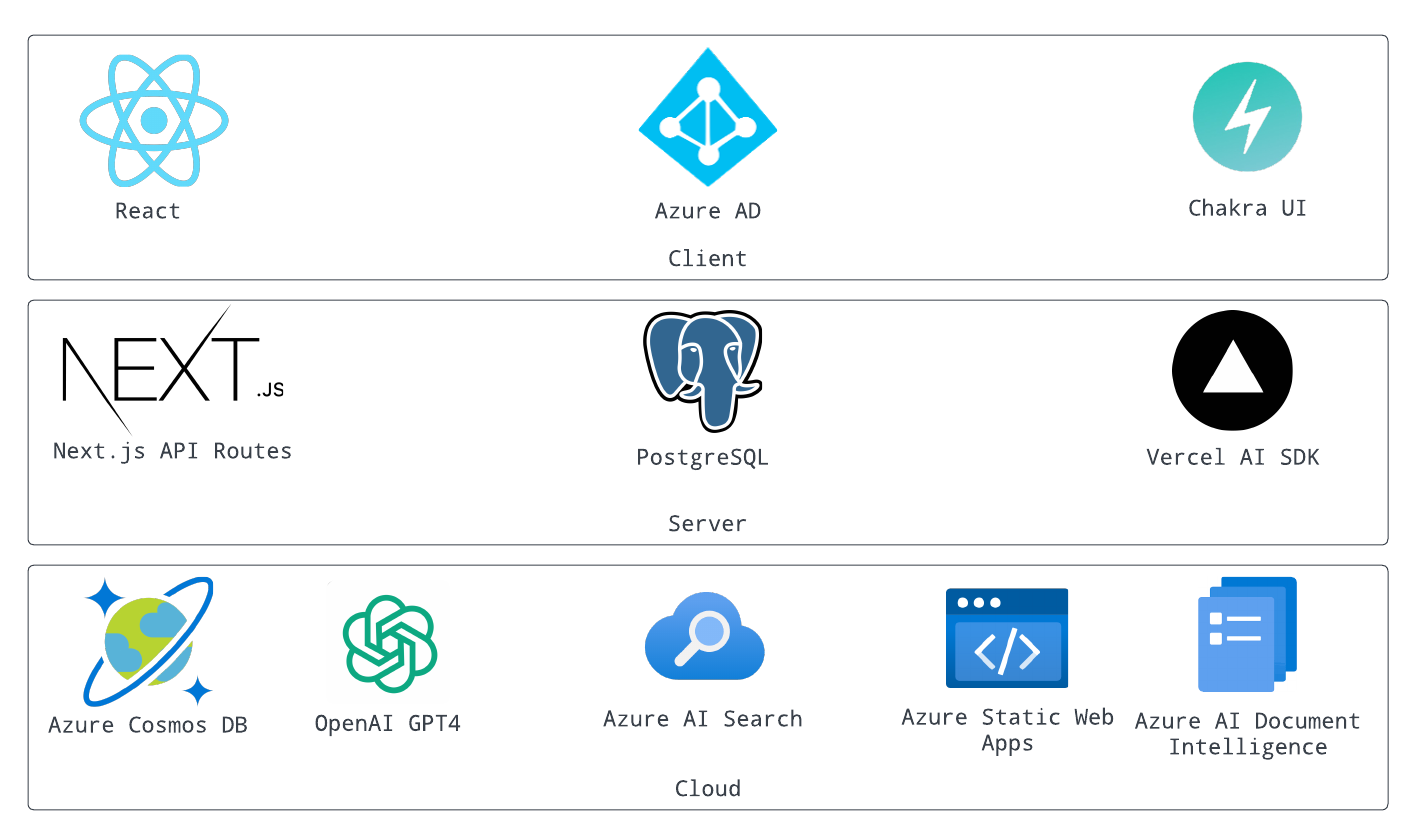
ChatEDU leverages combined Azure Services and modern web technologies to create a robust, scalable foundation for our education tool.
- Azure Cosmos PostgreSQL: database management system for storing user records, notebook, notes, and scores
- Azure AI Search:modern search service for indexing and efficient querying of user and notebook data
- Azure AI Document Intelligence: document analyzer for extracting text and images from user content
- Azure AD: secure user authentication service for managing user accounts and integrating third-party OAuth providers
- Azure Static Web Apps: deployment service for hosting and serving the front-end and API routes
- React: component library for creating stateful, flexible user interfaces
- Next.js: web framework for server-side rendering of pages and creation of API routes
- OpenAI GPT-4: Cutting-edge LLM used for analyzing user notes and generating educational content and practice questions
Content Upload and Extraction Flow
The uploading flow in ChatEDU allows users to add files or text via the web client, which then posts the data to the /api/notes/upload or /api/notes/add endpoints. This data is processed — text is extracted from files using Azure AI Document Intelligence — and subsequently stored in Azure Cosmos DB for further use within the platform.

RAG Prompting Flow
The Retrieval-Augmented Generation (RAG) prompting flow in ChatEDU begins when a user submits a prompt through the client interface, which sends a request to the /api/chat endpoint. The system then retrieves relevant information from the Azure Cosmos DB database to provide context to the generative language model, which uses this data to create personalized educational material. Finally, the response is streamed back to the client, providing the user with an answer that is augmented by the retrieved data, ensuring a more accurate and contextual interaction.

Azure AI Search
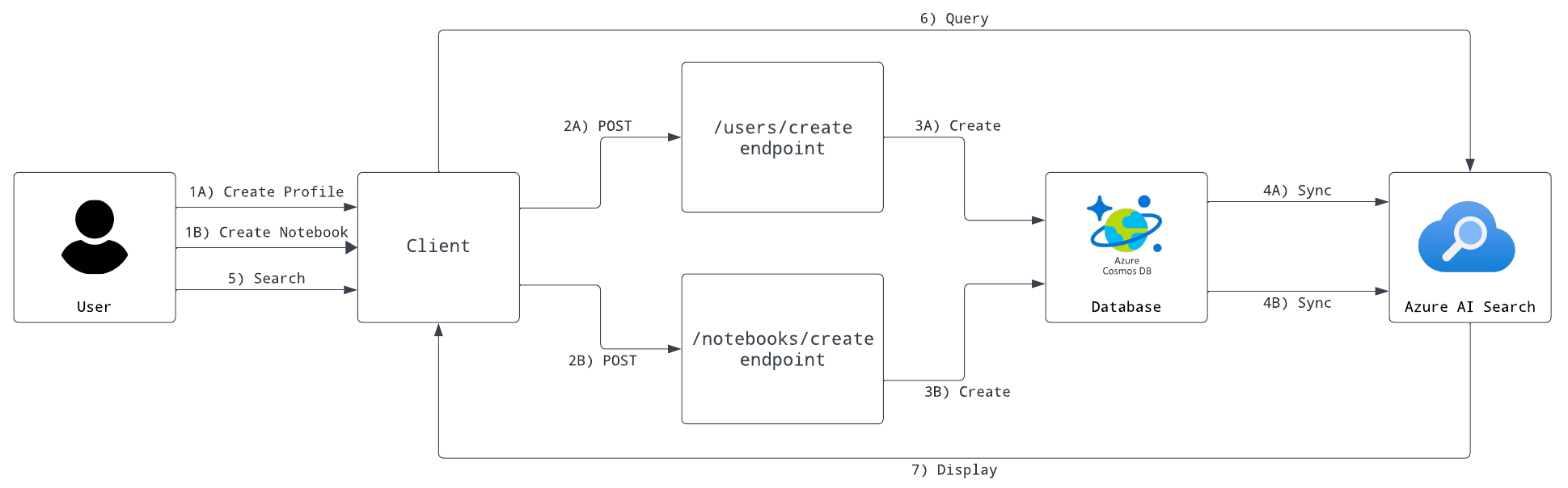
We utilize Azure AI search to index the users and notebooks collections of our database. This then allows users to perform fast and efficient searches on the data through the client. The search service is automatically synced with the database, ensuring that the search results are always up-to-date.
Continuous Integration and Deployment
The CI/CD pipeline for ChatEDU is implemented using GitHub Actions, which automates the process of code integration, testing, and deployment upon every push or pull request to the repository. Once the automated workflows verify the changes, the application is deployed to Azure Static Web Apps, ensuring continuous delivery of the latest version of the platform.

Team
We are a team of four computer science undergraduates from Vanderbilt University. Since meeting during our first year of school, we have collaborated on various projects and dedicated numerous hours to exploring the possibilities offered by emerging technologies. The Microsoft AI Classroom hackathon provided us with the ideal platform to create a tool that contributes to the community that brought us together.
 |
 |
 |
 |
|---|---|---|---|
| Jason Hedman Computer Science and Applied Math Web Developer |
Vasco Singh Computer Science and Applied Math Web Developer |
JP Higgins Computer Science and Education Prompt Engineer |
Jake Underwood Computer Science, Data Science, Engineering Science, and Engineering Management Product Manager |
Inspiration
As we started studying for our Algorithm Design final exam, we noticed that existing study tools primarily rely on note memorization. These tools only recognize the content you input and cannot generate new material that encourages learners to apply their knowledge to unfamiliar problems. While this approach may be suitable for recall-based subjects, it proves ineffective for a creative class like Algorithms. To address this issue, we initiated the development of ChatEDU, a platform that generates sample problems tailored to our test. As we made progress, we realized that we could expand the model to accommodate any subject matter.
Potential Impact
Addressing Educational Accessibility: According to USC Schaefer, only about 2% of students in the United States receive high-quality tutoring, and less than 4% of students who receive grades C or lower have access to such services. Our goal is to extend free, high-quality tutoring to all students through an AI-driven platform, aiming for 100% accessibility. This unprecedented access will bridge the gap in educational resources and transform the educational achievements of a vast majority of students, indiscriminately offering an opportunity to receive personalized tutoring, regardless of one’s geographical location, financial status, or academic standing. Leveling the playing field by providing statistically valuable access to high-quality tutors for the 98% of Americans who previously lacked such access may have profound impacts on the world of academia and innovation as we know it.
Personalized Learning (PL): As veteran students, we have seen just how diverse learning needs and patterns are for every student. As a result, we sought out a solution of personalized learning. PL significantly enhances student achievement, as evidenced by a RAND Corporation study showing students in personalized environments improving their scores by about 3 percentile points in both mathematics and reading. ChatEDU takes personalization further by tailoring the studying experience to the specific content provided by the user so as to adapt to the nuances of each class, professor, and institution, ensuring that the learning material is highly relevant and directly applicable to the user's current academic environment. This level of customization leads to improved learning outcomes, higher engagement, and increased motivation, empowering learners to take control of their education in a way that is most pertinent to their immediate academic needs.
Streamlining Studying Processes: Streamlining the studying process has a direct impact on academic performance. Research from Stanford University shows that a strategic approach to studying, including effective use of resources and study techniques, can improve exam scores by an average of one-third of a letter grade. This approach is not about working harder but more strategically, utilizing resources effectively to optimize learning. In two separate studies, students who employed strategic resource use before studying outperformed their peers by ~5 percentage points on average. Using ChatEDU to streamline studying processes can therefore significantly enhance academic outcomes and reduce the stress and inefficiency associated with traditional study methods. These are some of the most tangible ways to assess the value of study tools and it is inevitable that we contribute similarly to these academic improvements.
As current students ourselves armed with this information, we plan to continue to develop ChatEDU to afford students equal and immediate access to catalyze their academic improvement.
Quality of the Idea
As four students who've weathered the demands of intense study schedules, we channeled our shared experiences and insights into developing ChatEDU, a platform that we hope becomes a beacon of learning innovation. Here’s our approach:
| Creative Approach of ChatEDU | What Sets ChatEDU Apart |
|---|---|
| AI-Enhanced Learning: In response to the static nature of existing study materials, we transformed them into interactive, engaging learning experiences, suitable for the digital generation. | RAG Prompting Flow: We leveraged the RAG model to bring rich, relevant context to study materials, enhancing the application of theoretical knowledge. |
| Customized Learning Paths: Addressing the frustration of rigid study plans, especially in specialized courses, we developed adaptive algorithms for personalized educational paths. | Personalized Study Plans: Recognizing diverse student needs, we provide customized study plans to ensure each student's learning path aligns with their individual requirements, particularly in niche areas. |
| Gamified Learning Experience: Transforming study tedium into an engaging, motivational game, we've made learning both effective and enjoyable, motivating students on their educational journey. | Seamless Integration of Multiple Azure Services: Our integration of various Azure services has created a dynamic educational ecosystem that evolves with modern academic needs. |
| Collaborative Educational Environment: Fostering a digital community for group study and peer support, we've enabled students to share knowledge and grow together. | Context-Driven Study Sessions: Focusing on personalized education, our sessions adapt dynamically to each student’s knowledge and goals, offering a truly individualized learning experience. |
Next Steps
We are planning to launch a beta version of ChatEDU to our peers at Vanderbilt on Friday, December 9th, which is a week before our final exams begin. We have enlisted students from different majors to create notebooks for their classes, which they will share with their classmates. Based on the feedback we receive, we will continue to enhance the product with the goal of releasing it to the public in early 2024.
Roadmap

Short-Term Technical Improvements
In the upcoming weeks, our plan is to integrate additional Azure services to enhance the capabilities of ChatEDU. These include:
- Azure AI Search Vector Database: This service will be used to create embeddings for notes, optimizing our RAG flow.
- Azure Functions: We will host generation endpoints on Azure Functions to optimize our processes.
- Azure AI Personalizer: By leveraging this service, we will be able to train personalized study plans for students based on their performance across their notebooks.
- Azure AI Language Translator: To make personalized tutoring experiences more accessible, we will use this service to translate content into other languages.


Log in or sign up for Devpost to join the conversation.