-
-
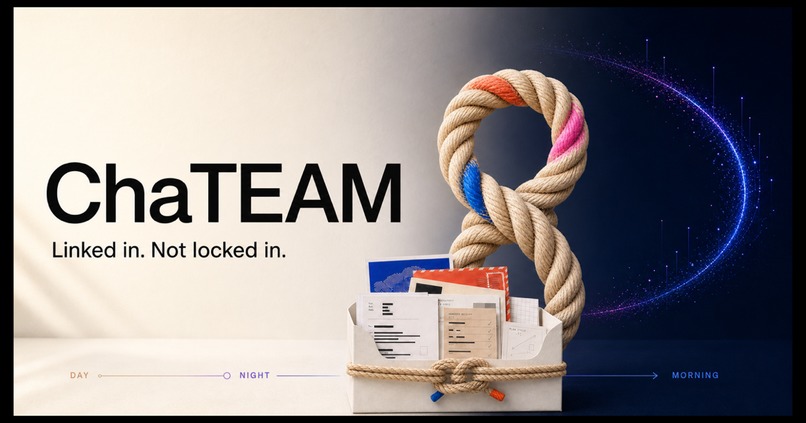
ChaTEAM — Linked in. Not locked in.
-

People create independently while the work stays connected.
-

Human-approved work continues inside fixed boundaries overnight.
-

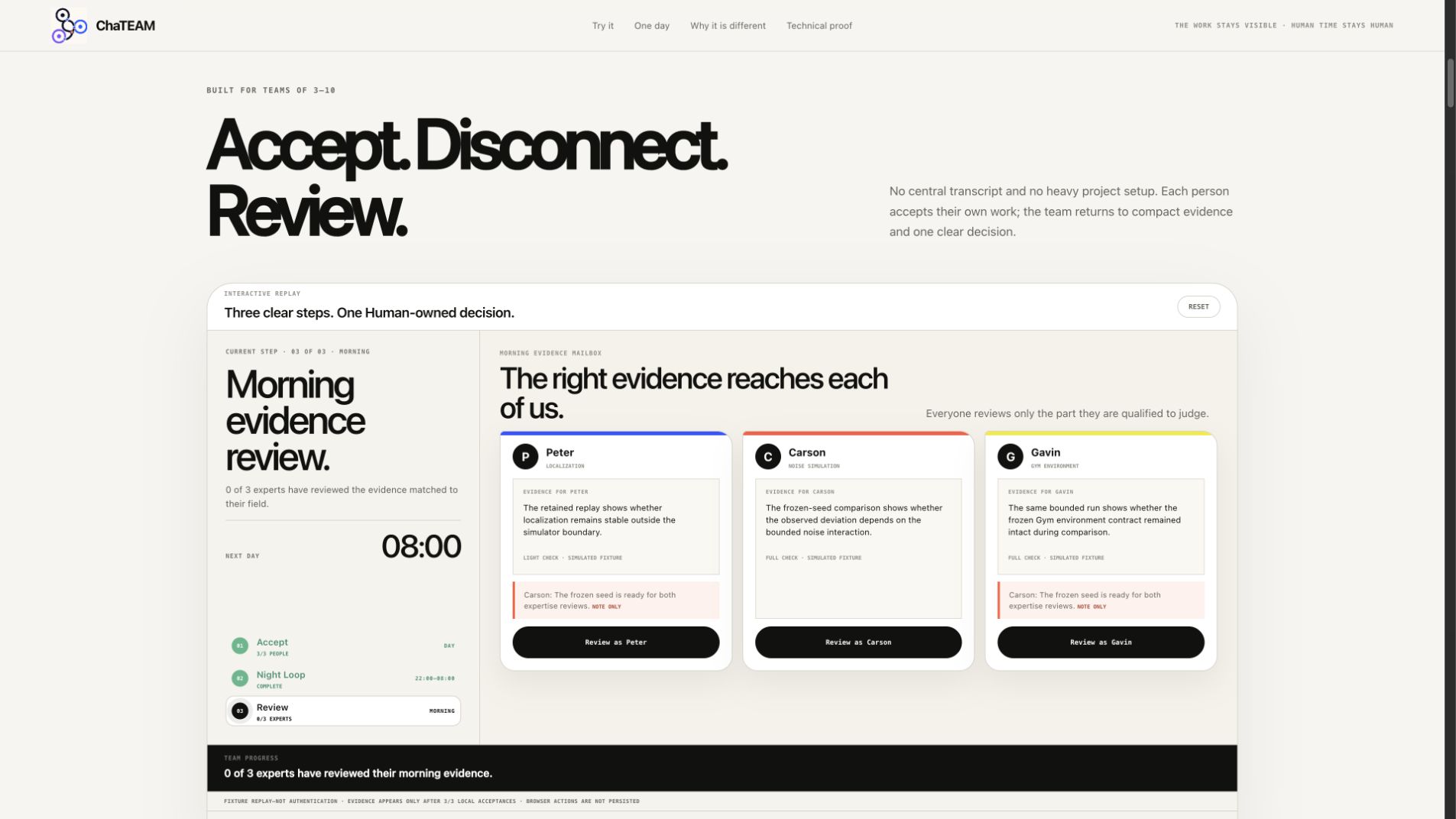
By morning, the right evidence reaches the right expert.
-
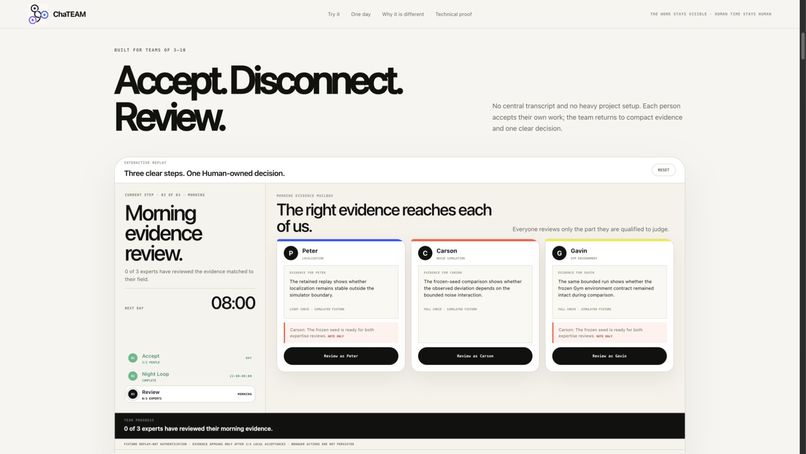
Every expert reviews their own evidence before the Human decision.
-
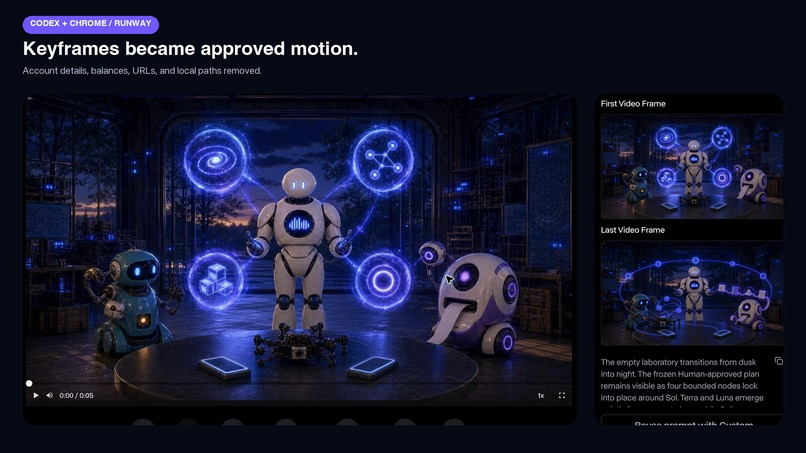
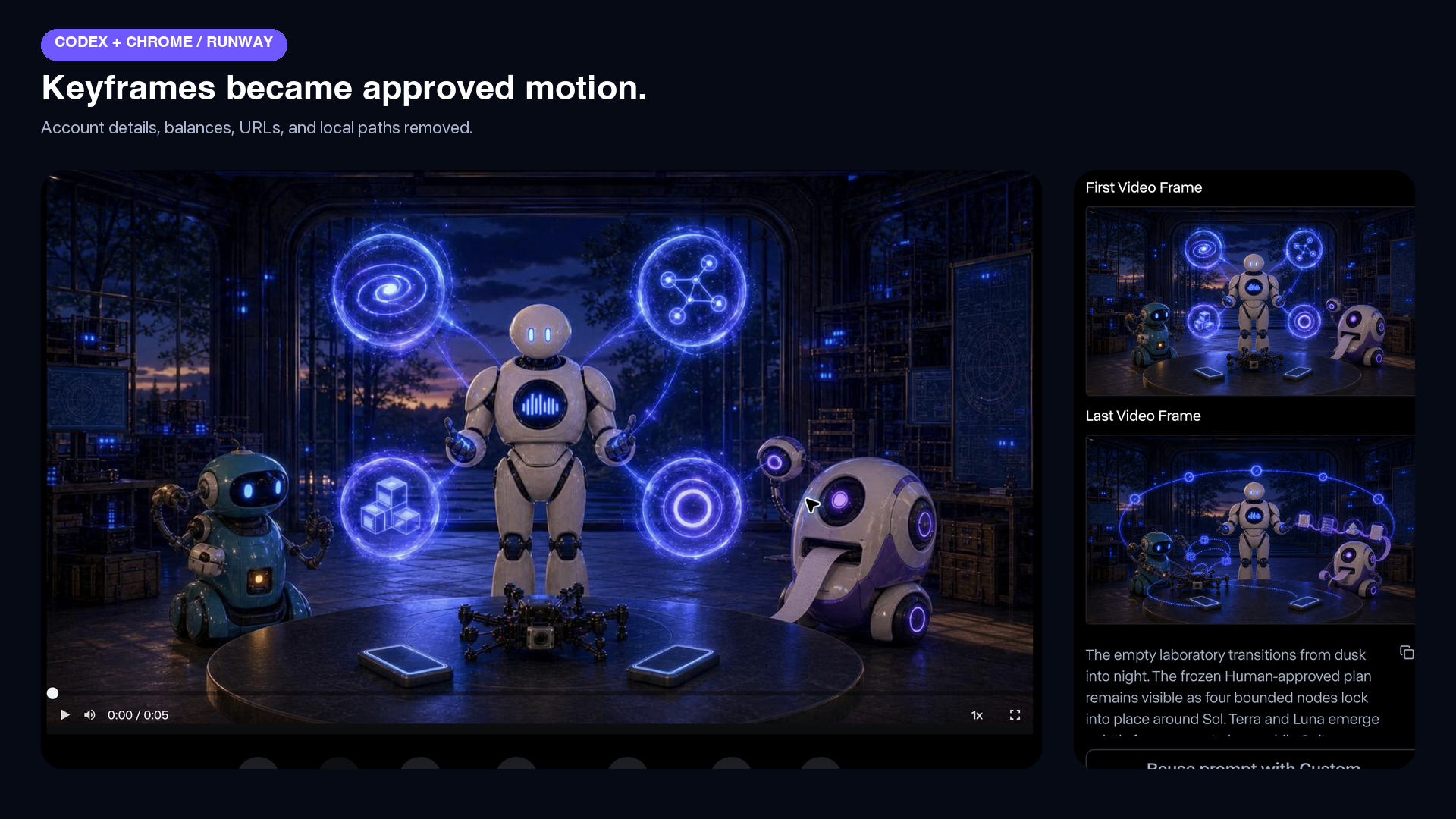
Codex coordinated the keyframe-to-video workflow through Chrome and Runway.



Inspiration
We are a small team of researchers and engineers from UW Madison. Throughout our research project, an issue repetitively occurred: codex could assist each of us to proceed more efficiently, while keeping the team aligned still need human coordination.
Import context was scattered across different conversations and meetings. Team members repeatedly explain what had changed, copied results between workspaces, checked who should review the bug, develop solutions from complex systems and stay online to supervise long-run tasks. Shortly after, we realized that people were becoming the communication layer between their AI agents and time for innovation and exploration was compressed.
We did not want to address this issue by placing every private conversation into one centralized system. Creative work is often unfinished, personal, and specific to the way each specialist thinks. Instead, we asked a different question:
What if everyone could keep their own AI workspace, while the team shared only the work that was intentionally handed off—evidence, decisions, responsibilities, and next steps?
That question became ChaTEAM. We designed ChaTEAM around a simple belief: AI should help work continue without requiring people to remain continuously available, while consequential decisions should always return to the right Human. Build Week gave us the opportunity to turn that working philosophy into a compact product prototype and invite the wider community to help us improve it.
What it does
ChaTEAM is a decentralized Human-Agent communication and work platform for small research and engineering teams whose members work across separate AI workspaces. Each person keeps their private conversations, drafts, and creative process in their own space. ChaTEAM does not treat private transcripts as shared team memory. Instead, team progress is created through governed handoffs: approved Context Capsules, tasks, evidence, reviews, and Human decisions. A typical ChaTEAM workflow looks like this: A team first creates a Team Charter defining its shared goal, specialist roles, visibility boundaries, and final Human approval owner. When someone wants to hand off work, ChaTEAM distills the source into a bounded Context Capsule. The owner reviews that capsule before it can enter the shared workflow. The system then routes role-specific jobs and Evidence Packets to the appropriate specialists. For work that continues asynchronously, ChaTEAM models a bounded Night Loop with a frozen source, scope, budget, assurance level, and stop conditions. When the loop ends, it returns evidence rather than an autonomous conclusion. If the evidence is conflicting or incomplete, the workflow stops and asks a Human to revise the direction. Final review, handoff, and delivery authority always remain with named people. Our current Mission Control demonstrates this through deterministic fixtures, including both a passing path and a conflict path. It does not claim a live unattended daemon, a real drone diagnosis, or autonomous research authority.
How we built it
We began with product constraints rather than an open-ended agent architecture. Private conversations should remain private. Shared work should be traceable. Agents should not silently widen scope. Evidence should not become authority. Every consequential transition should have a named Human owner. We translated those principles into typed contracts for Tasks, Routing Decisions, Evidence Items, Assurance Results, Approval Decisions, and Handoff Packages. A local state machine records jobs, artifacts, approvals, and events so that the workflow can be inspected rather than reconstructed from chat history. The core system is built with Node.js, TypeScript, and Zod. Local workflow state is persisted as structured JSON using integrity checks, atomic writes, and locking. Relay Runs store a digest of the original source and approved derived artifacts, rather than persisting the raw private input in the shared record. We created a deterministic fixture provider so judges can run the complete workflow without credentials or network access. We also implemented an explicitly opt-in OpenAI Responses API path using Structured Outputs and store: false. Environment variables alone cannot silently activate network execution; live mode requires both a provider selection and explicit Human confirmation. Mission Control is built with React and Next-compatible tooling. It presents Team Setup, the Golden Path, Relay Run, specialist Evidence Mailboxes, bounded Night Loops, assurance changes, and Human review gates as one visual product story. Codex was central to the build. It produced most of the implementation, tests, CLI, interface, fixtures, and documentation through an extended collaboration with us. Our role was to supply the lived problem, challenge proposed designs, choose the product direction, define privacy and authority boundaries, reject misleading claims, and make the final decisions about what ChaTEAM should become.
Challenges we ran into
Our hardest challenge was deciding what should actually be shared. Centralizing every AI conversation would have made implementation easier, but it contradicted the way we wanted teams to work. We had to design progress around deliberate artifacts and handoffs rather than raw conversational memory. The second challenge was separating intelligence from authority. An agent may propose a route, summarize evidence, or recommend an assurance level, but none of those actions should automatically authorize consequential work. We therefore separated routing, assurance, approval, and delivery into distinct contracts and state transitions. We also encountered a less obvious problem: Human-review overload. If every Agent result demands immediate attention, the system simply converts machine speed into a growing queue of interruptions for people. We designed an H0–H4 Human-attention model to prioritize review requests by urgency, uncertainty, risk, and consequence. Routine evidence can remain visible without interrupting the team, while ambiguous or consequential decisions are surfaced more prominently. These levels organize Human attention; they never replace required review or grant authority to an Agent. We also struggled with how to represent asynchronous work honestly. The idea of work continuing overnight is compelling, but our current product is a bounded and simulated workflow—not a production background daemon. We chose to make this boundary visible throughout the interface instead of presenting a more impressive but misleading claim. Another challenge was balancing technical rigor with a natural product experience. Concepts such as integrity binding, adaptive assurance, Plan Deltas, authority disposition, and Human-attention levels are important, but presenting all of them at once made the interface feel dense. We repeatedly simplified the first layer while preserving detailed evidence and controls underneath. Finally, we needed the Demo to be reliable without hiding the live architecture. This led us to support a deterministic credential-free judge path alongside a separately confirmed OpenAI provider path.
Accomplishments that we're proud of
We are proud that ChaTEAM became an executable vertical slice rather than remaining only a coordination concept. The current prototype includes: A local Team Charter for goals, roles, visibility, and Human ownership A one-to-many Collaboration Relay Owner-approved Context Capsules Role-specific parallel review jobs Evidence Packets routed by expertise Explicit approval and delivery gates Bounded two-cycle Night Loop fixtures Adaptive assurance that can increase from LIGHT to FULL A conflict path that blocks approval and requires Human revision A shared Work Trace that does not require centralizing private transcripts A deterministic offline Demo and an explicitly enabled OpenAI path We are especially proud that the failure path is treated as a first-class product experience. When evidence conflicts, ChaTEAM does not manufacture certainty or quietly continue. It records the conflict, stops the handoff, and returns the decision to a Human. At the time of submission, the core suite passes 74 tests, Mission Control passes 11 tests, and the static Build Week delivery validator passes its English-only, credential, artifact, and authority-boundary checks.
What we learned
We learned that the main bottleneck in multi-agent teamwork may not be generation quality. It may be continuity. A model can produce an excellent result, but the team still needs to know where it came from, what evidence supports it, who should review it, what changed, and who has the authority to decide what happens next. We also learned that useful shared memory does not need to mean complete shared history. A small number of well-defined artifacts can communicate more clearly than a large collection of copied conversations. Human gates were another important lesson. We initially worried that approvals would make the system feel less autonomous. Instead, clear gates made the workflow easier to trust because every participant could see where machine assistance ended and Human responsibility began. Most importantly, we learned that asynchronous AI work should not be measured by how long agents remain active. Its value should be measured by the quality of the next Human decision. The goal is not to make AI work all night. The goal is to help people begin the next morning with less uncertainty and more usable evidence.
What's next for ChaTeam
Our immediate goal is to make ChaTEAM smaller, clearer, and easier for a real team to adopt. The next product phase includes real team authentication, encrypted private storage, persistent Weekly Plans, finer-grained visibility controls, notifications, and integrations with repository-native workflows. Background execution would remain opt-in and bounded by the same scope, budget, assurance, and stop-condition contracts demonstrated in the current prototype. We also want to test ChaTEAM with small research and engineering teams and measure outcomes that matter to people: How often teammates are interrupted outside working hours How long it takes evidence to reach the correct reviewer How much time is spent repeating context How quickly a team can understand what happened while members were offline Whether morning review becomes easier than reconstructing work from chat history Over time, ChaTEAM could support many different specialist teams, but we want to begin with the environment we understand personally: small groups doing research and engineering across separate AI workspaces. Our long-term vision is not a centralized AI manager that watches everything. It is a lightweight coordination layer that lets people create independently, collaborate deliberately, and disconnect without losing the thread. The work stays visible. Human time stays human.
Built With
- adaptive-reasoning
- agentic-ai
- ai-agents
- chatgpt
- codex
- decentralized-collaboration
- developer-tools
- elevenlabs
- evidence-based-ai
- ffmpeg
- gpt-5.6
- html
- human-ai-collaboration
- human-in-the-loop
- javascript
- multi-agent-systems
- night-loop
- openai
- python
- research-tools
- runway
- team-collaboration
- work-life-balance
- work-trace
- workflow-automation


Log in or sign up for Devpost to join the conversation.