
Inspiration
Inspiration
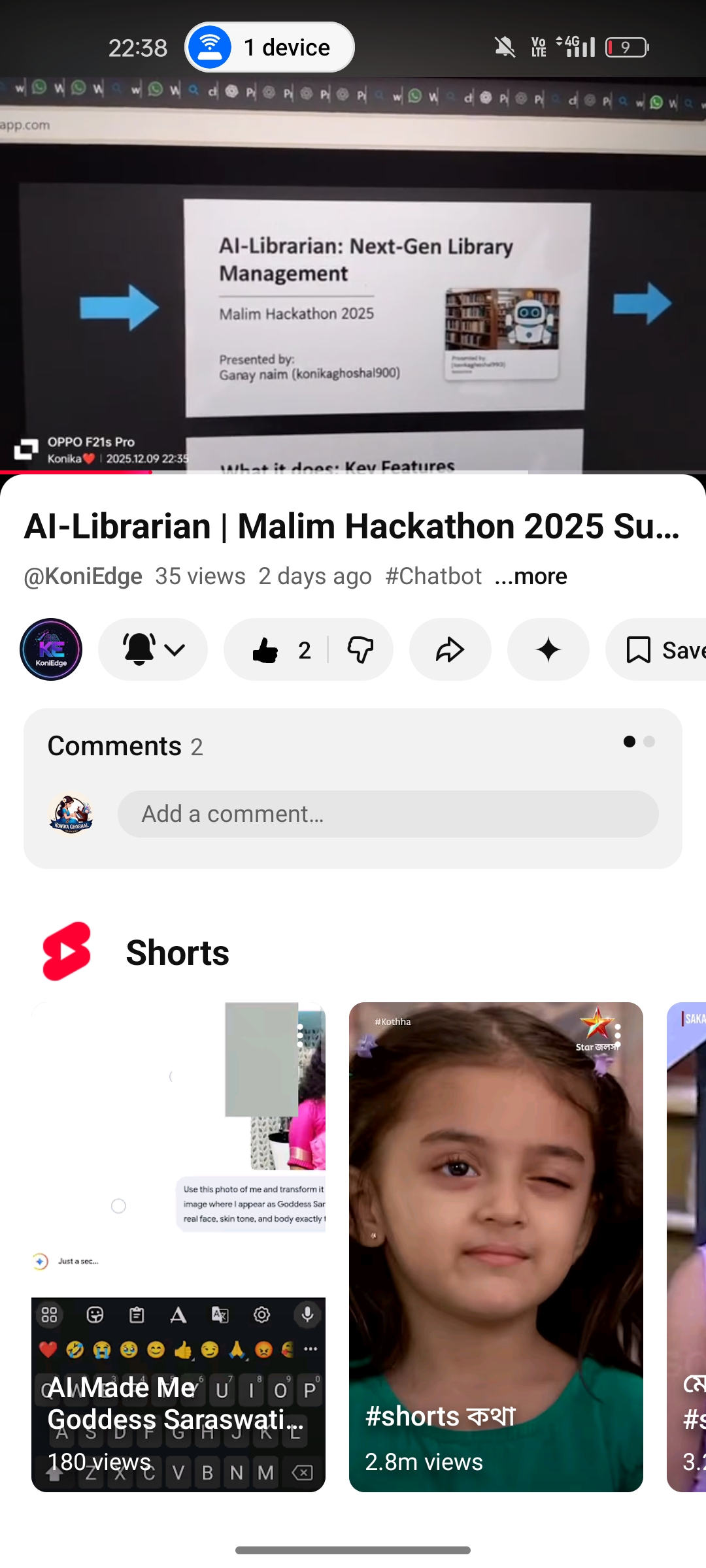
Libraries are full of knowledge, but finding the right book or information can still be difficult—especially for students who don’t know exactly what they are searching for. Many people feel shy asking librarians for help, books get misplaced, and searching through catalogs is time-consuming. The idea behind AI-Librarian is to make library knowledge instantly accessible, friendly, and interactive. We wanted to build a system that acts like a smart assistant—one that understands natural language, guides users to the right resources, and makes learning easier for everyone.
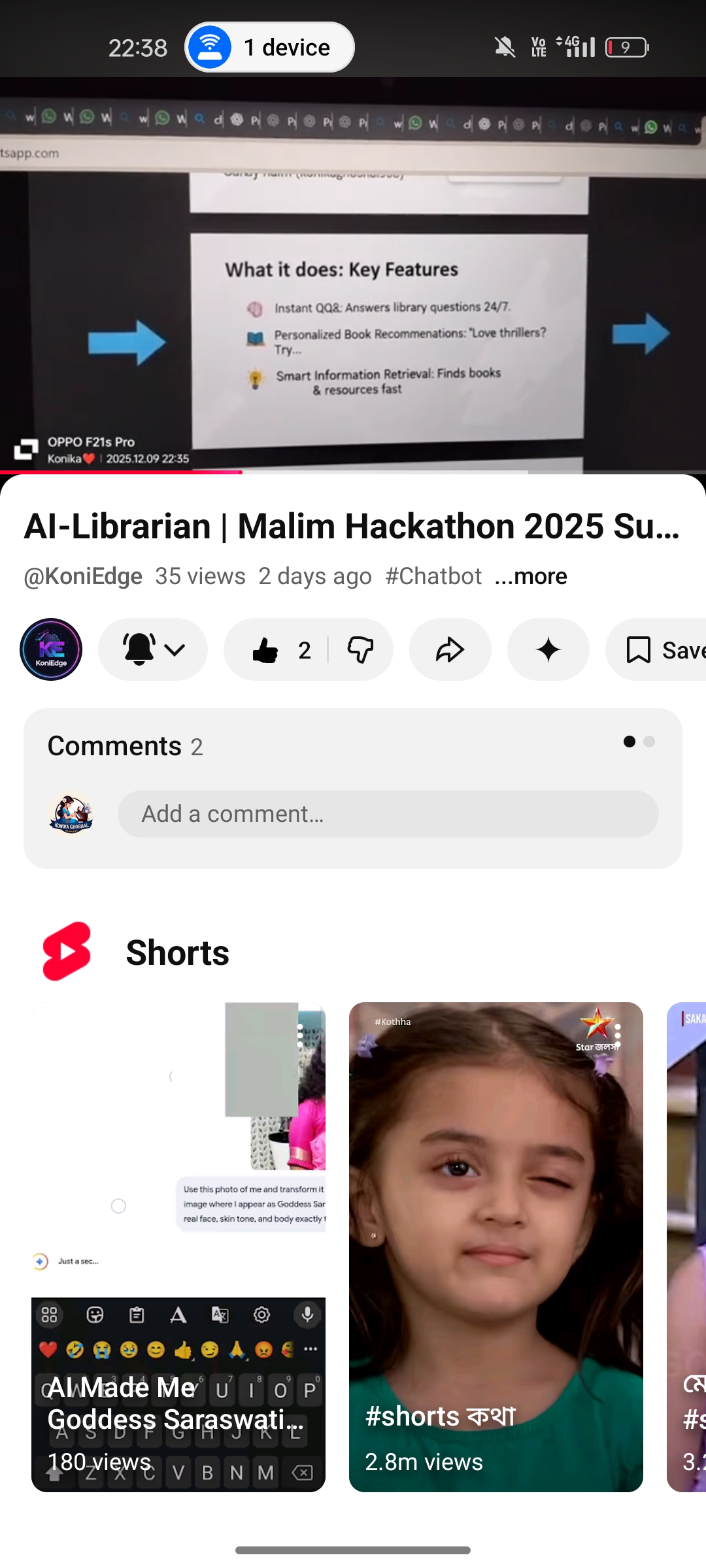
📌 What It Does — Key Features
AI-Librarian works like a smart chatbot dedicated to library support. Core features include:
🔍 Book Search by Title / Author / Keywords Users can ask for any topic and instantly get a list of available books.
👤 Personalized Recommendations Suggests books based on interests, reading history, and subjects.
📚 Category & Genre Browsing Helps explore fiction, non-fiction, research papers, student materials, etc.
🗺️ Locates Books in the Library Shows shelf number, section, or floor (if provided in the dataset).
💬 24/7 Chat Support Answers questions like “Where are history textbooks?” or “Which books help with robotics?”
🏫 Student-friendly Learning Support Can summarize books, explain topics, and give study assistance using AI.
🛠️ How We Built It
We built AI-Librarian with a focus on simplicity, scalability, and intelligence:
🐍 Backend Powered by Python Used to handle queries, manage database search, and structure the chatbot logic.
🌐 Simple Web Interface Designed a clean user interface where users can chat with the assistant directly in the browser.
🤖 OpenAI API for NLP & Intelligence Integrated the OpenAI API so the chatbot can understand questions, recommend books, and answer study-related topics naturally.
The combination of a lightweight Python backend, a simple web UI, and a powerful AI model makes AI-Librarian fast, user-friendly, and ready for deployment in real libraries. ⚠️ Challenges We Ran Into This was a solo project, so balancing research, coding, and UI development within the hackathon time limit was a major challenge. Learning and adapting to a new API on short notice added extra pressure — especially understanding rate limits, prompt formatting, and ensuring accurate responses. Integrating Python, the database, the web interface, and the OpenAI API together without breaking anything took a lot of trial and error. Debugging small issues under time stress was tough, but ultimately worth it.
🏆 Accomplishments That We're Proud Of The biggest achievement of this project is successfully connecting the smart AI model with real library-style book data and making the chatbot work in real time. Building a fully functional prototype — from backend logic to chat interface — within the hackathon timeframe was extremely rewarding. Seeing the chatbot respond naturally, recommend books, and understand user queries felt like a moment where everything came together. The result is a system that proves the idea works and has the potential to grow into a full product.
If you want, I can now generate: 🔹 “What’s Next” section 🔹 “Lessons Learned” section 🔹 A one-slide pitch poster 🔹 A full project PDF for submission Just tell me what you’d like next 🚀 ⚠️ Challenges We Ran Into This was a solo project, so balancing research, coding, and UI development within the hackathon time limit was a major challenge. Learning and adapting to a new API on short notice added extra pressure — especially understanding rate limits, prompt formatting, and ensuring accurate responses. Integrating Python, the database, the web interface, and the OpenAI API together without breaking anything took a lot of trial and error. Debugging small issues under time stress was tough, but ultimately worth it.
🏆 Accomplishments That We're Proud Of The biggest achievement of this project is successfully connecting the smart AI model with real library-style book data and making the chatbot work in real time. Building a fully functional prototype — from backend logic to chat interface — within the hackathon timeframe was extremely rewarding. Seeing the chatbot respond naturally, recommend books, and understand user queries felt like a moment where everything came together. The result is a system that proves the idea works and has the potential to grow into a full product.
If you want, I can now generate: 🔹 “What’s Next” section 🔹 “Lessons Learned” section 🔹 A one-slide pitch poster 🔹 A full project PDF for submission Just tell me what you’d like next 🚀


Log in or sign up for Devpost to join the conversation.