-
-
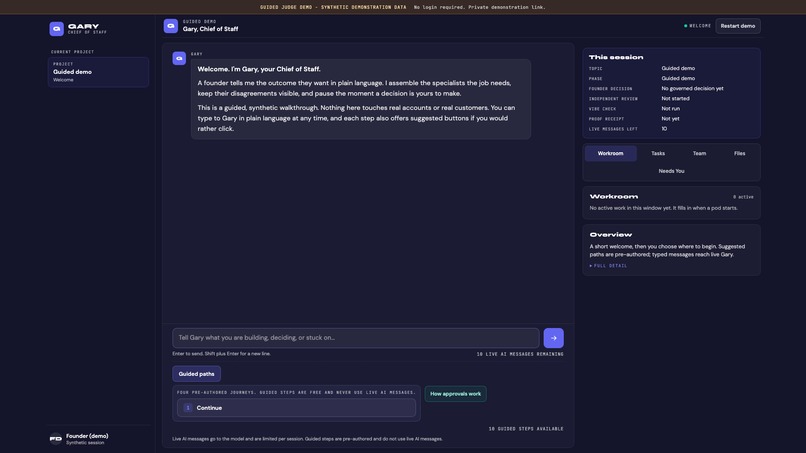
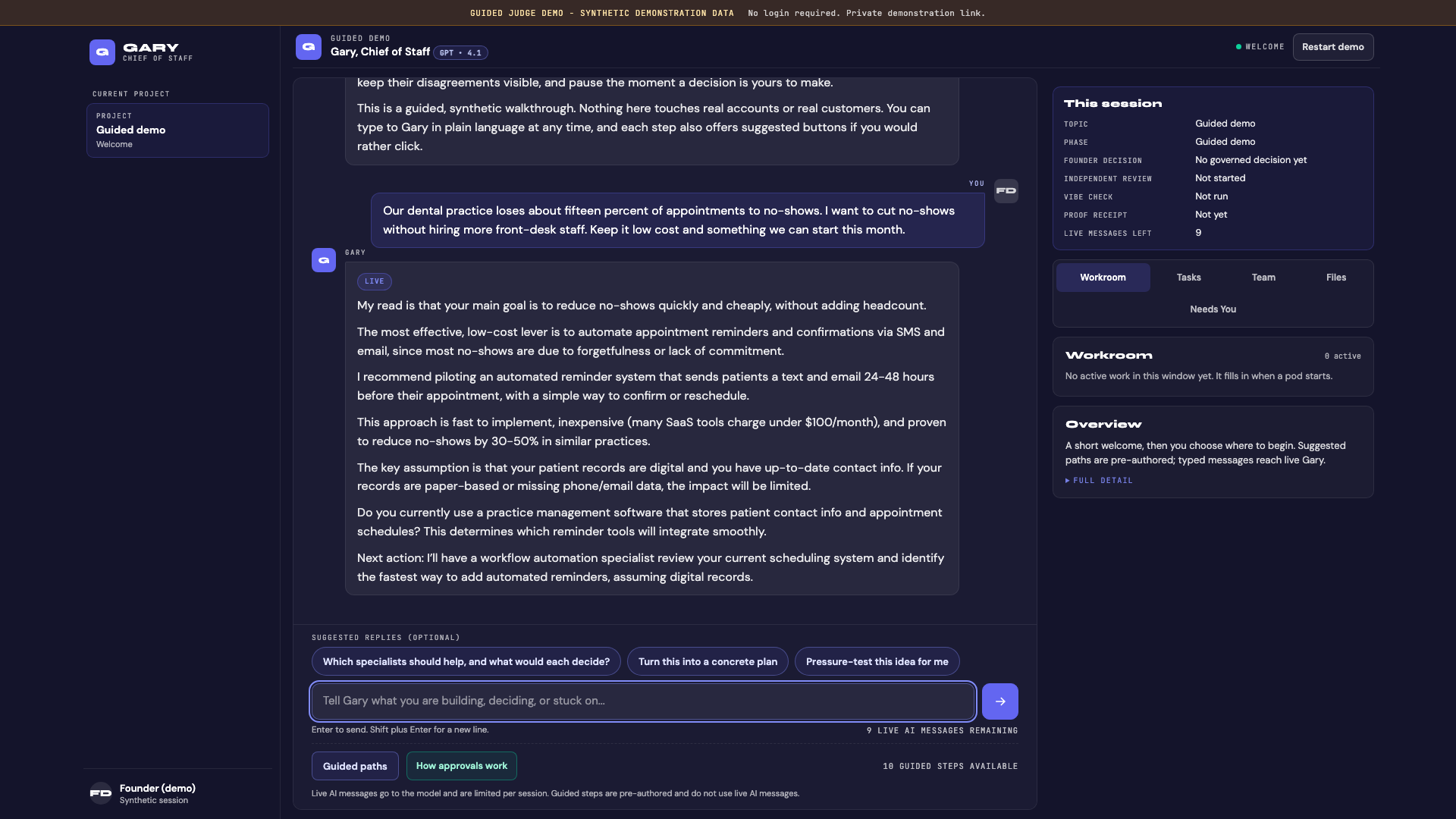
Gary, the GPT-powered Chief of Staff, receives the founder’s goal and guides the work from first request through verified proof.
-
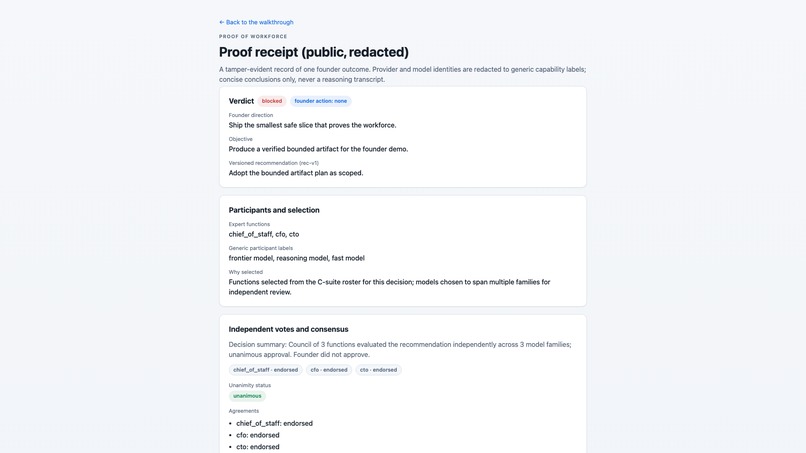
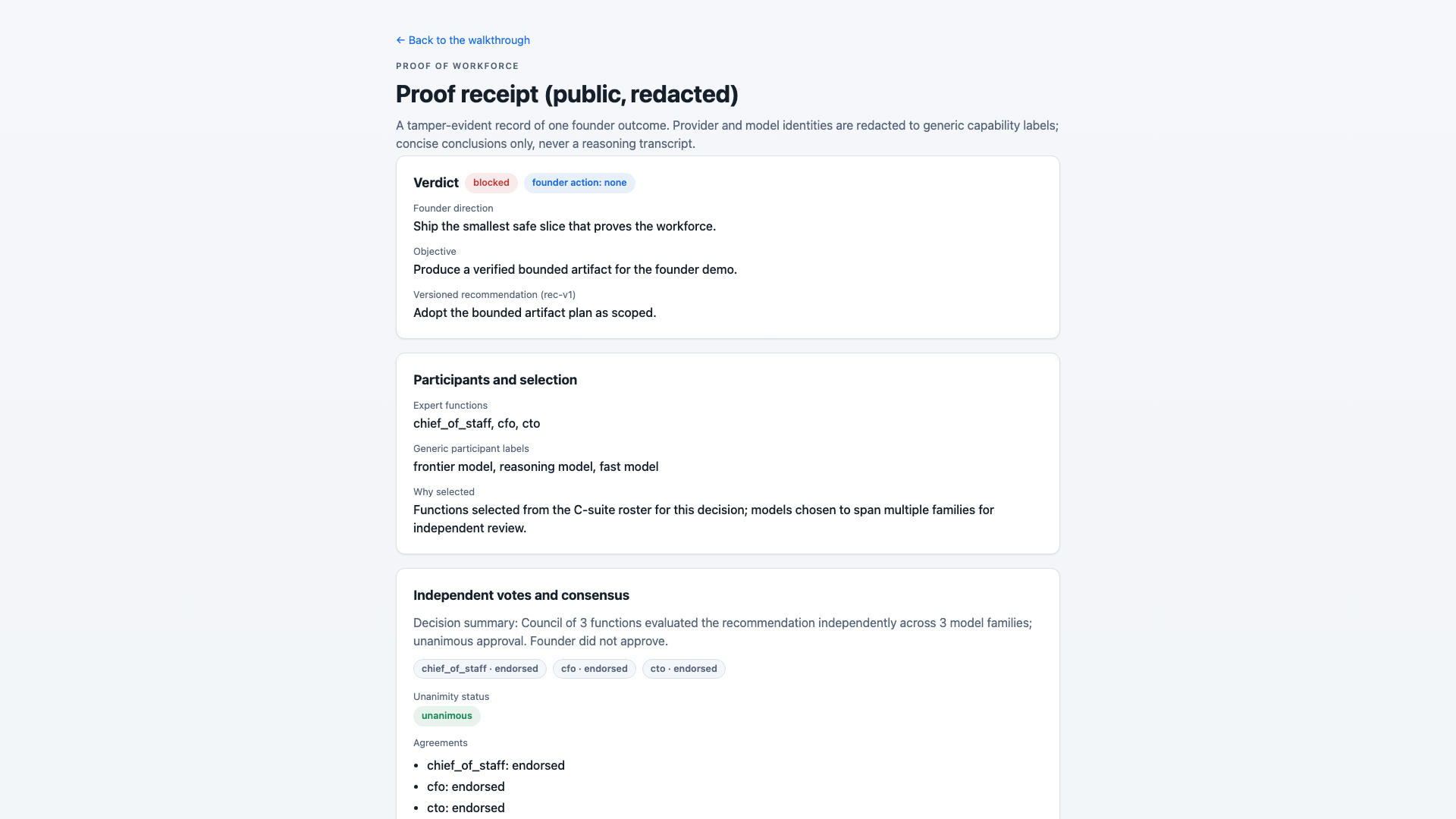
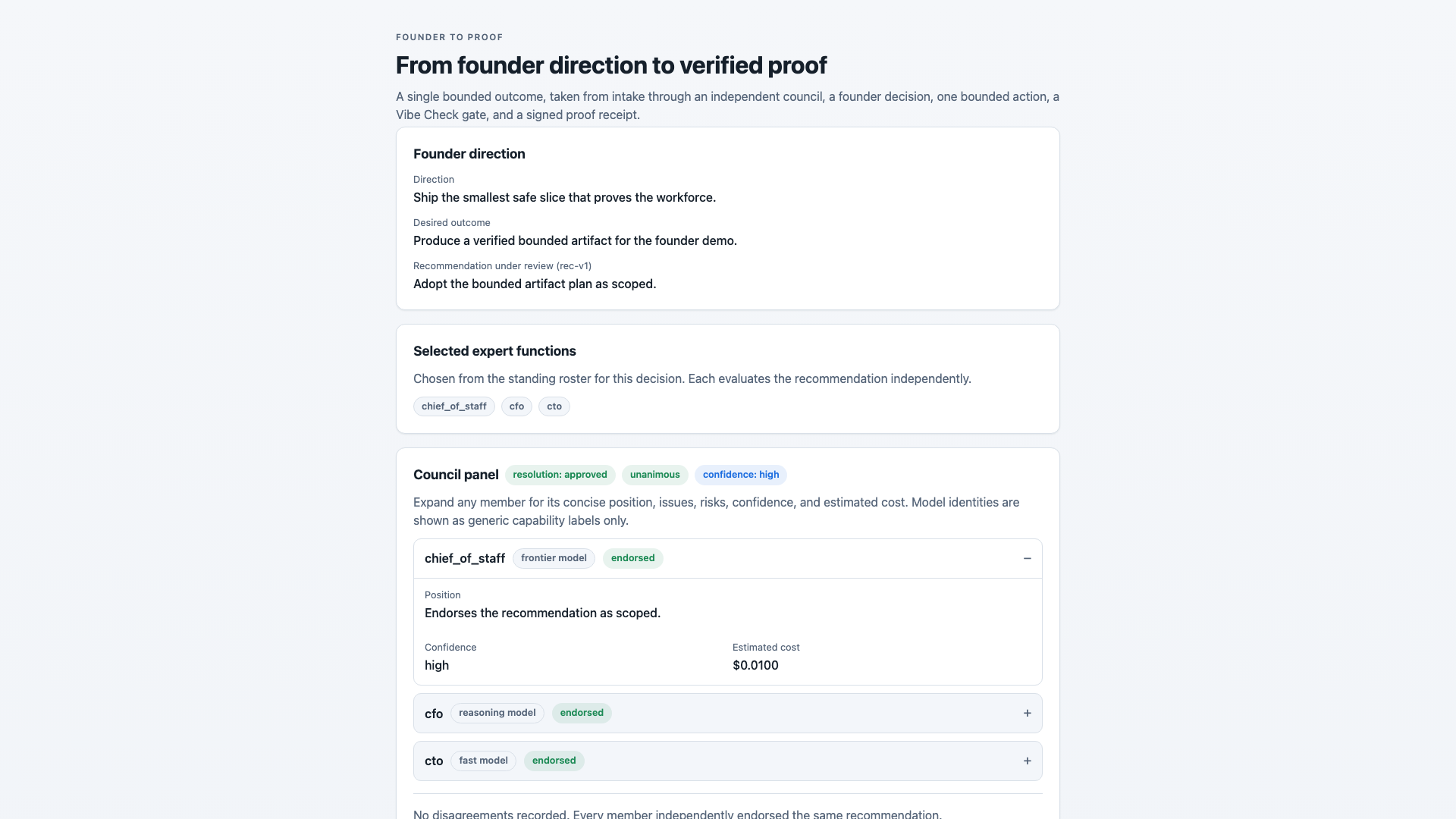
The Proof Receipt records the recommendation, participating GPT models, independent votes, and founder approval status.
-
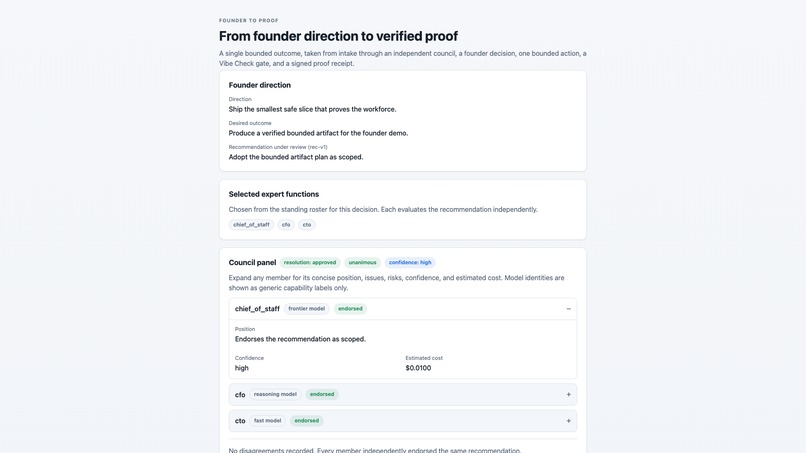
An independent expert council reviews the recommendation across multiple GPT model families before work can proceed.
-
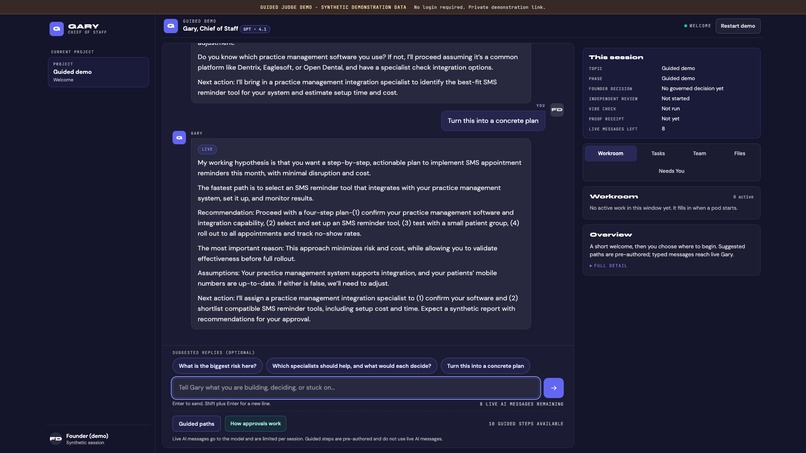
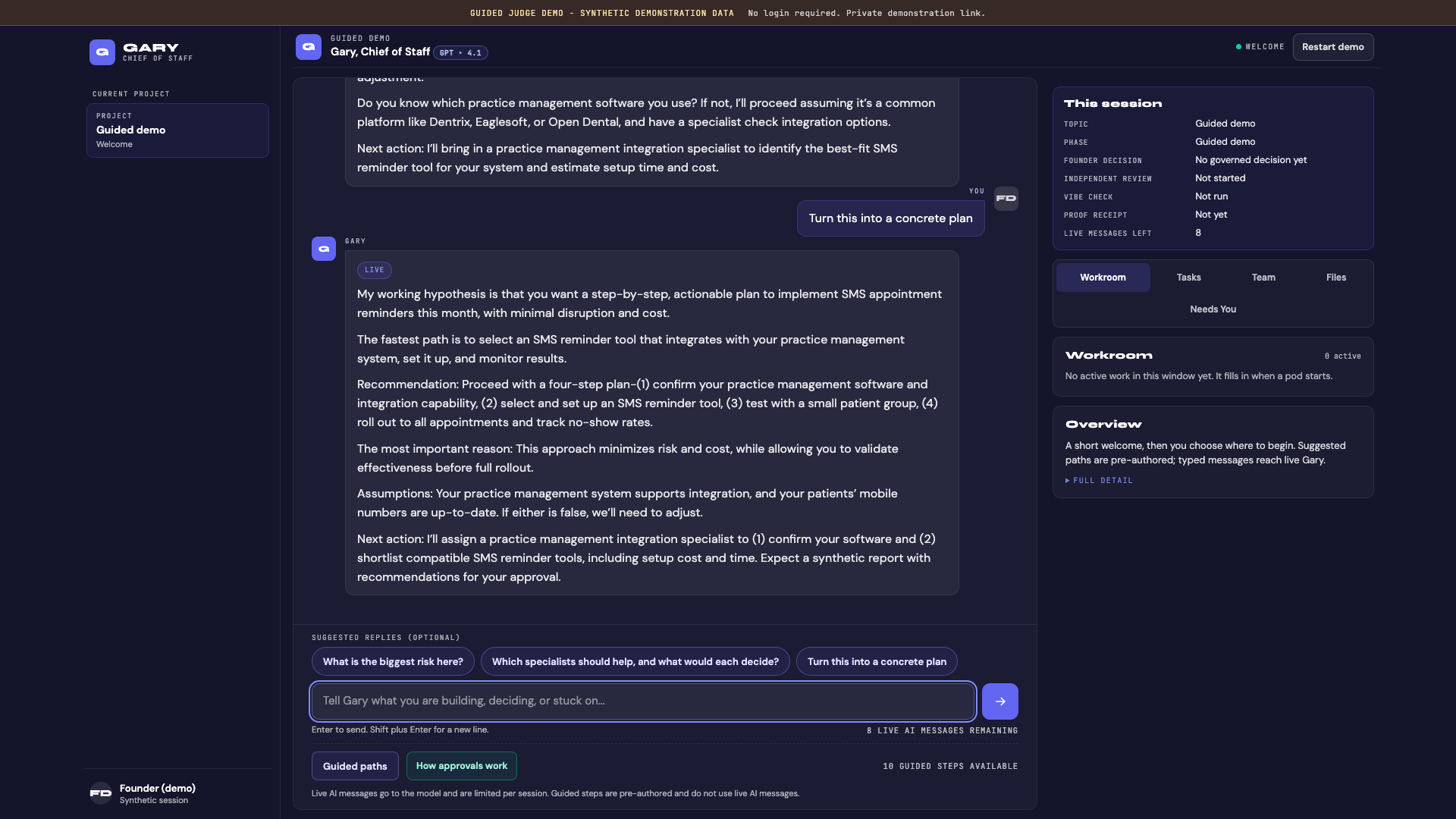
GPT converts the founder’s request into a concrete, phased plan with assumptions, risks, costs, and measurable next steps.
-
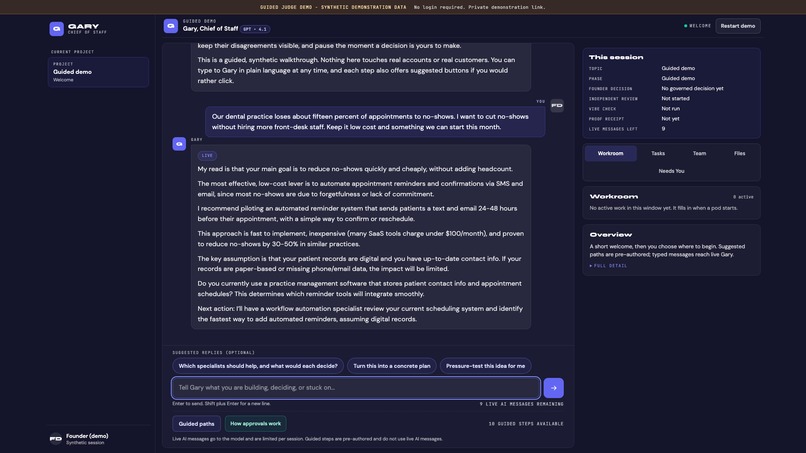
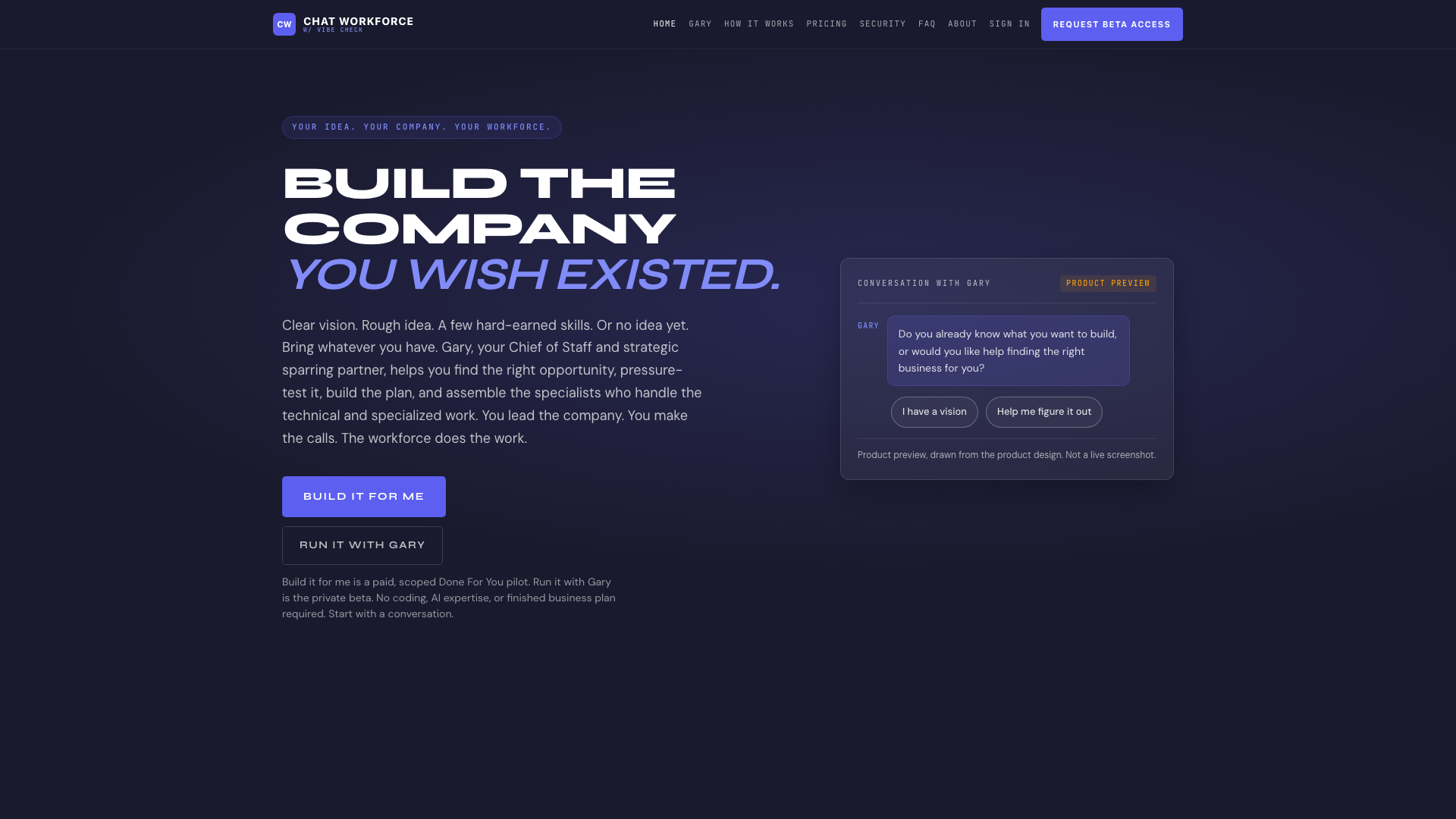
The founder describes a business problem in plain language, and GPT turns it into a clear recommendation and next action.
-
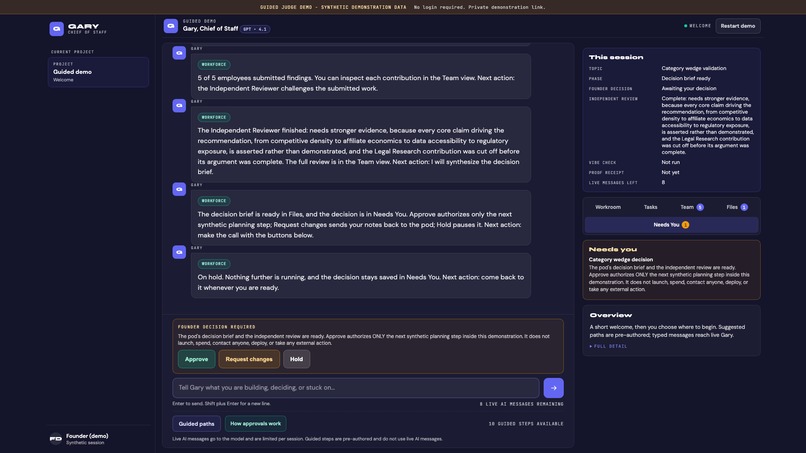
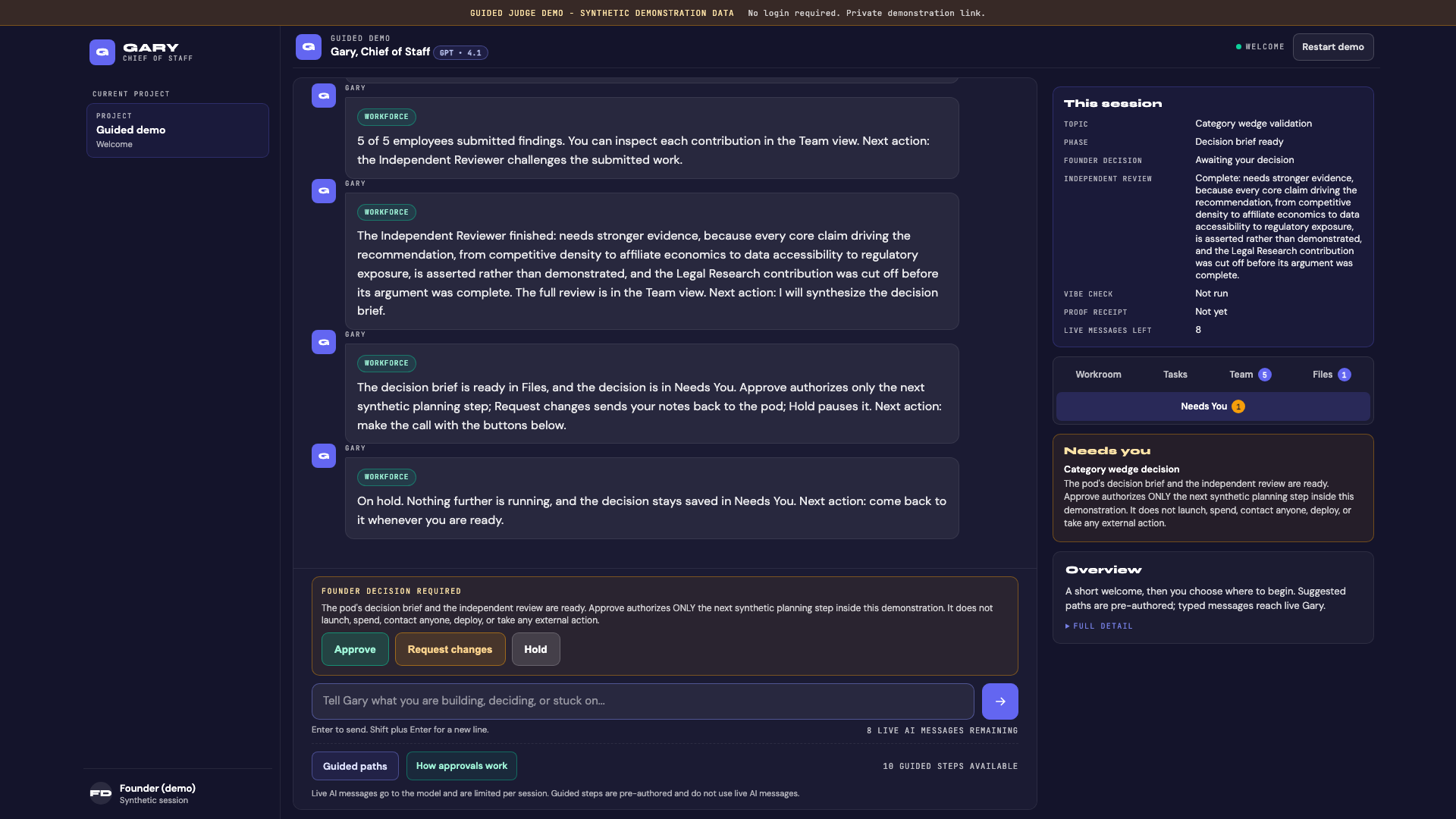
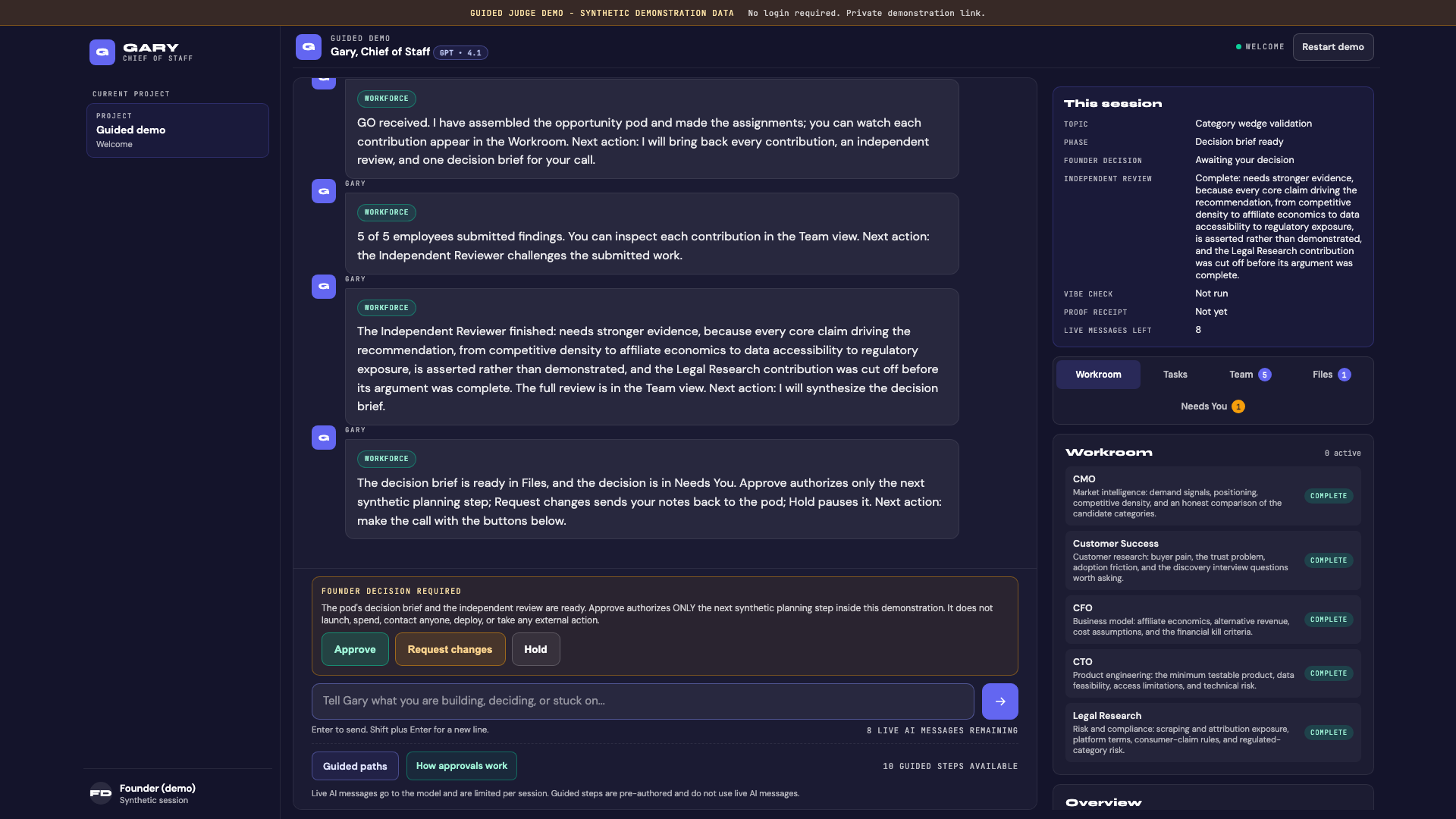
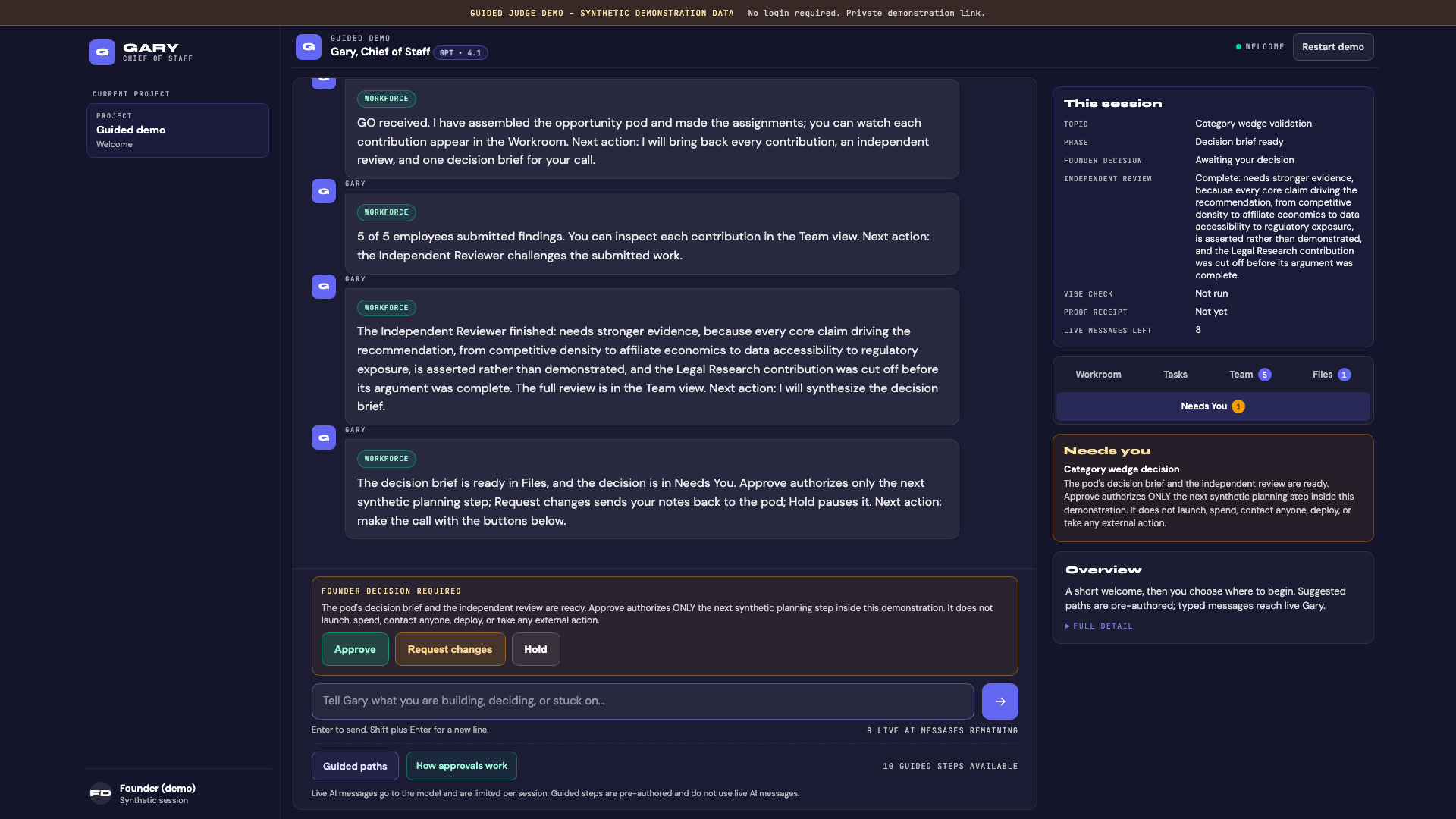
Choosing Hold pauses all further work while preserving the decision, proving the founder remains in control.
-
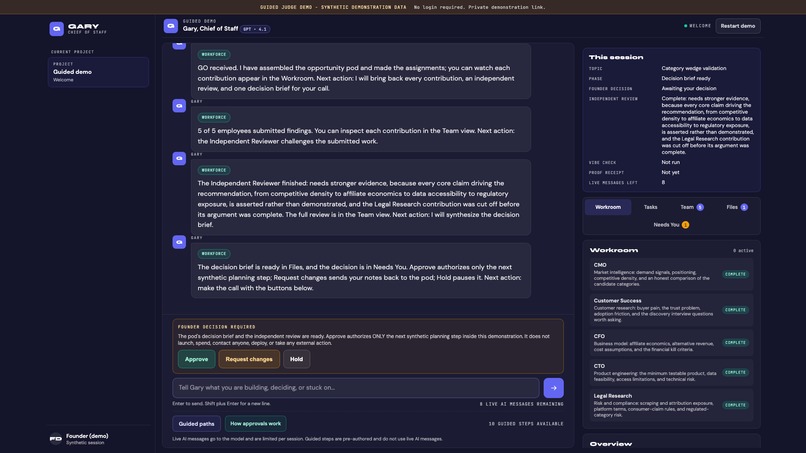
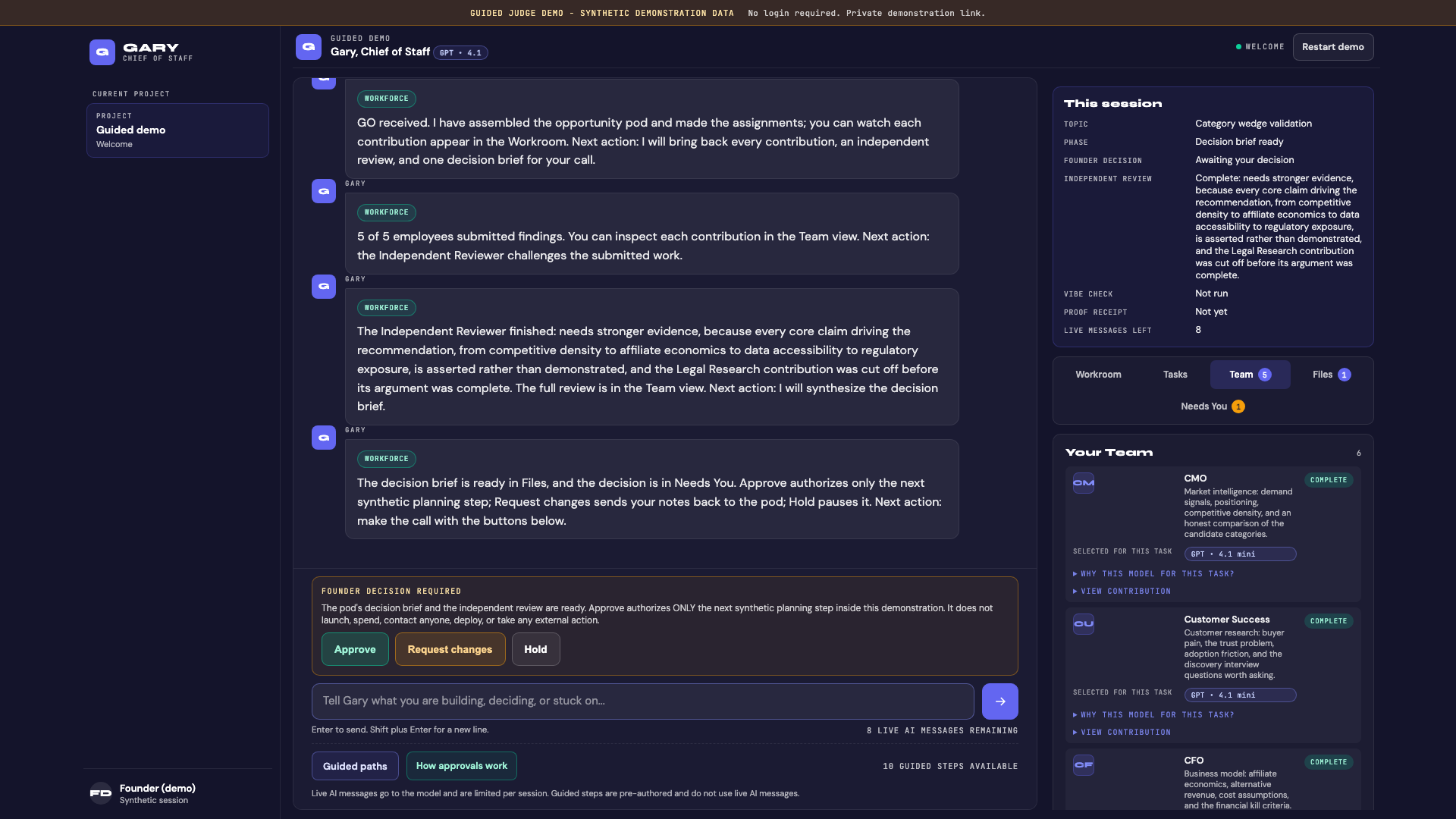
The Workroom makes every specialist’s assignment, contribution, and completion status visible to the founder.
-
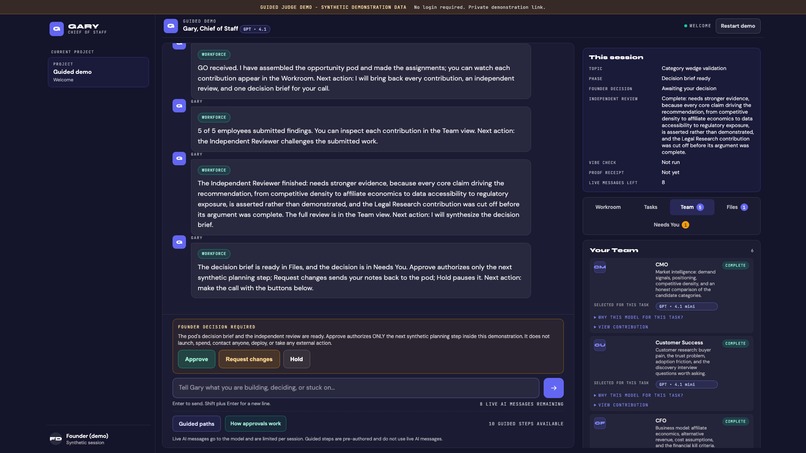
Gary assembles five specialists, selecting the right GPT model for each task and submitting their work for independent review.
-
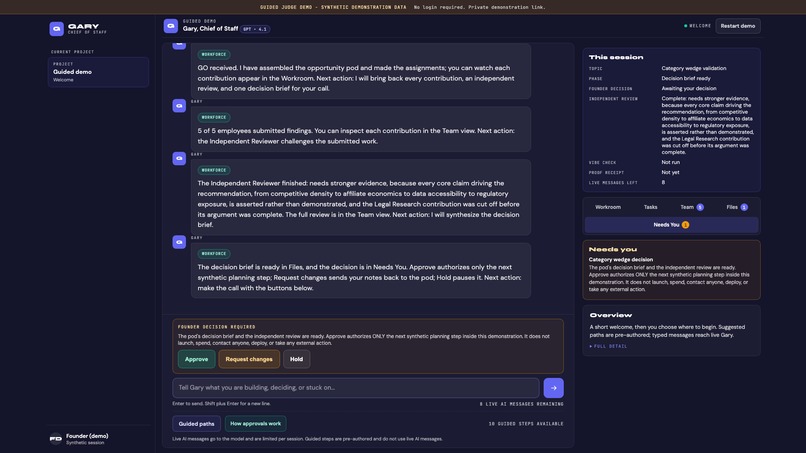
Consequential work stops at a founder decision gate: approve the next step, request changes, or place the project on hold.
-
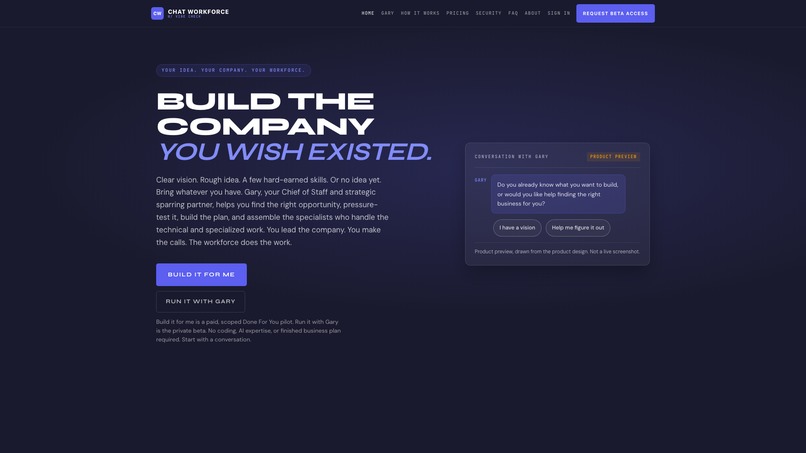
Chat Workforce turns a founder’s idea into a company, with Gary coordinating a specialized workforce powered by GPT.
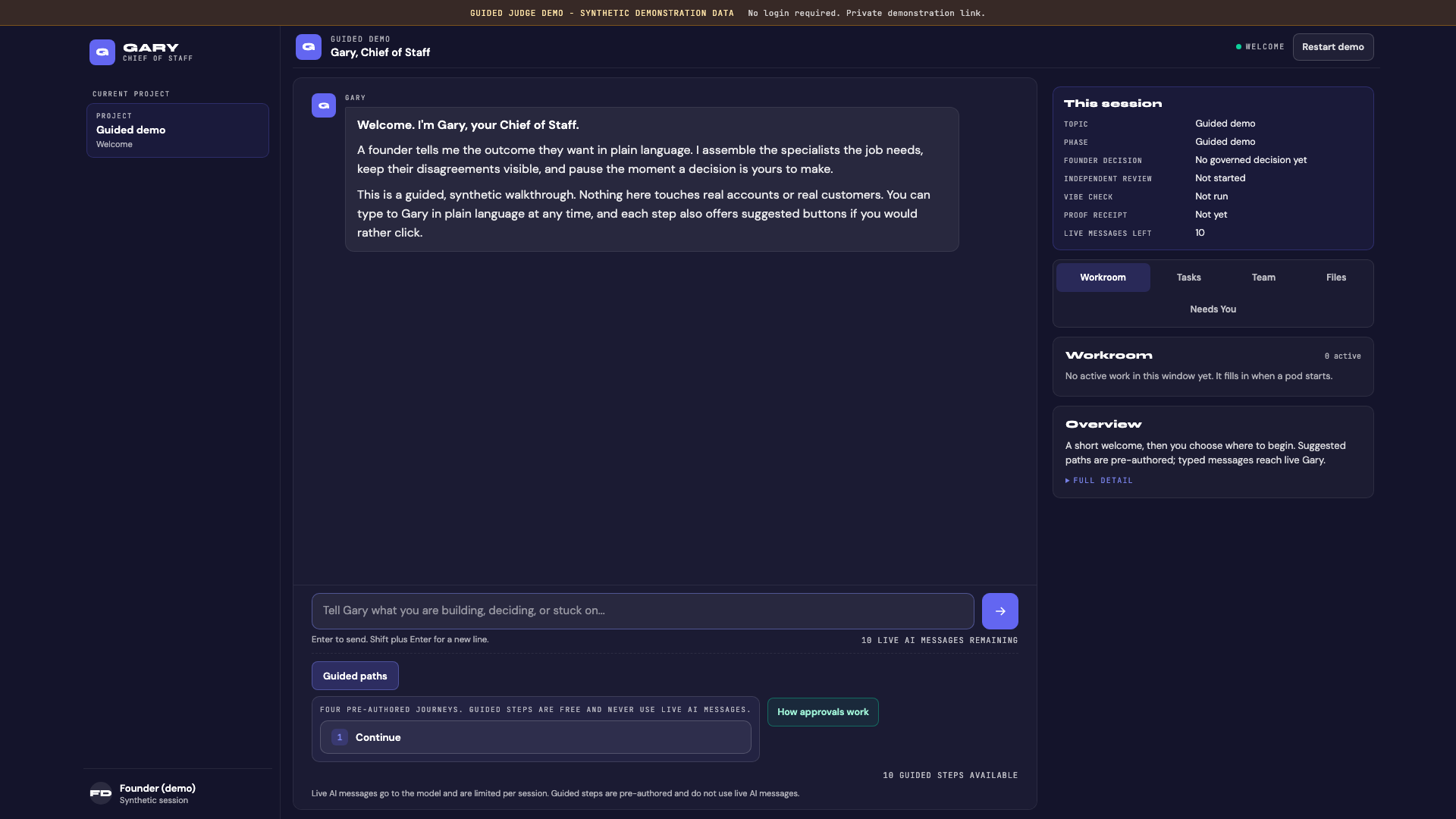
Chat Workforce: From Founder Direction to Proven Work
One founder. One conversation. A governed AI company that can plan, challenge, execute, and prove the work.
Inspiration
For more than thirteen years, I built a career in the commercial fitness industry while raising my son as a single mother. I worked my way from the ground floor to the executive table and generated more than $20 million in annual revenue while many of my peers produced a fraction of that.
From the outside, I had made it.
Then I reached the top and saw the ceiling clearly.
The people making the biggest decisions were not always the smartest, the most innovative, or the highest performers. Too often, they were simply the people who had been there the longest, knew the right people, or fit comfortably into a system that rewarded politics over ideas.
No matter how hard I worked, someone else would still decide whether my ideas were worth pursuing, whether I deserved another promotion, and whether I had permission to build something bigger.
I did not want permission anymore.
So in 2025, I walked away. Not because I hated my career. Because I believed there had to be a better way.
Then I found AI.
The ironic part? I had absolutely no technical background. I could not write code. I was not a software engineer. I had never heard of Cursor. I had never heard of Lovable. I did not know the “right” way to build an AI product.
That ignorance became an advantage. I was not interested in recreating the way software companies already worked. I asked a different question:
What if AI did not just help people complete tasks? What if it gave ordinary people the leverage to build and operate the companies they had always imagined?
People keep asking, “What if AI takes my job?”
I think they are asking the wrong question.
What happens when AI gives millions of people the confidence to leave jobs they never wanted in the first place?
That is the future I am building.
What it does
Meet Gary.
Gary is the founder’s Chief of Staff and the operating brain behind Chat Workforce. A founder describes the outcome they want in ordinary language. Gary determines which expert functions are needed for that specific job, assembles the right council, and selects models and platforms based on capability, security, reliability, latency, cost, and margin.
The founder does not have to choose a model, write a technical specification, or manage a collection of disconnected AI assistants.
Big decisions should not come from one confident AI. Independent experts across different models and platforms evaluate the work before seeing one another’s conclusions. For consequential decisions, they must approve the same versioned recommendation before Gary can present it as unanimous.
If they disagree, the disagreement stays visible. The founder sees concise positions, evidence, risks, tradeoffs, estimated cost, and confidence. No hidden chain-of-thought. No manufactured consensus. The founder can approve, revise, or hold.
Once the founder approves a clearly bounded action, the workforce can execute it.
Then Vibe Check (didyouvibecheck.com), the security and quality control layer I built for AI-generated work, evaluates the result and can block it. Completed work produces a Proof Receipt that records the founder’s direction, the exact approval, the participants, the selected approach, the artifacts and their hashes, the tests, the Vibe Check result, the actual cost, and any remaining limitations.
Chat Space preserves the project’s context, decisions, evidence, and artifacts. The founder does not have to rebuild the company’s memory every time a conversation ends.
The result is not another chatbot. It is a personalized board of directors, operating team, security function, and evidence ledger built around one founder’s company.
More simply: it is the operating system for an AI company, led by a founder who may not have known how to use AI yesterday.
Why it is different
Most AI products give a user access to a model and leave the user responsible for managing the work. The user has to know what to ask, which model to trust, when the answer is wrong, and whether the task was actually completed.
Chat Workforce takes responsibility for the operating structure around the models.
It dynamically assembles specialists instead of presenting a fixed menu of roles. It separates independent evaluation from group reconciliation. It binds founder approval to the exact action being authorized. It tracks cost and margin. It preserves dissent. It gives Vibe Check the authority to stop unsafe work. It produces evidence instead of asking the founder to trust a completion message.
The founder remains in control, but the founder is no longer the human router holding the entire system together.
How we built it
I started with the founder experience, not the model.
The founder speaks with Gary. Behind that single conversation, the application translates an intended outcome into a structured work order, assembles the necessary expert functions, collects independent recommendations, checks whether true unanimity exists, and returns a decision the founder can understand.
Approved work moves through a bounded execution path. Vibe Check evaluates the result. A Proof Receipt captures the complete record. Chat Space keeps the decisions and artifacts attached to the project.
The application uses Python and FastAPI for the product and orchestration layers, PostgreSQL for durable project, approval, and evidence records, Redis for background work, and provider adapters for model routing. The council surfaces conclusions, evidence, risks, cost, and confidence without exposing hidden reasoning or provider-specific details to the customer.
The Founder-to-Proof path is tested end to end with real persistence and synthetic demonstration data:
- The founder states an outcome.
- Gary assembles the relevant council.
- Experts evaluate independently.
- Dissent remains visible until the experts approve the same recommendation.
- The founder approves, revises, or holds.
- One bounded action executes.
- Vibe Check evaluates and can block the result.
- The system creates a durable Proof Receipt.
How Codex and GPT-5.6 were used
Chat Workforce existed before OpenAI Build Week. During Build Week, Codex with GPT-5.6 became my primary implementation environment for the Founder-to-Proof extension.
I used Codex from the terminal to trace a large existing codebase, turn founder direction into bounded implementation work, write and repair product code, create adversarial tests, review security controls, reconstruct a clean database path, prepare the judge experience, and document what changed. It accelerated the work most when the problem crossed several layers at once, such as approval integrity, model-council resolution, datastore safety, cost capture, and Proof Receipt persistence.
We kept the Build Week work separate from the existing product with dated commits, a dedicated changelog, automated tests, and a record of the primary Codex session.
GPT-5.6 is also part of the product itself. It participates as one of the independent experts reviewing major recommendations, rather than appearing as a decorative integration added for the competition.
I also used Claude Code as a continuous integration controller. That mixed-model build process became an unexpected demonstration of the product thesis: different systems can perform different responsibilities, but the founder still needs one governance structure, explicit authority, independent review, and a durable record of what happened.
Challenges we ran into
“Local” is not a security boundary
One of the scariest moments in the build came from a command labeled “local.” The command was running on my machine, but it had inherited a remote database target. We stopped the process, traced how the configuration was resolved, removed the unsafe inherited setting, and built a fail-closed datastore classifier. Database-changing operations now require an explicitly approved host fingerprint before a connection is made.
That incident changed how I think about AI safety. A reassuring label is not a control. The system has to prove where it is connecting and what it is authorized to do.
Agreement can be faked accidentally
Calling several models does not create independent judgment. They can repeat the same assumption, approve different versions of a recommendation, or appear unanimous after dissent has been summarized away.
We separated independent evaluation from reconciliation, bound each vote to an exact recommendation version, preserved dissent for the founder, and wrote mutation tests that deliberately removed each safeguard to prove the tests would fail.
“Done” is not evidence
AI systems are very good at reporting completion. That is not the same as proving completion.
We had to capture the approval, tenant, cost, artifacts, hashes, verification results, safety decision, and limitations without double-counting model calls or allowing one customer’s data to cross into another customer’s record. The Proof Receipt became the answer: completion is a collection of verifiable facts, not a sentence generated at the end of a task.
A real product has to start from nothing
The existing production database had years of history that a fresh environment did not. Some foundational objects had never been represented in the migration chain, and one historical migration was corrupt from the day it entered the repository.
We chose a versioned baseline for new databases, preserved production history, excluded a rejected legacy ledger, and tested the clean bootstrap in isolated environments. It was not glamorous work, but it is what separates a demo that works once from a product another person can actually run.
Accomplishments that we're proud of
I am proud that Chat Workforce does not confuse motion with authority.
If the experts do not agree, it does not execute. If the founder has not approved the exact action, it does not execute. If Vibe Check blocks the result, it does not execute. If the system cannot verify the datastore, tenant boundary, dependency, cost, or evidence, it does not continue.
I am proud that we built the full founder journey as one coherent product experience instead of a collection of disconnected technical demonstrations. A judge can follow one direction from conversation, through council review and founder approval, into bounded execution, safety evaluation, and a Proof Receipt.
I am proud of the less visible work too: adversarial inputs, prompt-injection resistance, tenant isolation, exact-version approvals, cost-accounting tests, secret and provider-name redaction, mobile behavior, clean database reconstruction, and tests that prove the controls have the correct polarity.
Most of all, I am proud that a solo, non-technical founder built this by directing AI systems the way a CEO directs a company. Chat Workforce is not a theory about what that leverage might look like. It is the operating structure I needed in order to create it.
What we learned
The biggest lesson was that more models do not automatically produce a better decision.
Their value comes from independence, specialization, structured disagreement, and governance. A council is useful only when dissent cannot be silently discarded and agreement cannot be fabricated.
I also learned that safety does not have to slow autonomy down. When approval boundaries, isolation, cost controls, and verification are built into the execution path, they allow the workforce to move without forcing the founder to supervise every technical step.
And I learned something personal: being non-technical did not disqualify me from building a technical company. In some ways, it forced the better product question. I did not begin with, “How do developers want to use AI?” I began with, “What would make an ordinary person trust AI with work that actually matters?”
That question shaped everything.
What's next for Chat Workforce
The next proof is not another internal feature. It is using Chat Workforce to build and operate another real product.
That product is Sales Spotter (trysalesspotter.com), an AI sales-training platform for field sellers. It will run through the same founder-directed process: direction, expert review, approval, bounded execution, security evaluation, cost evidence, and Proof Receipts. If Chat Workforce can reliably operate a separate company, it moves from “product that built itself” to an operating system that can repeatedly build and run founder-led businesses.
We are also testing job-based cost models so customers can understand what a completed, verified outcome costs, not just how many tokens were consumed.
Finally, I want to put Chat Workforce in the hands of people who are normally excluded from technical entrepreneurship. One future pilot I care deeply about is an entrepreneurship lab for graduating seniors with ideas, ambition, and no technical network. The goal would not be to teach every participant to code. It would be to let them experience what changes when they can direct a capable workforce and remain the decision-maker.
I did not build Chat Workforce because I wanted a better chatbot.
I built it because I was done asking permission.
Now I want to give that leverage to everyone who has an idea worth building and has spent too long waiting for someone else to say yes.
Built With
- anthropic-claude
- codex
- css
- fastapi
- github
- google-gemini
- gpt-5.6
- html
- javascript
- multi-model
- openai-api
- postgresql
- pydantic
- pytest
- python
- redis
- render
- sqlalchemy


Log in or sign up for Devpost to join the conversation.