Chat Tug Arena
Your chat doesn't just vote. It pulls.
Inspiration
A normal Twitch poll asks viewers to choose a side, then wait for the result. But what if the voting itself became the most entertaining part of the stream?
Imagine a streamer asking, "Should I play Mage or Warrior?" Instead of clicking once and moving on, viewers join opposing teams, rally together, and fight for their choice in a live tug-of-war. The rope swings back and forth, coordinated cheers create powerful combos, and a last-second comeback can change what happens next.
That's the idea behind Chat Tug Arena: turning audience decisions into shared live entertainment.
What It Does
Chat Tug Arena transforms Twitch chat into an interactive, physics-driven tug-of-war game.
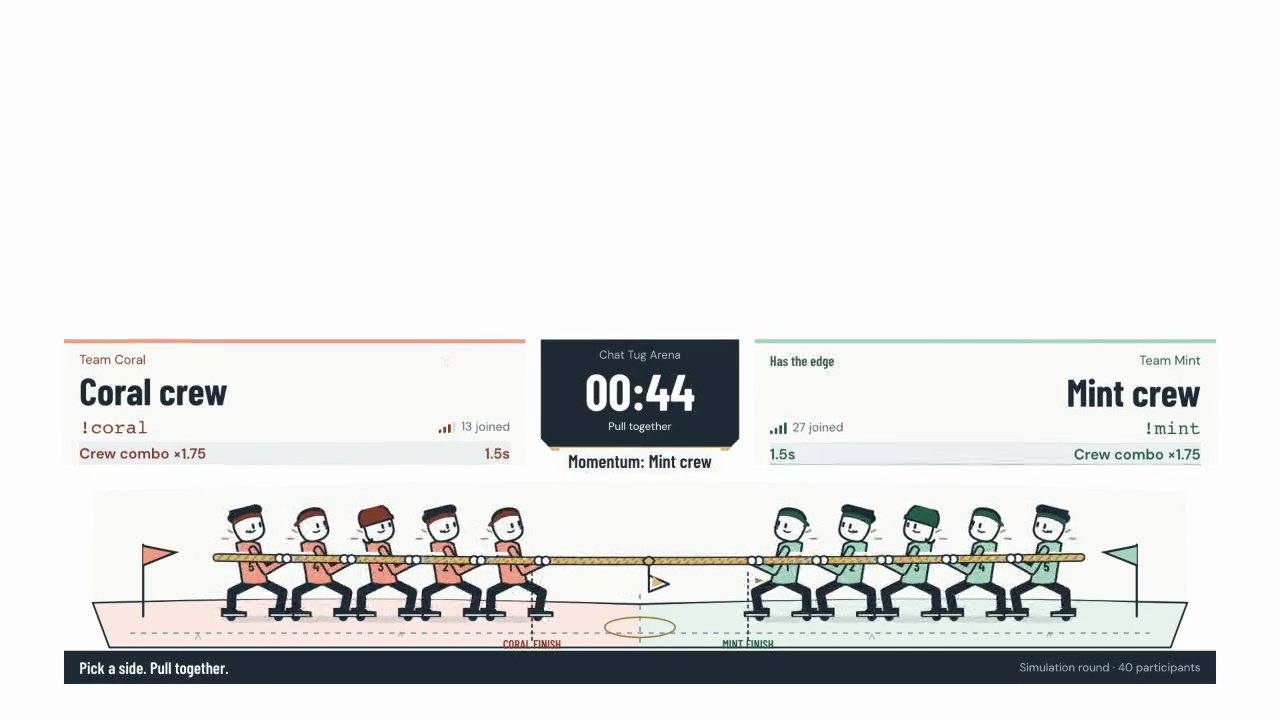
The streamer creates a showdown between two options. Viewers join by typing the corresponding keywords in Twitch chat, and their participation influences an animated tug-of-war displayed directly on the stream.
Unlike a traditional poll, Chat Tug Arena combines three core mechanics:
- Momentum Physics: Chat activity generates pulling force. The rope accelerates, carries momentum, and gradually loses force when activity slows down. A lead is never completely safe.
- Team Combos: Multiple unique viewers supporting the same side within a short window trigger temporary boosts and coordinated character animations. Teamwork matters more than message flooding.
- Real Consequences: The winning team decides something meaningful on stream, such as the next character, weapon, strategy, or community challenge.
The result isn't just a winning percentage. It's a moment that everyone helped create.
How It Works
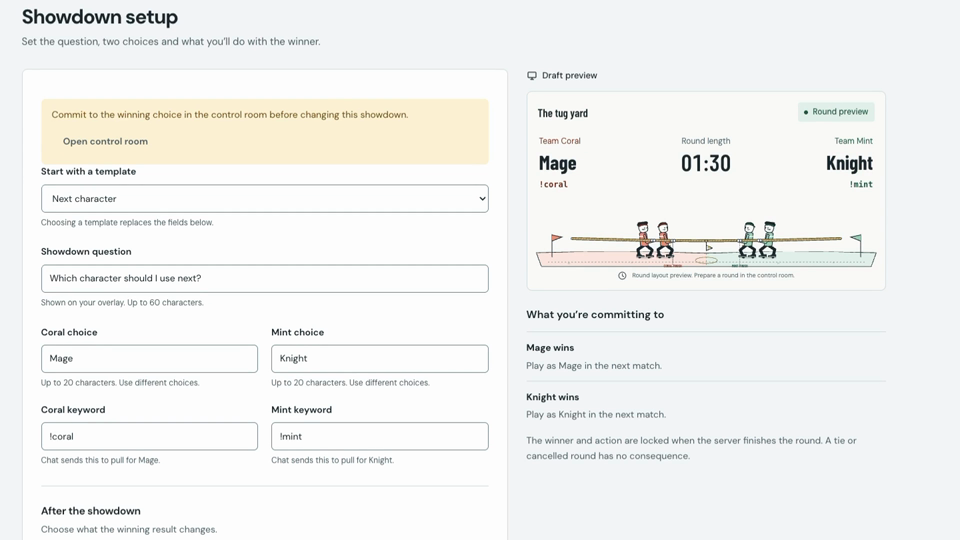
- The streamer creates a showdown. Choose two options, assign chat keywords, and set the round duration.
- Viewers join through Twitch chat. No additional viewer registration or separate voting website is required.
- The arena comes alive. Valid chat contributions generate pulling force, team combos create bursts of momentum, and animated characters react to the action.
- The community decides the outcome. The winning option becomes the streamer's next challenge or decision.
- Run it back. Start another showdown and give chat another chance to compete.
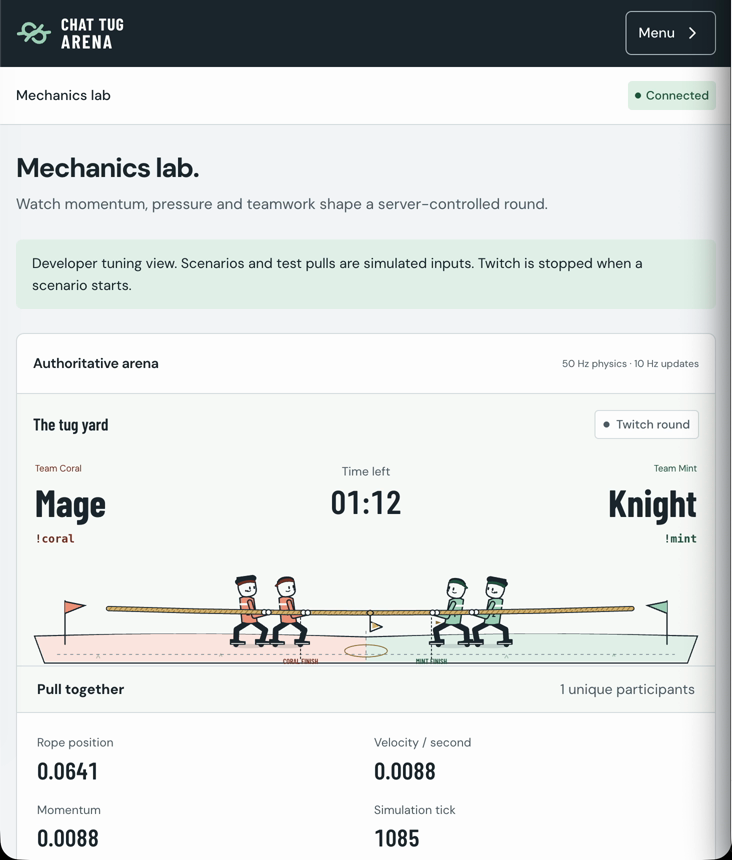
The streamer manages rounds from a control panel, while a dedicated browser overlay makes the experience visible on stream.
How I Built It
I used OpenAI Codex as my primary development assistant to turn the concept into a real-time Twitch experience.
The architecture separates Twitch chat ingestion, participation validation, game-state simulation, and visual rendering.
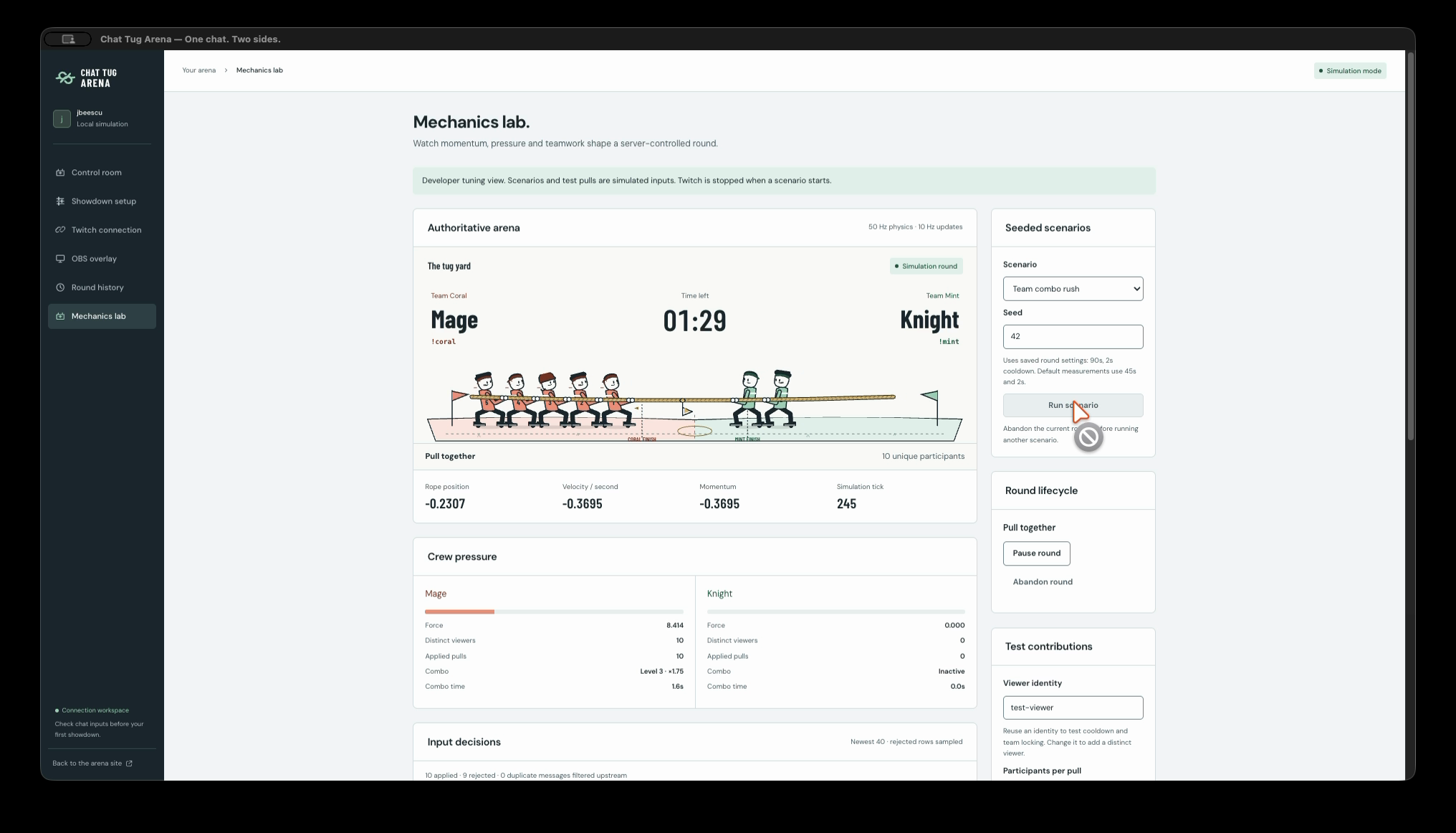
The game engine translates eligible chat messages into pulling force rather than simply counting votes. Momentum, force decay, and time-limited team bonuses create a more dynamic experience, while per-user participation limits and message deduplication help prevent spam from dominating the match.
The streamer dashboard manages round configuration and results, while the broadcast overlay turns the authoritative game state into a responsive visual experience.
For the interface, I focused on a coherent design system and consistent game artwork rather than generic AI-generated visuals. The goal was to make the product intuitive for streamers and entertaining for viewers.
Challenges
The central design challenge was balancing continuous participation with fairness.
If every message has unlimited influence, a small number of users can dominate by spamming. If everyone can contribute only once, the experience becomes another ordinary poll.
Chat Tug Arena addresses this with bounded contributions, cooldowns, diminishing returns, and bonuses for coordinated participation from distinct viewers.
Another challenge was translating rapidly changing chat activity into movement that feels physical, understandable, and exciting—without making the outcome arbitrary.
Finally, the overlay needed to remain visually clear during a real stream, even when the action intensified.
What I'm Proud Of
The most compelling part of Chat Tug Arena is the connection between audience participation and what happens next.
A quiet team can rally. A coordinated group can reverse the momentum. A streamer can watch the community compete to decide the next challenge.
The decision becomes the entertainment.
What I Learned
Building Chat Tug Arena reinforced how much realtime interactive products depend on the details: event handling, synchronization, predictable game mechanics, user feedback, and visual clarity.
It also gave me an opportunity to use Codex across the engineering workflow—from translating a product concept into technical components to iterating on the experience and validating its behavior.
What's Next
I'd like to explore streamer-versus-streamer community battles, custom game themes, Channel Points interactions, and additional ways to make audience decisions part of live content.
The long-term vision is simple: make Twitch chat feel less like a comment section and more like a team playing alongside the streamer.
Built With
- codex
- twitch


