Inspiration
What if we could make microorganisms work for us the same way we program computers?
Microbes are already being used to produce everything from industrial enzymes and biofuels to medicines and sustainable materials. But finding the right microorganism for a particular job isn't easy. A strain that performs well in a lab might struggle when exposed to higher temperatures, different nutrients, or the stressful conditions of industrial manufacturing.
And the information needed to figure this out is scattered everywhere: research papers, genomic databases, gene expression studies, metabolic models, and experimental datasets. Researchers often spend a huge amount of time just finding and connecting this information before they can even begin testing an idea.
Coming from backgrounds in computer science, AI, genetics, genomics, and bioinformatics, we started wondering: What if we could bring all of this together into one platform and let researchers describe what they want to achieve in plain English?
That's how ChassiX-AI started.
We wanted to build something that could make biological research more accessible while helping scientists explore better ways to manufacture useful products sustainably.
What it does
ChassiX-AI is an AI-powered platform designed to help researchers explore and compare microbial hosts for different biomanufacturing applications.
It starts with a simple question:
"What do you want to build?"
For example, someone could ask:
"I want to find a microorganism that can produce an industrial enzyme at higher temperatures, so we can potentially reduce the energy spent on cooling."
Instead of making the researcher manually search through papers, download datasets, configure different bioinformatics tools, and piece everything together, ChassiX-AI aims to bring that process into one connected workflow.
Here's how it works:
- Finding the right microbial hosts
An AI research agent uses retrieval-augmented generation (RAG) to explore scientific literature and biological databases, identify relevant microorganisms, and help researchers compare them based on their documented capabilities.
- Bringing biological data together
Once users select the hosts they're interested in, the platform is designed to find relevant public datasets or let them upload their own.
These include genomics, transcriptomics, functional perturbation studies, metabolomics, and metabolic pathway data. Each offers a different perspective on what's happening inside a microorganism.
- Running bioinformatics workflows
Different types of biological data require different analysis tools. Our architecture uses containerized, cloud-based workflows so that each analysis can run in an environment suited to its computational requirements.
The idea is to spare researchers from spending hours configuring dependencies and managing computational infrastructure.
- Connecting the dots with multiomics AI
This is the part we're most excited about.
Rather than looking at genes, metabolites, or pathways separately, we want ChassiX-AI to bring these findings together and build a more complete picture of how a microbial host behaves.
We're also incorporating metabolic flux analysis to explore how nutrients and metabolites move through metabolic networks, helping identify potential bottlenecks and tradeoffs.
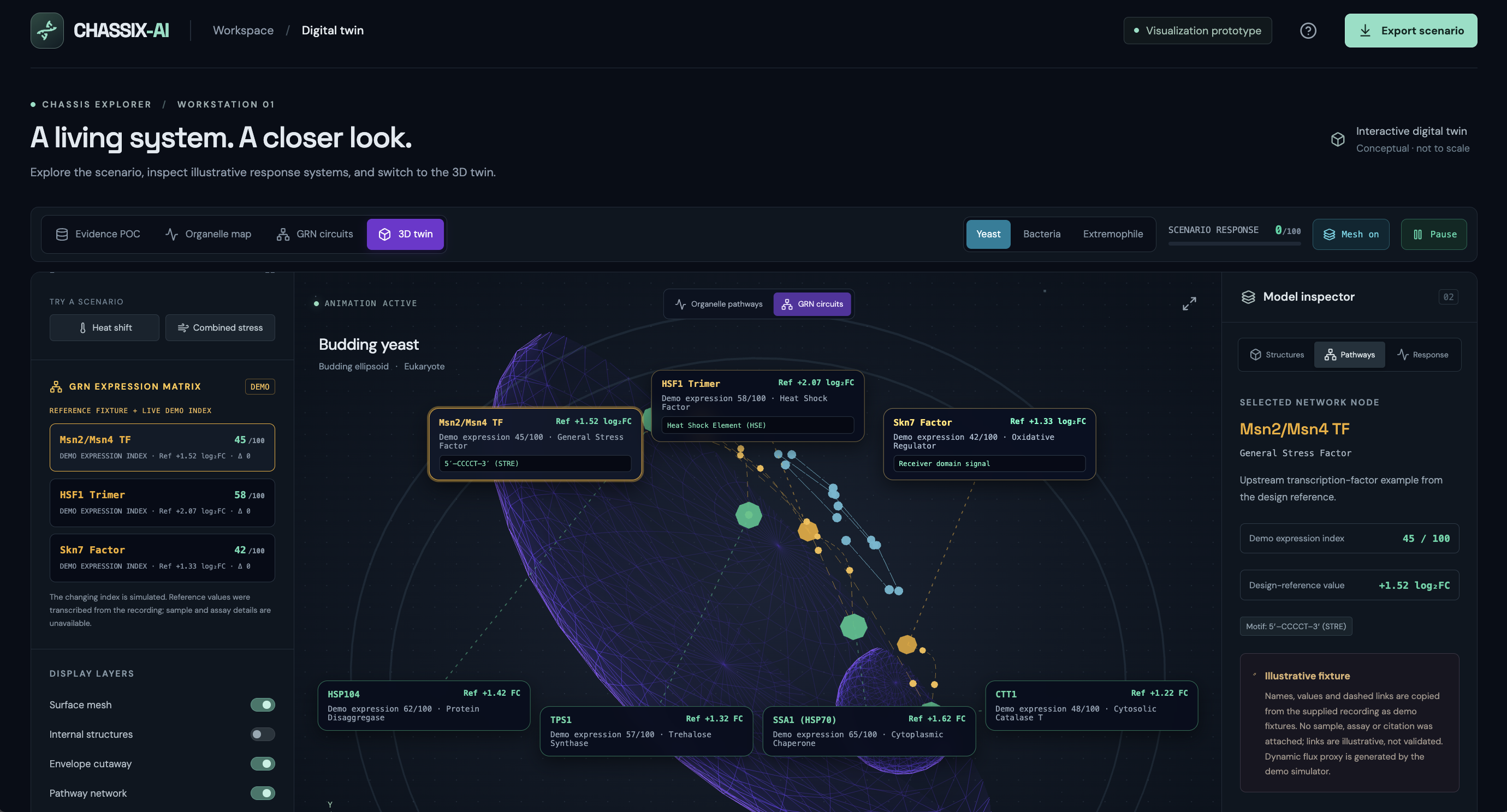
Over time, we hope to use this integrated information to develop better computational representations, or digital twins, of microbial cell factories.
- Making the results understandable
The final goal is an interactive research dashboard where users can compare potential hosts, explore gene and pathway evidence, visualize metabolic activity, inspect supporting research, and ask follow-up questions through an AI assistant.
We also want the system to be transparent about what it knows, what it's predicting, and where the evidence is missing.
How we built it
We started by breaking the problem into smaller pieces: understanding the researcher's goal, finding relevant scientific information, running the right analyses, and bringing the results back together in a useful way.
For the AI side, we designed a multi-agent architecture using LLMs and retrieval-augmented generation to interpret research objectives, find relevant literature, and organize scientific evidence.
On the bioinformatics side, we explored how Python-based tools could support genomics, transcriptomics, metabolomics, perturbation analysis, and metabolic modeling. We also designed the system around Docker and Nextflow so computational workflows can eventually run independently on cloud instances instead of relying on one machine with every dependency installed.
For the application, we built around a web-based experience where researchers can start with a natural-language prompt and move through a visual scientific workflow.
One of our biggest design decisions was to keep the scientific computations separate from the AI agents. We don't want an LLM guessing biological results. We want it to help choose, coordinate, and interpret actual computational analyses.
We're continuing to connect the individual components into a complete end-to-end system.
Challenges we ran into
Making sense of biological data from different sources
This was probably one of the trickiest parts. Genomics, transcriptomics, and metabolomics datasets don't naturally fit together. They use different identifiers, formats, experimental conditions, and measurement methods.
Simply combining the datasets isn't enough; we also need to understand whether the experiments are actually comparable.
Figuring out how much autonomy to give AI
It's tempting to let an LLM do everything, especially when it can generate such convincing scientific explanations. But biology isn't something we can afford to bluff our way through.
We had to think carefully about how AI should interact with real bioinformatics tools, how to verify its claims, and how to communicate uncertainty rather than presenting every output as a fact.
Designing a system that can handle computationally heavy workflows
Some analyses can run in seconds, while others can take hours and require considerable memory or computing resources.
We explored an architecture where workflows can run independently on cloud instances, allowing users to see results as they become available rather than waiting for the entire process to finish.
Connecting biological improvements to sustainability
A microorganism that grows at a higher temperature doesn't necessarily make a manufacturing process more sustainable.
There are still questions about productivity, energy consumption, feedstocks, and overall environmental impact. We wanted ChassiX-AI to help researchers think about these tradeoffs instead of simply optimizing one biological characteristic.
What we learned
One of our biggest takeaways was that AI doesn't have to replace scientific reasoning to be useful in science. Sometimes its biggest contribution is making the existing science easier to access, connect, and understand.
We also learned just how much information can get lost when biological datasets are analyzed independently. A gene expression change might look interesting on its own, but it becomes much more meaningful when connected to metabolic pathways, functional studies, and actual metabolite measurements.
And perhaps most importantly, building ChassiX-AI pushed us to think beyond just training another AI model. We had to think about the entire research experience, from the moment someone has an idea to the point where they have enough evidence to decide what to investigate next.
What's next for ChassiX-AI
There's still a lot we want to build.
Our next steps are to connect more public biological databases, get the individual multiomics workflows running reliably on cloud infrastructure, and improve how we integrate their outputs into meaningful host comparisons.
We're particularly interested in expanding metabolic flux analysis and eventually using experimental feedback to make our microbial models more informative.
In the longer term, we'd love to see ChassiX-AI help researchers working on sustainable enzyme production, agricultural waste conversion, biofuels, and other forms of biomanufacturing.
We know we're not going to solve biological engineering with one hackathon project. But if we can make it a little easier for researchers to ask better questions, find useful evidence, and explore promising ideas, that's already a meaningful step forward.
Our goal with ChassiX-AI is to make the journey from a biological idea to a research-backed strategy a lot less complicated.
Learn from nature. Build with intelligence. Make biology more accessible
Built With
- batch
- bioinformatics
- biopython
- cloud
- cobrapy
- css
- docker
- fastapi
- langgraph
- llms
- metabolomics
- multiomics
- next.js
- nextflow
- openms
- pgvector
- postgresql
- python
- pytorch
- rag
- react
- scanpy
- tailwind
- typescript

Log in or sign up for Devpost to join the conversation.