-
-
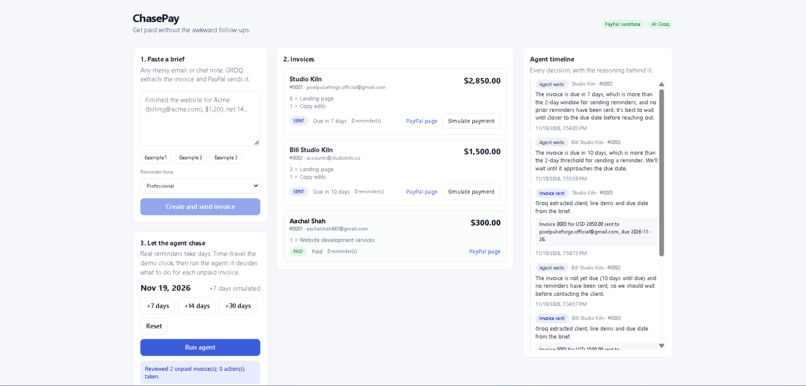
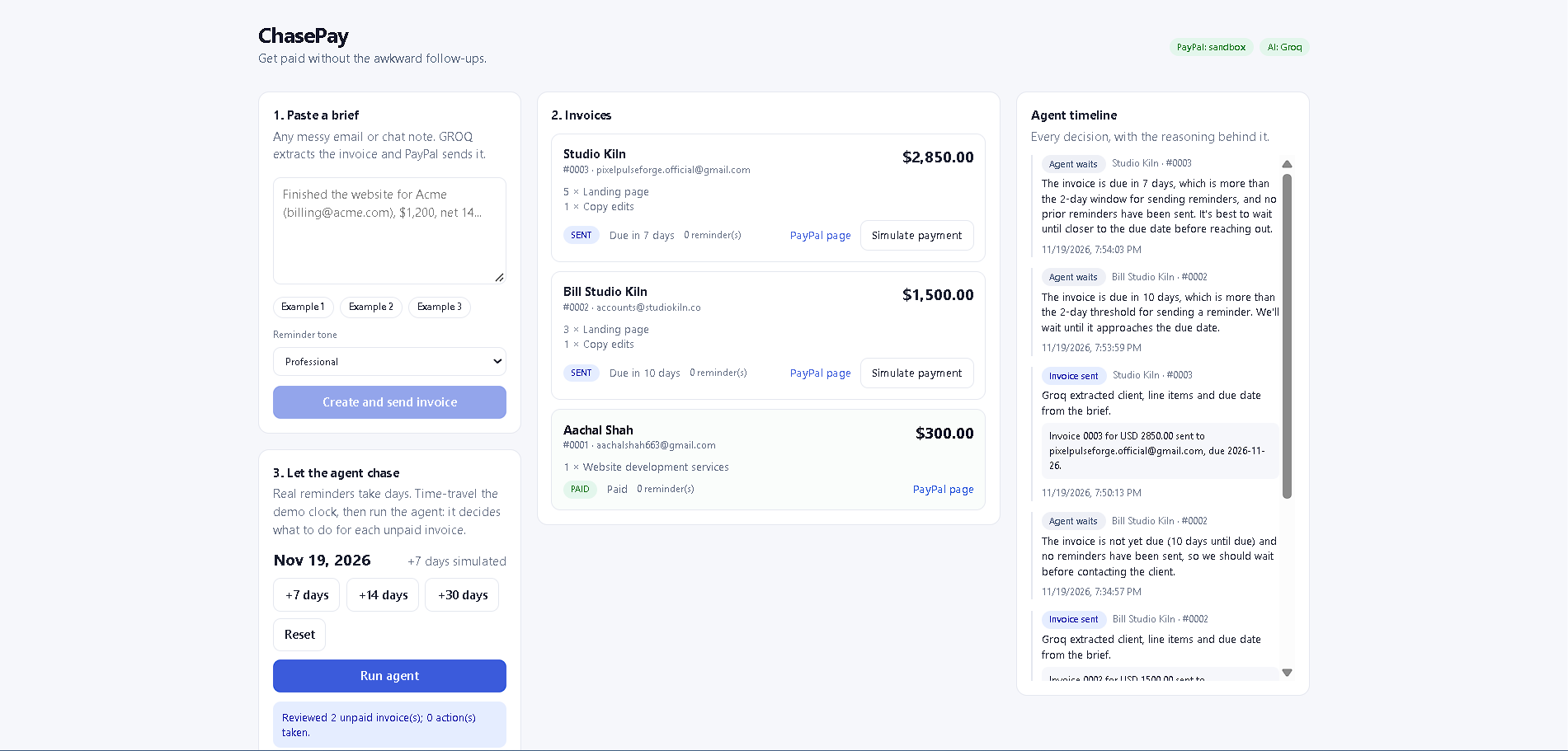
ChasePay dashboard: Track invoices, automate follow-ups, and run AI agents to get paid without the awkward reminders.
Inspiration
Freelancers do the work, send an invoice, and then wait. Chasing a late payment feels awkward, so people put it off, and cash flow suffers. Existing invoicing tools send reminders on a fixed timer (day 3, day 7) and never adapt. We wanted an agent that behaves like a polite, persistent assistant: it knows when to wait, when to nudge, and when to hand the problem back to the human.
What it does
ChasePay takes the whole invoice-to-payment loop off a freelancer's plate:
- Paste a brief. Any messy email or chat note, e.g. "Bill Studio Kiln, 3 landing pages at $550 each plus $100 for copy edits, due in 7 days."
- AI extracts the invoice. Client, email, line items, quantities, prices and due date come out as structured data.
- A real PayPal invoice is created and sent through the PayPal Invoicing API (sandbox).
- Payment is detected through PayPal webhooks (
INVOICING.INVOICE.PAID, signature-verified) with a status-sync fallback, and the invoice flips to PAID. - The collections agent runs. For every unpaid invoice it receives the full situation (days overdue, reminders already sent, tone preference) and must choose exactly one action:
wait,send_reminder(friendly or firm), orescalate_to_human. - Every decision is explained. The Agent timeline shows what the agent did and why, so the freelancer stays in control.
A demo clock lets you time-travel (+7 / +14 / +30 days) to see the agent's behaviour without waiting real days.
How we built it
- Backend: FastAPI + SQLAlchemy + SQLite.
- PayPal: Invoicing API v2 (create, send, remind, get status, record payment) with OAuth, plus Webhooks verified through PayPal's
verify-webhook-signatureendpoint. - AI: an LLM with tool calling (Llama 3.3 70B on Groq through an OpenAI-compatible API; the provider layer also supports Gemini and Claude and is switched by one environment variable). The model never "just writes text": it must call a tool, which makes its output structured and auditable.
- Guardrails: hard rules sit outside the model so a bad completion can never spam a client: at least 3 days between reminders, a maximum of 3 reminders, and escalation only when 14+ days overdue or after 3 reminders. When a guardrail overrides the model, the timeline says so.
- Frontend: React + TypeScript + Vite dashboard with the brief box, invoice list and decision timeline.
- Tests: 19 automated tests cover the escalation ladder, webhooks, guardrails and the AI provider handling.
Challenges we ran into
- The model misread a real brief. In live testing, Llama turned "3 landing pages at $550 each plus $100" into 5 pages and a $2,850 invoice. Sending a wrong amount to a client is the worst failure for this product, so we added a verification step: every quantity and price the model extracts must be traceable to the original message. If not, the model is asked to re-read once, and if it is still wrong the invoice is refused with a clear message instead of being sent.
- Sandbox emails do not reach real inboxes, so we verified invoices through the PayPal invoice page and sandbox accounts.
- Time-dependent behaviour is hard to demo, which led to the simulated clock.
Accomplishments we're proud of
- A real end-to-end loop on the PayPal sandbox: brief to invoice to payment to automated follow-up.
- An agent whose decisions are explainable and bounded, not a black box that emails clients.
What we learned
Reliable agents need structure around the model: tool calling for actions, deterministic guardrails for safety, and verification of any number that touches money.
What's next
Email and WhatsApp reminder channels, per-client payment history so tone adapts to habits, PayPal live-mode onboarding, and a weekly cash-flow summary for the freelancer.
What it does
How we built it
Challenges we ran into
Accomplishments that we're proud of
What we learned
What's next for ChasePay
Built With
- fastapi
- groq
- httpx
- llama-3
- llm-tool-calling
- openai/gpt-oss-120b
- paypal-invoicing-api
- paypal-webhooks
- pydantic
- python
- react
- sqlalchemy
- sqlite
- typescript
- vite
