Inspiration
We wanted to make a custom-fit desk accessory easier to shape and inspect without asking users to start with a full CAD workflow. Charu turns desk dimensions into a visible, editable concept and makes its fit and printer constraints explicit before someone tries to manufacture it.
What it does
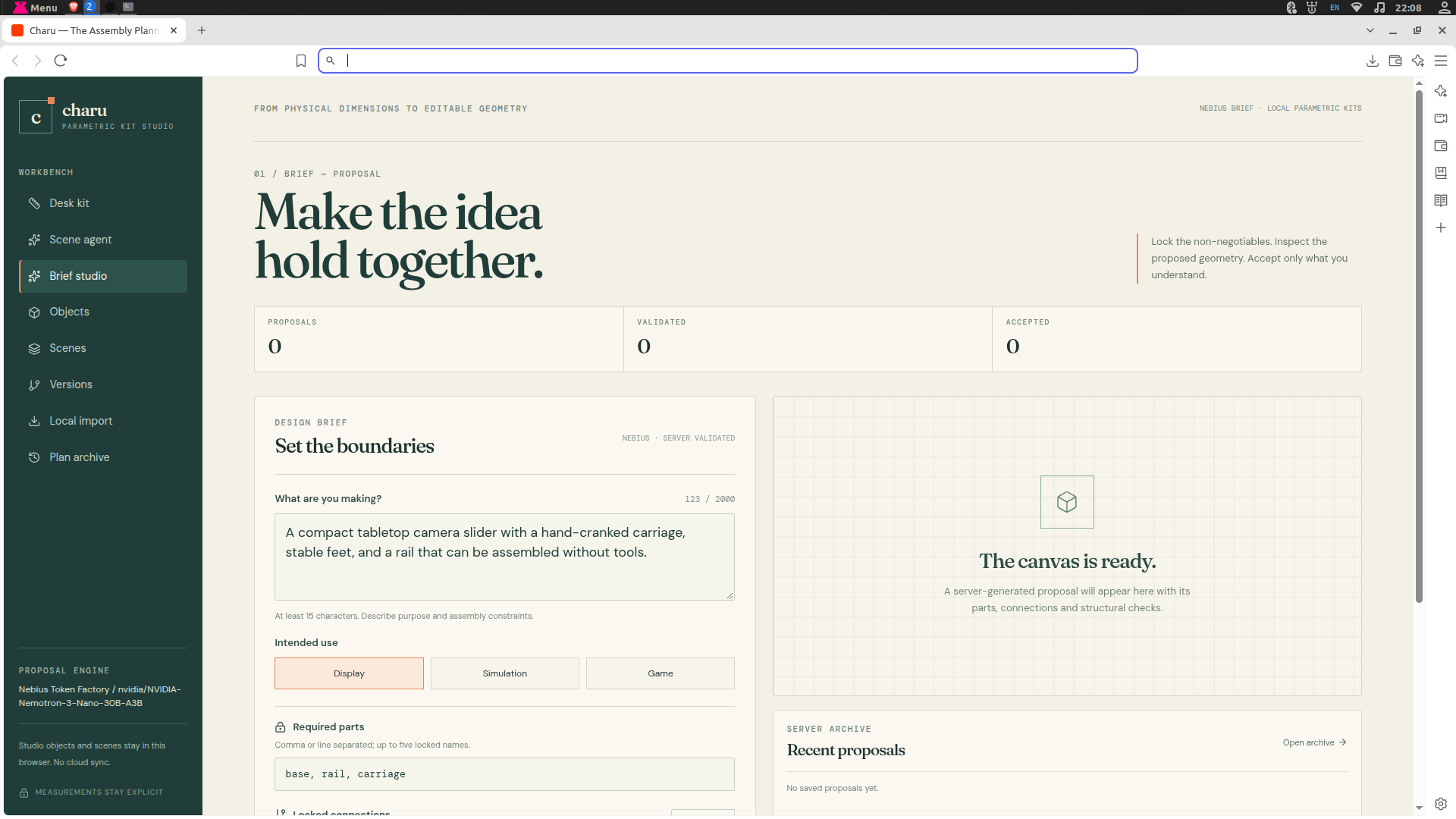
Charu builds a parametric under-desk cable-organizer kit from desk and cable measurements. It shows the design in an editable 3D scene, checks the clamp locations and available clearance in its Fit Passport, and splits supported parts to respect a selected printer-bed size. A local scene editor can propose explicit moves, rotations, additions, removals, or arrangements for review before applying them. A separate assembly-planning workflow uses a language model to propose constrained assembly concepts. The fit and printer checks are software estimates. They do not establish strength, safety, print quality, or real-world fit; physical testing is still required.
How we built it
The app uses React, TypeScript, Vite, Three.js/WebGL, and an SVG fallback for the editable design preview. The API uses Express, PostgreSQL, and Drizzle; OpenAPI, Orval, and Zod keep API clients and validation contracts aligned. The assembly-planning endpoint makes a runtime inference call to NVIDIA Nemotron 3 Nano 30B A3B through Nebius Token Factory. The server validates the structured proposal against the requested parts, connections, and geometry limits. The desk-kit geometry and scene-edit commands are deterministic local code; they do not call the model.
Challenges we ran into
The main challenge was separating a plausible visual concept from verified physical behavior. We made fit assumptions, printer limits, and proposal checks visible, and kept scene edits explicit and reviewable. We also had to keep generated API clients synchronized with the OpenAPI definition for a clean project export.
Accomplishments that we're proud of
- A custom-fit desk-kit workflow with an editable 3D preview.
- A Fit Passport that checks clamp points and clearance against the supplied dimensions.
- A printer-aware compiler that splits supported parts when the selected bed is too small.
- A deterministic scene editor that lets users inspect proposed local changes before applying them.
- A separate, real Nebius Token Factory/Nemotron assembly-proposal path with server-side structural validation.
- The exported Charu project installed offline, passed workspace typechecking and API/frontend builds, and passed all 24 geometry tests.
One observed live assembly-plan run produced a structured concept and passed 7/7 structural checks. This was a single run, not a benchmark or a claim of physical correctness.
What we learned
Editable 3D concepts are more useful when users can see which dimensions and constraints shaped them. We also learned to state the boundary between software checks and physical validation: a dimensional pass is not proof that a printed part will fit, hold a load, or be safe.
What's next for Charu — The Assembly Planner
We want to print the generated parts and compare their measured fit with the Fit Passport, improve collision and tolerance handling, and expand material and printer profiles. Those physical tests have not yet been completed.
Built With
- 3
- 30b
- drizzle-orm
- express.js
- nano
- nebius-token-factory
- nemotron
- node.js
- nvidia
- openapi
- orval
- postgresql
- react
- svg
- three.js
- typescript
- vite
- zod

Log in or sign up for Devpost to join the conversation.