-
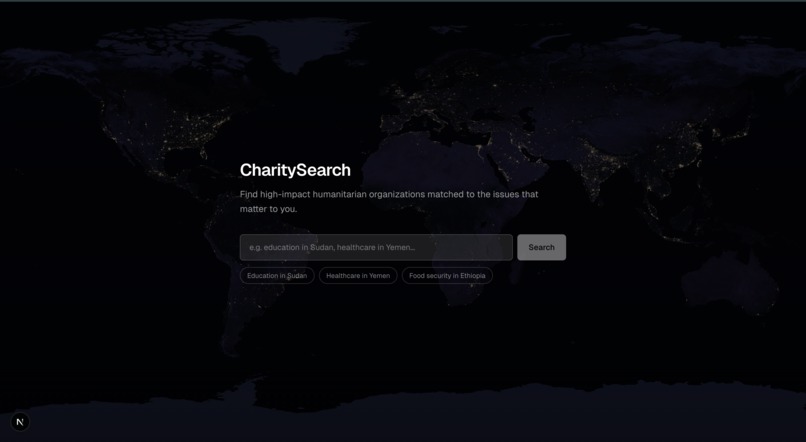
The front page for CharitySearch, emphasizing our global focus.
-
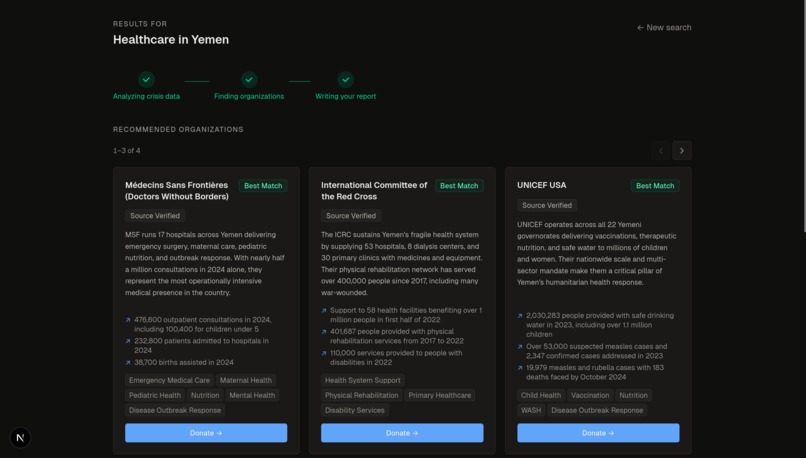
The search functionality; note the pipeline!
Inspiration
Giving charity is a core value for many people, but it is often difficult to know where help is most needed and which organizations are actually operating there. Existing platforms either focus on evaluating a small number of charities or provide raw data without context. We wanted to bridge that gap by combining real humanitarian data with AI-driven reasoning, making it easier for anyone to make informed, impactful donation decisions.
What it does
CharitySearch is an AI-powered platform that connects real-world crisis data with relevant humanitarian organizations. A user can input a goal like, “I want to support education efforts in Sudan,” and the system will:
- Analyze humanitarian data (e.g., displacement, education disruption, food insecurity)
- Estimate the severity of the crisis in that region
- Identify organizations working in that space
- Explain why those organizations are relevant, based on the specific needs of the region
Instead of telling users “this is the best charity,” CharitySearch provides transparent, context-aware recommendations grounded in data.
How we built it
We designed a pipeline that alternates between data retrieval and AI reasoning:
- Pulled humanitarian indicators from the Humanitarian Data Exchange using HAPI
- Used Claude Sonnet 4.5 to parse user intent, match crises to relevant charities, and generate a concrete list of organizations along with preliminary reasoning
- Used Claude Opus to sift through aggregated data on crises in select countries and generate an in-depth statistical analysis of relevant crises.
- Used a Fetch.ai Claude web search agent to search the internet for more information on candidate organizations4
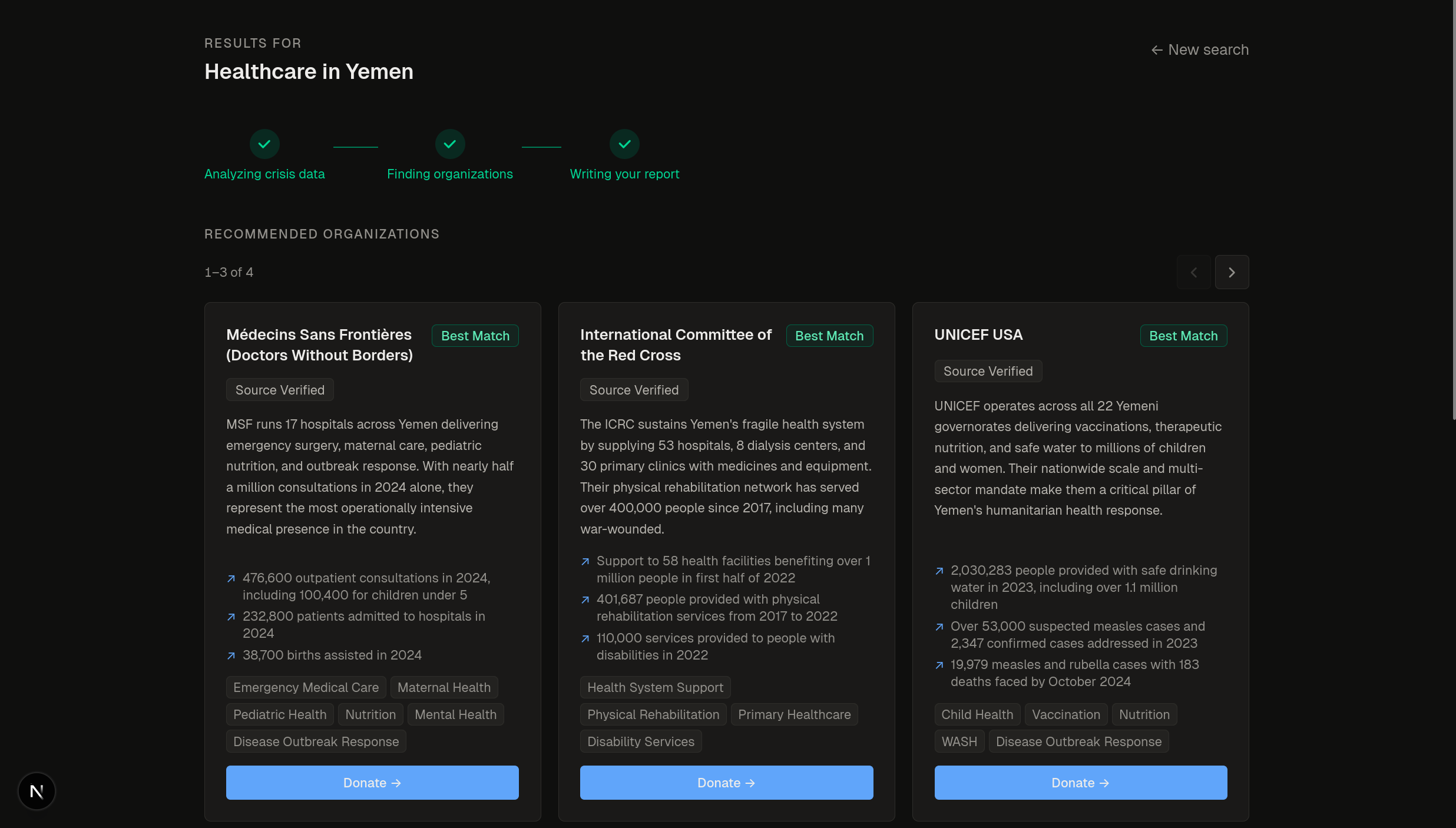
On the frontend, we created a simple interface that lets users input a donation goal to view crisis summaries, severity indicators, and recommended organizations with reasoning.
Challenges we ran into
Data inconsistency: Humanitarian datasets vary widely in format, granularity, and completeness.
Defining “impact”: It’s difficult (and risky) to rank charities without oversimplifying complex realities.
Time constraints: Integrating APIs, cleaning data, and building a usable interface within a few hours required tight scoping.
Avoiding hallucination: Ensuring AI outputs stayed grounded in real data required structured prompts and constraints.
Accomplishments that we're proud of
Built a working end-to-end pipeline from user prompt → data → insight → recommendations
Combined real humanitarian data with AI reasoning, rather than using AI as a superficial layer
Designed the system to be transparent and ethical, avoiding misleading “best charity” claims
Created a product that feels like a real decision-support tool, not just a demo
What we learned
AI is most powerful when paired with structured, real-world data
Simplicity and clarity matter more than complexity in a short build
Ethical considerations (like avoiding overclaiming impact) are critical in social good applications
Even imperfect data can be valuable when presented with context and transparency
What's next for CharitySearch
Expand the charity dataset using automated web extraction
Incorporate more real-time indicators (e.g., disaster alerts, funding gaps)
Add geospatial visualizations (interactive crisis heatmaps)
Improve matching with more nuanced sector and intervention modeling
Integrate donation pathways directly into the platform
Built With
- anthropic
- fetch.ai
- hapi
- next.js

Log in or sign up for Devpost to join the conversation.