-
-
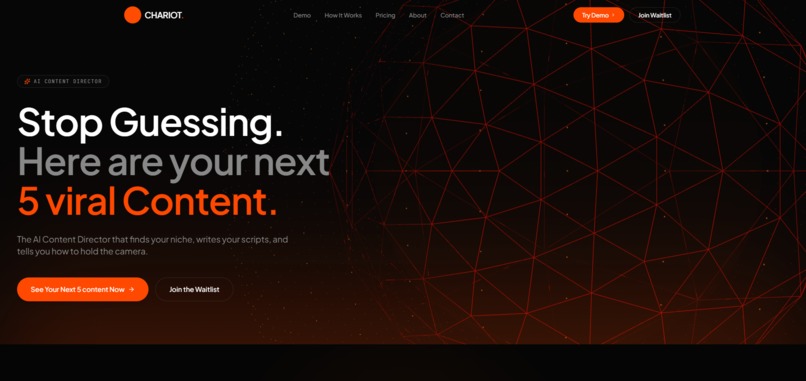
Landing Page
-
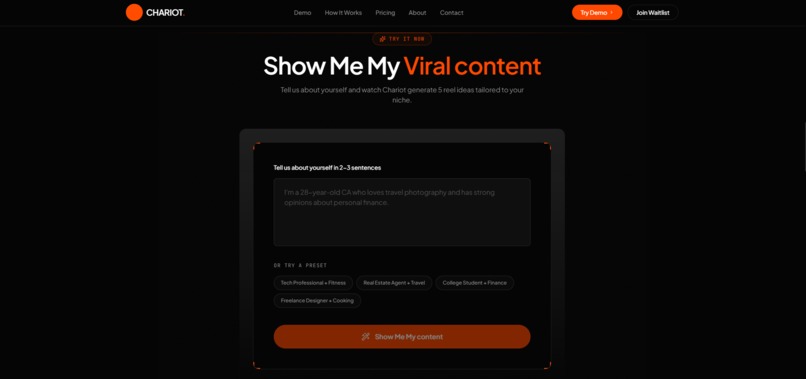
Viral Chatbot
-
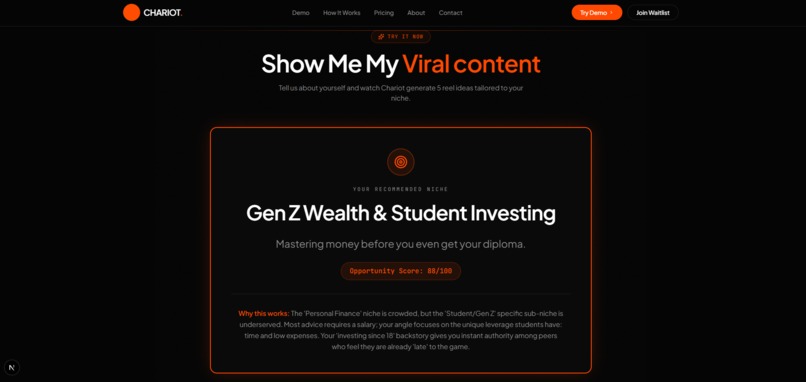
Recommended Niche
-
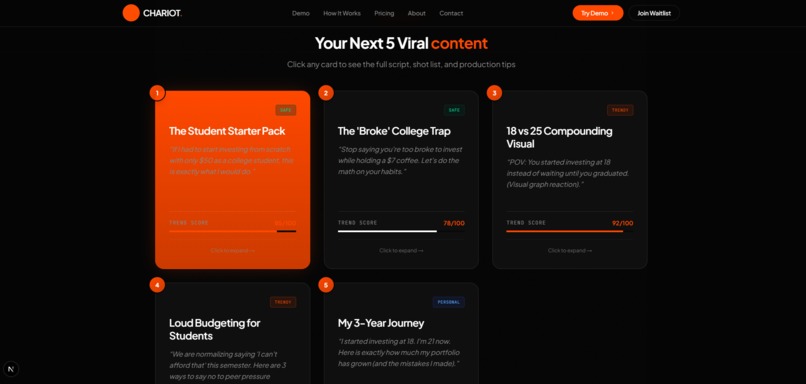
5 Viral Vids in a Day
-
Content Strategy
Chariot Agentic — Content Creation LaunchPad
Inspiration
73% of aspiring creators never post their first reel. Not because they lack talent — because they're paralyzed by one question: "What should I even create?"
We've watched this cycle kill creator dreams over and over. Someone passionate about fitness AND finance sits at their desk for hours, scrolling competitor accounts, reading "how to find your niche" articles, opening ChatGPT to generate script ideas that sound like everyone else's. They close the laptop and say "I'll figure it out tomorrow." Tomorrow never comes.
The creator economy is worth $313B in 2026. Over 50 million people worldwide want to become creators. But the tools available — Canva, CapCut, Hootsuite, ChatGPT — all assume you already know what to create. They help you edit, schedule, and write. Nobody helps you decide.
We realized the gap isn't a tool problem. It's a director problem. Every successful creator essentially has an invisible content strategist in their head — someone who knows their voice, tracks what's trending in their niche, and says "here's exactly what to post today, here's the script, and here's how to hold the camera." We're building that strategist as an AI agent. Not a chatbot. Not a prompt wrapper. An AI Content Director that remembers you, learns your voice, and gets smarter with every reel you post.
The personal trigger: our founder went through this exact paralysis — spending weeks deciding between niches, researching competitors, and second-guessing every content idea. The moment we framed the problem as "what if an AI just told you your next 5 reels every morning, personalized to YOUR skills and YOUR audience?" — everything clicked.
What it does
Chariot Agentic is an AI Content Director that takes a creator from "I don't know where to start" to "here's exactly what to film today" in under 60 seconds.
The core product loop:
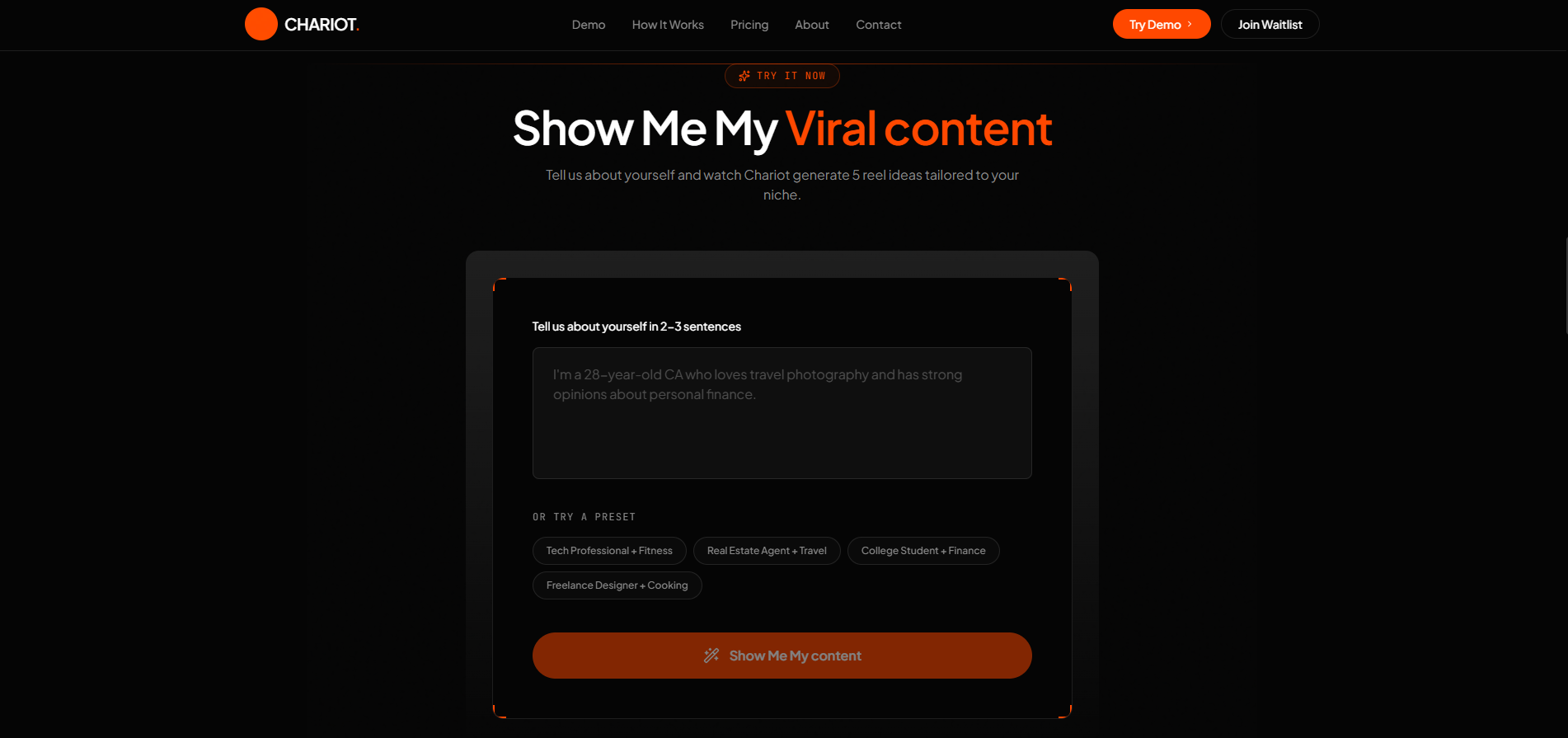
Tell us about yourself — No forms, no dropdowns. Just 2-3 sentences in natural language. "I'm a 26-year-old software engineer who loves fitness and meal prep. I want to help other tech people stay healthy."
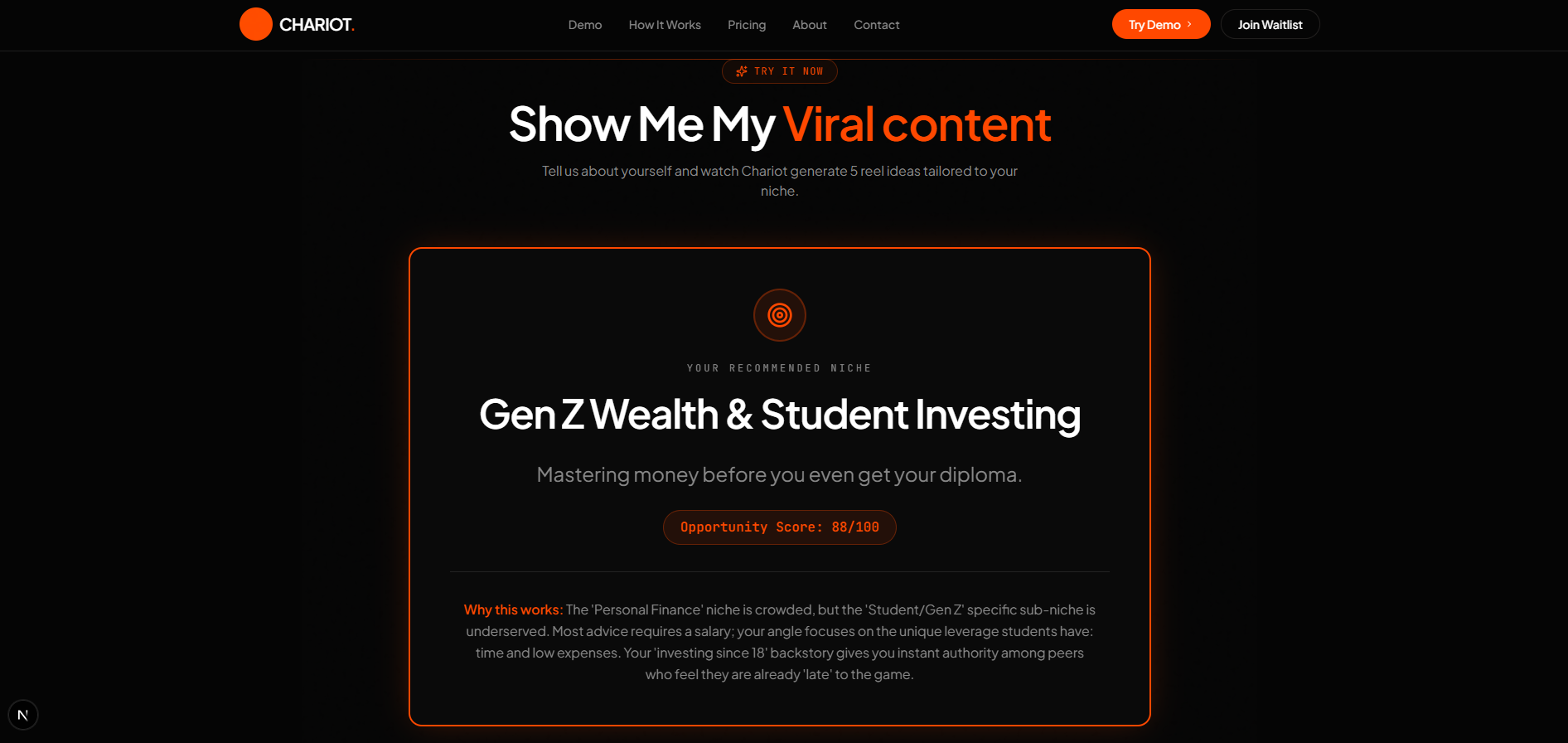
AI finds your niche — We don't just spit back what you told us. We cross-reference your skills, interests, and background against 50K+ existing creator profiles to find your unique angle — the intersection of your expertise that has low competition and high audience demand. You get 3 recommended niches with data-backed reasoning, opportunity scores, and competitor gap analysis.
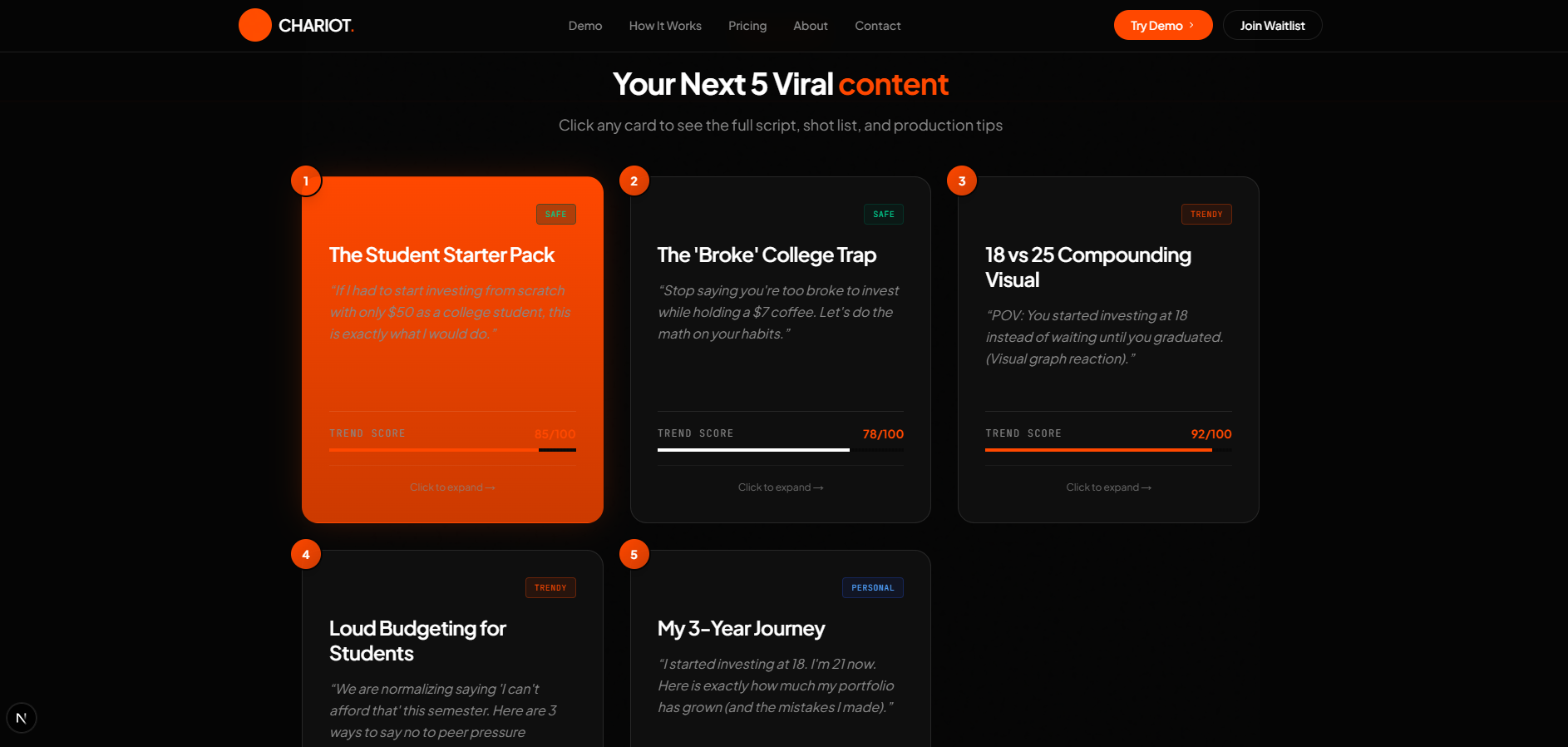
Get your Next 5 Reels — A weekly content calendar with 5 ready-to-create reels, balanced across: 2 "safe" (high search volume, proven formats), 2 "trendy" (viral potential, current hooks), and 1 "personal" (brand building, audience connection). Each reel includes a trend score and estimated reach range.
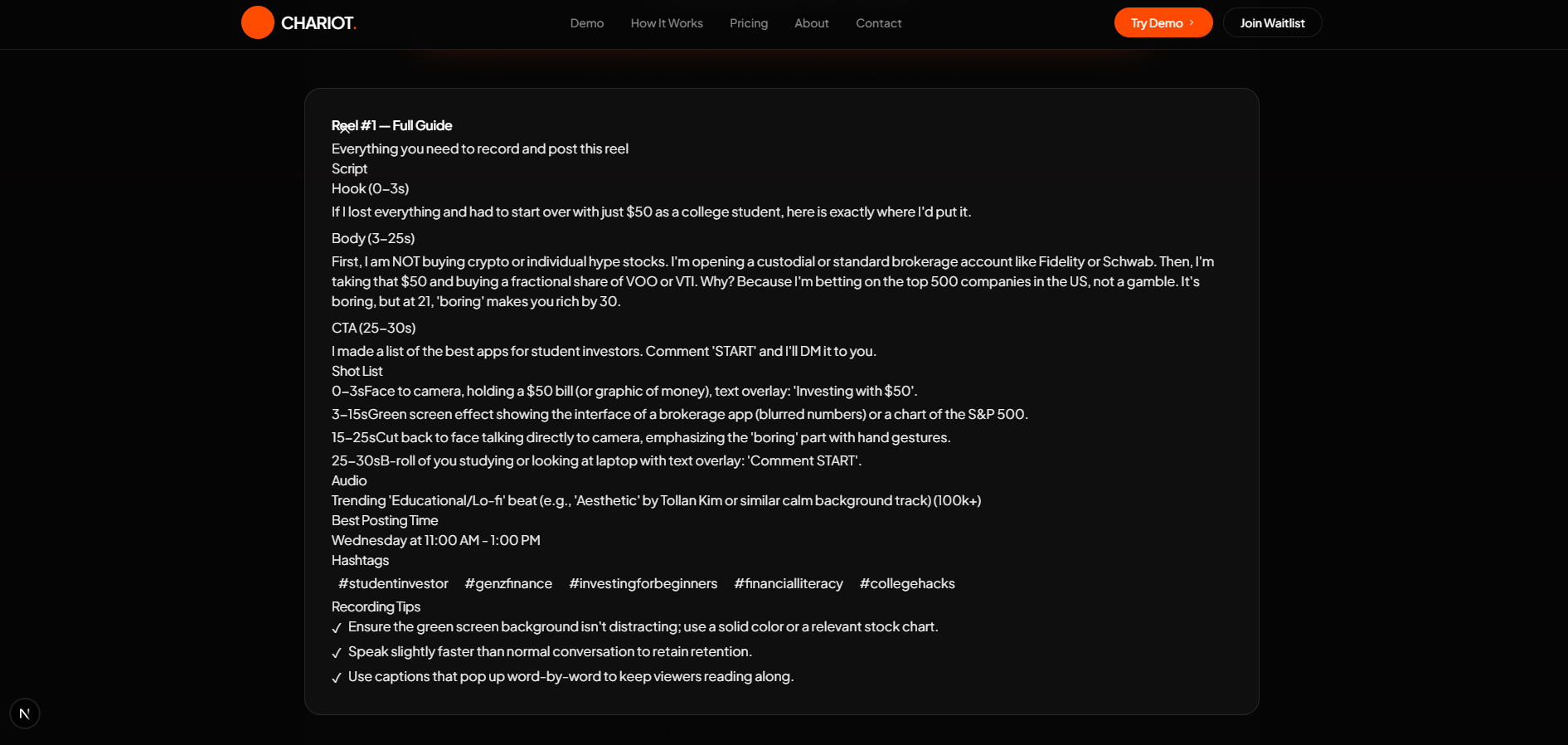
Complete Creation Guide — Click into any reel and get the full production package:
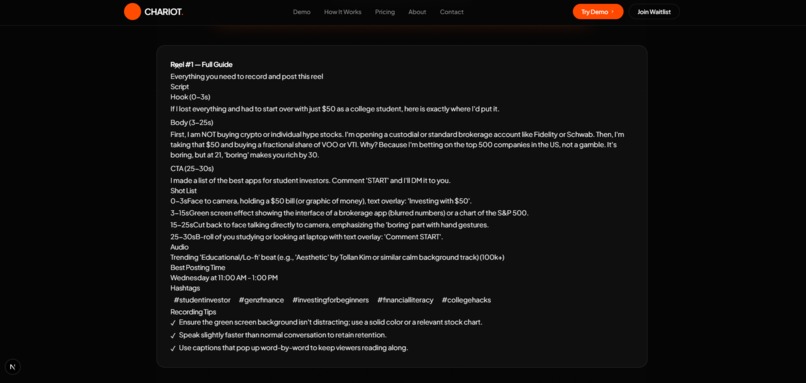
- The Script: Hook (0-3s), Body (3-25s), CTA (25-30s) — written in YOUR voice, not generic AI-speak
- The Shot List: Time-stamped visual instructions — "0-3s: Close-up of face, speak hook directly to camera" — so you know exactly how to film
- Audio & Posting: Trending audio suggestions with usage counts, optimal posting time, and niche-relevant hashtags
- Recording Tips: Practical filming advice specific to each reel's format
It remembers you — Powered by Mem0 (YC S23), every interaction compounds. The AI learns which hooks you prefer, which formats you skip, which reels you actually post. Your 50th suggestion is genuinely better than your first. Your "Viral DNA" lives in Chariot.
The key differentiator is the Shot List. Every AI tool can write a script. Nobody tells you how to hold the camera. That's the gap between "content writer" and "content director."
Live demo on the landing page: Visitors can try Chariot immediately — type an intro or select a preset persona, and watch the AI generate a complete niche recommendation + 5 reels + expanded guide in real-time. No signup required. Powered by live Gemini API calls via Google AI Studio with streaming output.
How we built it
Architecture decisions that shaped everything:
Mem0 as the foundation, not a bolt-on. Most AI products add personalization after launch. We architected Mem0 into the core from Day 1. Every user interaction — onboarding answers, niche selections, reel views, regeneration patterns, scripts they accept vs. reject — feeds into 6 distinct memory categories: user_profile, user_voice, content_preferences, rejected_styles, successful_hooks, and niche_context. The LLM doesn't just generate content — it queries the user's full memory state before every generation call and injects it as system prompt context.
Gemini (Google) as the primary LLM. We evaluated Gemini vs. Claude. Gemini won on structured output quality (JSON scripts, shot list tables), generous free-tier access via Google AI Studio for rapid prototyping, multimodal capabilities for future video analysis features, and cost efficiency at scale with competitive pricing. Google AI Studio made development and iteration significantly faster — we could test prompts, tune parameters, and validate output formats directly in the Studio playground before writing a single line of integration code. Every generation feature — niche discovery, reel ideation, script writing, shot list creation, cross-platform adaptation — runs through Gemini.
The tech stack:
- Frontend: Next.js 15 (App Router) deployed on Vercel — server components for the landing page, client components for the interactive demo
- Backend: FastAPI (Python) for the agentic pipeline — handles Mem0 queries, Gemini API orchestration, and trend data processing
- Database: Supabase (Postgres + Auth + Realtime) — user profiles, generated content, waitlist, analytics events
- Memory Layer: Mem0 SDK — user-specific memory store with category-based retrieval
- LLM: Google Gemini API via AI Studio with streaming — structured output via system prompts and Gemini's native JSON mode
- Payments (Phase 3): Stripe Checkout + Customer Portal
- Analytics: PostHog for privacy-friendly event tracking across the full funnel
The phased approach:
- Phase 1 (Week 1-2): Landing page + live demo + viral waitlist — the hype machine. Static frontend with live Gemini API calls for the demo. No auth, no database beyond email collection.
- Phase 2 (Week 3-6): Core product behind auth — onboarding, niche discovery, "Next 5" dashboard, complete reel guides, Mem0 integration. This is the "prove retention" phase.
- Phase 3 (Week 7-12): Moat builders — real-time trend data pipeline (X-API + Reddit), cross-platform content adaptation, Stripe subscriptions ($39/mo Pro, $79/mo Creator with founding member lock), performance feedback loop, teleprompter mode.
The demo architecture: The landing page demo uses live Gemini API calls — not pre-generated templates. Every visitor gets a unique, personalized output. We use streaming to show content as it generates (niche appears first, then reels populate one-by-one), turning latency into anticipation. Rate-limited to 3/IP/day with graceful degradation to waitlist CTA.
Challenges we ran into
1. The "AI Wrapper" trap. Our own strategy doc warned against it. Without Mem0 actually compounding value over time, we're just a pretty ChatGPT wrapper. The challenge was making the personalization layer feel materially different from a cold generation — and doing it from Day 1, not "eventually." We solved it by defining 6 specific memory categories and requiring a Mem0 query before every LLM call, even when the memory store is nearly empty. On the first generation, the system tells the user "I'm learning your style" — by the third, it references their past preferences explicitly.
2. Output format consistency. Getting Gemini to reliably produce structured JSON with nested objects (niche → reasoning array → reels array → per-reel scripts → shot list table) required aggressive system prompt engineering combined with Gemini's native JSON mode. Early iterations would sometimes break format on edge-case inputs. We solved it with strict output schemas using Gemini's structured output capabilities, few-shot examples, and a validation layer that retries with a simplified prompt on parse failure.
3. The "Magic Sync" problem. The pitch deck promised "paste your Instagram handle and we'll infer your niche from your existing content." Instagram's API restrictions make this legally fragile and technically unreliable. Rather than building something that could break with a single Meta policy change, we pivoted to the natural language approach — users describe themselves in their own words. This turned out to be BETTER for Mem0 because the user's self-description contains voice and personality signals that a follower count never would.
4. Pricing optimization. The original pitch deck said $29/mo. The strategy doc said $50/mo. We modeled unit economics: at $29/mo with ~$2-4 LLM cost per active user (leveraging Gemini's competitive pricing) plus infrastructure, margins still compress at scale. At $39/mo, we gain healthy margin while staying at the impulse-buy threshold for creators already spending $15-20/mo on scheduling tools. The "Founding Member" lock (convert in 90 days, keep your rate forever as prices rise to $49/$99) solved the urgency problem without artificial scarcity.
5. Scope discipline. The pitch deck promises 15+ features across 6 product areas. The UGC Marketplace, Analytics Dashboard, AI Video Editor, Multi-Language Support — all real features, all wrong to build right now. The hardest challenge was saying no to good ideas. We created an explicit "Parking Lot" and "Rejected Ideas" section in our feature plan to honor the ideas without letting them derail the core loop.
6. Demo shareability vs. cost management. A live Gemini API demo is genuinely impressive — every visitor gets unique output. Google AI Studio's generous free tier and Gemini's competitive per-token pricing help significantly with cost management compared to other providers. We further balanced this with 3/day IP rate limiting and a clear "Want unlimited? Join the waitlist" conversion hook that turns the limit into a feature.
Accomplishments that we're proud of
The Shot List is real. We didn't just theorize about it — the expanded reel guide actually tells you "0-3s: Close-up of face, speak hook directly to camera" and "15-19s: Wide shot, seated spinal twist left then right." Every AI content tool stops at the script. We went all the way to "how to hold the camera." That's the difference between a content writer and a content director.
Mem0 integration is architectural, not cosmetic. The memory layer isn't a "remember user name" gimmick. We defined 6 distinct memory categories that compound across every user action — views, regenerations, posted reels, rejected styles. The system is designed so that by Week 4 of usage, a returning user's output is measurably different from a new user's. That's the moat.
The live demo actually works. Not a recorded video. Not pre-generated templates. Real Gemini API calls, real streaming output, real personalization based on free-text input. Every visitor who tries it gets something unique they can screenshot and share.
The pricing model is designed for 5-year economics, not launch-week vanity. $39/mo Pro with founding member lock at $79/mo Creator, annual plans from day 1, explicit feature gating that makes free users WANT to pay (the Shot List gate is the strongest upgrade hook we have). We modeled this against LLM cost per user, infrastructure scaling, and projected price increases.
The phased build plan is honest about what we DON'T build. We rejected 5 ideas with written reasoning (native mobile app, real-time trends in Phase 1, freemium with no gates, pre-generated demo, A/B testing infrastructure). The feature plan has a dependency map, success metrics per phase, and explicit "proceed" gates. No phase starts until the previous one is verified.
The dual-entry user journey works. New creators (50M+ TAM) get niche discovery → "Next 5." Existing creators (10M+ TAM) skip straight to the dashboard. Same product, two entry points, no fragmentation. Both converge on the same retention loop.
What we learned
The problem is "what to create," not "how to create." Every competitor — Canva, CapCut, Hootsuite, ChatGPT — solves editing, scheduling, or writing. Nobody solves the decision layer. The highest-leverage thing we can do is eliminate the blank-page paralysis that stops 73% of aspiring creators from ever starting.
Memory is the moat, not the model. Any competitor can plug into Gemini or GPT-4. Nobody can replicate 4 weeks of accumulated user behavior data stored in Mem0. The moment a user has enough history that switching to a fresh tool feels like "losing an expert employee who knows my style" — that's the retention inflection point.
Show, don't pitch. The live demo converts better than any copy we could write. One generation that says "Based on your background as a CA who loves travel, only 0.3% of travel creators have finance credentials — here's your unique angle" does more than a hundred testimonials. The demo IS the pitch.
Shot Lists are the atomic differentiator. When we showed early testers the difference between "script only" (what ChatGPT gives) and "script + shot list" (what Chariot gives), the reaction was immediate: "Oh, so you're actually telling me how to make the video." That's the line between content tool and content director.
Scope kills startups faster than competition. We had a 15-feature pitch deck. We shipped 5 features in Phase 1. The discipline of writing "Rejected Ideas" with reasoning — publicly, in the feature plan — forced us to justify every cut. If we'd tried to build the UGC Marketplace and Analytics Dashboard before proving the core "Next 5" loop retains users, we'd have burned months on features nobody uses.
Price for unit economics, not approval. $29/mo sounds friendlier than $39/mo. But $10/mo × 2,000 users = $20K/mo — that's the difference between breaking even and being profitable. Creators already pay $15-20/mo for scheduling tools that don't tell them what to post. $39/mo for a content director is a steal. Price for the value you deliver, not the approval you want.
What's next for Chariot Agentic
Immediate (Phase 2, Weeks 3-6):
- Full authentication + user profiles on Supabase
- Mem0 integration with 6 memory categories operational
- Niche Discovery Engine for new creators (3 recommended niches with data-backed reasoning)
- Existing Creator fast-track (skip niche discovery, go straight to dashboard)
- The "Next 5 Reels" dashboard — the core product screen
- Complete Reel Guide generation with scripts, shot lists, audio, and tips
Near-term (Phase 3, Weeks 7-12):
- Real-time trend data pipeline pulling from X-API and Reddit, cached every 4 hours, shared across users in the same niche — making reel suggestions genuinely current
- Cross-platform content adaptation — one reel idea → versions for Instagram, X, YouTube Shorts, and LinkedIn
- Stripe subscriptions live — Free / Pro ($39/mo) / Creator ($79/mo) with founding member pricing lock
- Performance feedback loop — mark reels as "posted," input results, watch the AI learn what actually performs
- Teleprompter mode — full-screen script scroll with camera preview for in-app recording
- Leverage Gemini's multimodal capabilities for video content analysis and performance insights
6-12 months:
- Push notifications ("Reddit is exploding over [topic in your niche]. Here's your emergency script.")
- Instagram Graph API integration for automatic performance tracking
- UGC Marketplace — connect creators directly with brands looking for content in their niche
- Success Gallery — a feed of viral videos made with Chariot, as social proof
- Multi-language support — starting with Hindi and Spanish to unlock India and Latin America (leveraging Gemini's strong multilingual capabilities)
The vision: Chariot Agentic becomes the operating system for the creator economy. Every aspiring creator's first tool. Every established creator's daily companion. The AI that knows your voice better than you do, that finds your audience before you find them, and that turns "I don't know what to post" into a problem that simply doesn't exist anymore.
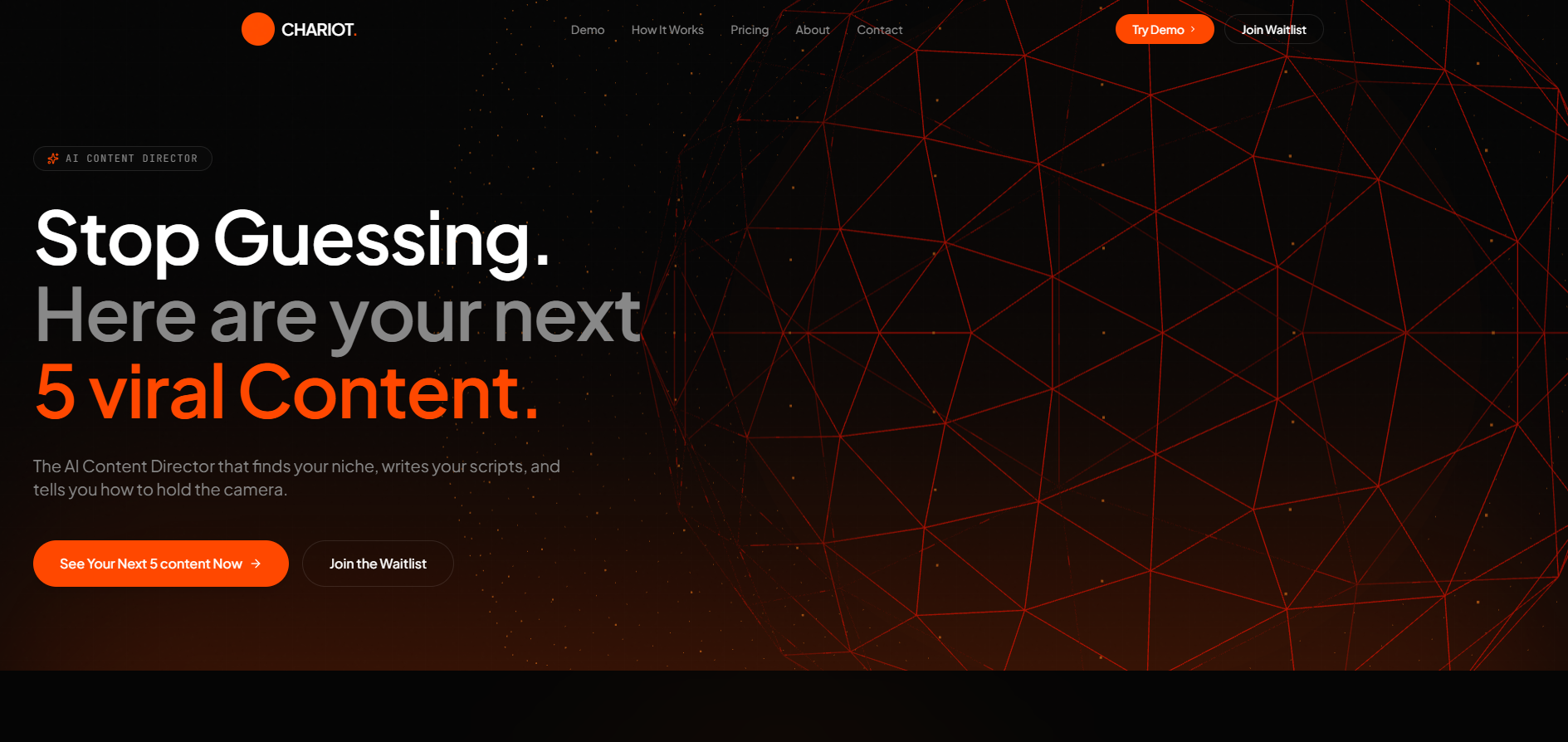
$313B creator economy. 50M people waiting to start. One AI Director that says: "Stop guessing. Here are your next 5 viral reels."

Log in or sign up for Devpost to join the conversation.