Every student learns differently, but most traditional learning resources provide the same explanations and assessments to everyone.
Students often struggle with:
- Understanding complex topics from lengthy PDFs, presentations, and notes.
- Finding explanations suited to their understanding level.
- Identifying weak areas after completing quizzes.
- Organizing large amounts of study material into meaningful topics.
- Knowing what to study next and tracking their learning progress.
We wanted to build an intelligent learning companion that doesn't just provide answers but helps students understand concepts, practice their knowledge, and improve continuously.
That idea became Chapterly.
Chapterly is an AI-powered personalized learning platform that transforms educational materials into interactive learning experiences.
Built using Python, Streamlit, and Google Gemini, Chapterly combines multimodal content processing, personalized AI tutoring, adaptive assessments, learning-path recommendations, and visual mind maps in one application.
Instead of switching between different applications for studying, asking questions, taking quizzes, and tracking progress, students can manage their learning journey within Chapterly.
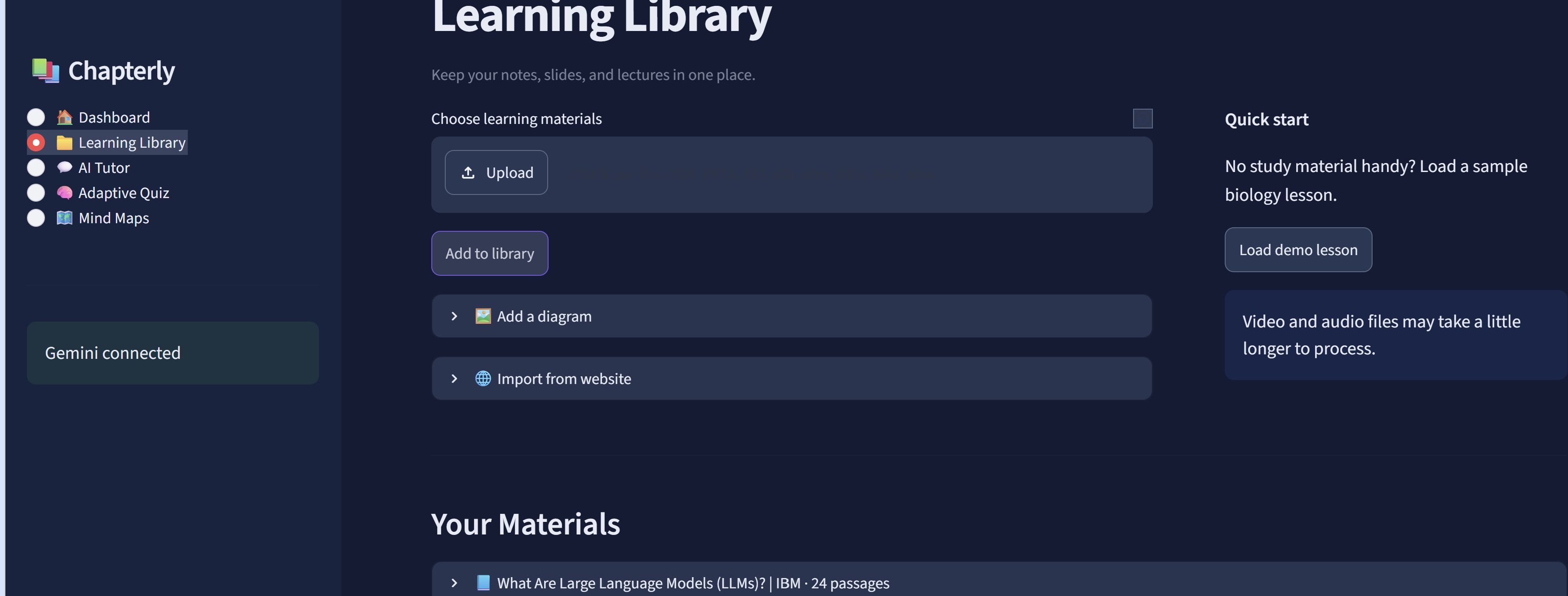
- Multimodal Learning Library*
Students can upload supported learning materials, including PDF documents, PowerPoint presentations, text files, and supported audio and video formats. They can also import educational content from websites and add diagrams for AI-assisted analysis.
Chapterly processes the material and makes relevant content available for learning activities.
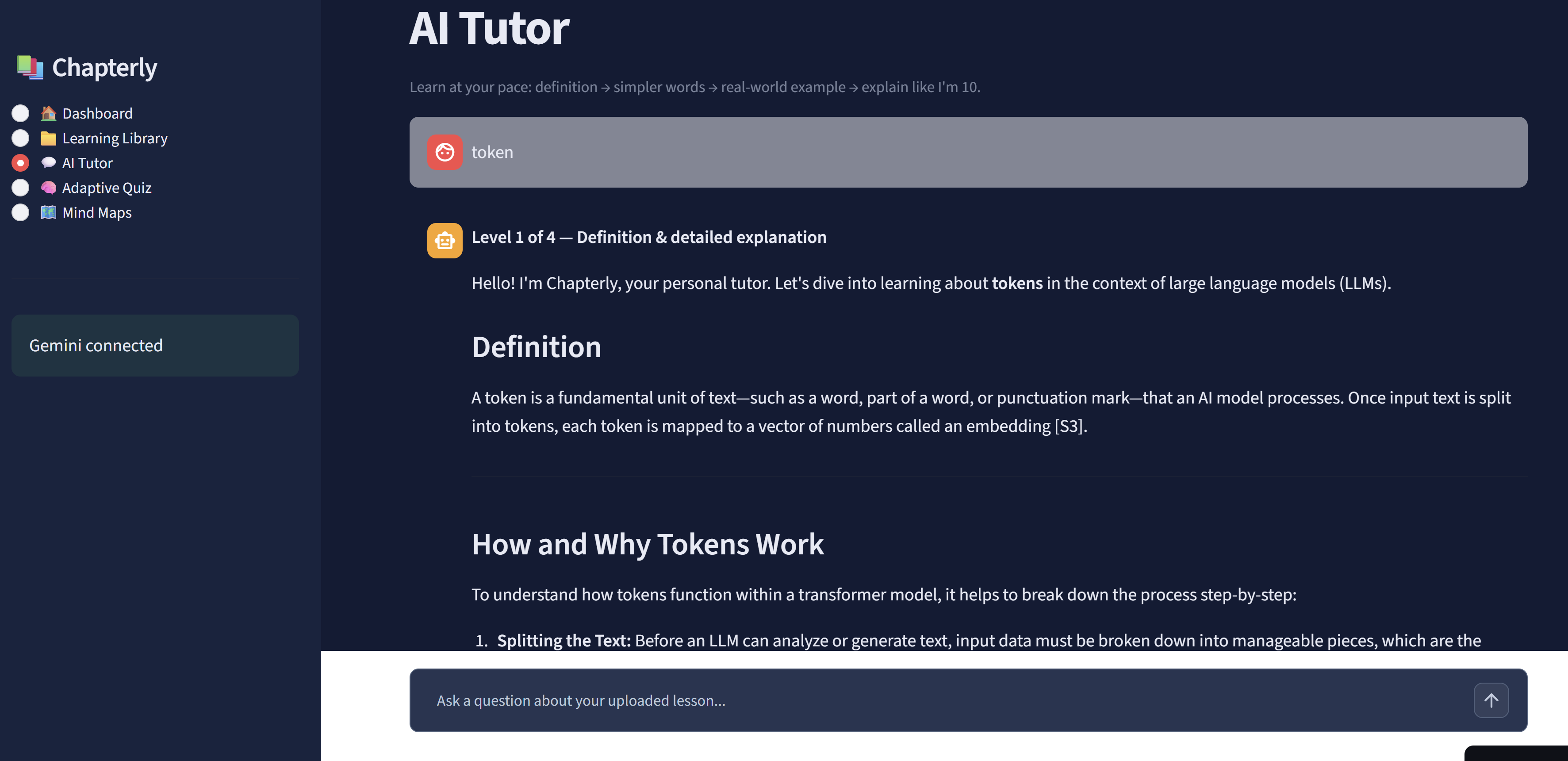
2. Four-Level AI Tutor
Chapterly provides personalized explanations through a four-stage teaching approach:
- Level 1: Definition and detailed explanation.
- Level 2: Explanation in simpler words.
- Level 3: Real-world examples.
- Level 4: Beginner-friendly, step-by-step explanation.
Students can request another explanation when they do not understand a concept.
The goal is to adapt the explanation to the learner rather than expecting every learner to understand the first response.
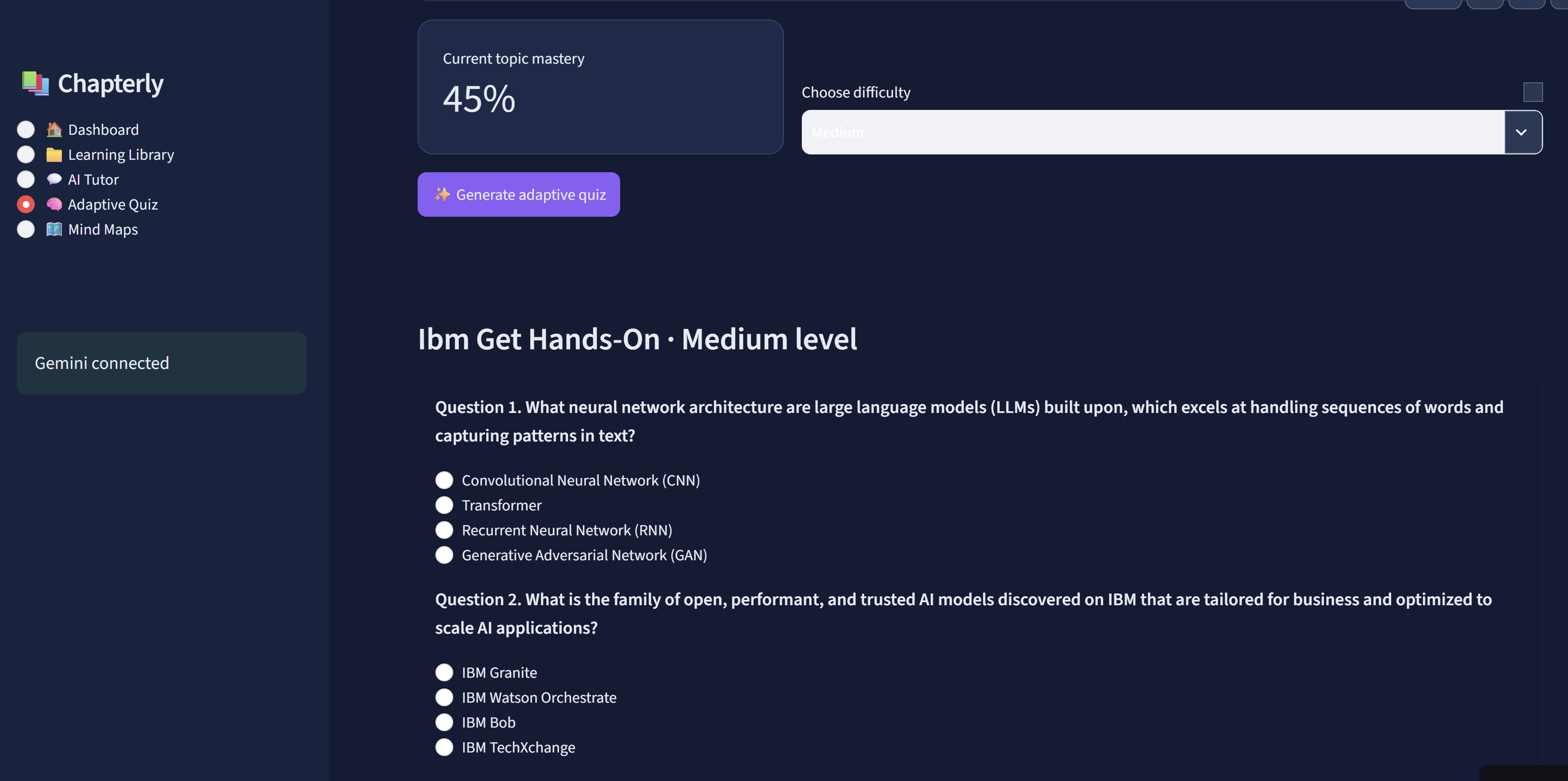
3. Adaptive Quiz and Knowledge Assessment
Chapterly generates topic-based quizzes using relevant study material.
Students can select the difficulty level, answer questions, and receive feedback on their performance.
The system tracks topic mastery and supports retrying missed questions.
When students struggle, Chapterly can guide them back to the AI Tutor to review the concepts they need to improve.
4. Smart Learning Path
Chapterly organizes uploaded learning materials into a recommended sequence of study topics.
Students can:
- View the topics identified from their materials.
- Select individual topics to study.
- Track completed topics using a progress bar.
- Receive recommendations for their next learning topic.
- Advance through the learning path after successfully completing assessments.
This creates a connected learning experience instead of isolated study sessions.
5. AI-Generated Mind Maps
Chapterly converts relevant learning content into structured concept maps.
These maps help students understand relationships between important ideas, revise concepts visually, and organize complex information.
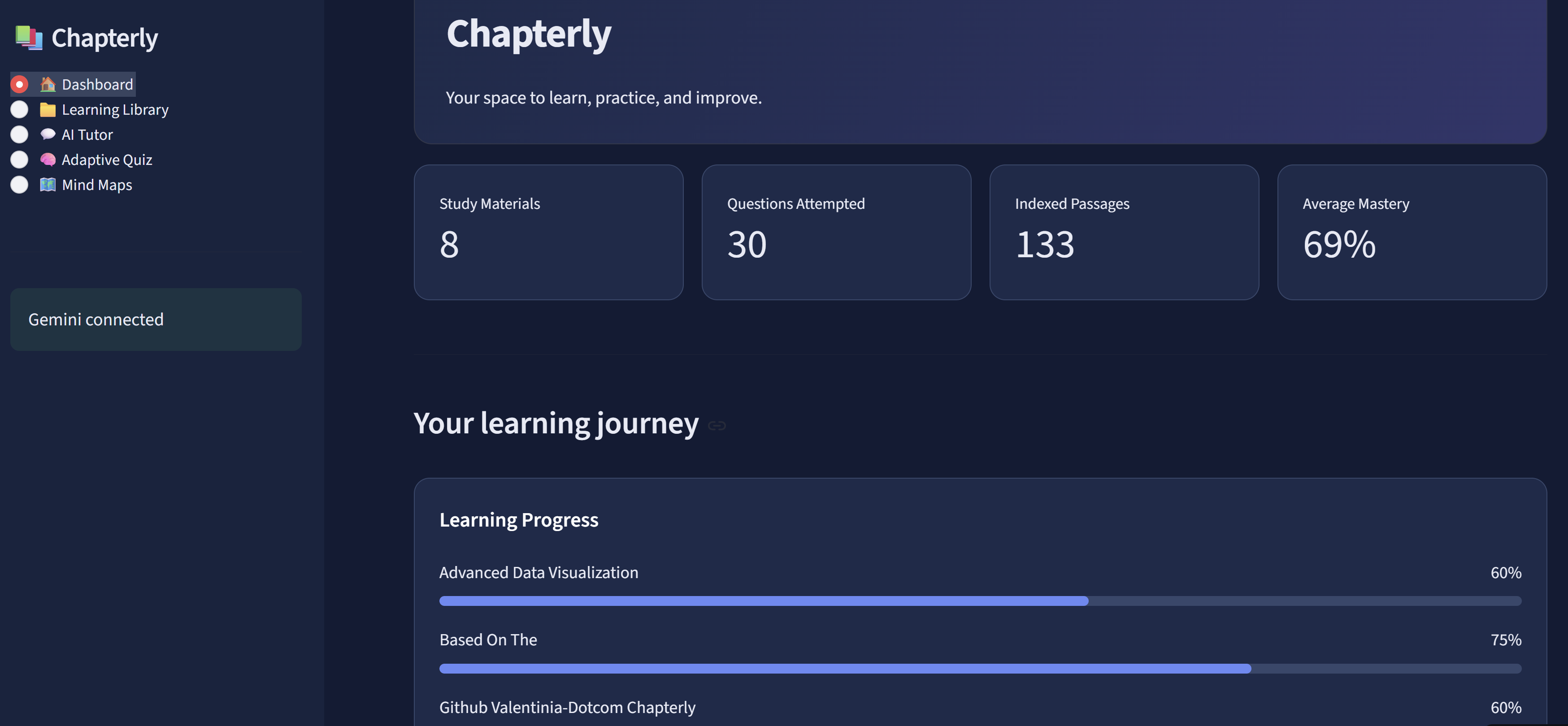
6. Personalized Learning Dashboard
The dashboard provides an overview of study materials, quiz activity, indexed passages, and learning progress.
This helps students monitor their performance and identify areas for improvement.
Chapterly follows a connected learning workflow:
Upload Materials → Extract Content → Organize Topics → Learn with AI → Practice with Quizzes → Track Mastery → Continue Learning
Step 1: Content Processing
Students upload study materials or import educational content. Chapterly extracts readable information and organizes it into searchable passages.
Step 2: Source-Grounded AI Tutoring
When a student asks a question, Chapterly retrieves relevant passages and uses Google Gemini to generate explanations informed by the learning material.
Step 3: Adaptive Assessment
Students generate quizzes for selected topics. Chapterly evaluates their responses, provides feedback, and updates their topic mastery.
Step 4: Learning Progression
Completed assessments contribute to learning-path progress. Chapterly recommends the next unfinished topic and supports further tutoring when necessary.
Step 5: Visual Learning
Students can generate mind maps that organize important concepts into branches and subtopics for revision.
Together, these capabilities form a continuous learning cycle.
How We Built It
Chapterly was developed using:
- Python: Core application logic and content processing.
- Streamlit: Interactive web application and student dashboard.
- Google Gemini API: AI-powered explanations, question generation, topic organization, and concept mapping.
- PyMuPDF: Extracting text from PDF documents.
- python-pptx: Processing PowerPoint presentations.
- Pandas: Supporting data handling and analysis.
- GitHub: Source-code management.
- Streamlit Community Cloud: Application deployment.
The project is organized into Python modules for the user interface, AI services, document processing, tutoring, quizzes, learning progress, and mind maps.
Challenges We Faced
One of the main challenges was connecting different learning activities into a single workflow.
We worked on ensuring that:
- The AI Tutor could provide explanations at different difficulty levels.
- Quiz results could update learning progress.
- Students could retry incorrect questions.
- Completed topics could lead to meaningful next-topic recommendations.
- Multiple document formats could be processed consistently.
- Mind maps could be generated from source material.
- The interface remained readable and usable across deployments.
We also encountered challenges with Streamlit deployment, dependency handling, file paths, interface styling, and AI response formatting.
These experiences helped us improve the application's reliability and usability.
What We Learned
Building Chapterly helped us understand how multimodal content processing, generative AI, retrieval-based learning, assessment, and progress tracking can be combined into an educational application.
We also learned the importance of grounding AI-generated educational content in relevant source material and designing interfaces that support different learning needs.
What's Next for Chapterly?
We plan to improve Chapterly with:
- More accurate topic identification and content segmentation.
- Stronger personalization based on individual learning performance.
- Improved AI-generated quizzes and feedback.
- Better support for diagrams, audio, and video learning materials.
- More interactive mind-map visualization.
- Persistent individual student profiles.
- Improved accessibility and multilingual learning support.
Our long-term vision is to develop Chapterly into an accessible AI learning companion that helps students learn at their own pace.
Conclusion
Chapterly is more than a question-answering tool. It is a connected AI-assisted learning experience.
By bringing together study-material processing, personalized tutoring, adaptive quizzes, learning paths, progress tracking, and visual knowledge organization, Chapterly aims to make education more interactive, structured, and learner-centered.
**Chapterly — Learn smarter. Understand better

Log in or sign up for Devpost to join the conversation.