-
-
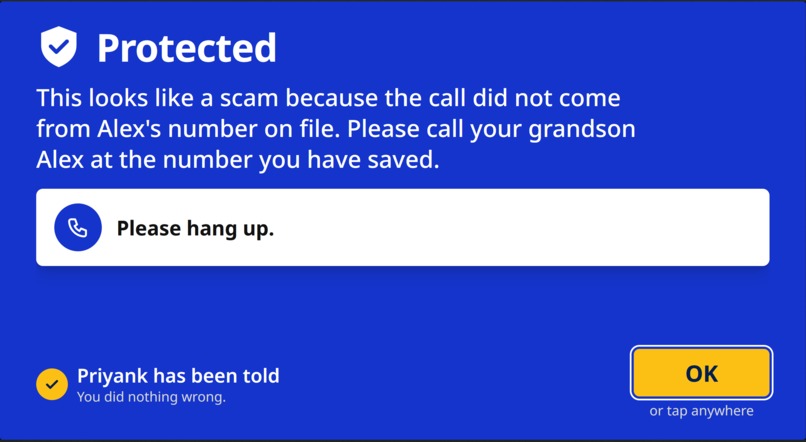
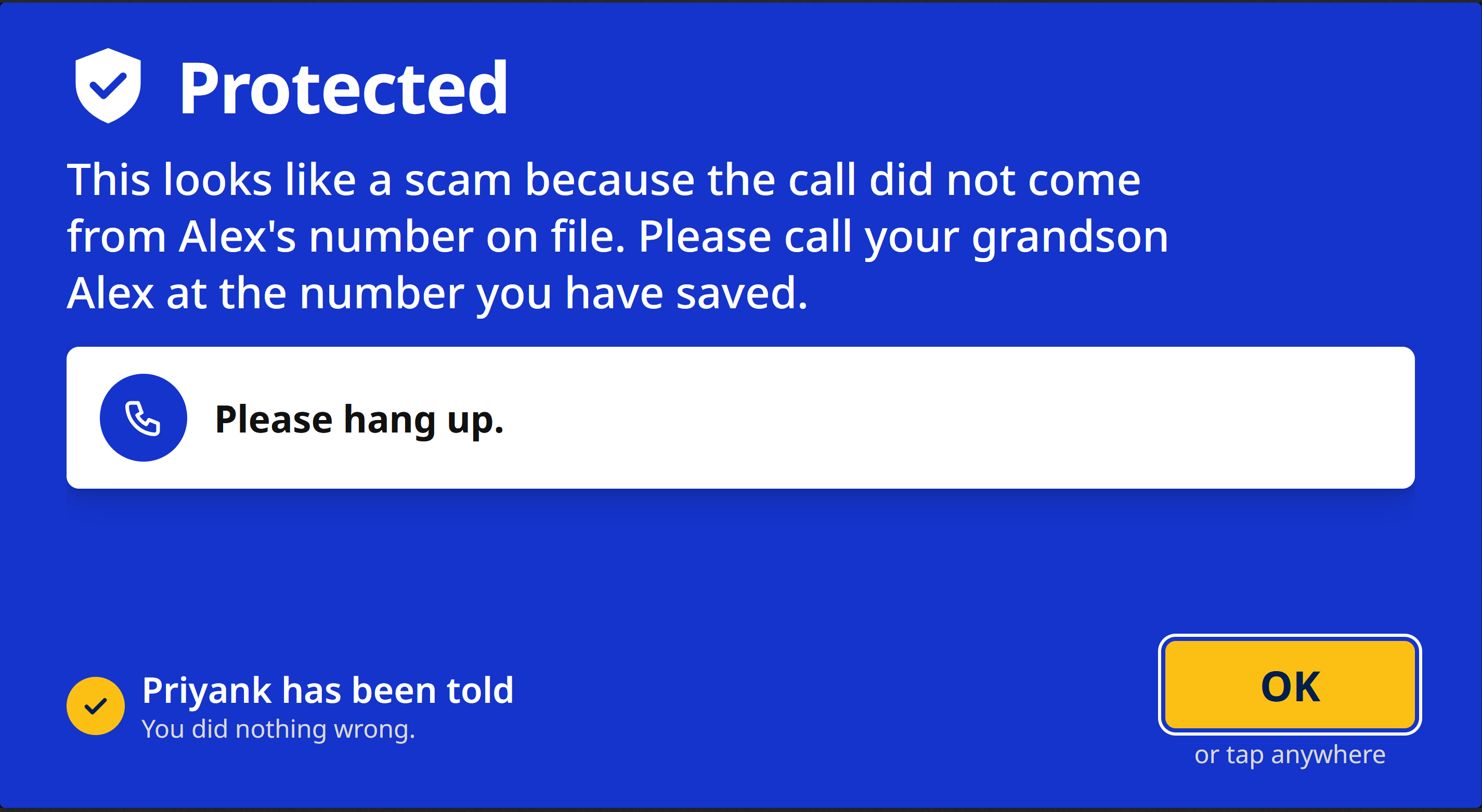
The Protected card: the full-screen alert Ruth sees when Chaperone stops a scam, with one clear action and no blame.
-
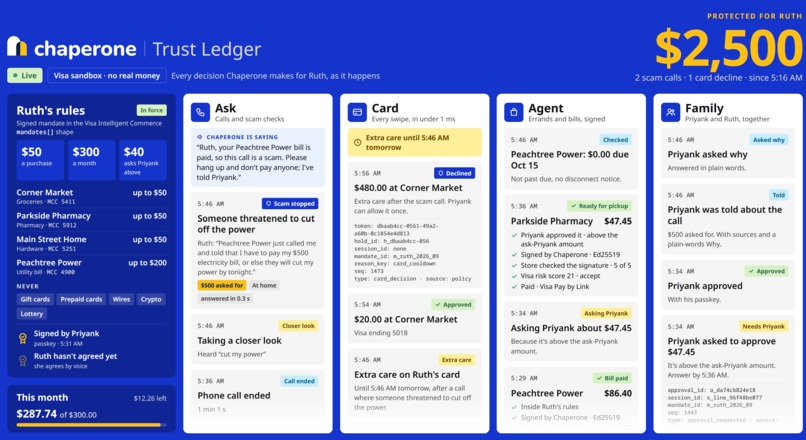
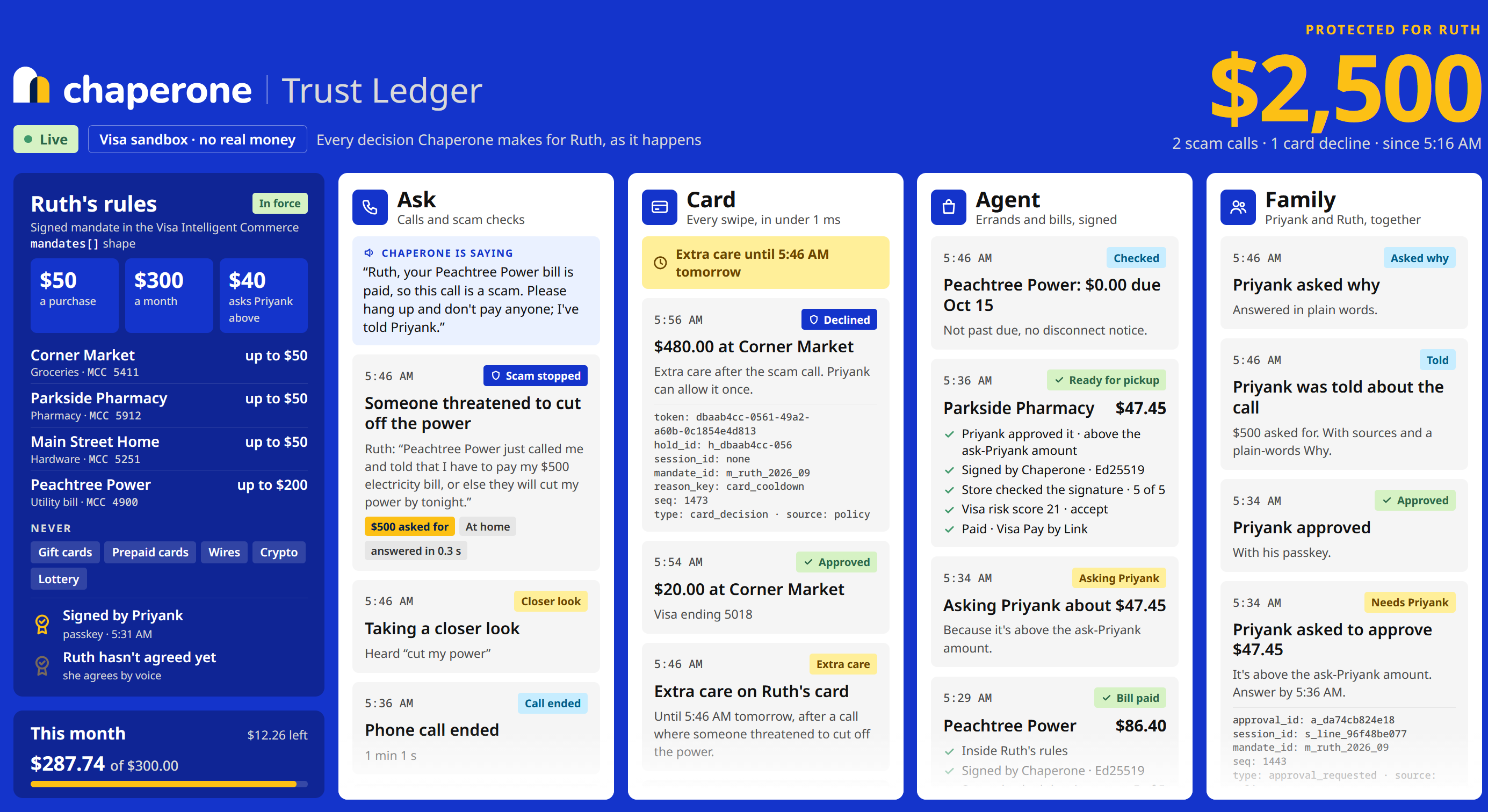
The Trust Ledger: a live wall showing every decision Chaperone makes, across four guards, with dollars protected.
-
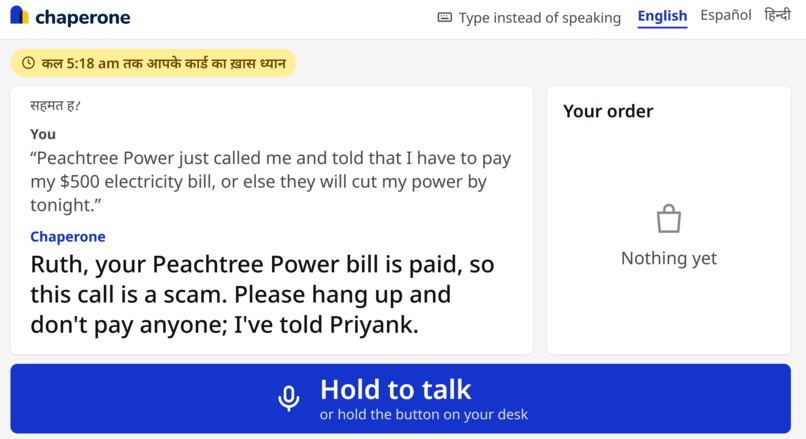
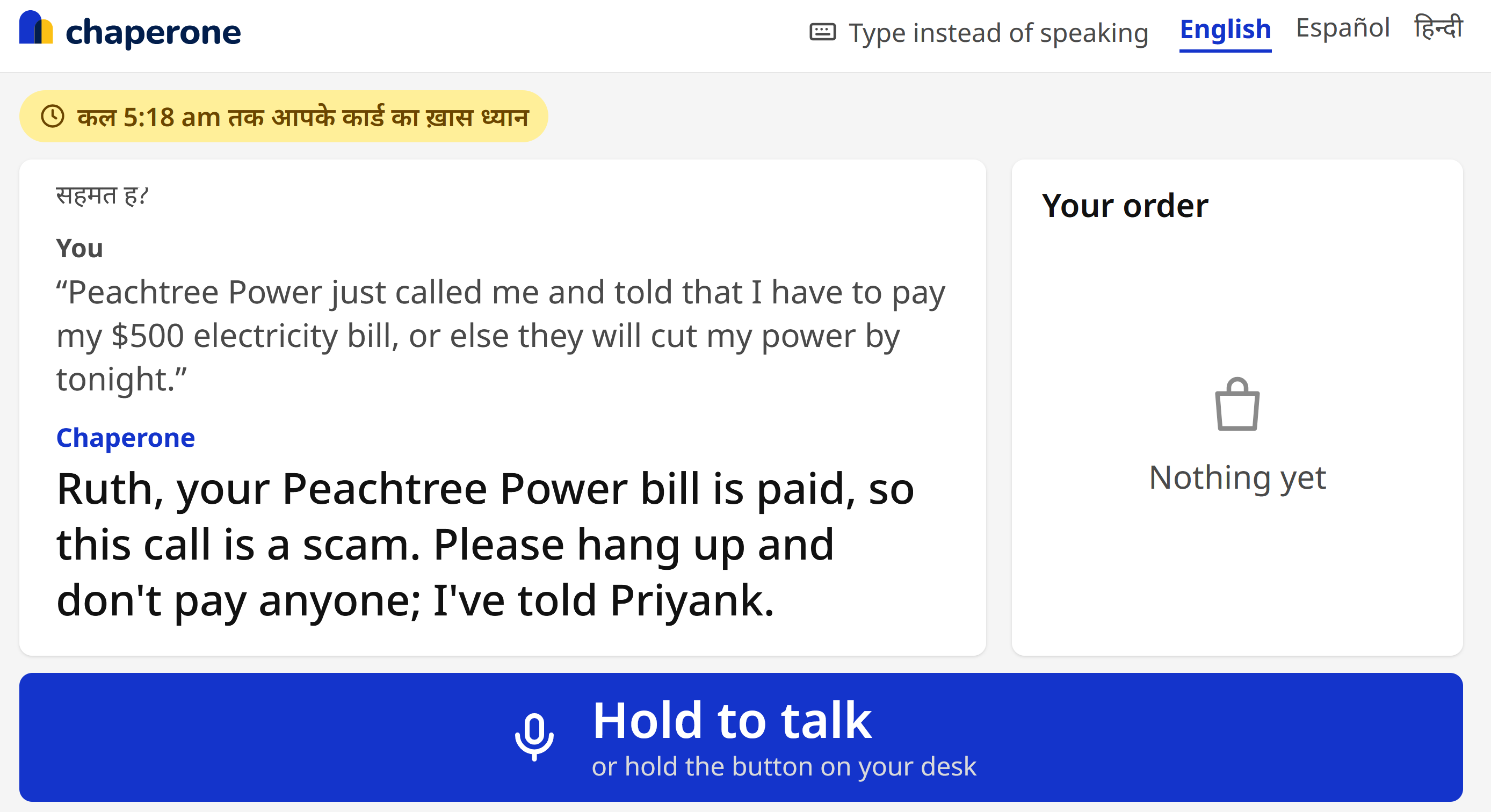
Ruth's kiosk: the voice station where an older adult shops, pays bills and checks suspicious calls by speaking, in three languages.
-
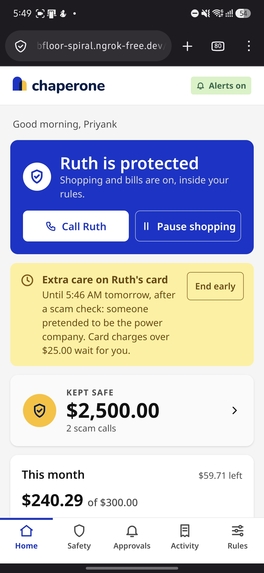
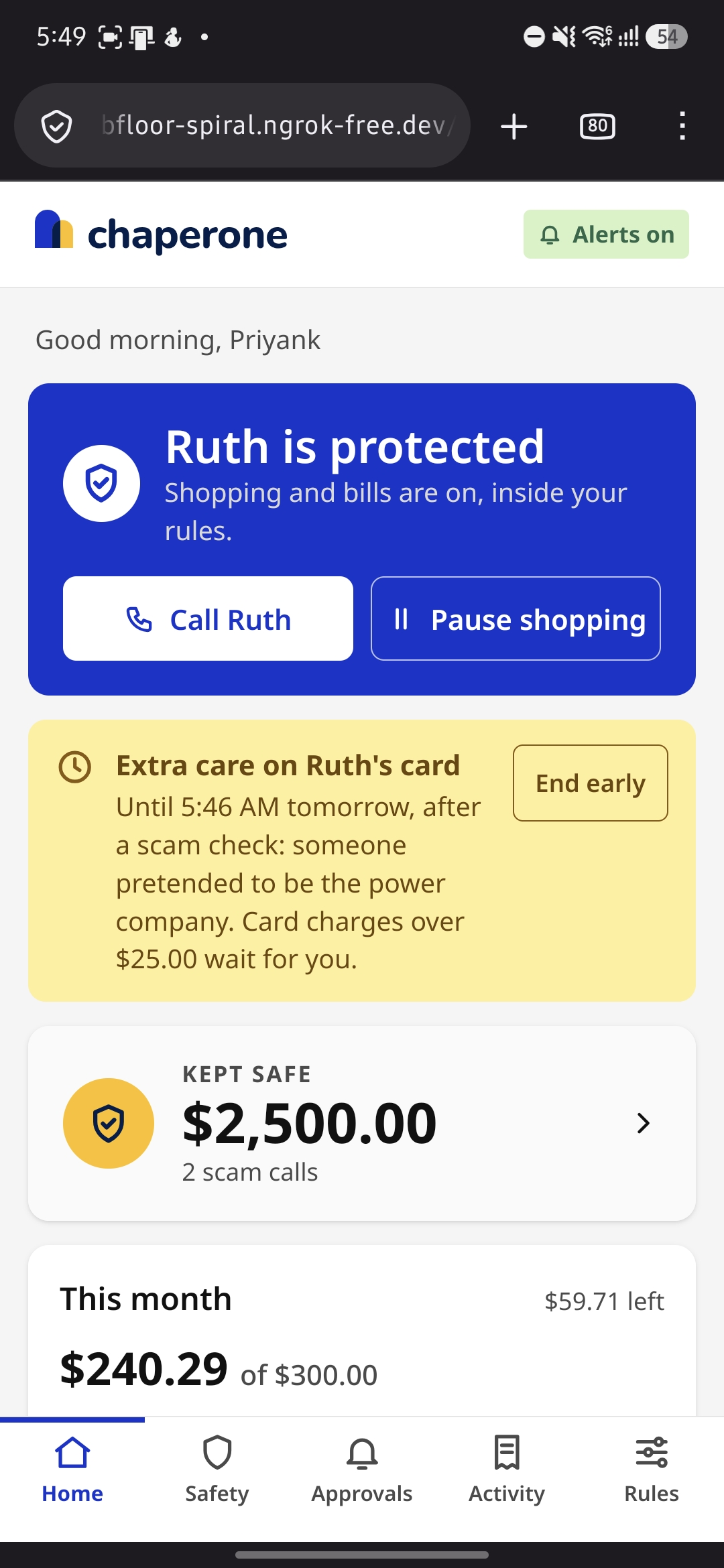
The caregiver's home screen: whether Ruth is protected, extra care on the card, dollars kept safe, and one tap to call or pause.
-
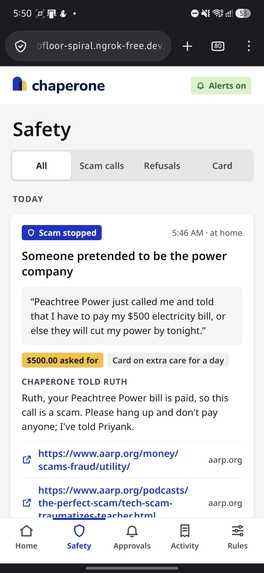
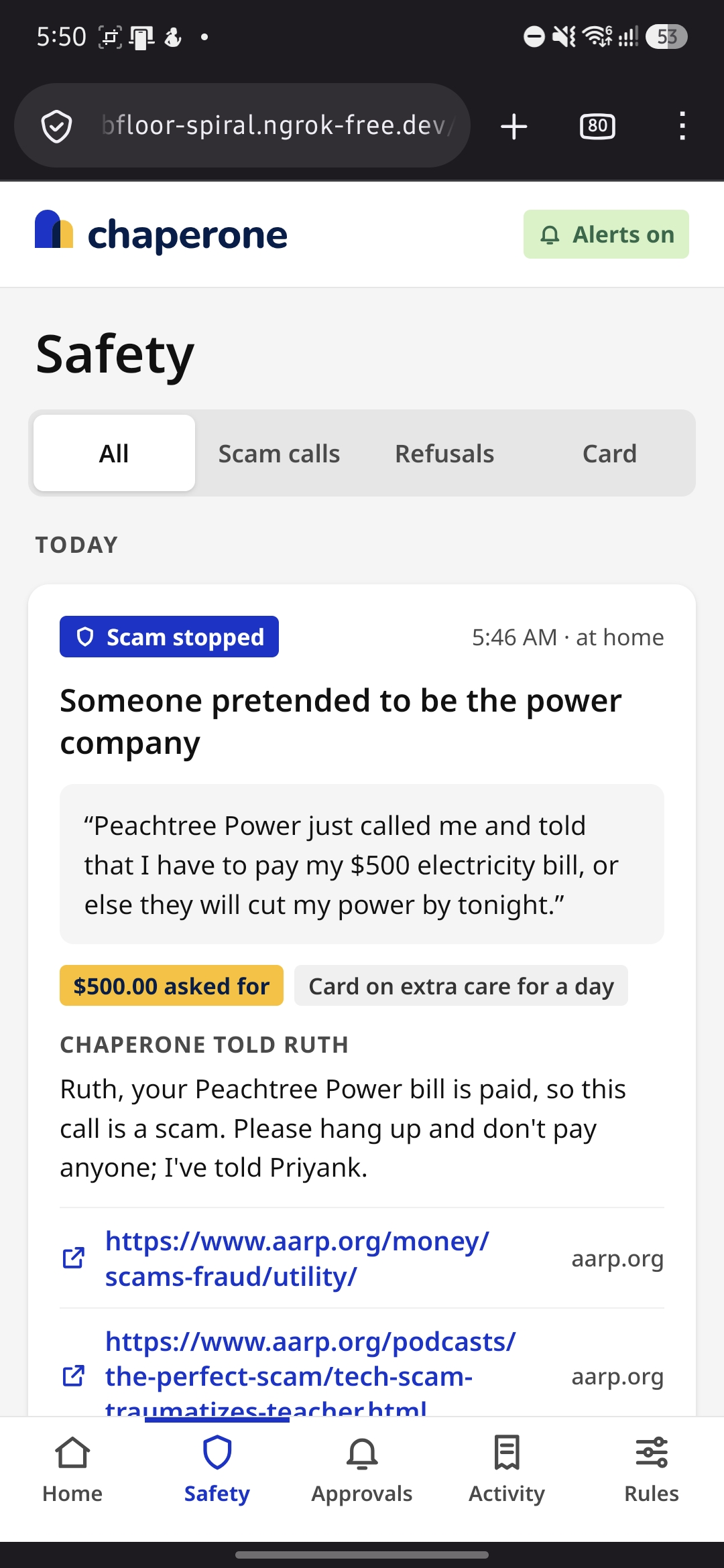
The Safety feed: each scam check with Ruth's own words, what Chaperone told Ruth, and the sources behind the verdict.
-
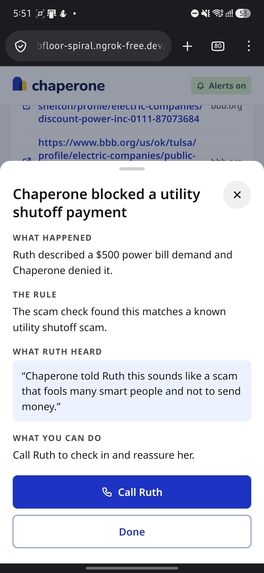
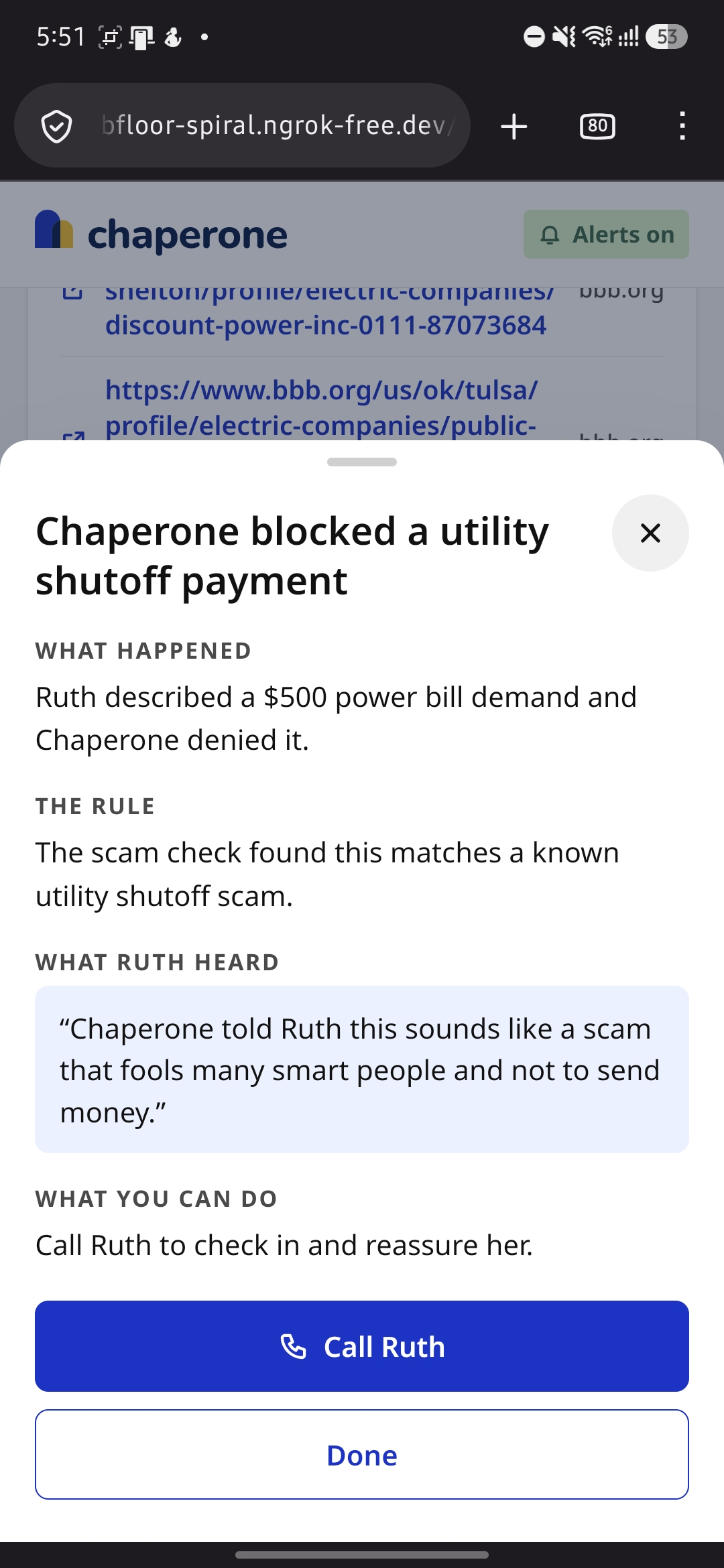
The plain-words "Why?": what happened, which rule applied, what Ruth heard, and what the caregiver can do next.
-
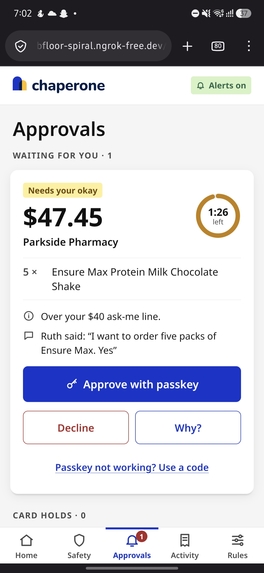
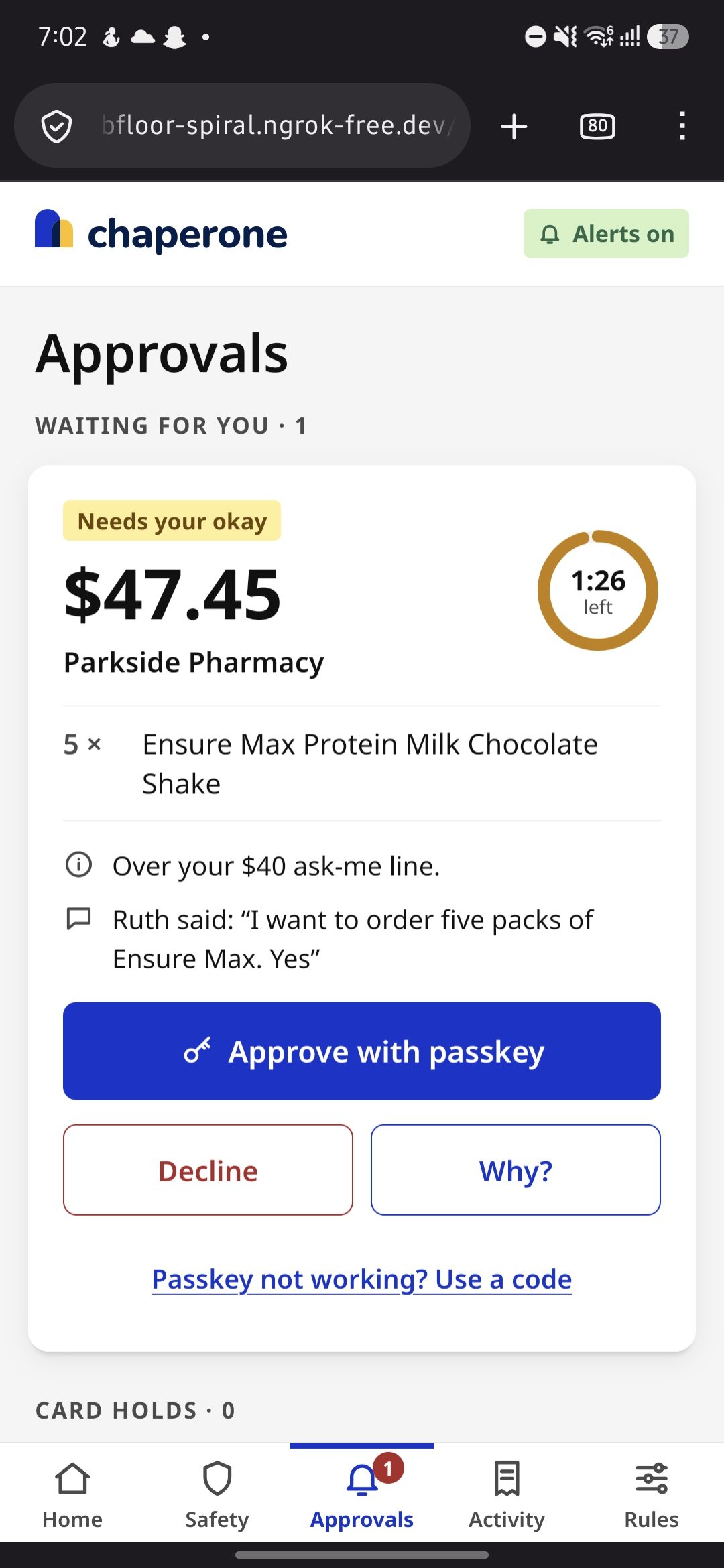
The caregiver's approval request: a purchase above the ask-me line, with Ruth's own words, approved by passkey or declined.
-
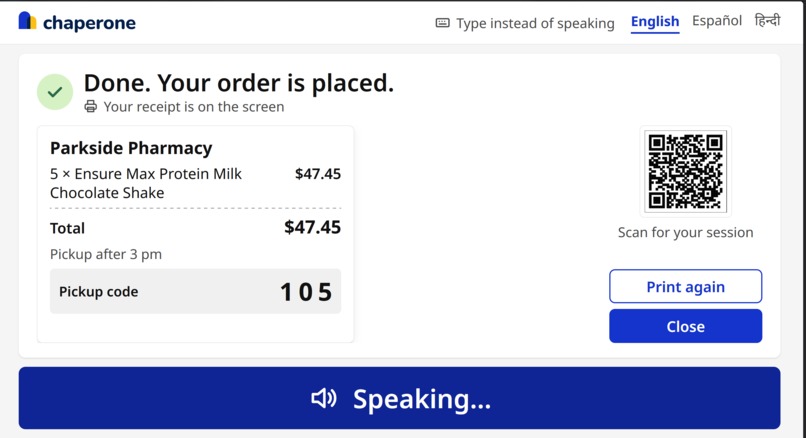
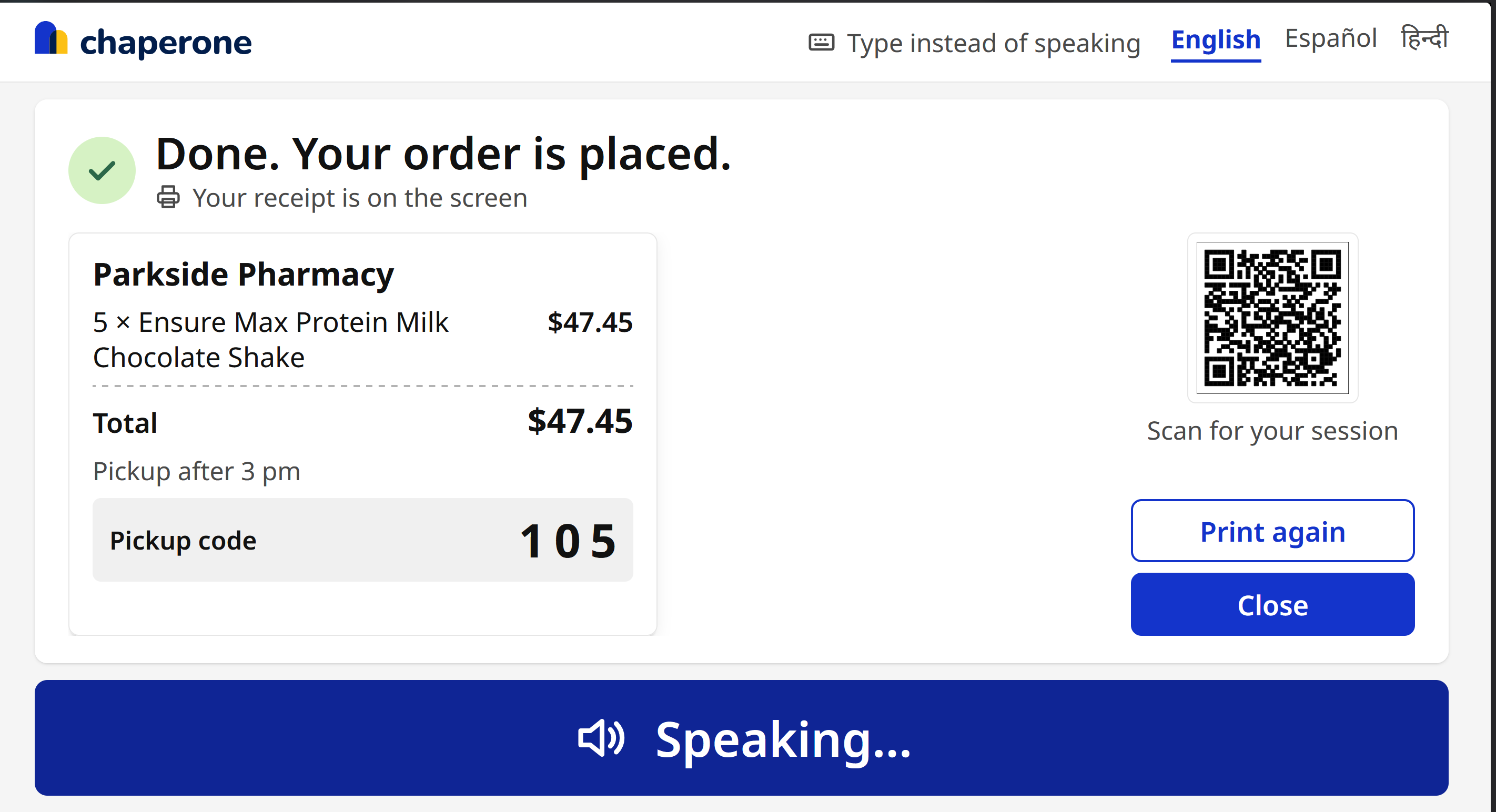
The receipt screen: what Ruth bought, where and when to pick it up, and a QR code to the session's public record.
-
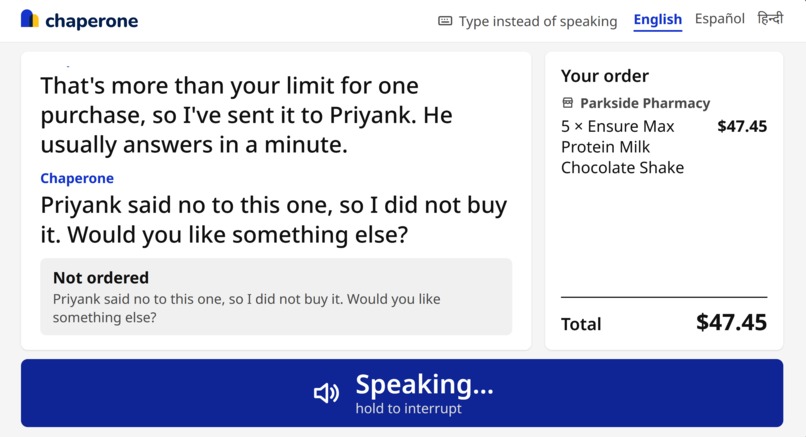
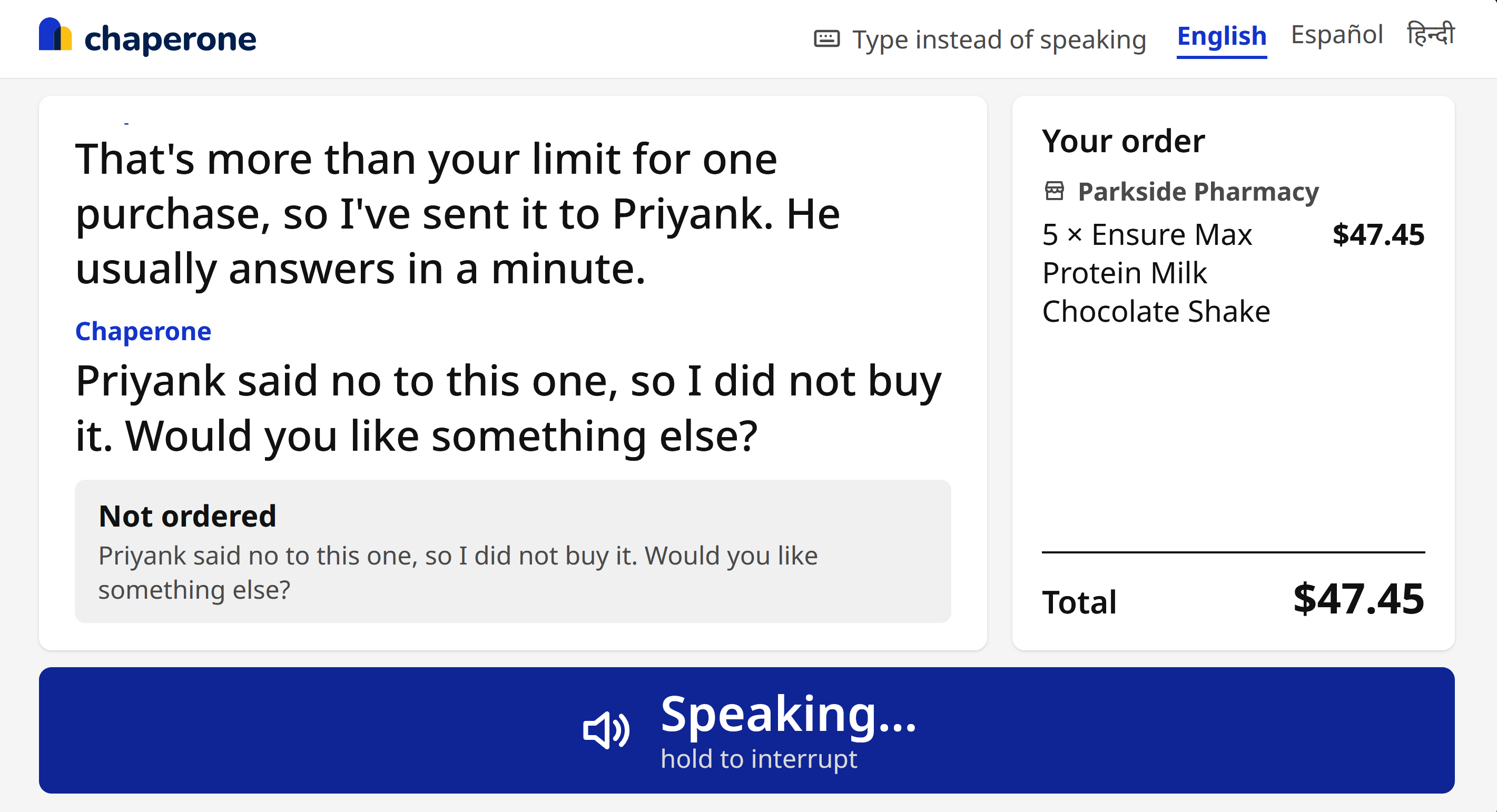
The kiosk after the caregiver declines: Chaperone tells Ruth kindly that nothing was bought.
-
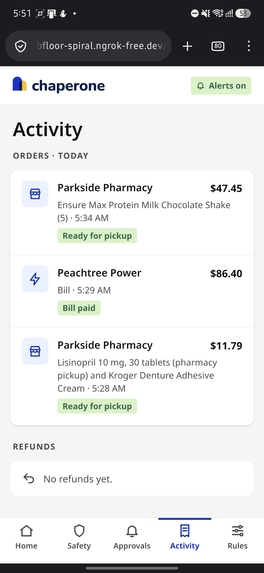
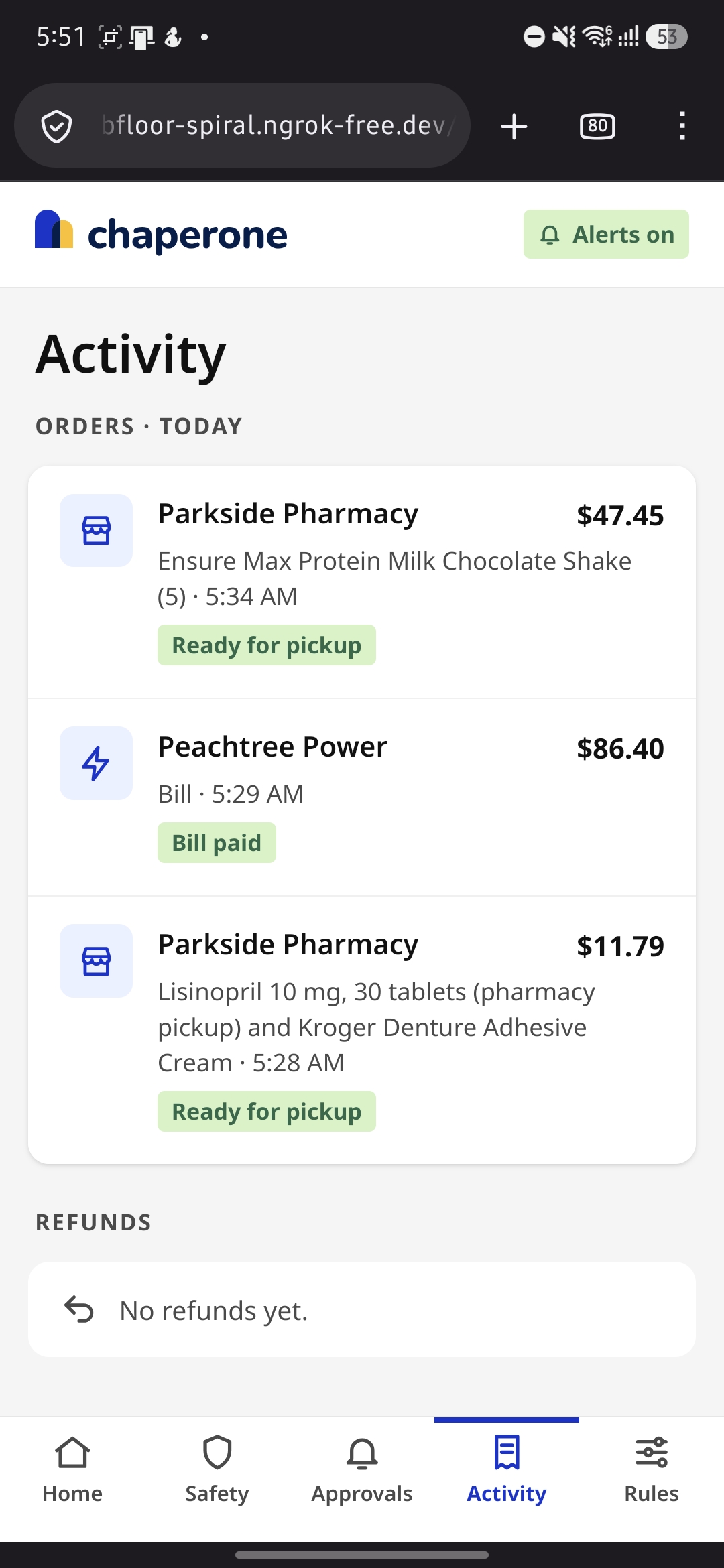
The Activity tab: every order and bill by store, with its status, and any refunds back to the card that paid.
-
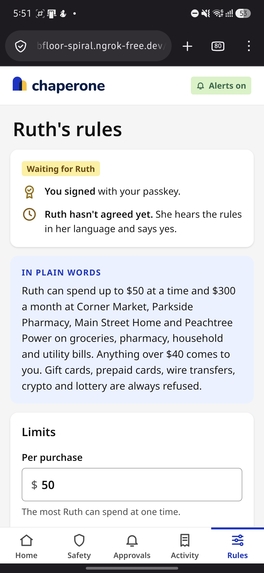
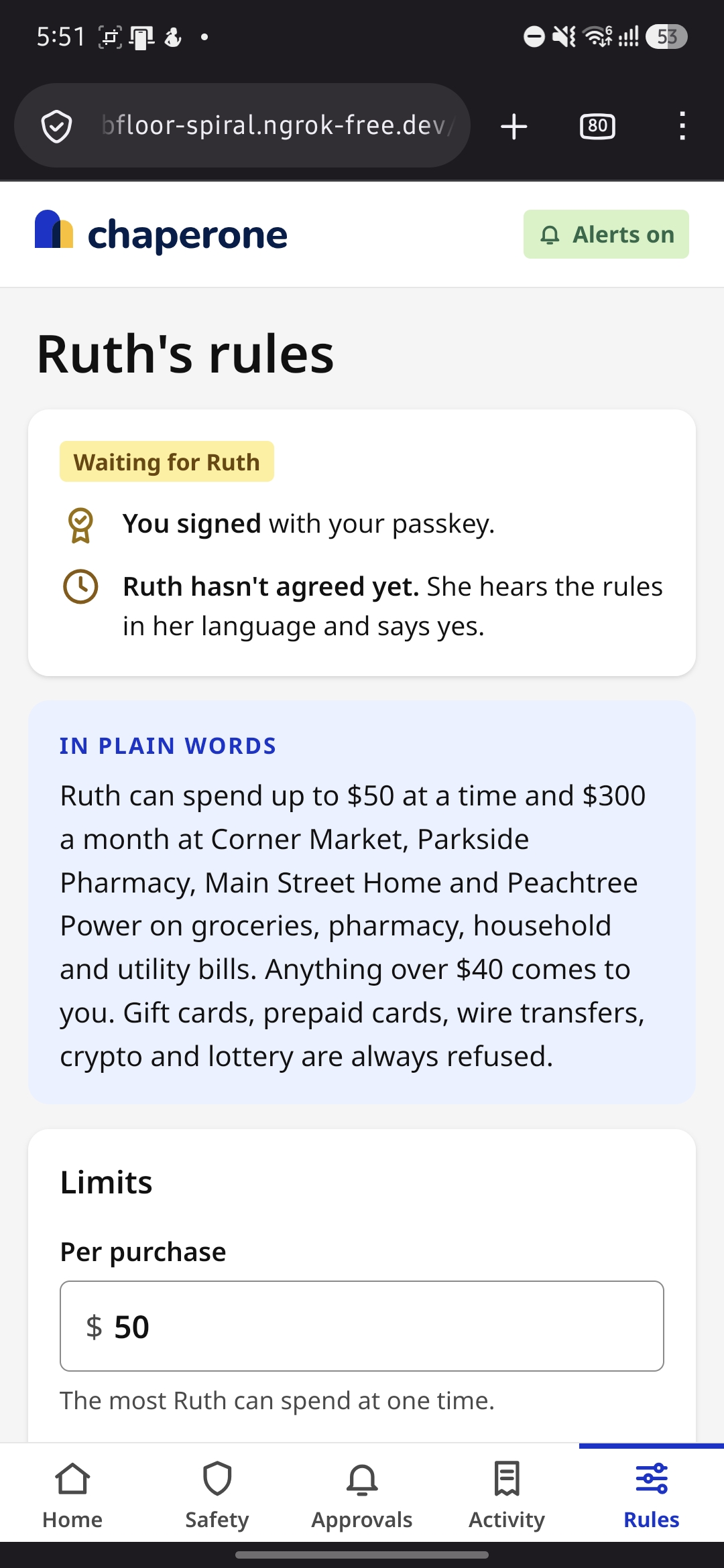
The rules the caregiver signs with a passkey, summed up in plain words, waiting for Ruth to agree by voice.
-
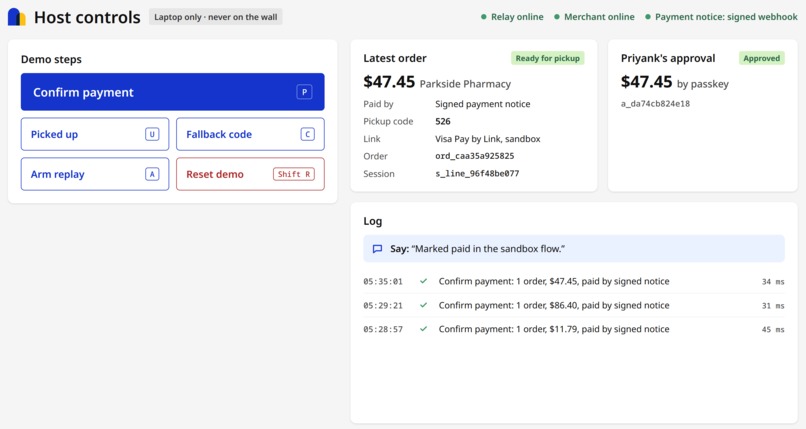
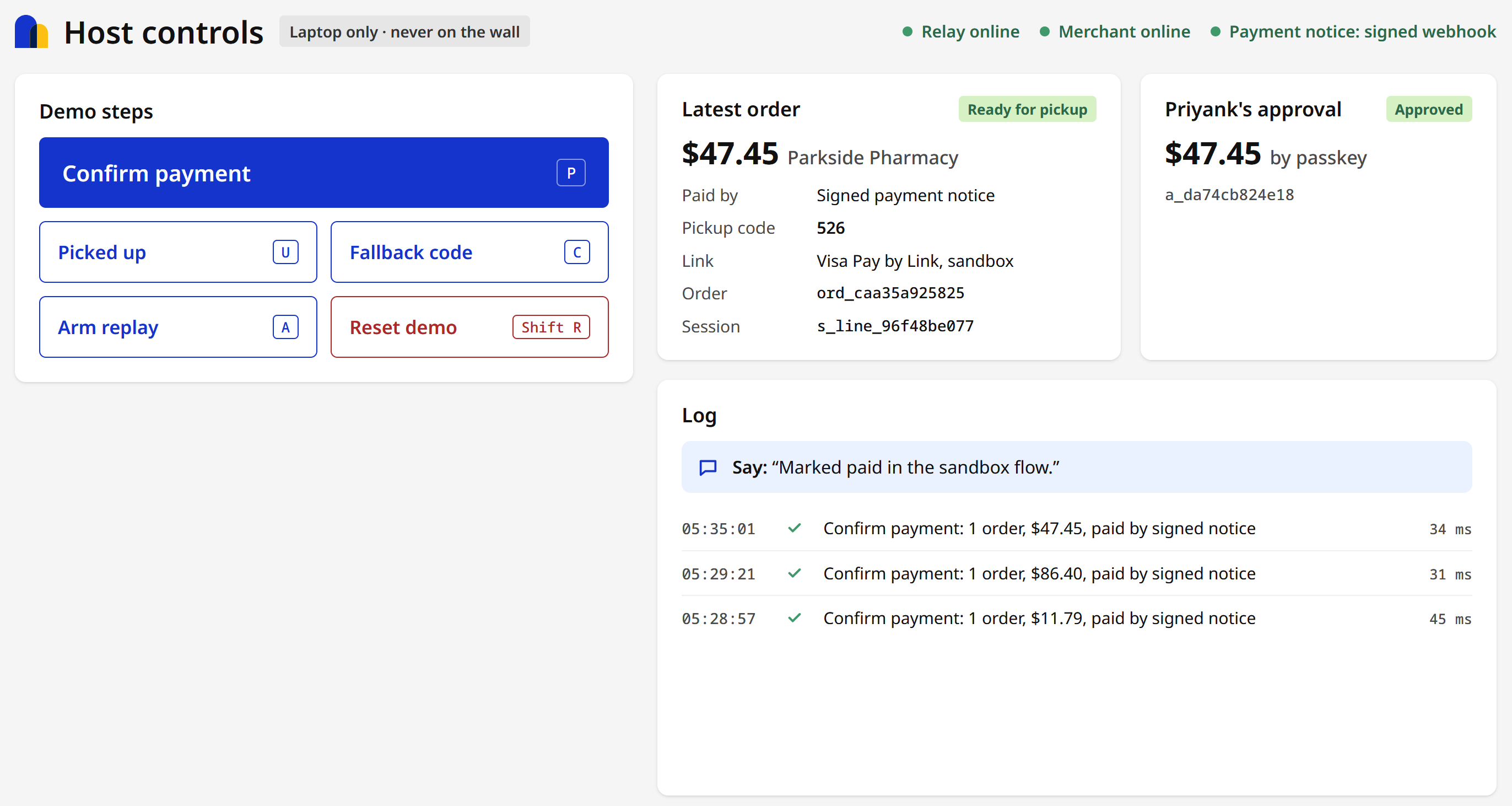
Host controls: the laptop-only demo console for confirming sandbox payments, marking pickups and resetting the demo.
Inspiration
Last year, Americans over 60 reported $7.7 billion lost to fraud (FBI IC3, 2025). A lot of it starts with a phone call: a "grandson" in jail, a "lawyer" who needs the bail within the hour, a Bitcoin machine at the corner drugstore. It is a problem close to home for almost every family.
The same people are the ones today's shopping apps leave behind: older adults, people who don't read English comfortably, people without a smartphone. Their families already help with the money, informally, by phone, from other cities.
Visa asked us to design an AI commerce experience that is useful, trusted and ready for the real world. A Marina's Mission asks for technology that makes a real difference and leaves no one behind. We built both at once: a shopping agent an older adult can simply talk to, that can only spend inside rules their family signed, and that says no to the scam, out loud, in their own language.
What it does
Chaperone shops, pays bills and handles returns for an older adult. In our demo he is Grandpa Ruthvik, "Ruth", and his caregiver is his grandson, Priyank. It covers the full journey Visa describes, behind four guards.
Discover (anywhere). Ruth starts where he is comfortable. He can talk to a kiosk at home, or call a phone number from any phone, speaking English, Spanish or Hindi. He can say "my blood pressure medicine" or "denture adhesive". Chaperone finds his usual items first and anything else live from Kroger, at a real store's prices.
Decide (personalized responsibly). Choices are narrowed by what Ruth said, his usual products, his preferences (lower sodium), what's left in his monthly budget, and which of his approved stores sells it. The cart is read back store by store before anything happens.
Transact (pay with trust).
- Secure credentials. Priyank signs Ruth's rules with a passkey. Every agent request to a store is cryptographically signed, and the store verifies it before taking the order. The AI never sees a card number.
- Risk decisioning. Each order is paid through Visa Acceptance Pay by Link and scored by Visa Decision Manager. Every swipe of Ruth's card is decided in real time against his rules, which are mirrored to Visa Transaction Controls.
- Familiar protections. Anything above the "ask me" amount waits for Priyank's passkey. Gift cards, crypto, wires and lottery are always refused.
Continue (after the purchase). Pickup codes and order status by voice, cancellations before payment, returns and refunds only to the card that paid, bills paid on time, rewards points, and a receipt with a QR code to a public record of the session.
The four guards that keep it safe:
- Ask: Ruth describes a call ("my grandson is in jail, don't tell Mom"). Chaperone recognizes the scam in his language, checks it against his own accounts ("your Peachtree Power bill is paid, so this call is a scam") and recent scam reports, and tells him the one thing to do next: hang up.
- Card: after a scam call, the card takes extra care for 24 hours. A $480 charge at the drugstore is declined, and a Bitcoin machine never works. Chaperone tells Ruth why, and Priyank can Allow once or Keep blocked.
- Agent: errands and bills happen only inside the signed rules, one signed order per store.
- Family: Priyank sets the rules, and Ruth hears them in his language and agrees by voice.
Trust you can see. Ruth hears a kind, plain reason for every "no". Priyank sees every decision on his phone with a plain-English Why?. The Trust Ledger wall shows everything live, with a dollars protected counter.
Everything runs in sandboxes with test cards; no real money moves.
How it answers Visa's challenge
- Who, and what friction is removed: older adults, non-English speakers and people without smartphones. No app, no forms, no card numbers: they just talk, in their own language, on any phone.
- When does the journey start: at discovery (a spoken need or a phone call) and all the way past payment.
- Trust. Informed: a spoken reason, a Why? and sources. In control: signed rules, approvals, allow once and keep blocked. Protected: a scam check, real-time card rules and risk scores.
- Beyond: bills (a power company), a pharmacy, returns, pickup, loyalty, and accessibility by phone.
- Make trust visible: the Trust Ledger, the caregiver's Safety feed, and receipts linked to a public session record. Ruth's rules are expressed in the shape of a Visa Intelligent Commerce mandate.
How it answers A Marina's Mission (Aramco)
- People left behind: built for older adults, speakers of Spanish and Hindi, and people who only have a basic phone.
- Help in their own language: every answer, warning and receipt line is in English, Spanish and Hindi.
- Dignity: Chaperone never blames Ruth ("You did nothing wrong"), and the family stays involved without taking over.
- Measurable impact: dollars protected, scam calls stopped and card declines, counted live.
- Real-world potential: it works on an ordinary phone line, a real card network's authorization hook, and Visa's own card controls. A bank, a pharmacy or a senior center could offer it to families.
How we built it
- Voice. The kiosk talks through Grok Voice in real time. The phone line is an agent in xAI's Voice Agent Builder calling our own MCP server, with a PIN spoken or typed on the keypad.
- Guardrails outside the model. The model never decides a payment. A policy service (FastAPI) re-prices every cart and applies the signed rules deterministically: stores, categories, caps, approval threshold, monthly budget. A rule lexicon in English, Spanish, Hindi and Hinglish screens every request. A Grok judge weighs only the ambiguous ones.
- Scam radar. Grok's Responses API with X search and web search, under one time budget. A known scam is answered in under a second, and the sources for the caregiver's alert are fetched in the background.
- Signed intent. A passkey (WebAuthn) signs a canonical (JCS) hash of the rules. Agent requests to stores are signed with RFC 9421 HTTP Message Signatures in the Trusted Agent Protocol header format, and each store verifies them against our JWKS.
- Payments. Visa Acceptance (Cybersource) sandbox Pay by Link on four separate merchant accounts (grocery, pharmacy, home goods, power company), with Decision Manager scoring each order and signature-verified webhooks.
- Card. A Lithic sandbox card with Auth Stream Access: our service decides each swipe in under a millisecond, about a second end to end. The rules are mirrored to the Visa Transaction Controls sandbox over two-way SSL.
- Catalog. The Kroger Products API, live, with real store prices; openFDA for over-the-counter medicines.
- Caregiver app. Next.js with passkey approvals, a Safety feed, card holds, rules and live alerts.
- Trust Ledger. Every service posts events validated against a JSON Schema contract to a relay that drives the wall, the alerts and the public session page.
- Quality. More than 900 automated tests. The scam evaluation covers 102 scripts in four languages. On the held-out half, rules plus Grok caught 25 of 25 scams and wrongly refused 1 of 24 honest requests.
Challenges we ran into
- An agent you can't talk into things. Voice models are agreeable, so every money decision lives outside the model: a read-back, a fresh "yes", deterministic pricing, and rules the model can't change.
- Kind but firm. "A gift card for someone at church" deserves a gentle no; "my grandson is in jail, don't tell Mom" is a scam; "don't tell Mom, it's a surprise party" is fine. Getting that right in Hindi and Hinglish took real care.
- Sandbox reality. Direct card authorizations on our Cybersource sandbox account failed on a processor configuration, so payments run through Pay by Link and a card network's sandbox. Visa Intelligent Commerce needs pilot access, so we modeled its mandate shape rather than calling it.
- Speed. A scam check must answer while Grandpa is still on the phone with the scammer.
- One "yes", several stores. A pharmacy and a power company, each order separately signed, verified, paid and refundable.
Accomplishments that we're proud of
- The full Visa journey works end to end on real sandbox calls: Visa Acceptance, Decision Manager, Visa Transaction Controls, a card network's real-time authorization and Kroger's live catalog.
- A phone number anyone can call, with no app, in three languages.
- The refusal is kind: it never blames the person, and it always gives one next step.
- Trust is visible to everyone: Ruth, Priyank and anyone watching the wall.
What we learned
- In AI commerce, trust comes from who sets the rules and from making every "no" understandable, not from a smarter model.
- Deterministic guardrails around a language model are what make it safe to hand it a wallet.
- Inclusion is a design constraint, not a feature: voice first, any phone, their language.
What's next for Chaperone
- With Visa: join the Visa Intelligent Commerce pilot so the signed mandate travels with the payment, and run Ruth's rules on a real issuer's Visa Transaction Controls.
- For people left behind: pilot with a senior center and local families, test with older adults, add more languages, and bring pharmacies and utilities on directly.
- Let several family members share caregiving.
Built With
- claude
- cursor
- cybersource
- fastapi
- grok
- json-schema
- kroger-api
- lithic
- model-context-protocol
- next.js
- ngrok
- node.js
- openfda
- python
- react
- rfc-9421
- simplewebauthn
- typescript
- visa-acceptance
- visa-decision-manager
- visa-transaction-controls
- vite
- webauthn
- xai-grok-voice
- xai-voice-agent-builder


Log in or sign up for Devpost to join the conversation.