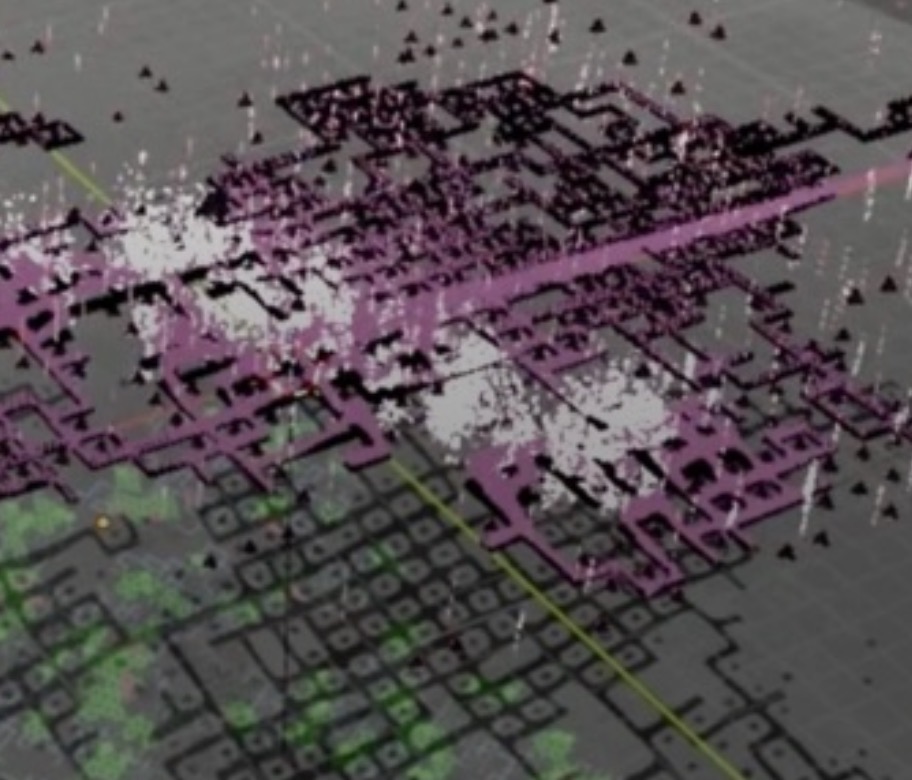
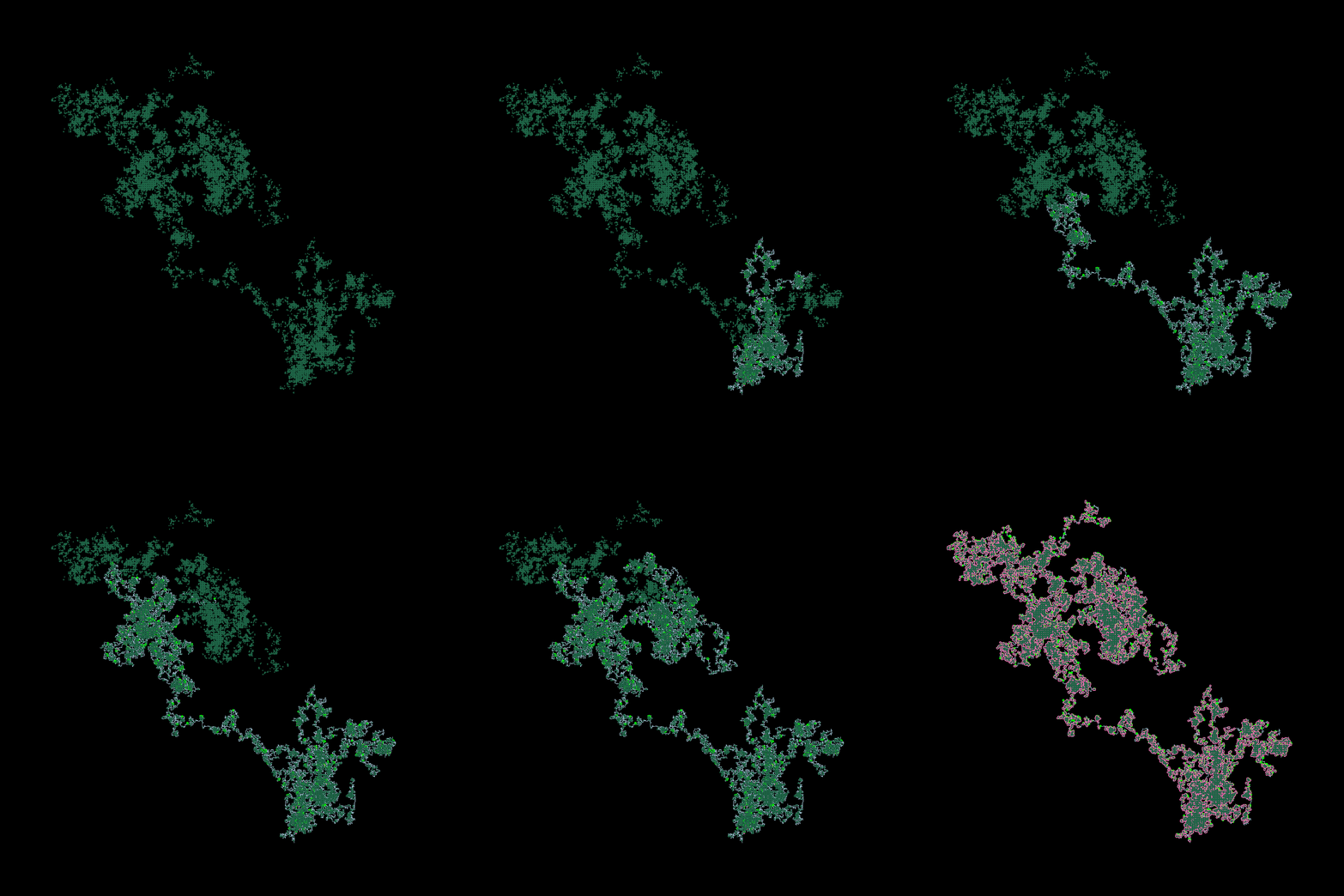
What it does
The Changes-Sieve constructs a KMotif-regulated data object, a compact representation of an evolving graph or simulation that emphasizes structural change over raw state.
Rather than storing every edge equally, the sieve records persistent topological events:
- revisited paths
- seam formations
- branching singularities
- regulated motif transitions
These measurements are summarized through the RSP scalar,
[ \mathrm{RSP}(G)= \left(R,S,P\right), ]
where
- (R) measures revisitation complexity,
- (S) measures seam continuity,
- (P) measures branching ("plus-sign") structure.
Derived quantities such as
[ \tau=f(R,S,P) ]
and
[ \rho=\frac{S}{P+S} ]
provide scale-independent descriptors of structural organization.
The resulting object serves as a geometry-aware intermediate representation for simulation, reinforcement learning, and language-model reasoning. A path is a commonly used term in computational language already, and this is merely extending that commonality into a heuristic that is workable.
KMotif regulation
Central to the representation is the family of KMotifs,
[ |3n-2|{-2,5}, ]
which defines a regulated motif grammar governing admissible structural growth.
Rather than treating paths as arbitrary walks, KMotifs constrain evolution into recursively compatible local configurations that remain stable under repeated transformations.
The Changes-Sieve therefore records regulated change, not merely graph connectivity.
Mathematically, each regulated object may be viewed as
[
\mathcal{K}
\left( V,E, R,S,P, \mathcal{M}, \Phi \right), ]
where
- (V,E) are the underlying graph,
- (R,S,P) are the structural invariants,
- (\mathcal M) is the motif hierarchy,
- (\Phi) denotes the regulation operators that preserve admissible evolution.
This allows downstream AI systems to reason over persistent structural features rather than raw transitions.

Log in or sign up for Devpost to join the conversation.