Inspiration
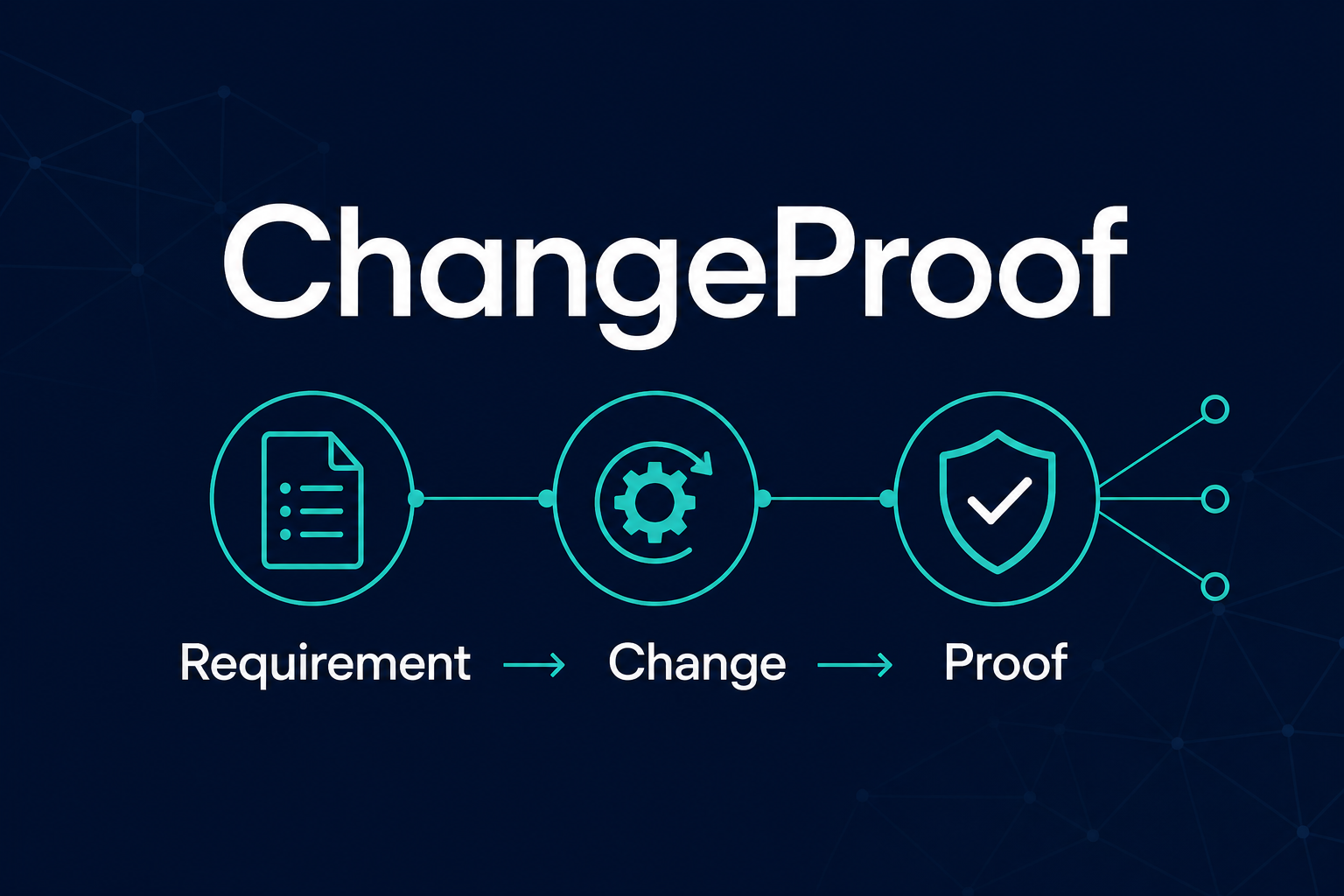
When a regulation changes, finding the new sentence is only the beginning. Teams must still identify every affected policy, procedure, control, system, test, and owner—and prove that the resulting changes are complete and approved.
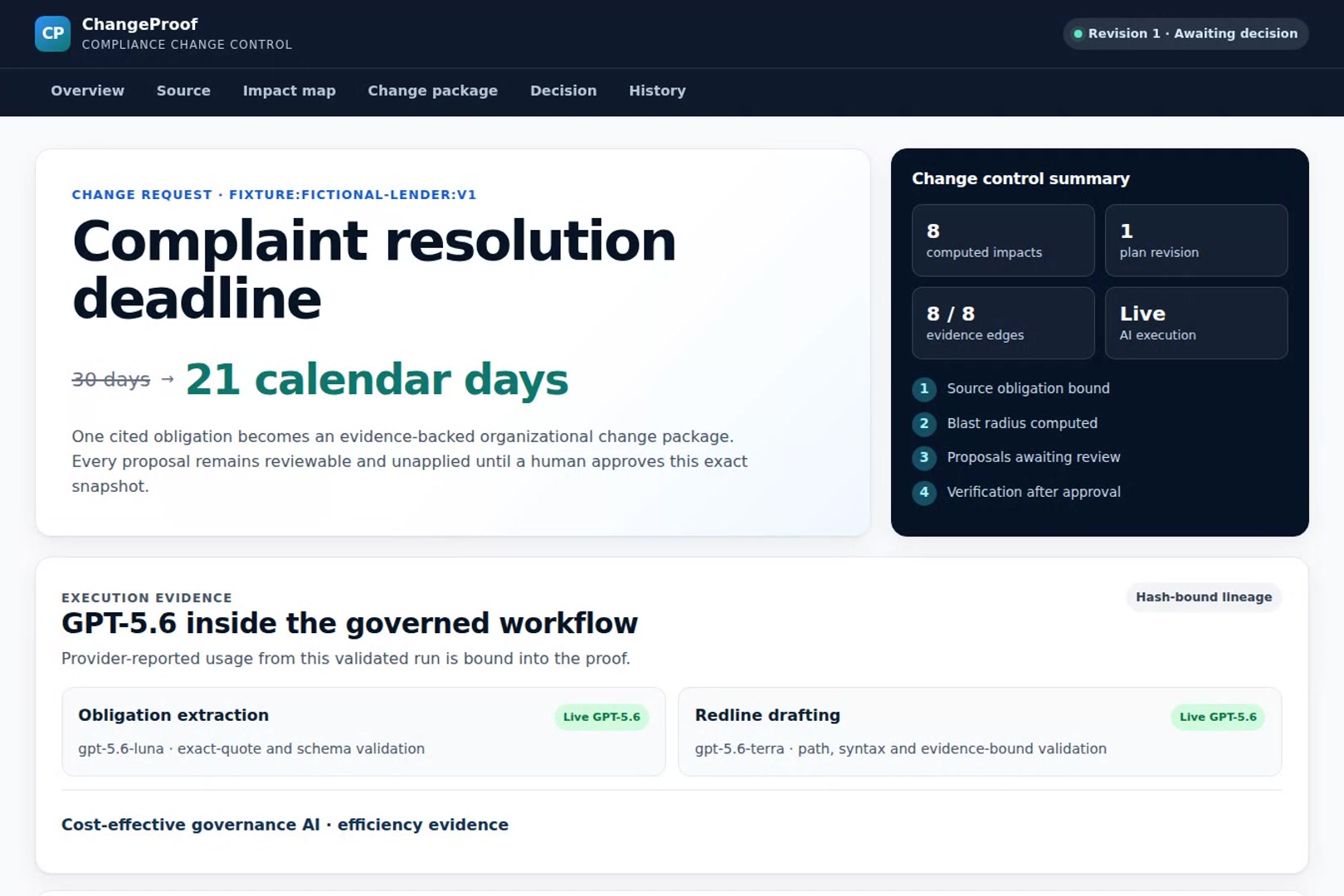
ChangeProof began with a fictional lender responding to an RBI complaint-handling requirement changing from 30 days to 21 days. We wanted an evidence-backed change workflow rather than another report, spreadsheet, or disconnected set of tickets.
What it does
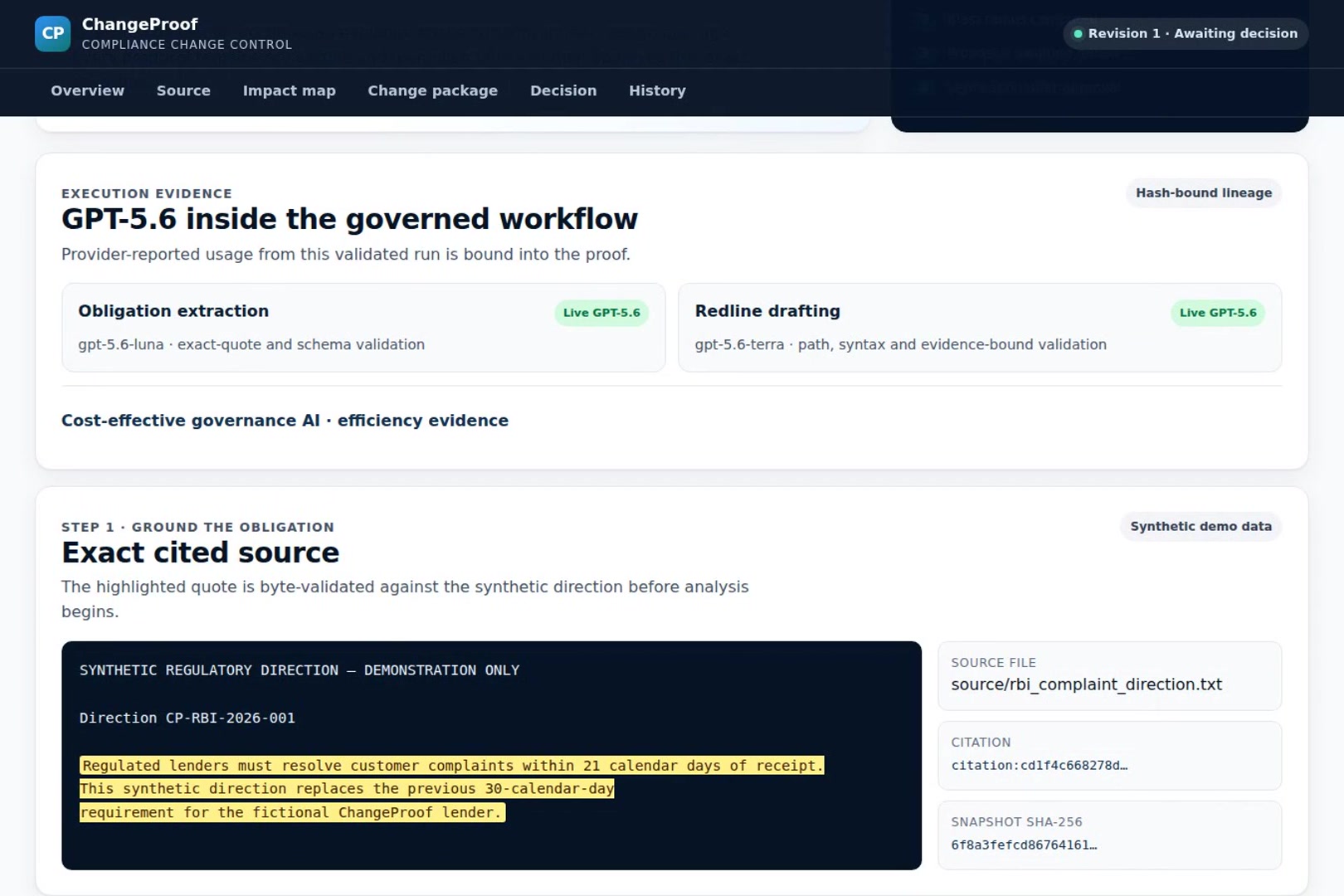
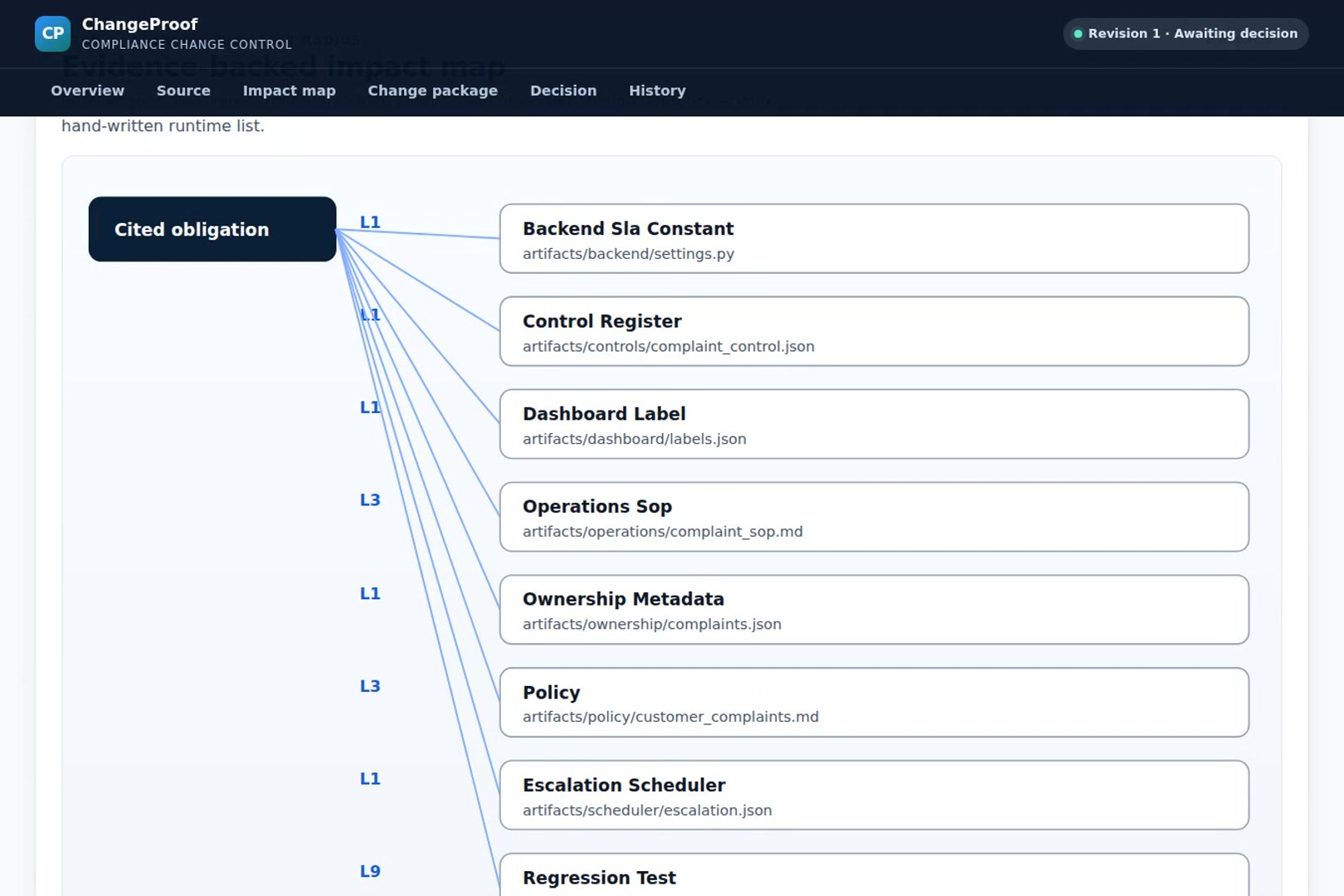
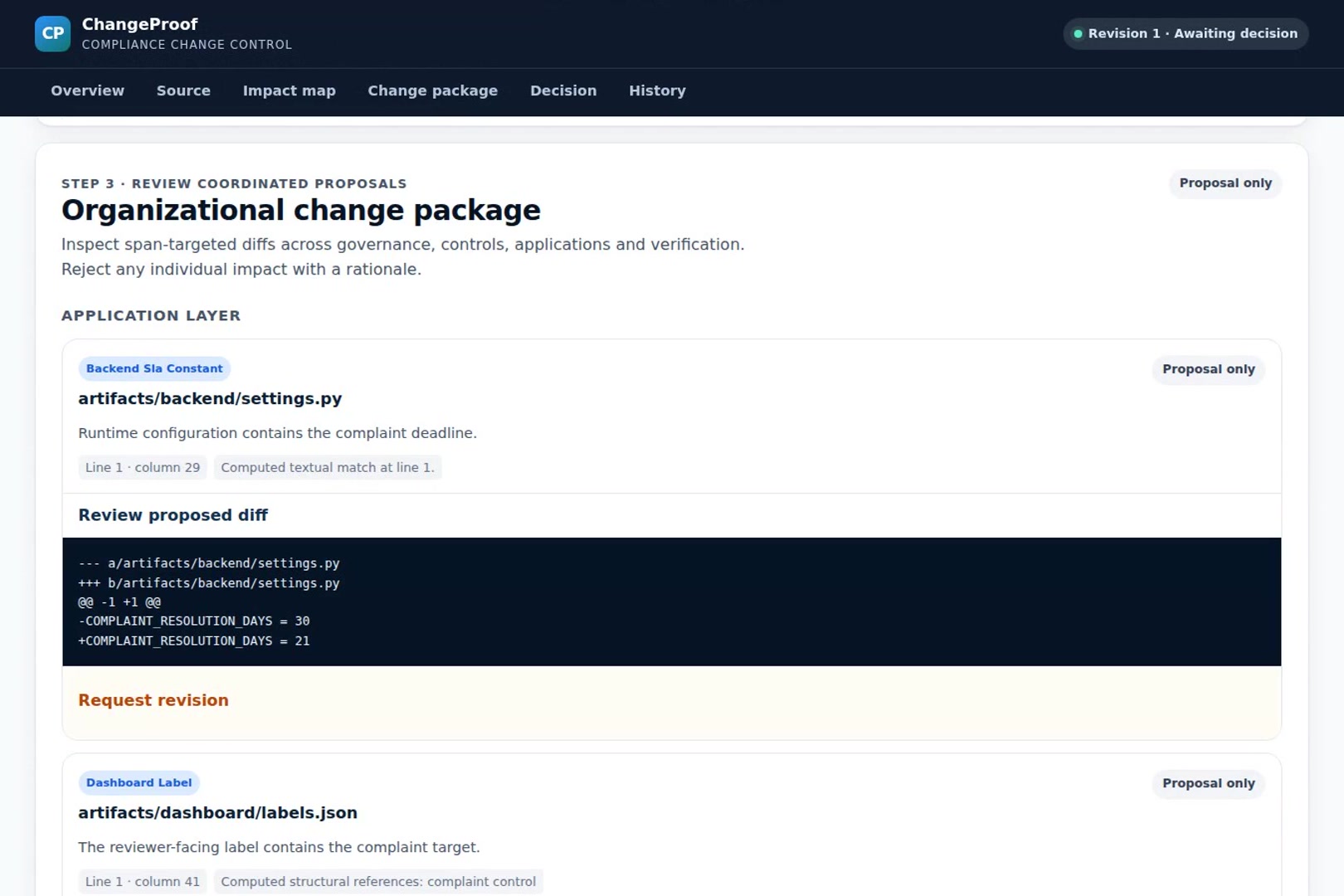
ChangeProof converts an external obligation into a cited, reviewable, and tested organizational change package. It extracts the exact source quote, computes the affected workspace spans with evidence for every graph edge, and proposes coordinated changes across policies, procedures, controls, application logic, schedulers, interfaces, and tests.
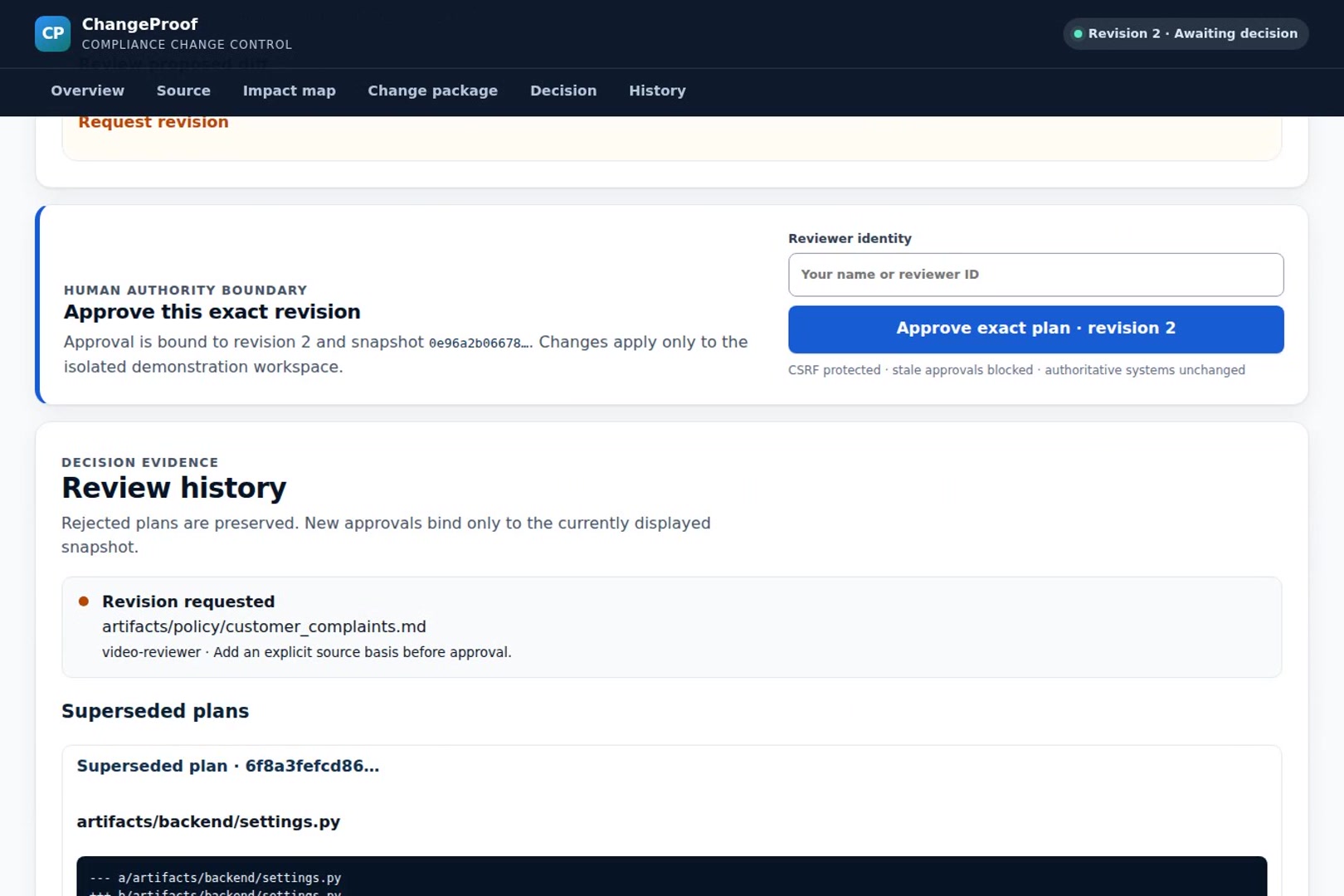
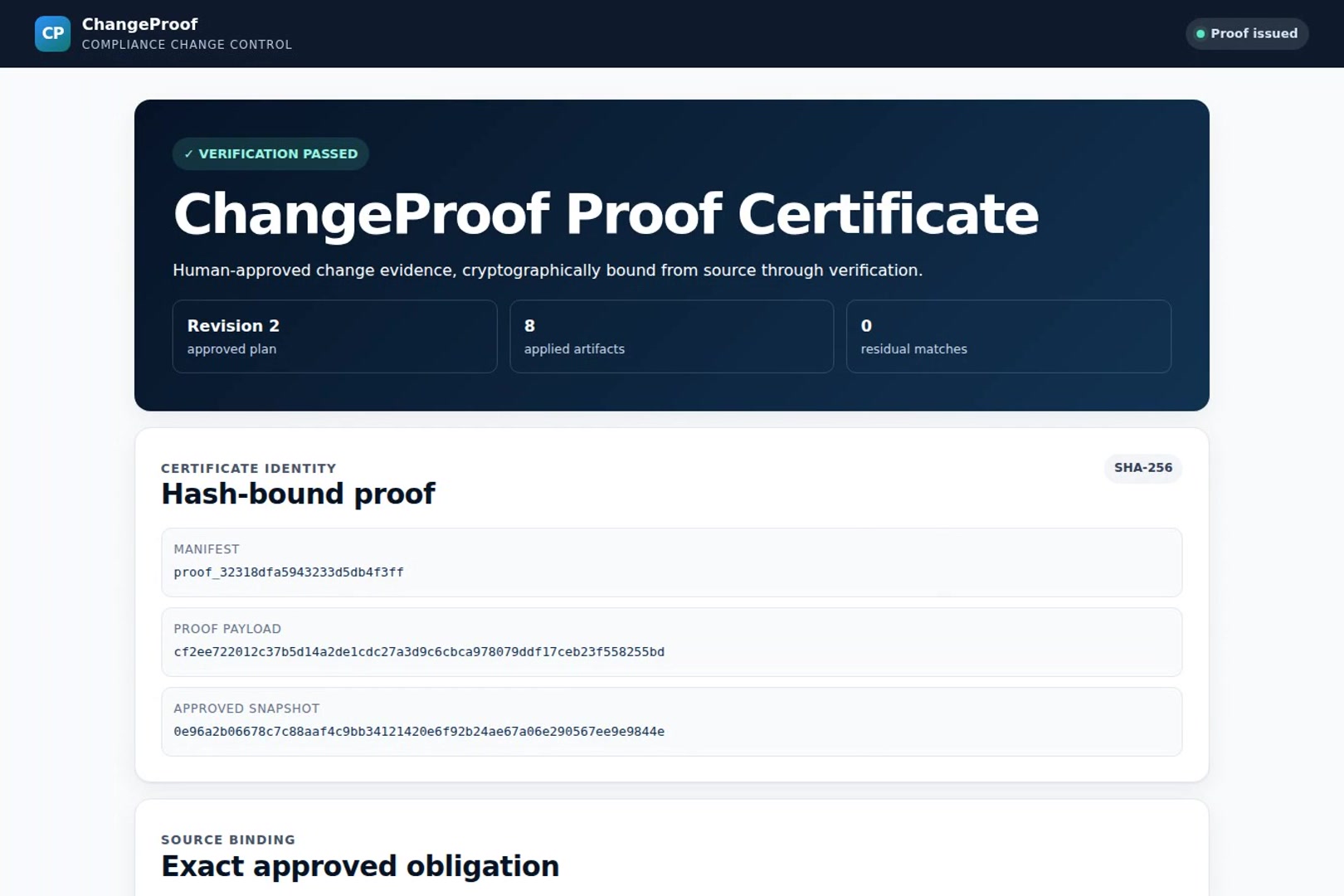
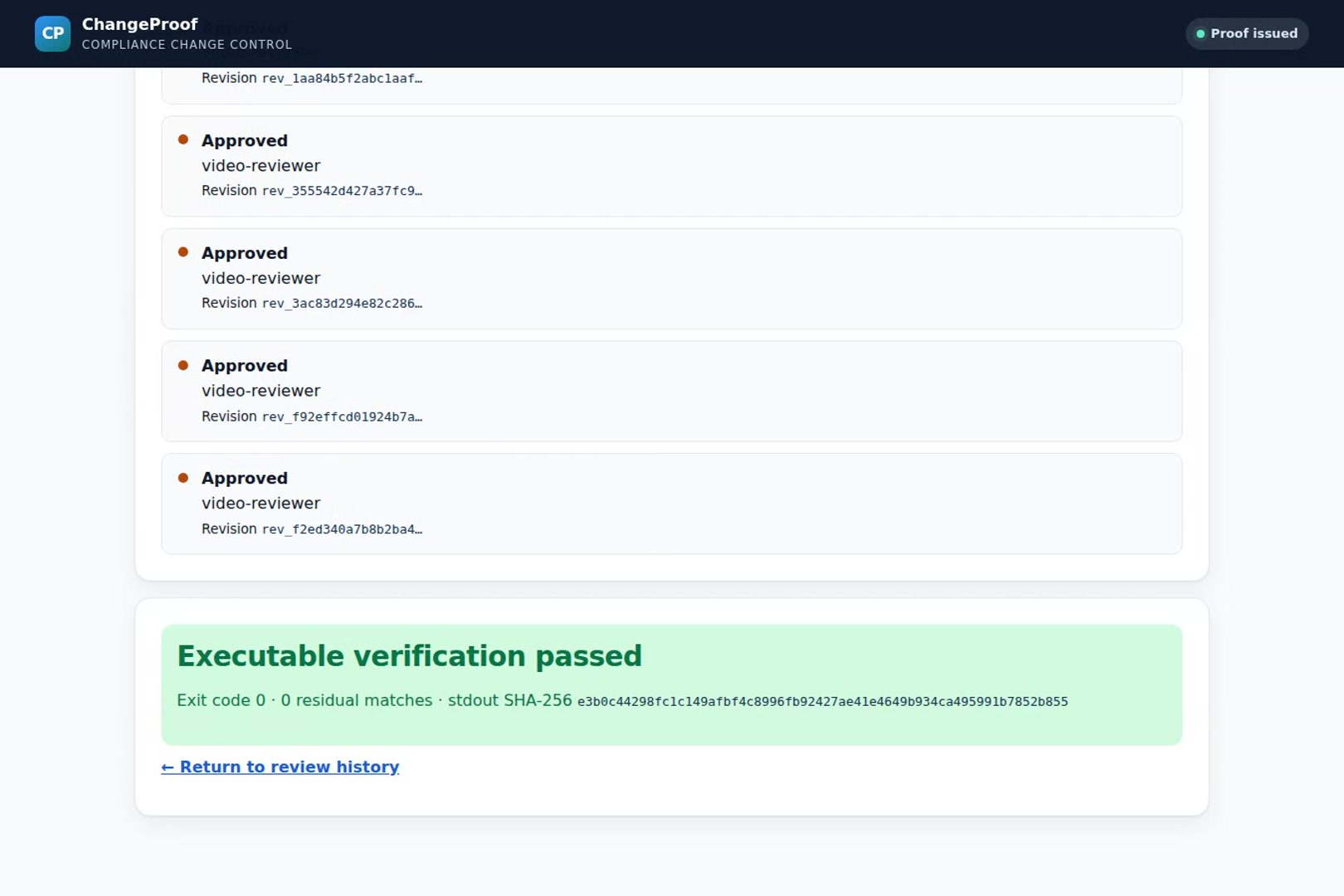
A reviewer can reject one impact with a rationale, inspect the revised plan while retaining the superseded version, and approve only the exact reviewed snapshot. ChangeProof then applies the approved package in an isolated workspace, runs verification, searches for obsolete requirements, and produces a hash-bound proof certificate containing citations, diffs, decisions, results, residuals, and exceptions.
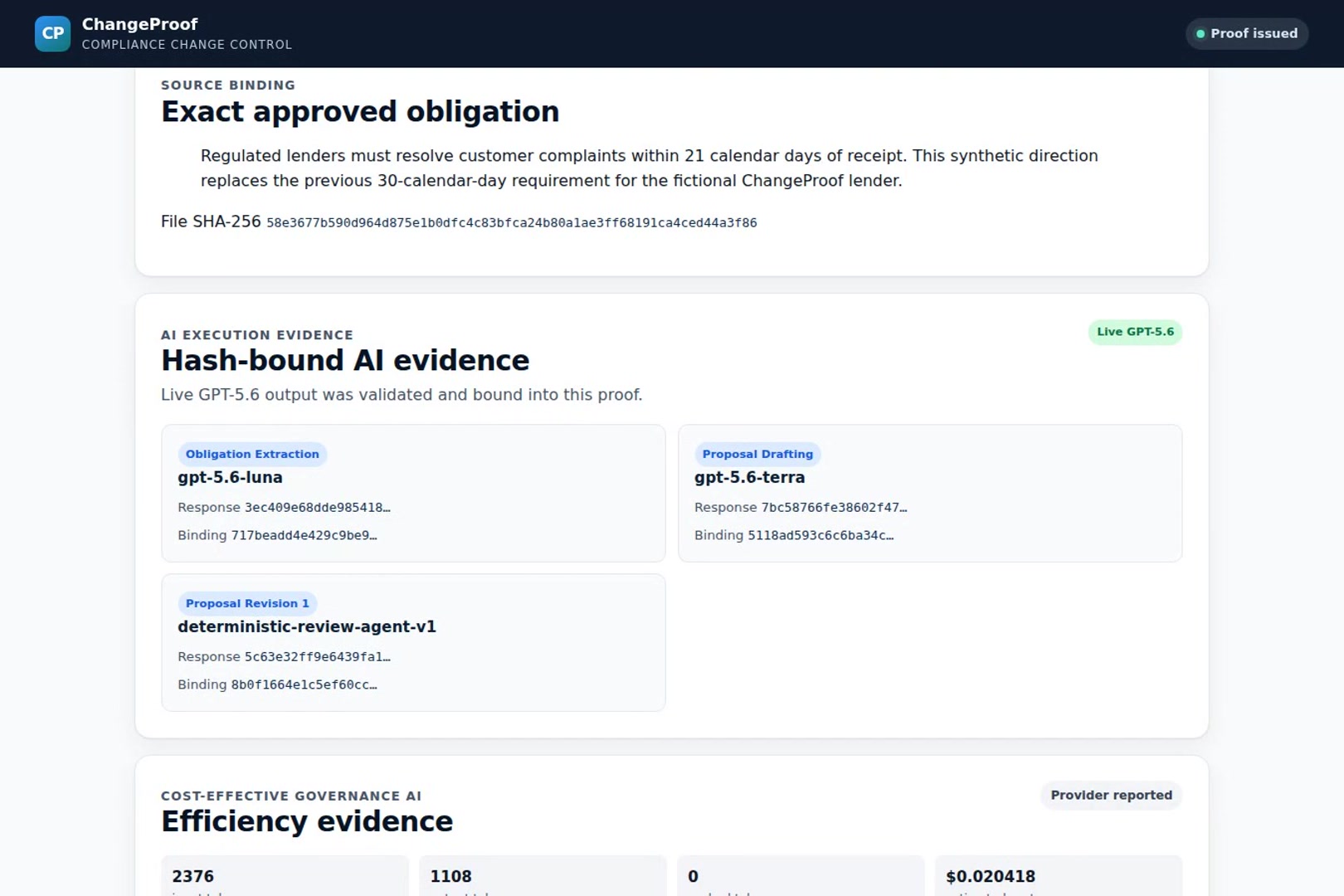
GPT-5.6 performs schema-constrained obligation extraction and coordinated redline drafting when an API key is configured. Model identity, prompt and schema versions, response hashes, token usage, and estimated cost are bound into the manifest. A deterministic offline fallback preserves the complete golden path with synthetic data and no credentials.
How we built it
Codex accelerated repository analysis, architecture, implementation, synthetic fixture design, tests, adversarial review, and release rehearsal. Human decisions set the fictional-lender scope, evidence standard, approval gates, safety boundaries, and product direction.
The product uses Python standard-library runtime components, SQLite, SHA-256 content bindings, strict JSON schemas, a computed workspace scanner, and a responsive reviewer UI. GPT-5.6 is integrated through the OpenAI Responses API. The repository has 61 passing tests and an optional private AWS deployment overlay; a clean clone still runs the full offline workflow without private infrastructure or package installation.
Challenges we ran into
Our first impact list was fixture-driven, and our first patching approach relied on global replacement. A skeptical reviewer could reasonably see a rehearsed fixture rather than an analysis engine. We replaced both with computed workspace discovery, exact spans, per-edge evidence, and span-targeted patches.
We also upgraded model metadata into tamper-evident, hash-bound proof links and built a genuine reject–revise–approve lifecycle. Every rejected plan remains viewable, every revision receives a new snapshot hash, and stale approvals fail.
Accomplishments that we're proud of
- Computed an eight-artifact blast radius from one cited obligation.
- Integrated GPT-5.6 with deterministic validation and offline fallback.
- Delivered a demonstrable human rejection, revision, approval, application, and verification workflow.
- Made cost-effective governance AI auditable through token, cache, execution-mode, estimated-cost, and cost-avoidance evidence.
- Pointed ChangeProof at ChangeProof: the self-compliance milestone passed 51 tests and 11/11 automated controls while disclosing two exceptions rather than hiding them.
- Kept the complete judge path portable, synthetic, and independent of private infrastructure.
- Published a processed, public 173-second Build Week demonstration video.
What we learned
Traceability must be structural, not explanatory prose added after generation. Every conclusion needs a source span, impact rationale, decision record, and stable hash. Human approval must bind to the exact content reviewed, and rejected plans must remain visible. Model identity, prompt and schema versions, usage, cost, and exceptions belong in the same evidence chain as the business change.
What's next for ChangeProof
We will expand the scanner and framework catalog beyond the demonstration, add enterprise identity and workflow integrations, and gather broader real-world cost and accuracy evidence. The core direction remains the same: turn any external obligation into a human-governed, verifiable organizational change—without pretending that AI replaces legal judgment or accountable approval.

Log in or sign up for Devpost to join the conversation.