-
-
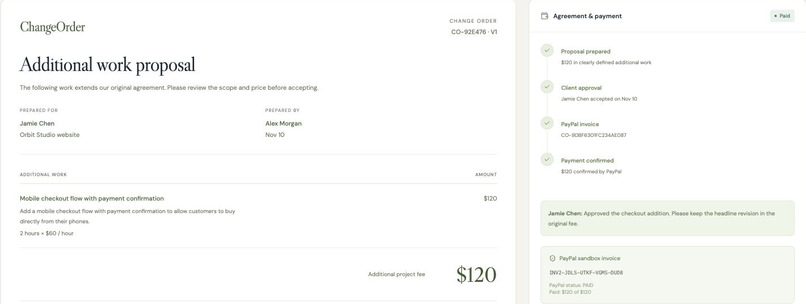
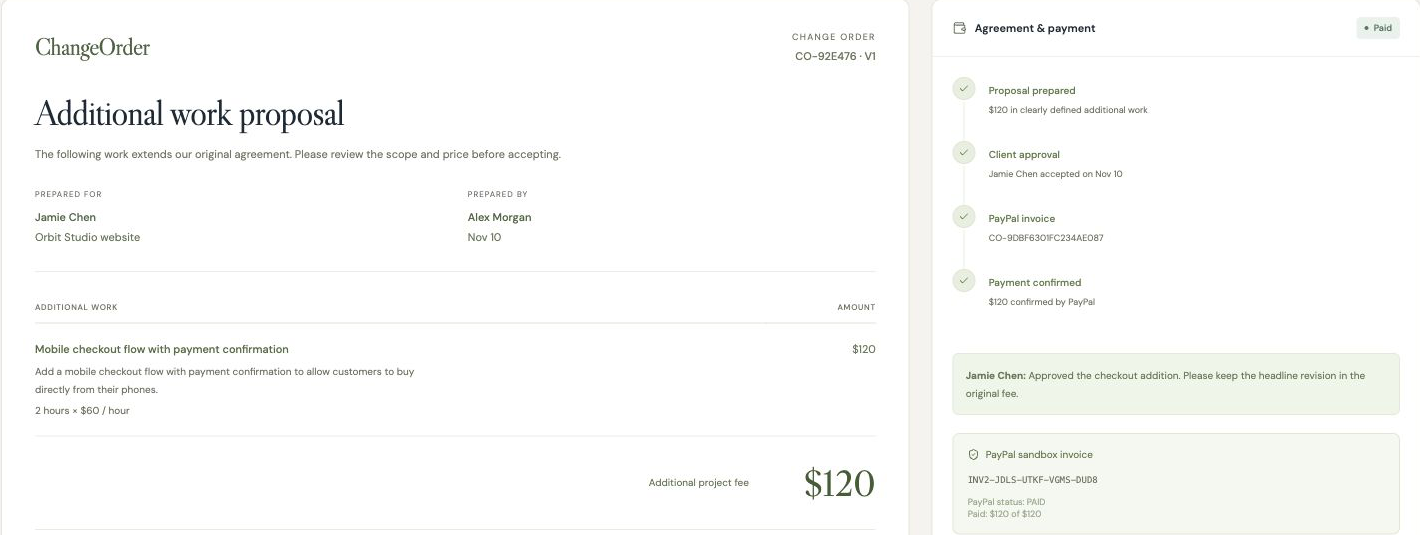
PayPal sandbox payment of $120, confirmed by an authenticated invoice status check.
-
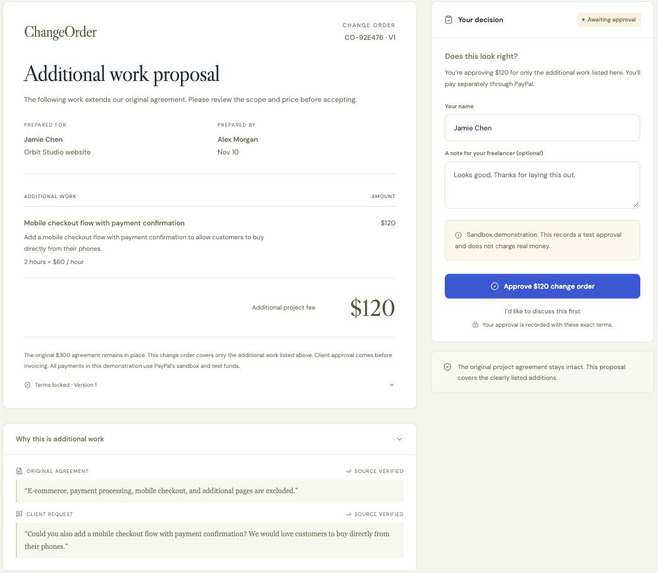
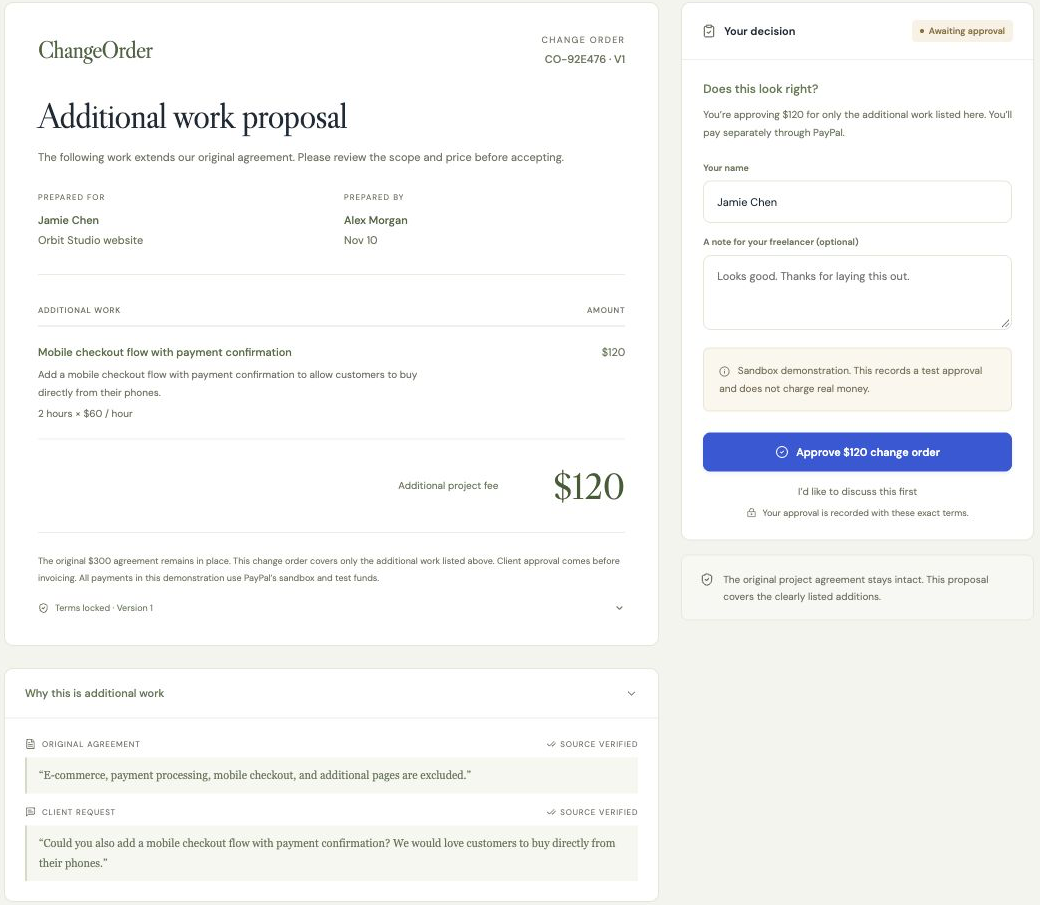
The client reviews and explicitly accepts only the additional work: two hours at $60, totaling $120.
-
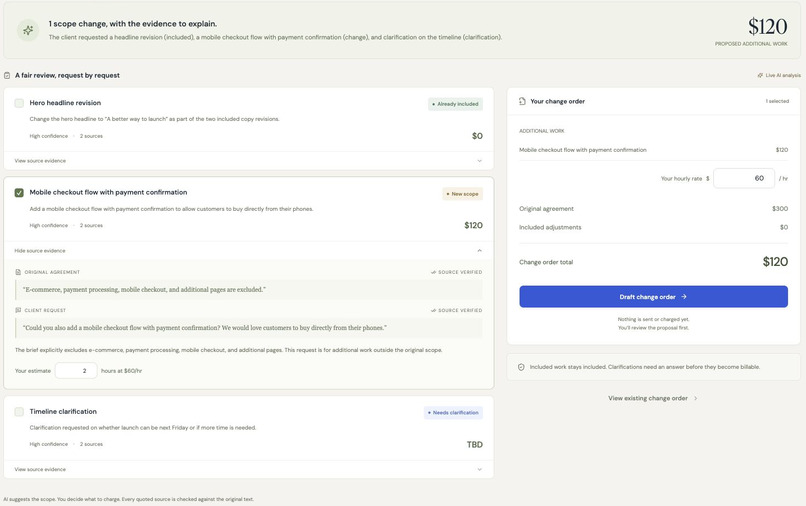
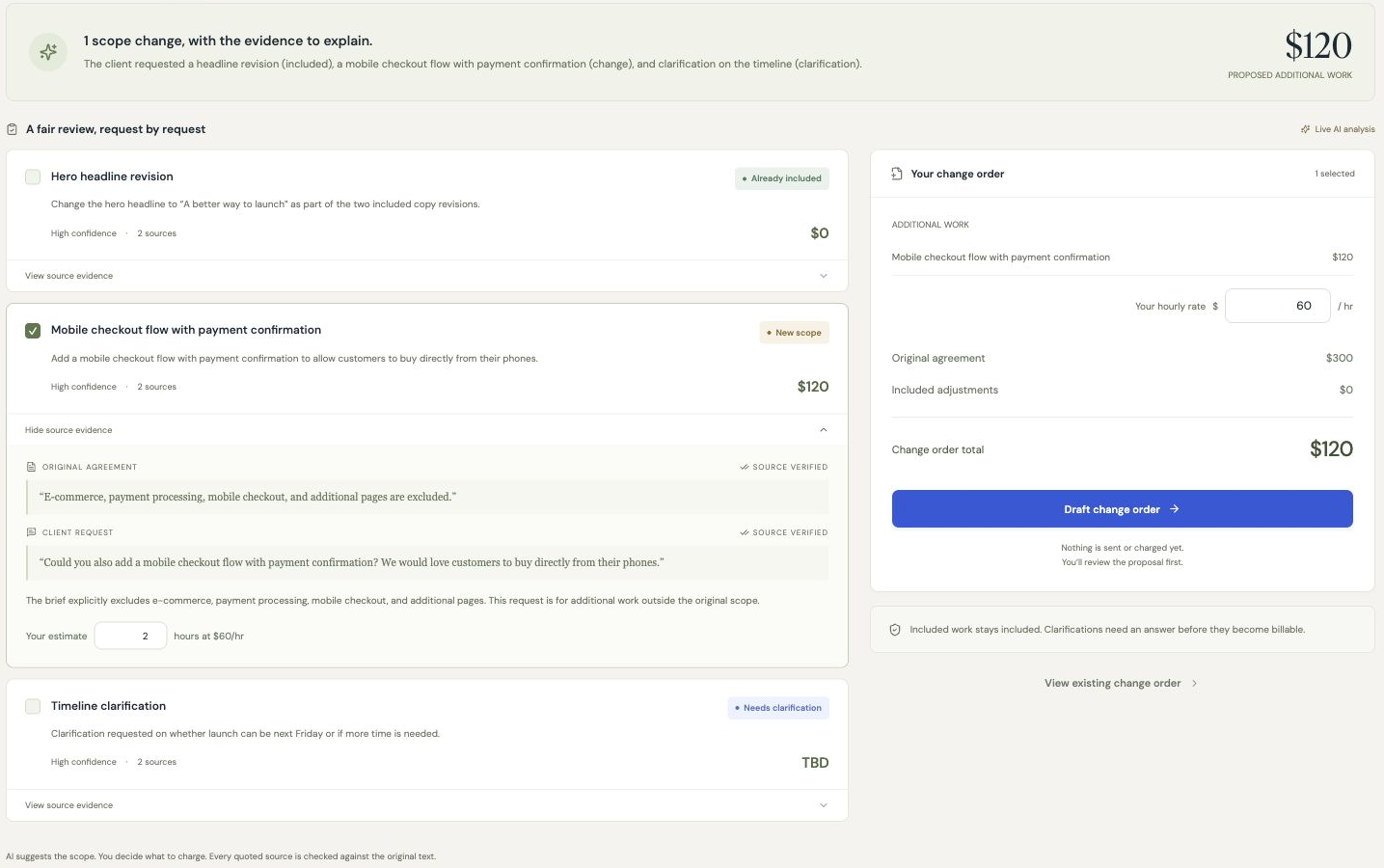
AI separates included work, additional scope, and clarification, with exact source evidence.
-
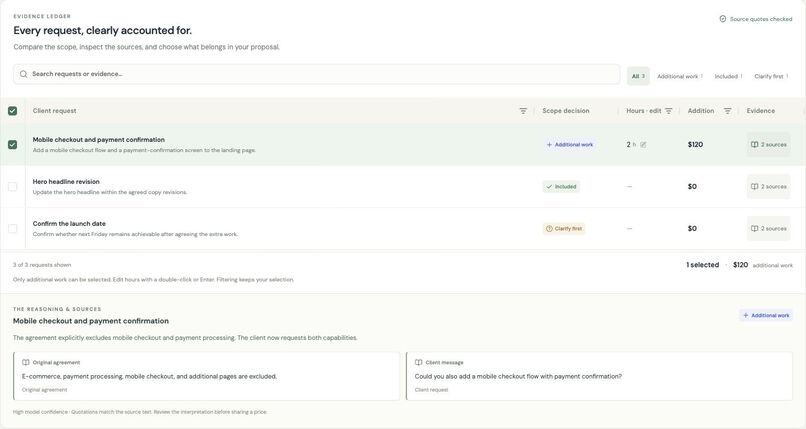
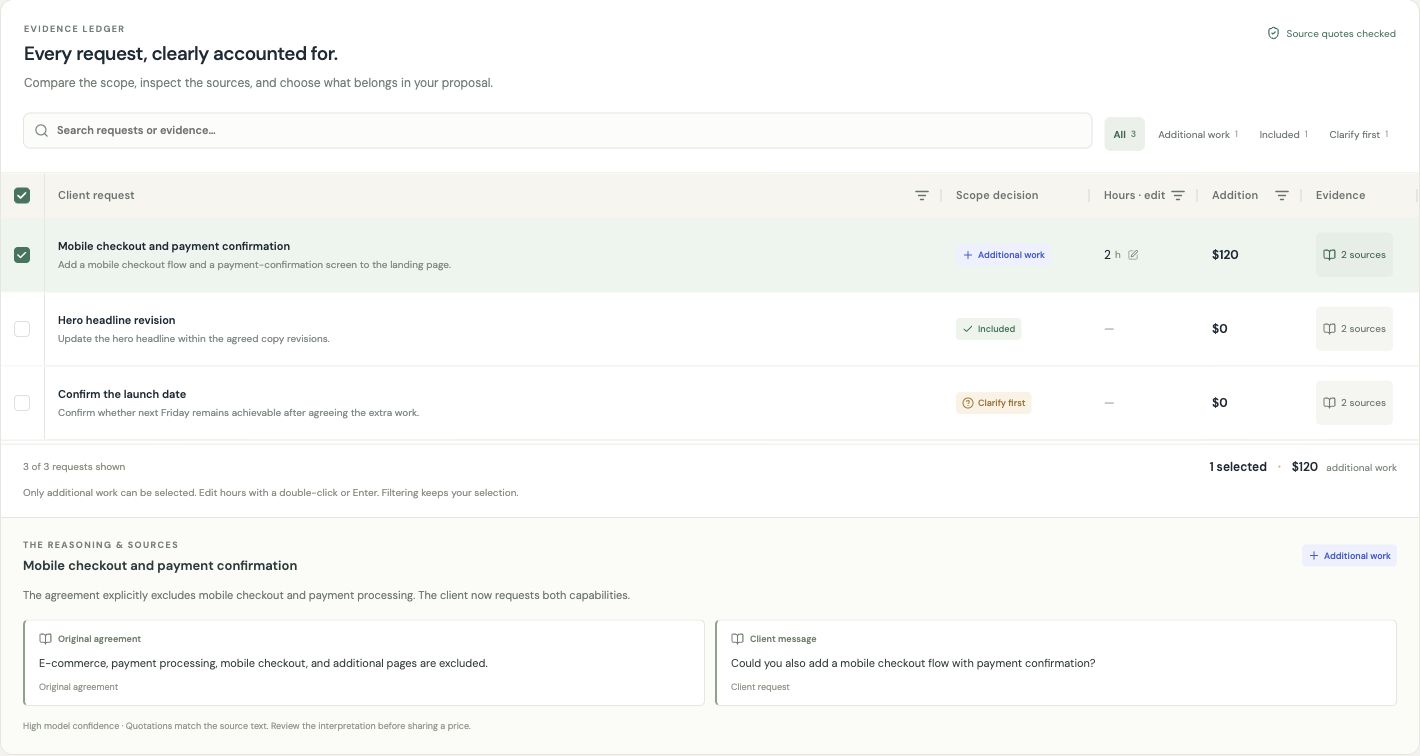
AG Grid Community Evidence ledger: filter requests, edit hours, inspect exact quotes, and price only additional work.
Try it: Interactive browser sample · Full runnable build and setup · Judge walkthrough
The hosted sample uses clearly labeled prewritten findings and browser-local state. It supports evidence review, editable estimates, and test client approval, and stops before invoicing. The 2:41 video separately demonstrates live GPT-4.1 and an actual PayPal sandbox payment.
Inspiration
A web designer agrees to a fixed-price website with two included copy revisions. Then the client sends three messages: change the headline, add mobile checkout, and confirm the launch date. Charging for every message is unfair to the client; absorbing every addition is costly for the freelancer.
This is a documented problem beyond our example. STUC's 2025 survey of 805 Scottish creative-industry workers reported unclear freelance expectations and late-payment problems, including scope additions without fee or timeline adjustments. This sector-specific evidence motivates the problem; it does not establish demand for our product. Primary report.
ChangeOrder helps fixed-price web freelancers and small agencies make the change clear before the extra work begins.
What it does
AI compares the project brief with client messages and separates included work, additional work, and questions needing clarification. Every finding cites source text, and application code verifies each quotation. The freelancer reviews the interpretation, chooses the additions to offer, and sets the hours and rate.
The client sees the additional deliverable, its price, and its supporting evidence. They can accept or request a discussion. Sharing fixes the terms; client acceptance enables a separate, itemized PayPal sandbox invoice. An authenticated invoice fetch confirms the amount and payment state.
In the fictional $300 website project, the headline revision stays included at $0, checkout becomes a human-reviewed two-hour proposal at $60 per hour, and the date question remains a clarification. The client accepts the $120 addition, pays through PayPal's hosted sandbox page, and ChangeOrder independently confirms payment with PayPal.
Why this approach matters
The client's included work stays visible, and the freelancer can explain an addition with evidence. One trail connects the request, reviewed price, fixed accepted terms, separate invoice, and confirmed payment.
Existing products already support parts of this workflow. Bonsai describes connected scopes and contracts, and HoneyBook documents AI invoice editing. ChangeOrder focuses on the decision between an incoming request and a new charge: exact citations, explicit included and uncertain work, human pricing, client acceptance, and provider-confirmed payment. We do not claim to have invented change orders or AI invoicing.
For illustration, assume a $300 base project takes five hours and an addition takes two. Doing both for $300 yields $42.86 per hour; agreeing and collecting another $120 preserves $60 per hour before fees and costs. This is fictional arithmetic, not measured revenue uplift. Our impact notes separate external evidence, the illustration, and validation still needed.
How we built it
React and TypeScript power the owner workspace and client review. Express persists projects, proposals, and audit history in SQLite. GPT-4.1 runs through a server-side OpenAI-compatible model gateway. Zod validates structured findings; application code checks exact quotations against the identified source. Unsupported evidence fails analysis. Monetary totals use integer cents.
The branded AG Grid Community Evidence ledger adds search, classification filters, sorting, editable hours, protected additional-work selection, and readable source details. Ledger and cards share the same selection and estimates. Included and uncertain work remain unchargeable, with the server enforcing that boundary. The ledger is loaded when opened. This is Community usage, not AG Studio.
PayPal Invoicing is central: each accepted addition gets its own financial record. Stable invoice identifiers and serialized operations protect retries. Reconciliation checks identity, amount, currency, and payment state. Credentials remain server-side.
The separately built public sample has isolated browser storage and no provider credentials or payment simulation. The complete repository reproduces live integrations with judge-supplied credentials.
Challenges we ran into
A quotation can be accurate while the interpretation is wrong. Human review stays between AI analysis and an offered price. The recording makes this visible: the freelancer corrects the model's eight-hour estimate to two before sharing.
Payment needs a similar boundary: a checkout success page cannot replace an authenticated invoice check. Regional compatibility required an India merchant app and a US personal sandbox buyer for the recorded USD flow. Live webhook delivery to localhost was not tested.
Review also caught two edge cases: changed source terms now block sharing an old draft, and prewritten findings require the exact supplied brief and requests. Amendments and added messages cannot reuse an old sample charge.
Accomplishments we're proud of
The public 2:41 video records live analysis, human pricing, client acceptance, a real sandbox invoice, test-card checkout, and API-confirmed receipt of $120. All people and project data are fictional; no real funds moved. The recording also includes the Evidence ledger in a clearly labeled public sample using prewritten findings. It uses stock Gemini Achird conversational synthetic narration, synchronized captions, and privacy-edited app footage.
Fourteen automated tests, typecheck, both builds, and GitHub CI pass. Browser checks verified ledger/card synchronization, nonbillable protection, editable totals, and client approval without a simulated payment. A separate live model run matched expected labels across eight synthetic scenarios and ten requests. That is a small measured run, not a general accuracy or security guarantee. Reports and reproduction steps are public.
What we learned
The useful decision is shared scope and price before the invoice. Showing why a revision costs $0 matters as much as explaining why an addition has a price. AI organizes evidence, people approve the change, and PayPal confirms payment.
What's next
Pilot with fixed-price web freelancers and small agencies, comparing proposal preparation time, client understanding, and confirmed payment completion with their current process. Team workspaces, message imports, and richer revision history are future work. Customer demand, pricing, and business impact remain unvalidated.
Built With
- ag-grid
- express.js
- gpt-4.1
- node.js
- paypal
- react
- sqlite
- typescript
- vite
