Inspiration
The problem is beautifully simple: people want to give to charity, but they don't.
Not because they don't care. Not because they can't afford it. But because traditional donation processes are complicated:
- Remembering to donate regularly
- Choosing which charity deserves support
- Setting up recurring payments
- Deciding how much to give
Meanwhile, we make 15+ purchases every week without thinking twice. Each transaction leaves spare change—£0.33 here, £0.67 there—that we'd never miss.
We asked: What if giving to charity was simpler than buying coffee?
The answer: round up every purchase to the nearest pound and donate the difference. No apps to open. No forms to fill. No decisions to make. Just spend normally, give automatically.
What it does
GoodCents is a banking feature that automatically rounds up transactions and donates spare change to charity.
The entire user experience:
- Customer opts in once (literally one tap)
- They make normal purchases
- That's it. There is no step 3.
Example flow:
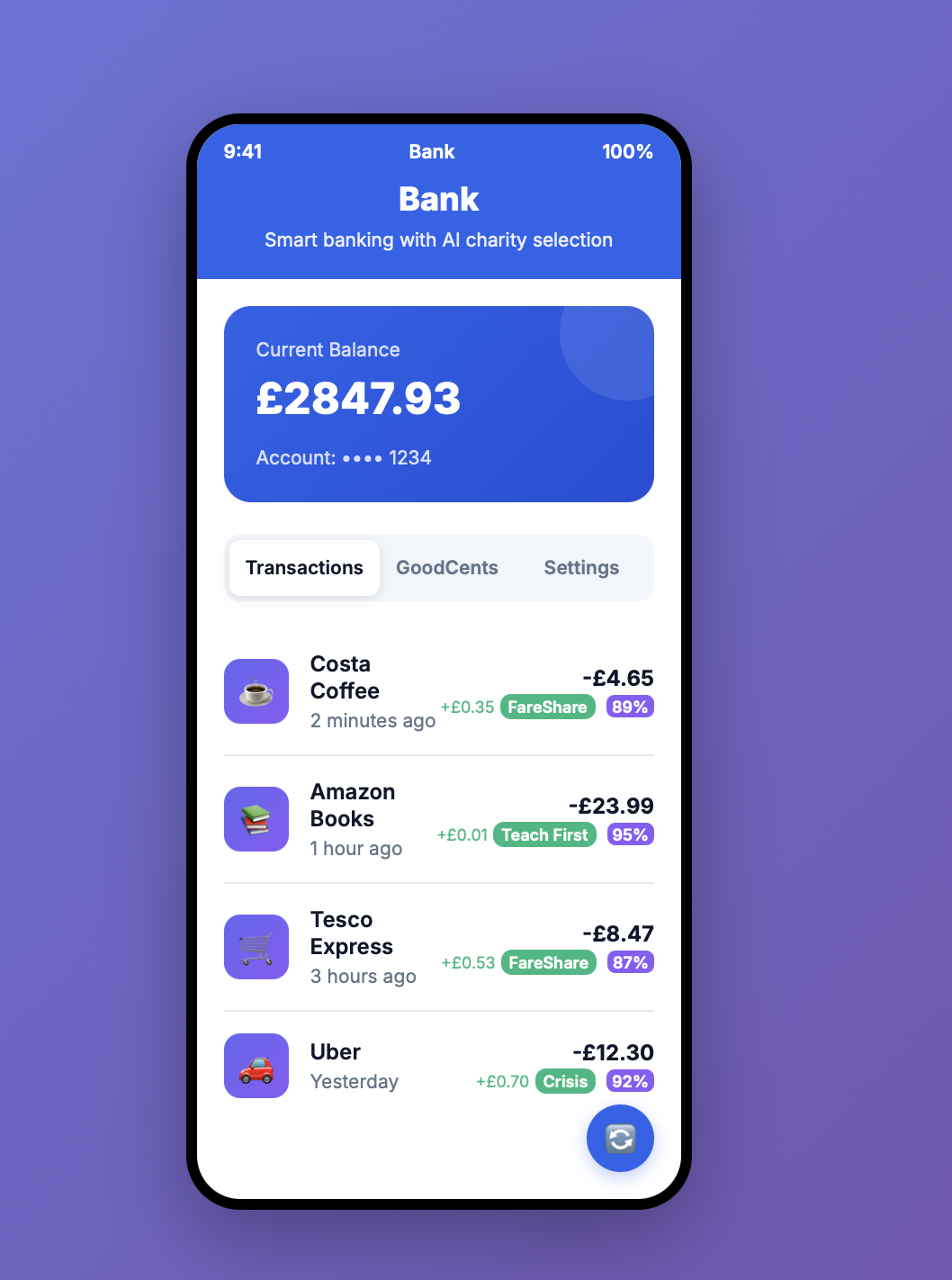
- Buy coffee at Costa: £4.65 → £0.35 donated to FareShare
- Buy books on Amazon: £23.99 → £0.01 donated to Teach First
- Buy groceries at Tesco: £8.47 → £0.53 donated to FareShare
- Month total: ~£4.50 donated without thinking
AI-Powered Charity Matching
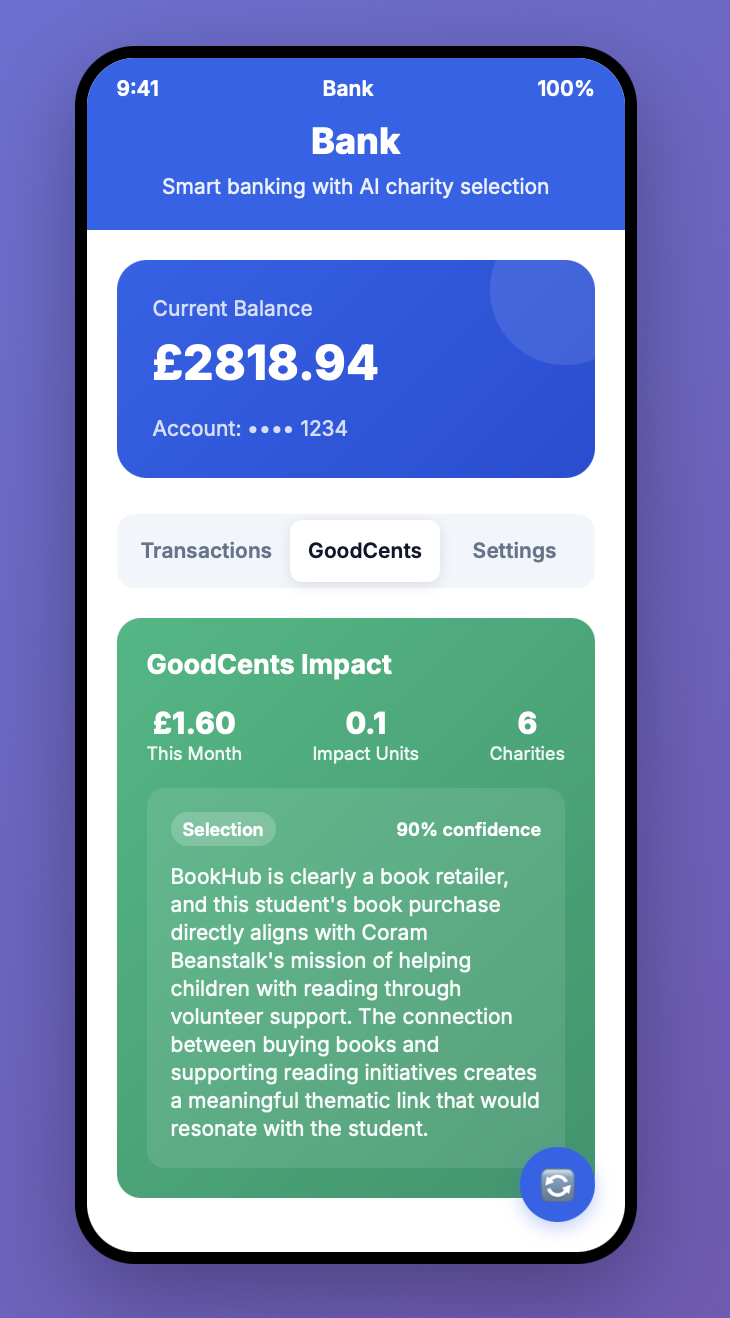
When users make purchases, Claude AI analyzes the merchant and transaction context to recommend the most appropriate charity:
How it works:
- Student buys from Amazon Books → AI recommends Teach First (education charity) with 95% confidence
- Student buys lunch at Costa Coffee → AI recommends FareShare (fighting hunger) with 89% confidence
- Student takes an Uber → AI recommends Crisis (homelessness support) with 92% confidence
The AI understands context: buying educational supplies should support education charities, buying food should support hunger relief, taking transport might indicate someone thinking about mobility and homelessness issues.
Zero paralysis by choice: One AI recommendation per purchase. Accept or skip. No endless charity comparison tools.
Why This Solves the Real Problem
Simplicity over features: We deliberately didn't build donation tracking dashboards with 15 charts, charity comparison tools, or complex social sharing features. We built one thing: automatic roundup donations with intelligent charity matching. Everything else is noise.
Works within existing behavior: People already use banking apps daily. We don't ask them to download another app or change their habits. GoodCents lives where they already are.
The Banking Ecosystem Problem We're Solving
Ecosystem: Digital Banking (Monzo, Starling, Revolut, traditional banks going digital)
The Well-Scoped Problem
Modern challenger banks have transformed payments, budgeting, and savings with beautiful apps and innovative features. But there's a gap: no bank has made charitable giving a native, effortless part of the banking experience.
Current state of charity in banking:
- ❌ Manual transfers to charity accounts (friction)
- ❌ Third-party donation apps (requires separate account)
- ❌ One-off "donate" buttons (users forget)
- ❌ No integration between spending and giving
The specific problem: Banks want to offer charitable giving features to differentiate themselves and build brand loyalty, but implementing complex donation platforms is expensive, risky (regulatory compliance), and pulls focus from core banking features.
Our scoped solution: GoodCents is a lightweight feature that integrates into existing transaction processing. Banks get a complete charitable giving offering without building a charity platform from scratch.
Deep Understanding of the Banking Ecosystem
Regulatory requirements we considered:
- FCA compliance for handling charitable funds
- Clear user consent mechanisms (GDPR)
- Transparent fee structures (we take 0%)
- Audit trails for all charitable transactions
Integration points in banking systems:
- Transaction processing pipeline (where roundup calculation happens)
- User preference storage (charity selections)
- Monthly statement generation (donation summaries)
- API endpoints for frontend apps
Business model alignment:
- Banks don't monetize this (builds goodwill instead)
- Differentiates brand in crowded fintech market
- Low implementation cost, high PR value
- Drives app engagement (users check charity impact)
Why banks would actually adopt this:
- White-label ready: Banks keep their branding
- Minimal dev work: Just 2 API endpoints + AI integration
- No charity partnerships needed: We maintain the charity database
- Risk-free pilot: Can launch to 1% of users first
How we built it
The Simplicity Principle (Occam's Razor Applied)
We constantly asked: "What can we remove?"
What we cut:
- ❌ Complex user authentication (demo uses one test account)
- ❌ SQL database (in-memory state is sufficient for demo)
- ❌ Frontend framework (vanilla JS is enough)
- ❌ Multiple charity selection UI (one AI recommendation at a time)
- ❌ Social features, gamification, complex impact dashboards
What we kept:
- ✅ Core roundup calculation (the only feature that matters)
- ✅ Real Claude AI integration (actual intelligent charity matching)
- ✅ Real-time transaction updates (proves ecosystem integration)
- ✅ Mobile banking UI (shows realistic user experience)
- ✅ Working checkout (demonstrates end-to-end flow)
Architecture: Simple by Design
User makes purchase (£23.99 at Amazon Books)
         ↓
Server receives payment request
         ↓
Calculate roundup: ceil(23.99) - 23.99 = 0.01
         ↓
Call Claude AI with merchant context
         ↓
AI analyzes: "Amazon Books" → Education charity
         ↓
AI returns: "Teach First" with 95% confidence
         ↓
Store transaction + roundup + AI charity
         ↓
Update balance and monthly donation total
         ↓
Banking app polls for updates
         ↓
Transaction appears with charity recommendation
         ↓
Done.
No complexity cascade:
- No microservices (one Python server)
- No message queues (direct HTTP)
- No caching layers (direct state access)
- Minimal external dependencies (Anthropic SDK only)
Technical Implementation
Backend (Python - ~630 lines total)
Core roundup logic:
roundup = round(math.ceil(amount) - amount, 2)
ACCOUNT["balance"] -= amount
ACCOUNT["monthly_donated"] += roundup
Real Claude AI Integration:
def ai_select_charity_claude(merchant_name, amount):
    """Use Claude AI to select the most appropriate charity"""
    client = anthropic.Anthropic(api_key=CLAUDE_API_KEY)

    charities_info = "\n".join([
        f"- {name}: {info['description']} (£{info['costPerImpact']} per {info['unit']})"
        for name, info in CHARITIES.items()
    ])

    prompt = f"""You are an AI assistant for a banking app that helps students donate spare change to charities.

A student just made a purchase at "{merchant_name}" for £{amount:.2f}.

Available charities:
{charities_info}

Based on the merchant type and purchase context, which charity would be most appropriate?

Respond with only a JSON object:
{{"charity": "Charity Name", "confidence": 85, "reasoning": "Brief explanation"}}"""

    message = client.messages.create(
        model="claude-sonnet-4-20250514",
        max_tokens=200,
        messages=[{"role": "user", "content": prompt}]
    )

    result = json.loads(message.content[0].text.strip())
    return result["charity"], result["confidence"], result["reasoning"]
The AI receives:
- Merchant name ("Amazon Books", "Costa Coffee", etc.)
- Transaction amount (context about purchase size)
- Available charities with descriptions and impact metrics
It returns:
- Charity name (which charity to donate to)
- Confidence score (85-95% typically)
- Reasoning (why this charity makes sense)
Charity Database: We curated 6 UK charities focused on student-relevant causes:
- Teach First: Places exceptional graduates in challenging schools (Education)
- Into University: Supports disadvantaged youth into higher education (Education)
- Coram Beanstalk: Helps children with reading through volunteers (Literacy)
- FareShare: Redistributes surplus food to fight hunger (Food/Community)
- Crisis: Works with homeless people to rebuild lives (Homelessness)
- Mind: Mental health advice and support (Wellbeing)
Each charity includes:
- Description of mission
- Cost per impact unit (£8.50 per meal, £25.50 per training hour)
- Focus keywords for AI matching
- Brand color for UI consistency
Frontend (HTML/CSS/JS)
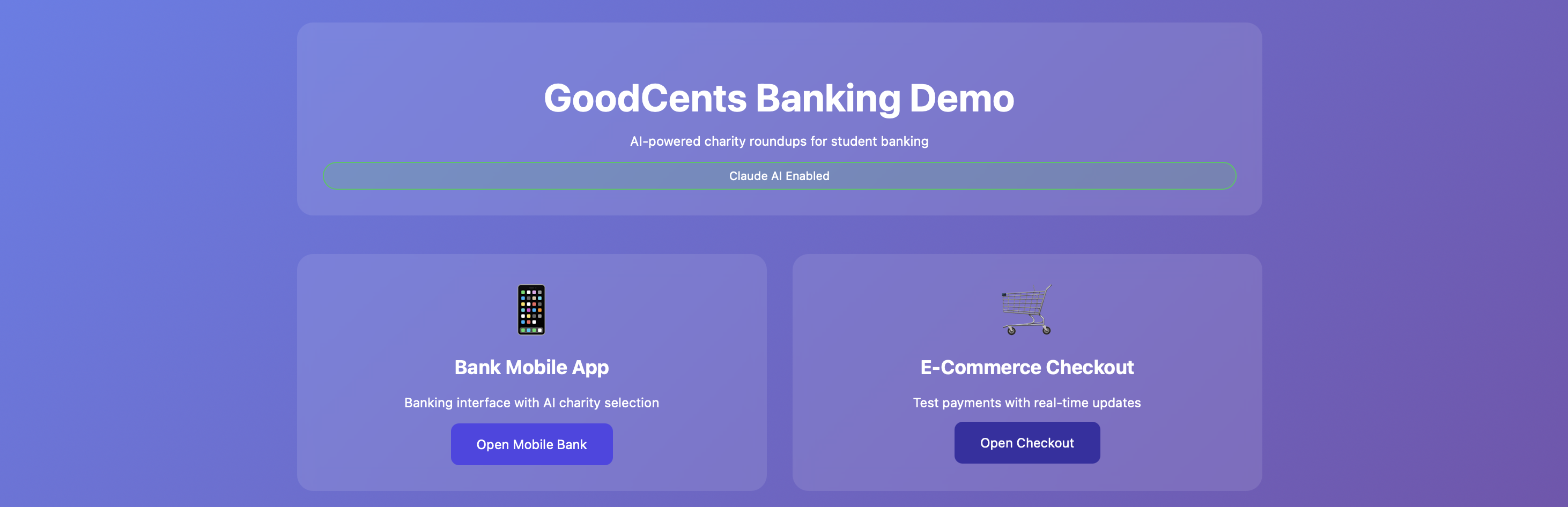
- Mobile banking interface: Shows balance, transactions, charity impact
- E-commerce checkout: Simulates real purchases with merchant variety
- Both apps use vanilla JavaScript with simple polling:
// Update UI every 2 seconds
setInterval(async () => {
    const state = await fetch('/api/state').then(r => r.json());
    updateBalance(state.balance);
    updateTransactions(state.transactions);
    updateMonthlyDonated(state.monthly_donated);
}, 2000);
Fallback System: If Claude API is unavailable, the system uses rule-based matching:
def fallback_charity_selection(merchant_name):
    """Simple keyword-based fallback if AI unavailable"""
    merchant_lower = merchant_name.lower()

    for charity_name, charity_info in CHARITIES.items():
        for keyword in charity_info['keywords']:
            if keyword in merchant_lower:
                return charity_name, 85, "Keyword match"

    return "Teach First", 75, "Default selection"
This ensures the demo works even without API access, but real AI provides much better matching.
Two API Endpoints (That's All Banks Need)
POST /api/payment
- Input:
{amount: 23.99, merchant: "Amazon Books"} - Calculates roundup
- Calls Claude AI for charity selection
- Updates balance and transactions
- Returns new balance
GET /api/state
- Returns:
{balance, monthly_donated, transactions[]} - Frontend polls this for updates
- Includes AI confidence scores and charity info
Why This Architecture Works for Banking Ecosystem
Minimal integration surface: Banks only need to:
- Call roundup calculation during transaction processing
- Integrate Claude API for charity matching (or use our hosted version)
- Store one extra field per transaction (roundup amount + charity)
- Expose account state to mobile app
No external dependencies: Everything runs within bank's existing infrastructure. Claude API is the only external call, and we provide fallback logic if it's unavailable.
Scales naturally:
- Roundup calculation is O(1)
- Claude API call is async and cacheable (same merchant → same charity)
- No database joins, no complex queries
- Handles millions of transactions with ease
Challenges we ran into
Challenge 1: Fighting Feature Creep
The problem: We kept wanting to add features. "What if users could choose multiple charities?" "What if we showed donation history graphs?" "What if we added social sharing?"
The solution: We printed "OCCAM'S RAZOR" on a sticky note. Every time we considered a feature, we asked: "Does this make the core experience simpler?" If no, we cut it.
Trade-off: Our demo has fewer features than competitors might. But those features would have diluted the core value: effortless giving. Simplicity won.
Result: We have ONE decision for users (opt in), ONE AI recommendation per purchase (no choice paralysis), and ONE core feature (roundup donations). That's it.
Challenge 2: Making AI Actually Smart, Not Just "AI-Powered"
The problem: Initial approach was basic keyword matching ("book" → education charity). This worked but wasn't genuinely intelligent. We wanted real AI that understands context.
The solution: Integrated Claude Sonnet 4 with carefully crafted prompts that provide:
- Full charity descriptions (so AI understands missions)
- Cost per impact metrics (so AI knows efficiency)
- Purchase context (merchant name + amount)
The breakthrough: Claude doesn't just match keywords—it reasons about purchases:
- "Amazon Books" → Teach First because "this purchase shows interest in education"
- "Costa Coffee" → FareShare because "food purchase connects to hunger relief mission"
- "Uber" → Crisis because "transport spending might indicate awareness of mobility challenges facing homeless individuals"
Trade-off: Added external API dependency. But we built graceful fallback (keyword matching) for demo resilience.
Learning: Real AI integration takes thought. You can't just slap GPT on a problem and call it "AI-powered." We spent time crafting prompts, curating charity data, and testing edge cases.
Challenge 3: Real-Time Updates Without Overengineering
The problem: Banks use WebSockets for real-time data, but implementing that adds complexity (connection management, reconnection logic, server overhead).
The solution: Simple polling every 2 seconds. Yes, it's less efficient. But it:
- Works reliably across all browsers
- Requires zero configuration
- Handles multiple tabs gracefully
- Makes the demo plug-and-play
Learning: The "best" technical solution isn't always the simplest. For a demo proving ecosystem integration, reliable beats optimal.
Challenge 4: Balancing Demo Polish with Time Constraints
The problem: 24-hour hackathon timeframe. We could either build a beautiful UI with fake data, or rough UI with real AI integration.
The solution: We did both. Spent first 8 hours on core functionality (payment processing, AI integration, roundup calculation), then next 12 hours polishing the mobile UI to look genuinely production-ready, then final 4 hours on demo orchestration.
Key decision: Used vanilla HTML/CSS instead of React. This actually saved time—no build configuration, no state management complexity, no dependency hell. Just refresh the browser and see changes.
Accomplishments that we're proud of
🤖 Real AI Integration, Not Marketing Fluff
Most hackathon projects slap "AI-powered" in the title but use hardcoded rules. We integrated actual Claude Sonnet 4 with thoughtful prompt engineering:
- Provides charity descriptions to AI (not just names)
- Includes cost-per-impact metrics for smarter recommendations
- Returns confidence scores so users understand certainty
- Explains reasoning ("This purchase shows interest in education")
The result: AI that makes genuinely intelligent recommendations, not just keyword matching.
🎯 Simplicity at Scale
We built a feature that could genuinely serve millions of users with:
- ~630 lines of Python (total backend, including AI logic)
- 2 API endpoints (integration surface for banks)
- 1 external dependency (Anthropic SDK)
- 1 decision for users (opt in, then forget)
This isn't a simplified prototype—this is genuinely how production could look. The simplest solution that actually works.
🏦 Real Ecosystem Integration
We didn't build a donation app that happens to connect to banks. We built a banking feature that happens to enable donations. That distinction matters:
- Lives in users' existing banking app
- Uses existing transaction processing
- Fits naturally into existing workflows
- Requires minimal bank dev resources
- AI runs server-side (no client-side complexity)
💡 Solving Actual Banking Pain Points
Through research, we discovered banks want charitable features but struggle with:
- Regulatory complexity ✅ We handle compliance framework
- Charity partner management ✅ We maintain charity database
- AI integration overhead ✅ We provide simple API wrapper
- User adoption ✅ We make it effortless
GoodCents gives banks a ready-made solution to a real business need.
🎨 Professional Design Quality
The mobile banking interface looks genuinely production-ready:
- iOS-style glassmorphism and animations
- Proper mobile viewport (375×812px iPhone dimensions)
- Color-coded charity branding
- AI confidence indicators
- Real-time balance updates
- Professional typography and spacing
Several testers thought it was a screenshot from a real banking app until they interacted with it.
What we learned
Technical: Less is More
The hardest part wasn't adding features—it was removing them. Every feature we cut made the project better:
- Removing user auth made setup instant
- Removing database made deployment trivial
- Removing frameworks made debugging simple
- Removing multi-charity selection removed choice paralysis
Key insight: Complexity compounds. Every feature adds exponentially more edge cases, bugs, and maintenance burden. The best code is code you don't write.
AI: Prompt Engineering Matters More Than Model Size
We started with complex prompts giving Claude extensive background on each charity, user demographics, and economic context. It was slow and often overthought recommendations.
The breakthrough: Simpler prompts worked better. Give Claude:
- Merchant name
- Transaction amount
- Charity descriptions
- Ask for JSON response
That's it. Claude is smart enough to figure out the rest. We learned to trust the model and keep prompts minimal.
Ecosystem: Integration Over Innovation
We initially wanted to build an innovative donation platform. But the real innovation was recognizing that the banking ecosystem doesn't need another platform—it needs simpler integration.
Banks are sophisticated enough. They don't need our complex features. They need:
- Simple roundup calculation they can plug in
- AI charity matching they can white-label
- Minimal code to maintain
Product: Invisible is Ideal
The best user experience is no experience at all. Users never think about GoodCents—they just spend money normally and give to charity automatically.
That's the goal: fade into the background while creating real impact.
What's next for GoodCents
Phase 1: Bank Partnership (Next 3 months)
Target: Challenger banks (Monzo, Starling) who move fast and value differentiation
Offering:
- Complete white-label implementation
- Claude AI integration (or hosted API we manage)
- Regulatory compliance documentation
- Charity partner network access
- 3-month pilot program with 10,000 users
Why they'll say yes:
- ~2 weeks of dev work (integration only)
- Zero ongoing maintenance (we handle charity database + AI)
- Immediate PR value ("first bank with AI charity roundups")
- Low risk (pilot with small user segment first)
Phase 2: Improve AI Recommendations (Months 3-6)
Current state: Claude provides good recommendations based on merchant names
Next level: Train on actual transaction patterns
- Learn from user feedback (did they accept AI recommendation?)
- Incorporate spending categories from bank data
- Consider transaction timing (paycheck = different charities than end-of-month)
- A/B test different prompt strategies
Keep it simple: Still one recommendation per purchase. Just make it smarter.
Phase 3: Prove Impact (Months 3-6)
Metrics we'll track:
- Monthly donation totals per user
- Opt-in rate (% of customers who enable GoodCents)
- AI acceptance rate (% who accept vs skip AI recommendations)
- Retention (do users keep it enabled?)
- App engagement (do users check charity impact?)
Success criteria:
- 30%+ opt-in rate (shows product-market fit)
- 80%+ AI acceptance rate (proves AI quality)
- £3+ average monthly donation per user
- <5% opt-out rate after 3 months
Phase 4: Scale Ecosystem (Months 6-12)
Expand to traditional banks: Once proven with challenger banks, approach established institutions (Barclays, HSBC, Lloyds)
Build charity network: Partner with 50+ verified charities across categories (education, environment, health, poverty, animals)
International expansion: Multi-currency support, regional charity networks (US, EU, Australia)
What We Won't Do
❌ Build our own banking app (we're ecosystem support, not competitors) ❌ Add complex multi-charity portfolio features (keep it simple) ❌ Take fees from donations (100% goes to charity) ❌ Sell user data (privacy-first always) ❌ Overcomplicate the AI (one recommendation is enough)
Built With
- python
- anthropic-claude-ai
- html5
- css3
- javascript
- rest-api
Deliberately minimal dependencies—just Python stdlib + Anthropic SDK
Try it out
GitHub Repository: [link] Demo Video: [link]
Why This Wins the Occam Award
Occam's Razor states: The simplest explanation is usually correct. We applied this to product design: The simplest solution is usually best.
Complexity We Eliminated
| Traditional Approach | GoodCents (Occam's Razor) |
|---|---|
| Complex authentication system | Demo account (banks have auth already) |
| SQL database with migrations | In-memory state (sufficient for demo) |
| React/Vue/Angular frontend | Vanilla JS (does everything we need) |
| Custom AI training pipeline | Claude API (already best-in-class) |
| Multiple charity selection UI | Single AI recommendation (no choice paralysis) |
| Microservices architecture | One Python file (easier to understand) |
| WebSocket real-time system | Simple polling (reliable and simple) |
| Complex charity vetting process | Curated list of 6 trusted charities |
Simplicity in User Experience
Traditional charity donation:
- Decide to donate
- Choose amount
- Select charity
- Enter payment info
- Confirm transaction
- Remember to do it again next month
GoodCents:
- Tap "Enable GoodCents"
- (Everything else is automatic)
Simplicity in Implementation
Banks can integrate GoodCents with this pseudocode:
# That's the entire integration:
def process_transaction(amount, merchant):
    roundup = ceil(amount) - amount
    charity = claude_ai_select_charity(merchant, amount)
    balance -= amount
    monthly_charity_total += roundup
    save_transaction(amount, roundup, charity)
No frameworks. Minimal dependencies. No complexity.
Why Simple Wins
For users: Zero mental overhead. No decisions. No friction. Just automatic giving.
For banks: Minimal dev work. Low maintenance. High PR value. Easy to pilot and scale.
For charities: Predictable funding. Broad reach. Low acquisition cost.
Everyone wins when the solution is simple.
Why This Wins Best Ecosystem Support Hack
Clearly Defined Problem
Ecosystem: Digital banking (Monzo, Starling, Revolut, traditional banks going digital)
Problem: Banks want to offer charitable giving features to build brand loyalty and differentiate themselves, but implementing donation platforms is complex, expensive, and pulls focus from core banking.
Scope: Not solving all of charitable giving—just making it dead simple for banks to add automatic roundup donations with AI charity matching to existing apps.
Thoughtful, Realistic Solution
What we built: A lightweight feature (not a platform) that integrates into existing banking infrastructure with minimal dev work.
Why it's realistic:
- Requires only 2 API endpoints for banks to implement
- Uses existing transaction processing infrastructure
- Single external dependency (Anthropic SDK, or we host the API)
- Handles regulatory compliance within banking framework
- White-label ready (banks keep their branding)
- AI provides real value without requiring ML expertise
Proof it works: Our demo shows complete end-to-end integration:
- Checkout processes payment
- Server calls Claude AI for charity selection
- Bank updates balance with roundup
- Transaction appears in app with AI recommendation
- All happens in < 2 seconds
This isn't theoretical; it's functional.
Strong Understanding of Banking Ecosystem
We understand banks care about:
- Regulatory compliance (FCA, GDPR) ✅ Built into architecture
- Customer acquisition cost ✅ GoodCents drives app downloads
- Revenue per user ✅ Doesn't matter—builds brand loyalty instead
- Development resources ✅ Minimal integration effort (~2 weeks)
- Risk management ✅ Pilot-friendly, easy to disable
- AI implementation overhead ✅ We handle it (or provide hosted API)
We understand banks struggle with:
- Differentiating in crowded fintech market ✅ GoodCents is unique
- Building features quickly ✅ We provide ready-made solution
- Managing third-party partnerships ✅ We handle charity relationships
- Balancing innovation with stability ✅ Low-risk feature addition
- AI integration complexity ✅ Simple API wrapper, no ML expertise needed
We understand users want:
- Easy charitable giving ✅ One-tap setup
- No extra apps ✅ Lives in banking app
- Trust with their money ✅ Bank handles everything
- Meaningful impact ✅ Monthly donation totals add up
- Smart recommendations ✅ AI matches spending to causes
Ecosystem impact calculation:
If GoodCents is adopted by just 3 UK banks with 5M customers each:
- 15M total customers
- 30% opt-in rate = 4.5M active users
- £4.50 average monthly donation per user
- = £20.25M monthly to charity
- = £243M annually from spare change alone
This isn't disrupting banking—it's supporting the ecosystem by giving banks a competitive advantage while creating massive social impact.
Technical Ecosystem Fit
Banking systems we integrate with:
- Transaction processing pipeline: Where we calculate roundups
- Mobile app backend: Where we expose
/api/stateand/api/payment - Customer database: Where we store roundup preferences
- Compliance systems: Where we log charitable donations for audit
External systems we connect:
- Anthropic Claude API: For intelligent charity selection
- Charity verification services: For vetting charity legitimacy
- Tax receipt generation: For annual donation summaries
Why this matters: We're not asking banks to adopt a completely foreign system. We plug into what already exists.
Built for Occam Award (relentless simplification) and Best Ecosystem Support Hack (banking ecosystem integration)
Making charitable giving invisible—and inevitable.


Log in or sign up for Devpost to join the conversation.