Inspiration
Most people do not fail their fitness or personal goals because they need another dashboard. They fail because nobody checks in when motivation fades. Traditional habit and fitness apps wait for users to manually log workouts, meals, streaks, or progress — but the exact moment someone starts drifting is usually when they stop opening the app.
We wanted to flip that model.
Champ is a voice-first AI accountability coach that feels more like a gym friend calling you than another habit tracker. Instead of asking users to fill out forms, Champ starts a live voice check-in, asks what actually happened during the week, catches excuses, and turns the conversation into a clear next-step plan.
What it does
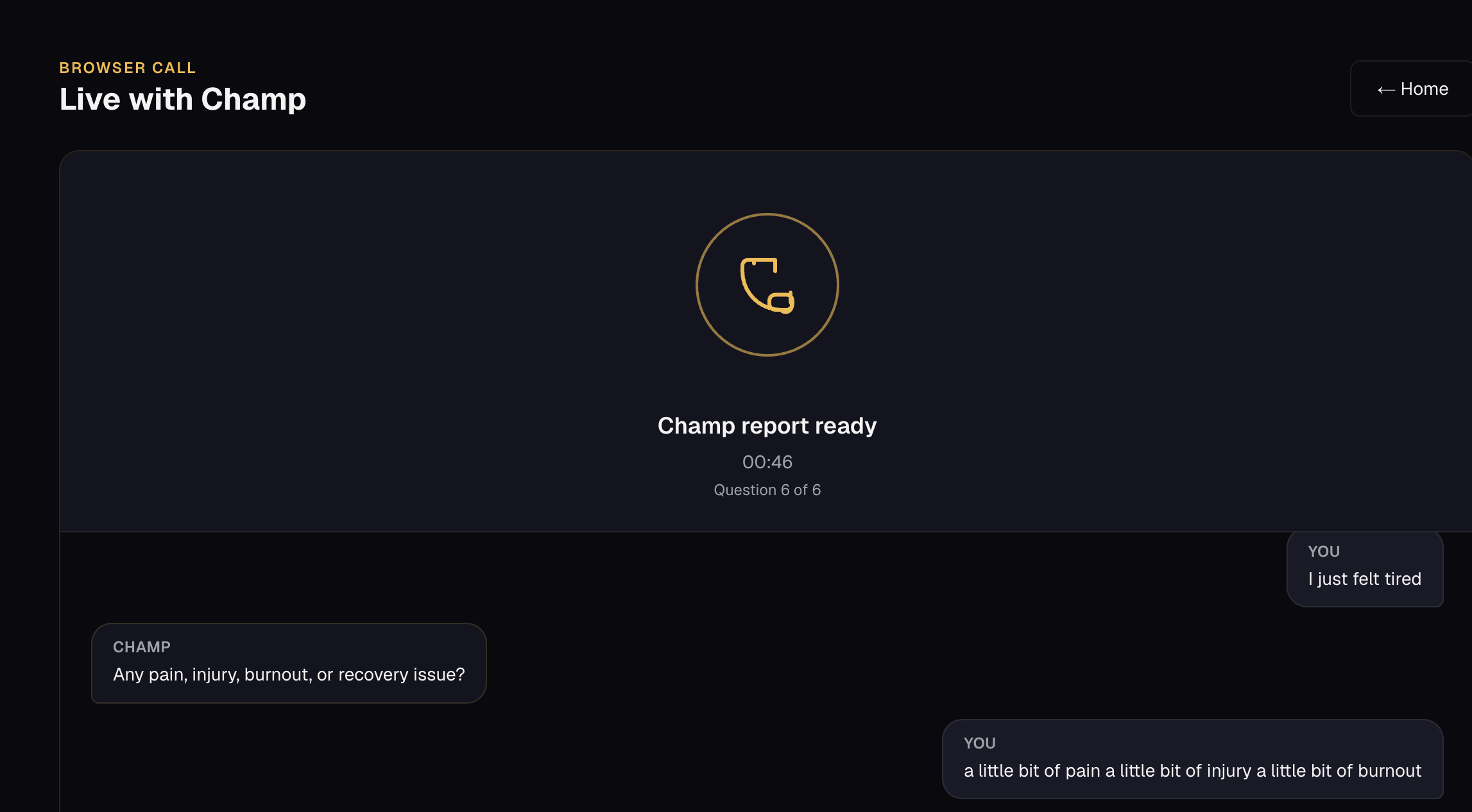
Champ runs a browser-based voice call with the user. During the call, Champ asks short accountability questions:
- What goal were you supposed to hit this week?
- How many times did you actually train or work on it?
- What improved?
- What did you skip?
- What excuse showed up most often?
- Any pain, injury, burnout, or recovery issue?
The user can respond by voice, with typed fallback for reliability. Champ captures the conversation as a transcript, analyzes it with AI, and generates a structured accountability report containing:
- accountability score
- wins
- misses
- excuse pattern
- next-week action plan
- safety/risk flags
- final Champ message
After generating the report, Champ also speaks the summary back to the user so the experience feels like a real coach call rather than a static dashboard.
How we built it
We built Champ as a Next.js web app with a voice-first browser call interface. The core flow is designed around reliability: if one voice layer fails, the app falls back gracefully instead of breaking the demo.
The frontend handles the call-style UI, transcript bubbles, call states, typed fallback, and result dashboard. The backend handles AI analysis through Gemini and secure server-side API routes. ElevenLabs was explored for agent/voice functionality, with browser speech fallback used to keep the live demo dependable.
The main state machine controls the call flow:
- Start Browser Call
- Champ asks a question
- User responds
- Transcript is captured
- Repeat through the check-in
- Send transcript to AI analysis
- Display and speak the final report
Challenges we ran into
The hardest part was making the voice experience feel like an actual call instead of a form with a microphone button attached. Browser voice APIs, microphone permissions, speech recognition, and external voice APIs can all behave differently depending on browser, device, account tier, and deployment environment.
We had to add multiple fallbacks:
- ElevenLabs voice/agent path when available
- browser speech synthesis fallback
- speech recognition fallback
- typed answer fallback
- mock demo fallback
- Gemini analysis fallback
The goal was simple: the demo should never get stuck just because one API or browser feature fails.
Accomplishments that we're proud of
We are proud that Champ feels like a real product interaction, not just a chatbot. The core moment is memorable: Champ asks questions out loud, listens to what the user did or skipped, then calls out the pattern and gives a next-week plan.
We also built the system with safety in mind. Champ can be direct and funny, but it does not provide medical advice. If the user mentions pain, injury, severe distress, or other risk signals, Champ flags it and recommends reducing intensity or speaking with a qualified professional.
What we learned
We learned that voice AI products need strong fallback design. A beautiful voice demo is useless if it freezes during a live presentation. Building a reliable voice-first experience means treating microphone access, speech recognition, text-to-speech, API failures, and latency as first-class product concerns.
We also learned that accountability is more powerful when it feels conversational. A static habit score is easy to ignore. A voice that asks what happened and reflects your own excuses back to you is much harder to dismiss.
What's next for Champ
Inspiration
What it does
How we built it
Challenges we ran into
Accomplishments that we're proud of
What we learned
What's next for ChampAI
Inspiration
Most people do not fail their fitness or personal goals because they need another dashboard. They fail because nobody checks in when motivation fades. Traditional habit and fitness apps wait for users to manually log workouts, meals, streaks, or progress — but the exact moment someone starts drifting is usually when they stop opening the app.
We wanted to flip that model.
Champ is a voice-first AI accountability coach that feels more like a gym friend calling you than another habit tracker. Instead of asking users to fill out forms, Champ starts a live voice check-in, asks what actually happened during the week, catches excuses, and turns the conversation into a clear next-step plan.
What it does
Champ runs a browser-based voice call with the user. During the call, Champ asks short accountability questions:
- What goal were you supposed to hit this week?
- How many times did you actually train or work on it?
- What improved?
- What did you skip?
- What excuse showed up most often?
- Any pain, injury, burnout, or recovery issue?
The user can respond by voice, with typed fallback for reliability. Champ captures the conversation as a transcript, analyzes it with AI, and generates a structured accountability report containing:
- accountability score
- wins
- misses
- excuse pattern
- next-week action plan
- safety/risk flags
- final Champ message
After generating the report, Champ also speaks the summary back to the user so the experience feels like a real coach call rather than a static dashboard.
How we built it
We built Champ as a Next.js web app with a voice-first browser call interface. The core flow is designed around reliability: if one voice layer fails, the app falls back gracefully instead of breaking the demo.
The frontend handles the call-style UI, transcript bubbles, call states, typed fallback, and result dashboard. The backend handles AI analysis through Gemini and secure server-side API routes. ElevenLabs was explored for agent/voice functionality, with browser speech fallback used to keep the live demo dependable.
The main state machine controls the call flow:
- Start Browser Call
- Champ asks a question
- User responds
- Transcript is captured
- Repeat through the check-in
- Send transcript to AI analysis
- Display and speak the final report
Challenges we ran into
The hardest part was making the voice experience feel like an actual call instead of a form with a microphone button attached. Browser voice APIs, microphone permissions, speech recognition, and external voice APIs can all behave differently depending on browser, device, account tier, and deployment environment.
We had to add multiple fallbacks:
- ElevenLabs voice/agent path when available
- browser speech synthesis fallback
- speech recognition fallback
- typed answer fallback
- mock demo fallback
- Gemini analysis fallback
The goal was simple: the demo should never get stuck just because one API or browser feature fails.
Accomplishments that we're proud of
We are proud that Champ feels like a real product interaction, not just a chatbot. The core moment is memorable: Champ asks questions out loud, listens to what the user did or skipped, then calls out the pattern and gives a next-week plan.
We also built the system with safety in mind. Champ can be direct and funny, but it does not provide medical advice. If the user mentions pain, injury, severe distress, or other risk signals, Champ flags it and recommends reducing intensity or speaking with a qualified professional.
What we learned
We learned that voice AI products need strong fallback design. A beautiful voice demo is useless if it freezes during a live presentation. Building a reliable voice-first experience means treating microphone access, speech recognition, text-to-speech, API failures, and latency as first-class product concerns.
We also learned that accountability is more powerful when it feels conversational. A static habit score is easy to ignore. A voice that asks what happened and reflects your own excuses back to you is much harder to dismiss.
What's next for Champ
Next, Champ could expand into:
- real phone-call check-ins
- scheduled weekly accountability calls
- SMS/email summaries
- team accountability packs
- deeper fitness integrations
- founder/student/productivity modes
- persistent memory across check-ins
- personalized coaching style over time
The long-term vision is simple: Champ becomes the accountability layer for anyone trying to stay consistent. Next, Champ could expand into:
- real phone-call check-ins
- scheduled weekly accountability calls
- SMS/email summaries
- team accountability packs
- deeper fitness integrations
- founder/student/productivity modes
- persistent memory across check-ins
- personalized coaching style over time
The long-term vision is simple: Champ becomes the accountability layer for anyone trying to stay consistent.
Built With
- browser-speechsynthesis
- elevenlabs
- gemini-api
- next.js
- tailwind-css
- typescript
- vercel
- web-speech-api

Log in or sign up for Devpost to join the conversation.