-
-
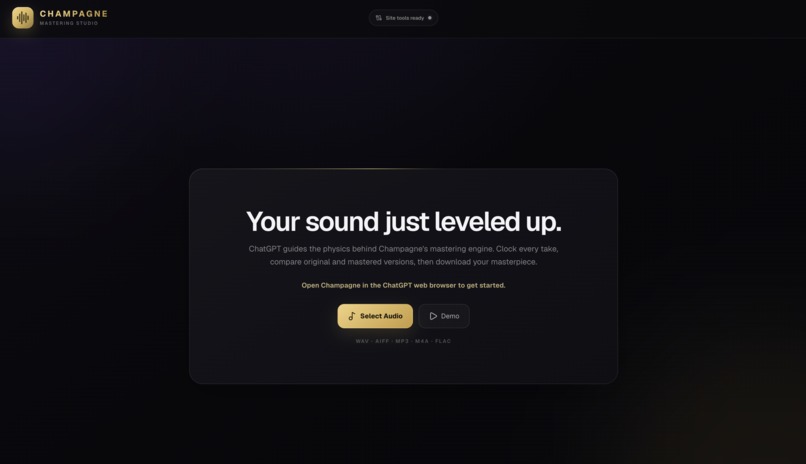
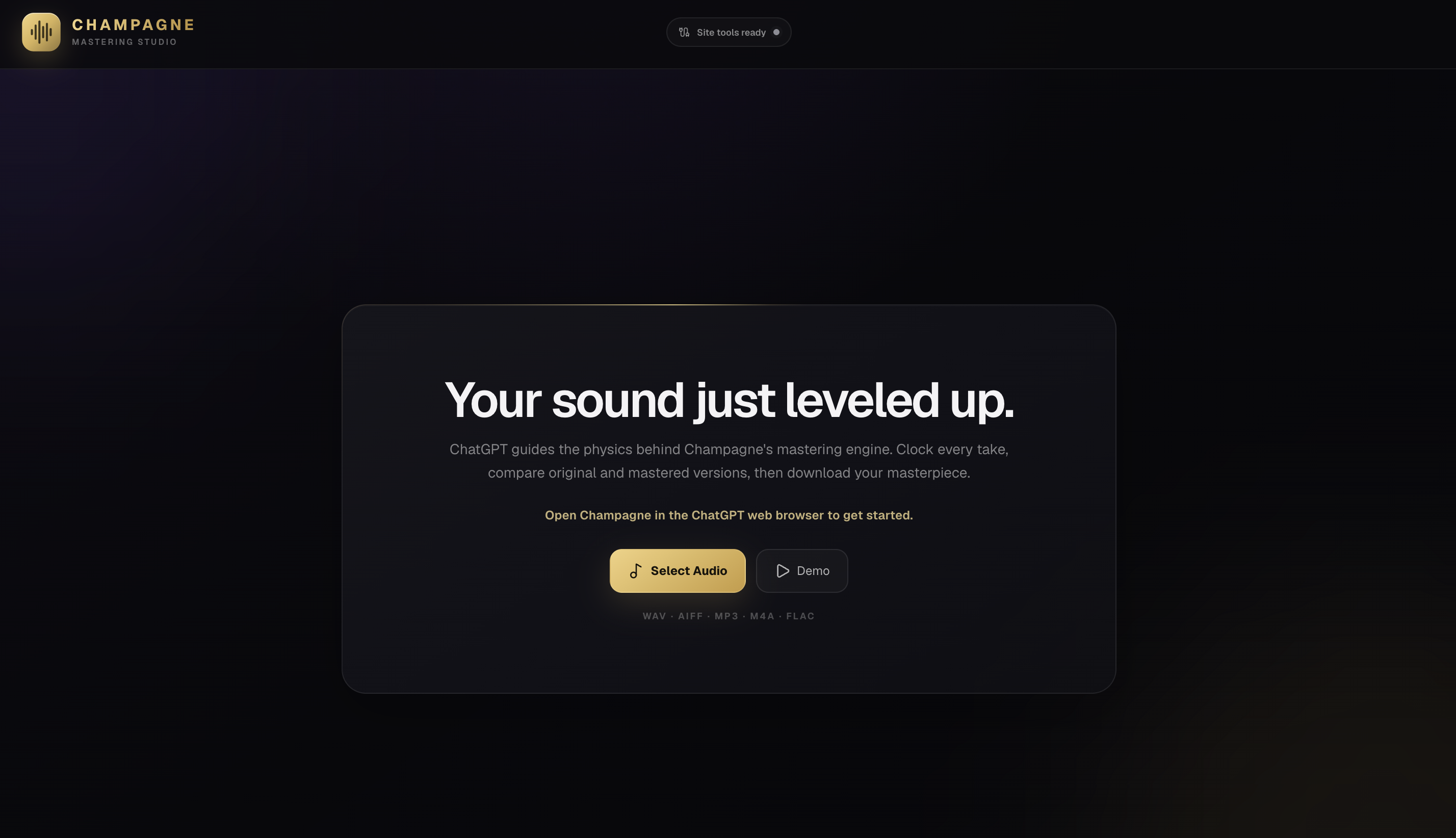
Champagne Landing Page
-
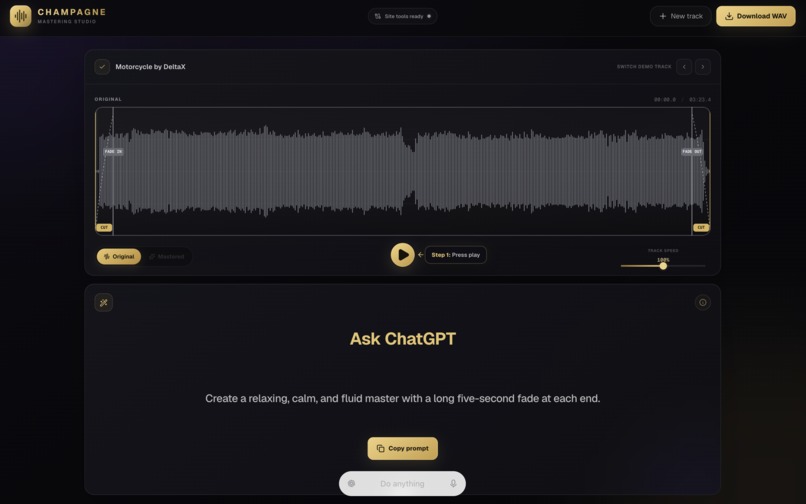
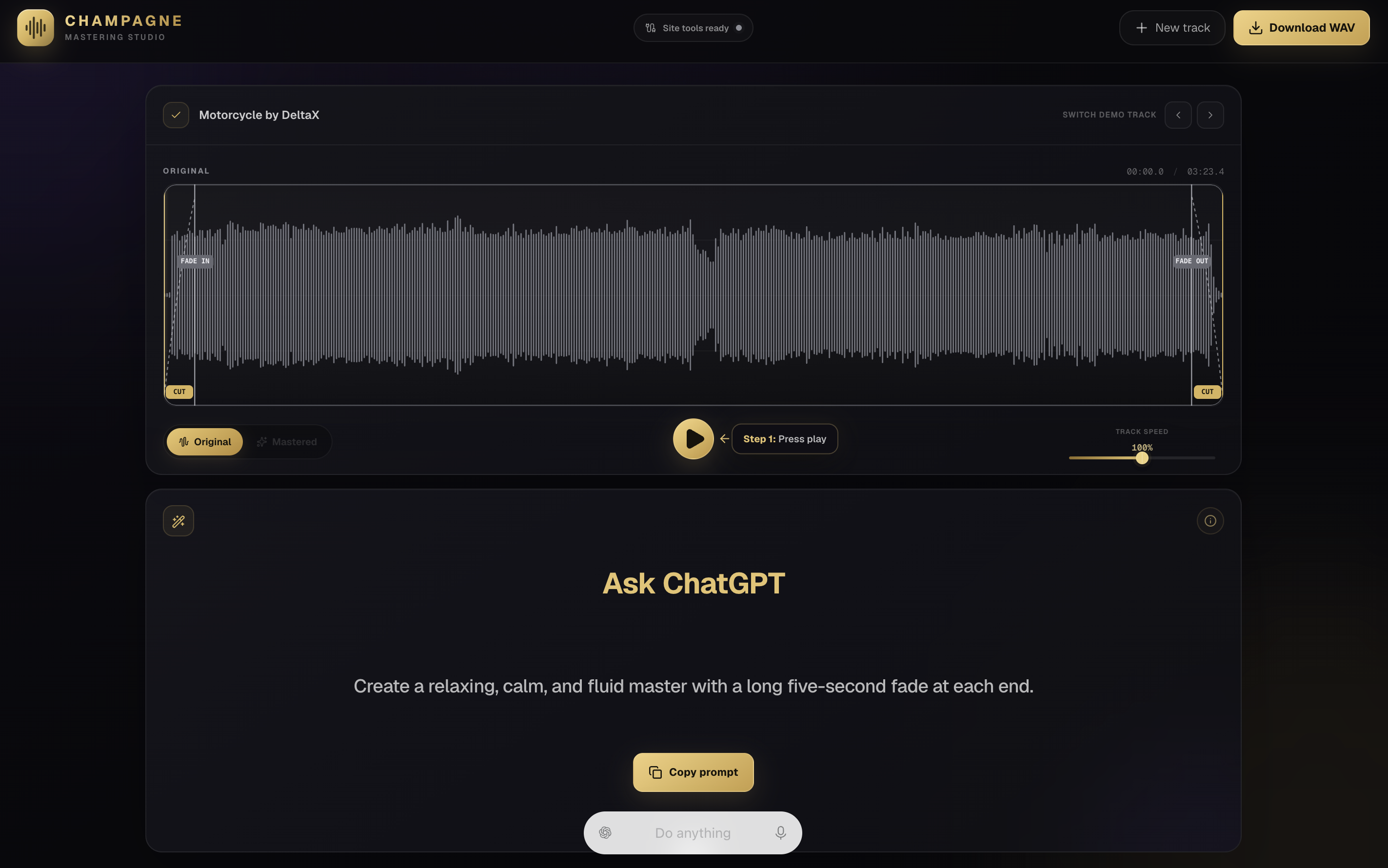
Champagne Mastering Studio
Inspiration
I've been producing music for over 15 years. I recently jumped into making AI music, and the first thing I noticed was how thin the outputs sounded. That's where Champagne was born. As far as turning it into a ChatGPT + WebMCP integration, that magic sorta just happened!
What it does
Champagne masters any audio track, but it's optimized specifically for songs from Suno. Suno outputs are thin and quiet. Champagne makes them full-bodied and vibrant.
Based on your prompt, ChatGPT selects one of four signature mastering styles and directs bounded refinements to Warmth, Brightness, Punch, Dynamics, Low End, Presence, Air, Width, Glue, Density, and Smoothness. Champagne’s local browser engine applies those adjustments to the audio.
Champagne applies advanced tonal processing to audio, making songs radio-ready in less than a minute.
How I built it
I released Champagne on the Mac App Store a few days before this contest was announced. After attempting to build a different WebMCP website with no success, I had a lightbulb moment: This would be the perfect opportunity to build a web demo for my new macOS app! I ported the app from Swift into TypeScript + CSS using a blueprint roadmap method, then got to tuning the actual operation of the system.
Champagne registers nine page-bound tools using document.modelContext.registerTool, allowing ChatGPT to inspect the studio, create and refine masters, compare results, apply trims and fades, and adjust track speed. Audio processing remains local in the browser. Connecting ChatGPT into the mastering engine enables specific tuning that provides artists more control over the processing adjustments than the original macOS app ever did.
You can learn more about the integration specifics through the README on GitHub: https://github.com/LoganVoss/Champagne
How people and agents work together
✵ Artist imports audio.
✵ Artist describes the desired result.
✵ Champagne analyzes the audio locally and exposes compact measurements through WebMCP.
✵ ChatGPT interprets those measurements and the artist’s prompt.
✵ ChatGPT chooses and calls the appropriate WebMCP tools.
✵ ChatGPT coordinates mastering, refinements, trims, fades, and speed.
✵ Artist reviews the result. Don't like it? Tell ChatGPT what to fix.
✵ Artist downloads the mastered audio file.
Challenges I ran into
The first major challenge I ran into was not understanding what WebMCP actually does.
At first, I built a prompt box on the website that guided the mastering engine with specific presets, but that didn't feel right. There was no real AI input. The dots finally connected when I realized how you're supposed to work side by side using the ChatGPT app web browser + chat window. Once I made that connection, it all came together.
The other primary challenge I faced was deciding what to show when somebody visits the site through a web browser that doesn't support WebMCP. This was a little confusing mainly because it's like building two versions of the same product, but I had experience with that from iOS development (iPhone/iPad apps), so I figured it out pretty quickly.
Accomplishments that I'm proud of
I'm most proud of how simple it makes the mastering process for AI music artists. AI music artists can produce hundreds of songs per day, and they need an easy way to master the music they create. Champagne gives them the ability to do that rapidly, so they can share their creations even quicker.
I'm also really proud of how WebMCP took Champagne to the next level through creating fine-tuned results with precision adjustments. In music, small changes make the biggest difference, and that's what makes this project really glow.
What I learned
I learned what WebMCP actually is, and how it can make products better through integrating AI natively.
What's next for Champagne
Champagne was created as a one-price replacement for pay-per-track / subscription services that perform a similar method of signal processing. With this contest, I decided to open source the code, enabling people to use the tool for free.
As for building a stronger integration with ChatGPT + WebMCP, there's a universe of opportunity.
Currently, the results are a little restricted with the four signature baselines. This could be removed entirely to provide an even more individualized mastering experience for each song, but it will take some work to make sure the outputs don't go completely off the rails. Another improvement I'm considering is changing the audio processing pipeline from local to server side, for further precision. More to come! ;-)


Log in or sign up for Devpost to join the conversation.