-
-
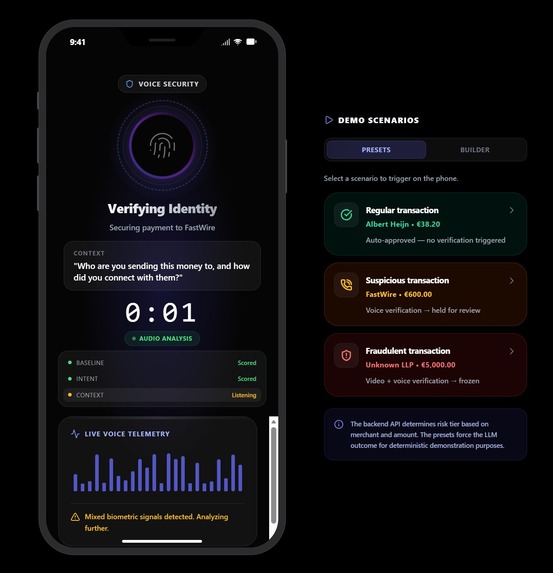
Interface for POC
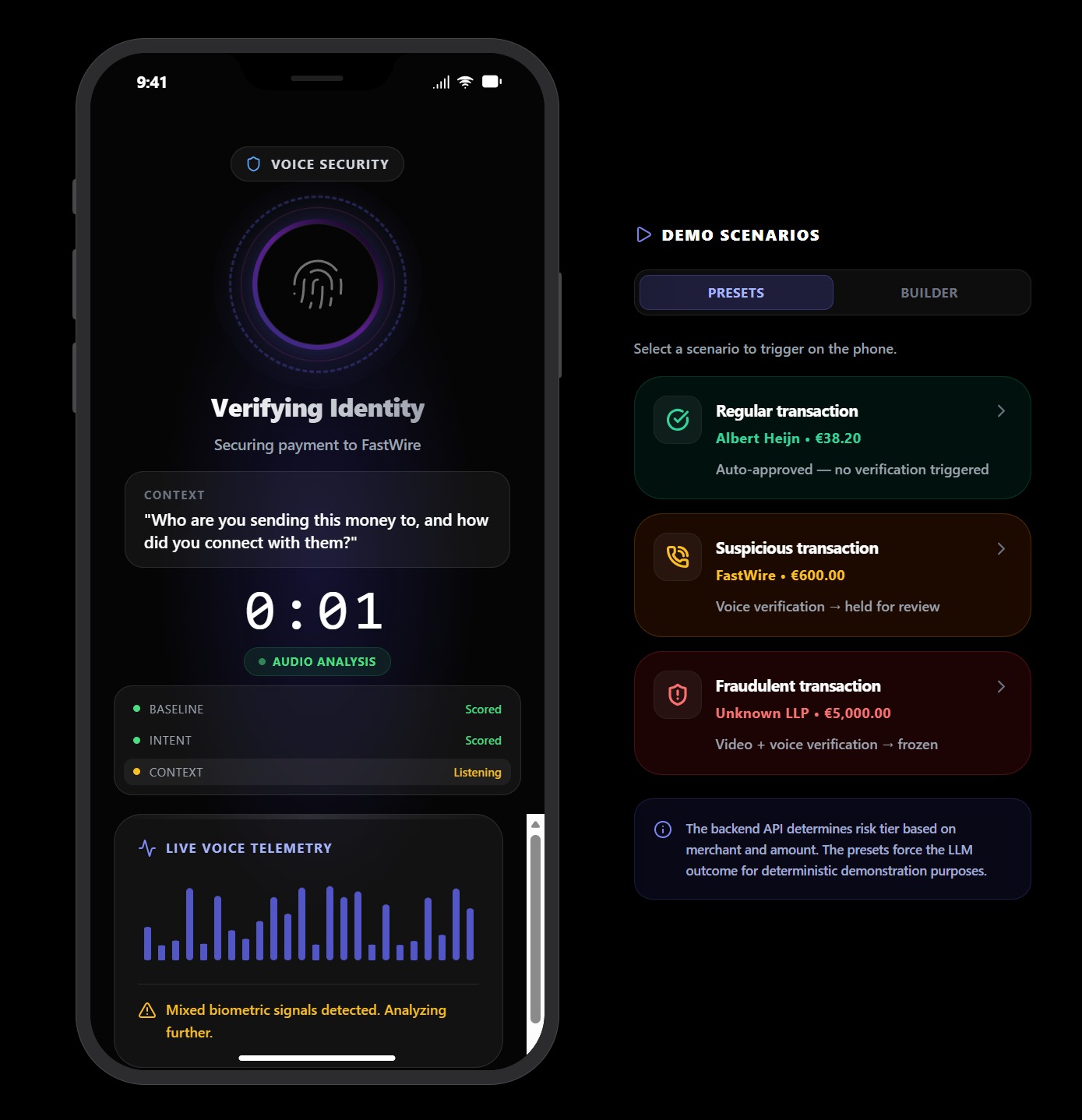
Try it out
Repo
https://github.com/notBruno3/bunqhack7
Inspiration
Banks have spent years perfecting identity verification. FaceID, fingerprints, PINs, device checks and behavioural biometrics can prove that the person pressing “send” is really the account holder.
But the fastest-growing threat is no longer just stolen credentials. It is manipulation.
In Authorised Push Payment (APP) fraud, victims are socially engineered into sending the money themselves. They may believe they are protecting their savings, helping a family member, paying a fake invoice, investing in a fake opportunity, or following instructions from someone pretending to be their bank. From the bank’s perspective, everything looks legitimate: the user logged in, authenticated correctly, and approved the payment.
That is the problem.
Authentication proves identity. It does not prove intent.
APP scams are one of the most urgent fraud challenges in Europe. The European Payments Council describes APP fraud as a rapidly growing threat, and UK Finance reported that APP losses reached £257.5 million in just the first half of 2025, a 12% increase compared with the same period the year before.
Current banking security asks: “Is this really you?”
CHAMB asks the missing question:
“Do you actually want to do this?”
We built CHAMB because social engineering is emotional. Fraudsters create fear, urgency, pressure, confusion and trust. So instead of only looking at transaction data, our approach adds a human layer: voice-based affective analysis that can detect signs of stress, hesitation or coercion when a transaction becomes suspicious.
Our motivation is simple: if fraud happens by manipulating human emotion, then fraud prevention should be able to understand human emotion too.
What it does
CHAMB: Coercion & Human Affective Monitoring Barrier is an intent-verification layer for banking transactions.
It protects users from authorised fraud by combining transaction risk scoring with voice-based emotional verification.
For every transaction, CHAMB classifies the risk level:
- No risk: the transaction goes through normally
- Medium risk: the user completes a short voice verification
- High risk: the transaction is escalated to stronger verification and possible human review
During voice verification, CHAMB analyses emotional signals such as stress, fear, uncertainty and pressure. The goal is not to judge the user, but to detect when a transaction may not be truly voluntary.
The system then decides whether to:
- Let the transaction proceed
- Run additional checks
- Place a soft hold
- Escalate the case to human review
CHAMB does not silently block users. It creates a safer path forward, with explainable decisions and an audit trail for both the customer and the bank.
How we built it
We built CHAMB as a layered fraud-prevention pipeline.
First, a transaction enters a risk-scoring stage. This can use signals such as amount, merchant familiarity, past spending behaviour, time of day, location, and anomaly detection.
If the transaction is low risk, it proceeds without friction.
If the transaction is medium risk, CHAMB starts a short voice-based verification flow. The user is asked simple confirmation questions, while the system analyses vocal prosody and emotional state using voice emotion detection.
If the transaction is high risk, the system can escalate to stronger checks, including multimodal verification and human review.
Our core architecture combines:
- Transaction risk scoring to decide when verification is needed
- Voice emotion analysis to detect affective signals linked to coercion or distress
- Decision logic to classify outcomes as clean, ambiguous or flagged
- Soft holds to delay risky transactions without creating unnecessary friction
- Audit logs to support transparency, compliance and later review
The key idea is that CHAMB is not replacing normal authentication. It sits on top of it.
Authentication verifies the user’s identity.
CHAMB verifies the user’s intent.
Challenges we ran into
The biggest challenge was that emotion is not binary.
A stressed voice does not always mean fraud. A calm voice does not always mean safety. People can sound anxious for many reasons, especially when dealing with money.
To handle this, we designed CHAMB as a layered system instead of a single yes/no model. Suspicious signals do not automatically block a transaction. They trigger extra checks, soft holds or human review.
Another challenge was balancing safety and friction. A banking security feature that interrupts every payment would quickly become unusable. That is why CHAMB only appears when the transaction is risky enough to justify it.
We also had to think carefully about trust. Analysing emotion in a banking context is sensitive, so the system must be transparent, limited in scope, and focused on user protection. CHAMB is not designed to punish users or make hidden decisions. It is designed to notice when something feels wrong and create a safer path forward.
Accomplishments that we're proud of
We are proud that CHAMB reframes fraud prevention around a missing concept: intent.
Most fraud systems focus on credentials, devices, merchants or transaction patterns. CHAMB adds the human layer that APP fraud exploits.
We are especially proud of:
- Turning a real and growing fraud problem into a concrete product concept
- Building a system that protects users without blocking normal banking activity
- Combining behavioural risk scoring with emotional voice analysis
- Designing a flow that supports both user safety and bank compliance
- Creating a product idea that feels realistic for a modern banking app like bunq
Our strongest accomplishment is the core insight:
The user can be real, authenticated and still not truly free to approve the transaction.
CHAMB is built for that exact gap.
What we learned
We learned that modern fraud is increasingly psychological, not just technical.
Fraudsters do not always break into accounts. They break into trust. They use pressure, urgency and emotional manipulation to make victims authorise payments themselves.
We also learned that good fraud prevention cannot rely on a single signal. Voice emotion analysis is powerful, but it becomes much stronger when combined with transaction risk, merchant context, behavioural patterns and human review.
Most importantly, we learned that the future of banking security is not only about asking whether a transaction is technically valid. It is about asking whether it is genuinely wanted.
What's next for CHAMB: Coercion & Human Affective Monitoring Barrier
Next, we would improve CHAMB by making the risk scoring more personalised and adaptive.
Instead of only using general rules, CHAMB could learn each user’s normal transaction patterns and emotional baseline, making verification more accurate and less intrusive over time.
Future improvements include:
- Better behavioural risk scoring using transaction history and anomaly detection
- Personalised emotional baselines for more accurate voice analysis
- Stronger privacy controls for emotional data
- Real integration with banking APIs and transaction webhooks
- A compliance dashboard for reviewed transactions and audit trails
- More refined soft-hold flows for card payments and bank transfers
Long term, CHAMB could become a new safety layer for digital banking.
Not just:
“Is this you?”
But:
“Are you safe, confident and genuinely choosing to do this?”


Log in or sign up for Devpost to join the conversation.