Inspiration
Cham Cham Cham became popular through Korean TV variety shows in the 1990s, and I used to play it all the time with my friends growing up. The rules are incredibly simple, but somehow it always gets surprisingly competitive.
Having never developed a game before, I figured something with such simple rules would be a manageable first project. (I couldn't have been more wrong -_-;;)
Still, it seemed like a perfect fit for this hackathon. It's a game you can play sitting down, and it naturally involves hand and head movements rather than controllers. A bit of childhood nostalgia didn't hurt either.
So, without overthinking it, I decided to give it a shot. I wanted to make something playful that people of different ages could enjoy. And since I have a soft spot for cute characters, I decided my first opponent had to be an adorable, slightly cheeky bunny.
What it does
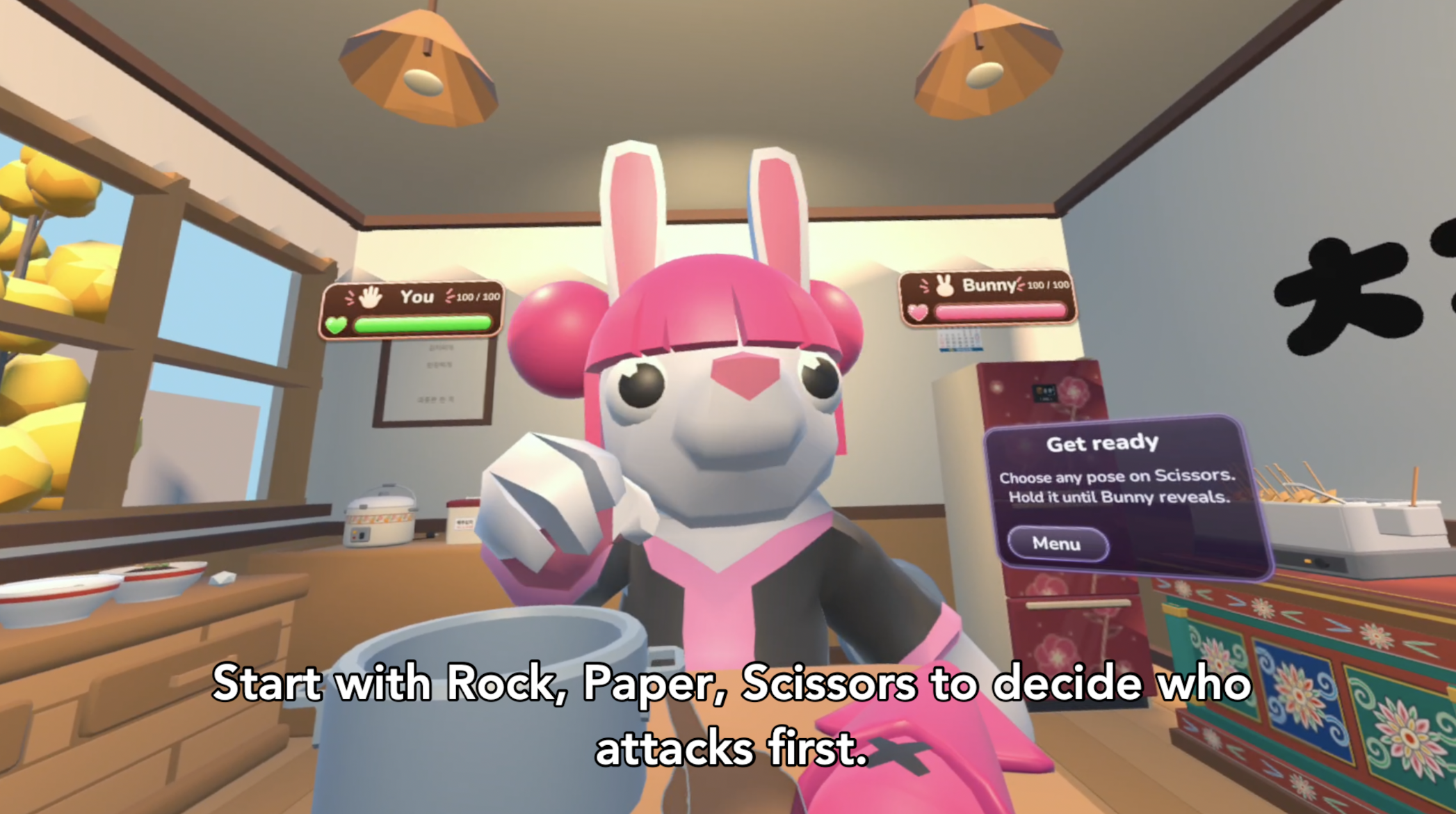
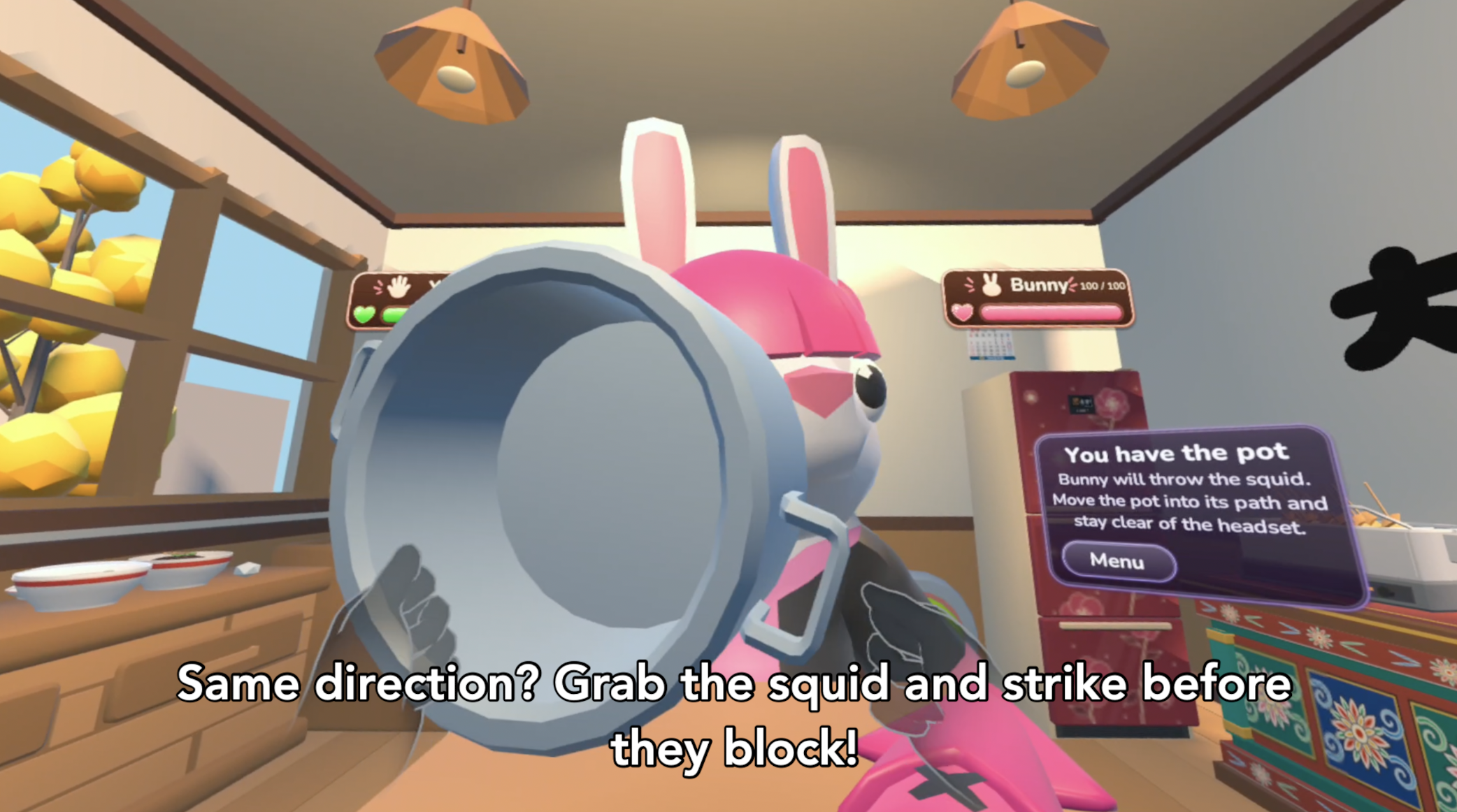
Cham Cham Cham is a hands-first VR reflex game where you sit across from a cute animal opponent in a cozy Korean diner. The entire game is played using your hands and head, with no controllers required.
First, you play rock, paper, scissors to decide who leads the first Cham.
Then comes "Cham, Cham, Cham!" On the final Cham, the attacker turns an open hand left or right while the defender turns their head in either direction.
If the directions match, the attacker gets to grab a squid and try to whack their opponent before the defender can block it with a pot. If the directions differ, the defender takes the lead in the next Cham.
The back-and-forth continues as you try to outsmart, outreact, and outlast your opponent. When either player's health reaches zero, the duel is over. Beat the bunny, and you can unlock a tougher animal challenger.
How we built it
I started building Cham Cham Cham from scratch specifically for this hackathon, using Unity 6, Meta XR SDK, and hand tracking for Meta Quest 3.
Before writing any code, I worked out the game rules and mapped the gameplay flow in a flowchart. I wanted to make sure the transitions between rock, paper, scissors, Cham, attacking, and defending actually made sense.
I started with a table and a rabbit sitting across from the player. The first step was getting rock, paper, scissors to work with hand tracking. Once that was reasonably functional, I moved on to detecting head turns for Cham, implementing the squid and pot interactions, and building the health and opponent progression systems.
For the visuals, I used existing low-poly 3D asset packs to create a cozy Korean diner. I spent some time customizing the rabbit's animations, adjusting its hand gestures, arm movements, and reactions to make the game feel more natural and expressive.
Once the core gameplay started coming together, I built an animated introduction using virtual ghost hands to demonstrate how to play. I also added voice instructions, sound effects, music, and a health bar to make the experience easier to follow.
I used OpenAI Codex to help write the C# code, troubleshoot problems, and run tests. I handled the game design, visual direction, character poses, animation timing, and interaction decisions, constantly going back and forth between Unity, Codex, and testing on the Quest 3.
Challenges we ran into
I ran into all kinds of challenges: figuring out a gameplay flow that worked in VR, tweaking character gestures, finding and synchronizing sound effects, writing voice instructions, and debugging countless edge cases. But by far the biggest challenge was getting hand interactions to work reliably.
Recognizing rock, paper, scissors sounds easy enough, but in practice, hands sometimes disappear from tracking, gestures get confused, and even a tiny difference in timing can change the result. A fist held in preparation might be mistaken for a rock, or a perfectly good gesture might go unrecognized at the worst possible moment.
Getting the left and right directions right was another headache, especially because the player and bunny face each other. What looks like "left" from one perspective isn't necessarily left from the other.
Then there were the physical interactions. In real life, picking something up, swinging it, or putting a pot over your head takes almost no thought. I had no idea how much work it would take to make those same actions feel natural in VR, let alone figure out exactly when a hit or block should count.
Animation was another learning experience. With no animation background, I found myself going through movements frame by frame in Unity, adjusting the rabbit's hands and arms, and trying to synchronize everything with the voice cues.
Even the introduction turned into a project of its own. I thought showing a pair of virtual hands demonstrating the rules would be straightforward. Instead, I spent hours dealing with hands facing the wrong way, awkward finger positions, unnatural grabbing motions, and transitions that didn't look right. Every movement had to be timed carefully with the narration, the bunny's reactions, and the objects on the table. And everything had to look right from the player's seated perspective inside the headset.
I gradually realized that getting the individual pieces to work was only half the battle. The animations, sound effects, voice instructions, hand tracking, and gameplay all had to come together at exactly the right moments.
Accomplishments that we're proud of
What I'm most proud of is that I started this project with absolutely no game development experience and managed to turn an idea into an actual playable VR game using hand tracking.
Being able to sit down, face a bunny, play rock, paper, scissors, grab a squid, and defend myself with a pot, all without picking up a controller, is something I wouldn't have imagined building just a few weeks earlier.
I also learned that, with the help of AI coding tools like Codex, I could take on a project that previously felt completely out of reach. It took countless conversations, experiments, mistakes, and revisions, but I was able to make my ideas come to life.
There's still plenty I want to improve, but seeing the game actually running on a Quest 3 has been incredibly rewarding.
What we learned
I learned how hand-tracking data is interpreted as gestures, and why recognition thresholds, input timing, and tracking reliability matter. I also learned that tracking loss needs to be handled differently from an incorrect gesture.
I learned how coordinate systems affect left/right detection when two characters face each other, and how object grabbing, collision detection, and hit/block decisions require separate logic.
I also became familiar with editing joint poses and animation keyframes in Unity, synchronizing animations with audio cues, and using Edit Mode and Play Mode tests, APK builds, and device logs for debugging.
One important lesson was that passing automated tests in Unity doesn't necessarily mean an interaction will work correctly with real hands on Quest 3.
What's next for Cham Cham Cham - Korean Reflex Game
My first major goal after refining the single-player experience is to add multiplayer, so friends who live far apart can play Cham Cham Cham together, just as I used to play with my friends growing up.
I'm also planning to expand the roster of animal challengers, each with different personalities, reactions, and difficulty levels. I plan to make character animations more dynamic, including reactions that change as they take more hits.
Another planned feature is an expanded XP progression system and a social lounge with leaderboards, where players can track their progress, compare XP, and see how they rank against others.
I'm planning on also continuing to improve hand-tracking accuracy and work toward adding mixed reality through Quest's passthrough features, allowing players to face their opponents in their own living rooms.
My goal is to make Cham Cham Cham a game that anyone can learn in seconds, enjoy playing, and want to come back to.
