-
-
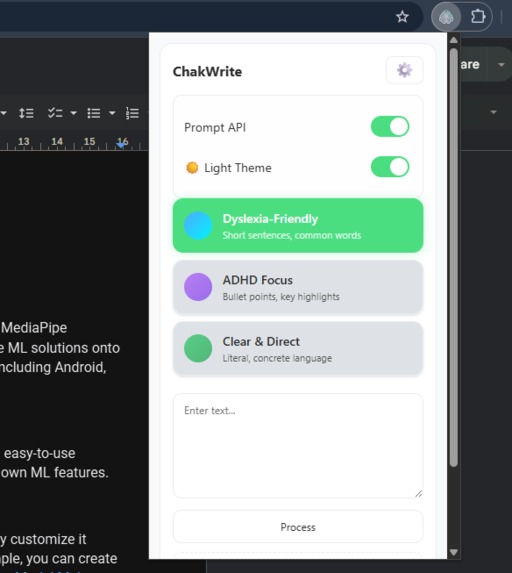
white extension theme
-
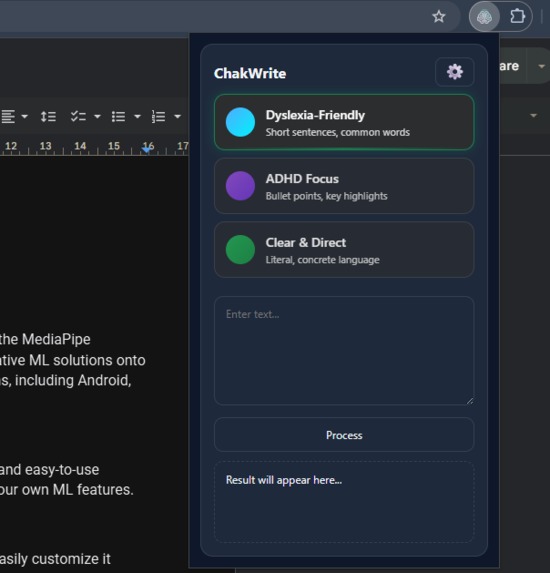
main extension
-
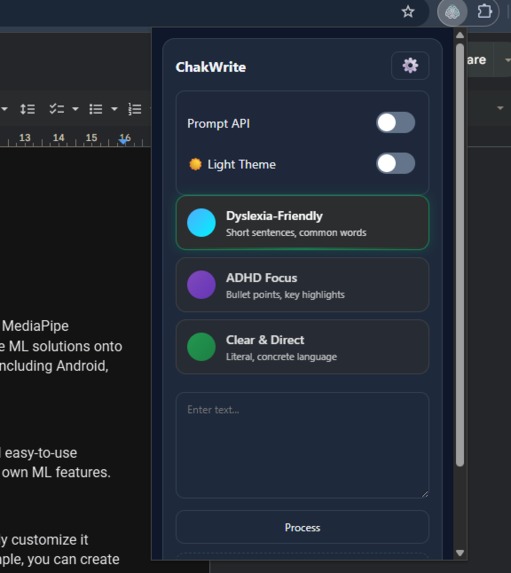
settings extension
-
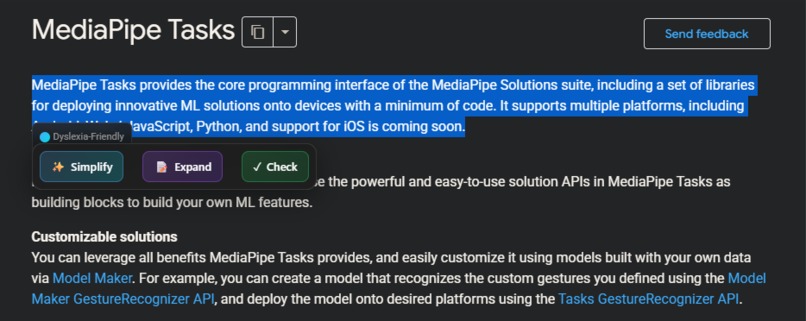
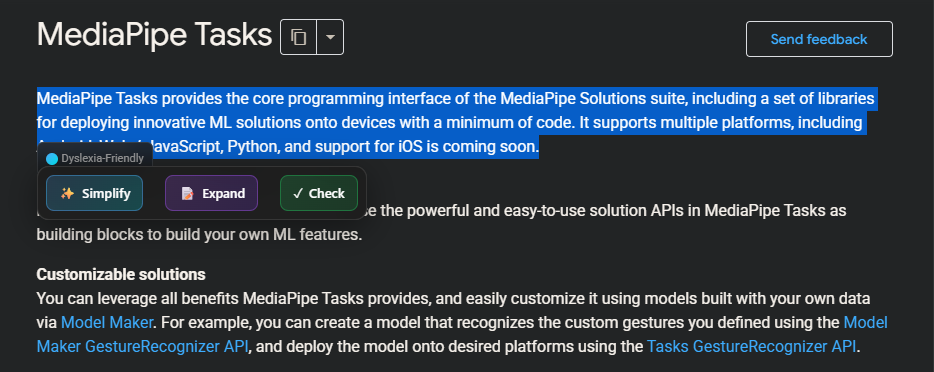
Overlay
-
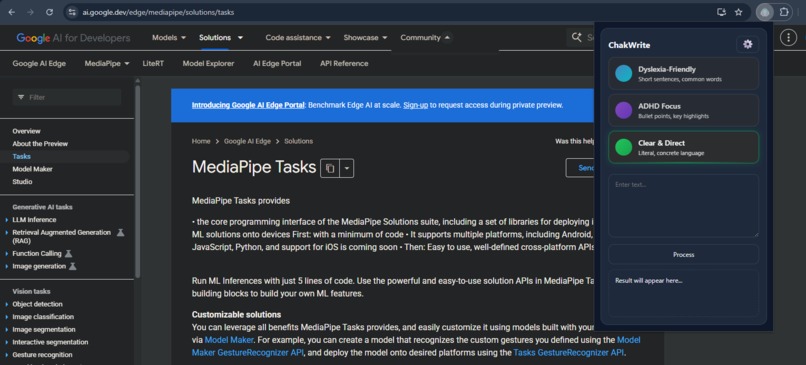
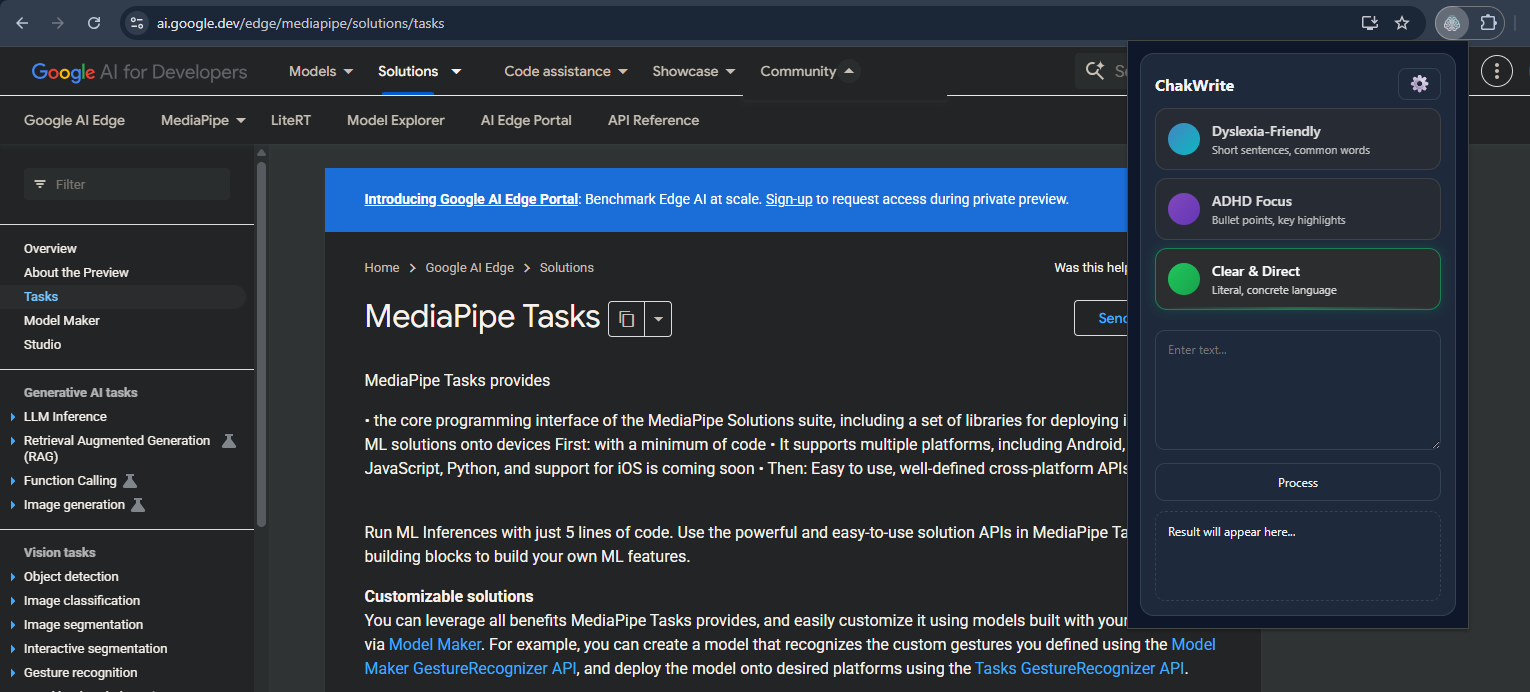
Popup Extention
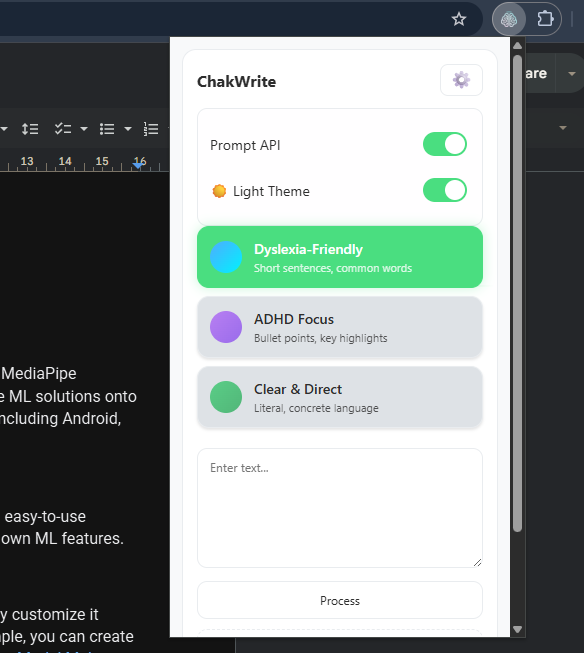
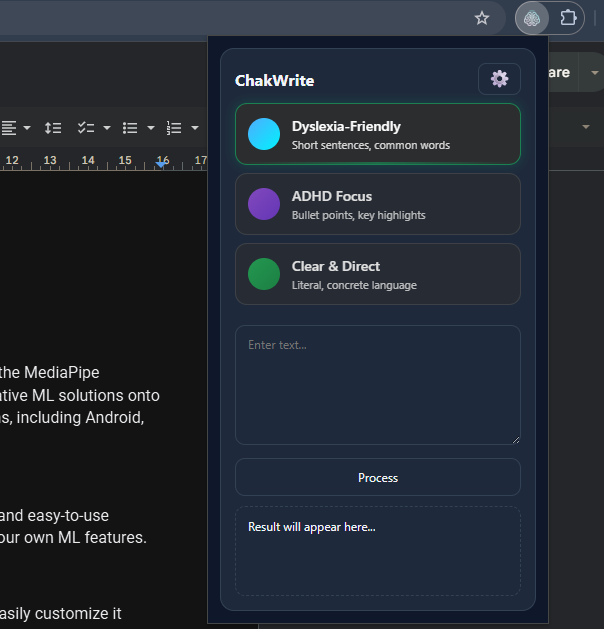
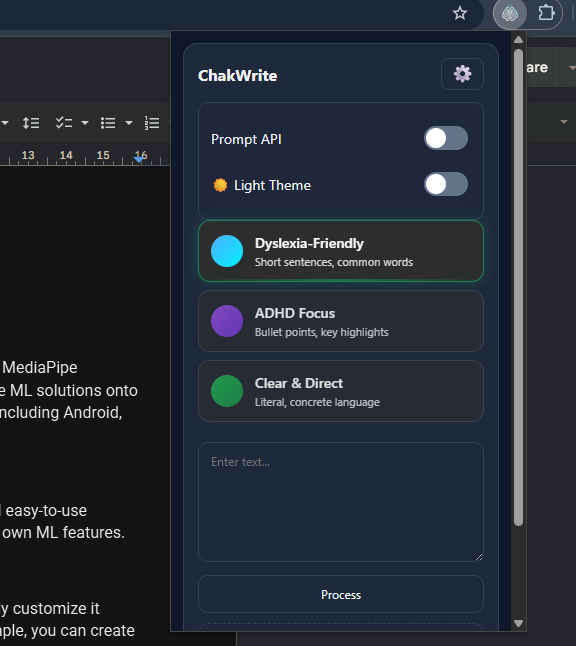
ChakWrite AI Assistant - Project Description
Inspiration
Our inspiration came from recognizing the daily struggles faced by neurodivergent individuals in digital communication. People with dyslexia struggle with complex sentences, ADHD individuals lose focus in lengthy paragraphs, and autistic users get confused by metaphorical language. The Google Chrome Built-in AI Challenge presented the perfect opportunity to create an AI-powered writing assistant that truly understands and supports neurodivergent minds, leveraging Chrome's local AI capabilities for privacy-first assistance.
What it does
ChakWrite AI Assistant is a Chrome extension that provides real-time, AI-powered writing support tailored to specific neurological differences. The extension features three specialized modes:
- Dyslexia-Friendly Mode: Simplifies complex sentences, suggests easier vocabulary, and breaks down lengthy text
- ADHD Focus Mode: Structures thoughts into bullet points, adds clear transitions, and highlights key information
- Autism Clarity Mode: Converts metaphorical language into direct statements and ensures concrete communication
Users can select text on any webpage, and our floating overlay instantly appears with AI-powered suggestions. The extension processes everything locally using Chrome's Built-in AI APIs (Gemini Nano), ensuring complete privacy - no personal data ever leaves the user's device.
How we built it
We developed ChakWrite using Chrome's Built-in AI APIs, implementing multiple APIs including Prompt, Rewriter, Summarizer, Writer, and Proofreader for comprehensive text assistance.
Technical Stack:
- Manifest V3 Chrome Extension with Service Worker
- Minimalist UI with accessibility-focused design
- Content Scripts for webpage text interaction
- Floating Overlays for seamless user experience
- Local Storage for user preferences
- Responsive Design supporting both light and dark themes
The extension features a clean, minimal interface with carefully chosen colors that don't overwhelm users with sensory sensitivities.
Challenges we ran into
Chrome AI API Availability:
- Encountered
window.ai undefinederrors across different regions - Chrome Built-in AI APIs have limited geographical availability
- Required specific Chrome flags configuration to access APIs
Service Worker Architecture:
- Hit
importScriptsfailures with NetworkError status code 15 - Struggled with file path resolution in Manifest V3 Service Workers
- Had to restructure from complex folder hierarchy to simplified flat structure
Content Security Policy Violations:
- Encountered CSP errors blocking inline JavaScript execution
- Required complete refactoring from inline scripts to external modules
- Faced browser caching issues that persisted old violations
Cross-Website Compatibility:
- Ran into
chrome.runtime.sendMessagefailures on certain websites - Implemented fallback local processing for restricted domains
- Added comprehensive error handling for API unavailability scenarios
Accomplishments that we're proud of
- Comprehensive AI Integration: Successfully integrated multiple Chrome Built-in AI APIs in a single application
- Neuro-Inclusive Pioneer: Created the first AI writing assistant specifically designed for dyslexia, ADHD, and autism support
- Privacy-First Architecture: Achieved 100% local processing with zero data transmission
- Robust Error Handling: Built comprehensive fallback systems ensuring functionality even when APIs are unavailable
- Accessibility Excellence: Implemented WCAG-compliant design with high contrast and reduced motion options
What we learned
Technical Insights:
- Chrome Built-in AI APIs are cutting-edge but have geographical limitations
- Service Workers in Manifest V3 require careful planning and robust error handling
- CSP compliance is crucial and can't be treated as an afterthought
- Different websites have varying levels of extension compatibility
Accessibility Understanding:
- Gained deeper appreciation for diverse neurodivergent user needs
- Learned how interface design impacts different neurological conditions
- Discovered the importance of providing multiple interaction methods
- Understood that specialized solutions serve users better than generic ones
What's next for ChakWrite
Immediate Roadmap:
- Enhanced AI Integration: Expand support for additional Chrome AI APIs
- Custom Learning: Implement user-specific preference training
- Multi-Language Support: Utilize Translator API for international accessibility
- Advanced Customization: Allow fine-tuning of AI behavior
Feature Expansion:
- Reading Assistance: AI-powered content summarization for complex articles
- Voice Integration: Text-to-speech capabilities for auditory learners
- Educational Features: Shared settings for institutions
- Usage Analytics: Privacy-focused insights for writing pattern understanding
Community Growth:
- Open Source Release: Share codebase to encourage accessibility innovation
- Educational Partnerships: Collaborate with schools and accessibility organizations
- Research Contribution: Publish findings on AI-assisted neurodivergent communication
Technical Innovation
ChakWrite represents one of the first comprehensive implementations of Chrome's Built-in AI ecosystem for accessibility. Our project demonstrates how privacy-first AI can revolutionize assistive technology without compromising user data, creating a new paradigm where AI adapts to neurological differences rather than expecting users to adapt to technology.
Built With
- api
- css3
- html5
- javascript
- json
- manifestv3
- serviceworker


Log in or sign up for Devpost to join the conversation.