Inspiration
The idea for ChainSensor was born in a hospital waiting room.
Our co-founder sat helplessly as a loved one waited hours for a diagnosis that could’ve been made earlier, if only a smart monitoring system had flagged their biometric warning signs. The data was there heart rate irregularities, sleep disruptions, fatigue, but it was scattered across devices and never connected. No one had built a system that could take real-world, human data and turn it into an active, responsive sensor. That moment sparked a realization: we live in a world overflowing with data, yet we still rely on outdated, generic sensors that don’t understand individual or environmental context. What if anyone a doctor, a researcher, a maker could create a custom sensor trained on specific data, without needing to be an engineer? ChainSensor was created to fill that gap. We built it so people can take control of their own data, transform it into smart, adaptive sensors and use it to improve lives. Whether in healthcare, climate tech, agriculture, or smart cities, ChainSensor empowers a new generation of builders to turn data into action because sometimes, the right signal can save a life.
What it does
ChainSensor is a powerful, AI-powered platform that transforms real-world and human data into intelligent virtual and physical sensors. Whether you're a developer, researcher, doctor, farmer, or engineer, ChainSensor gives you the tools to build custom sensors without needing to code or with full-code flexibility if you prefer. Users simply upload datasets from biometric readings, environmental logs, machine activity, or human behavior and ChainSensor helps them create responsive, context-aware sensors. These sensors can then be exported as APIs, deployed on microcontrollers (like Arduino, ESP32, Raspberry Pi), or connected directly to edge devices and apps. ChainSensor supports both no-code and pro-code workflows. Use the drag-and-drop logic builder to define events (e.g., “If temperature > 100°F, trigger alert”), or generate entire codebases using our built-in Chat AI a conversational assistant that converts prompts into backend code and functional logic. From predictive health tools to smart agriculture systems, ChainSensor empowers anyone to build data-first sensors that adapt to their unique environment and needs. It democratizes access to intelligent sensor creation by abstracting complexity while enabling powerful customization for experts. ChainSensor is redefining how we interact with data not just analyzing it, but building live systems from it. It's the first platform that lets your real-world data become a living, deployable sensor that responds, learns, and empowers action.
##Problem statement In 2020, during the early months of the COVID-19 pandemic, thousands of patients globally suffered from delayed detection of respiratory distress due to the lack of personalized, real-time monitoring systems. In hospitals and at home, vital data like oxygen levels and heart rates were collected but not dynamically analyzed to trigger alerts or actions. This exposed a major global problem: while data was abundant, there were no smart, context-aware systems to transform that data into life-saving sensors. ChainSensor was created in response to this failure where data existed, but intelligence was missing, leading to preventable delays in response and care.
Another case incident In June 2024, Pakistan experienced an extreme heatwave in Sindh province, with temperatures soaring to nearly 49 °C (120 °F). Over 568 people died within days from heat-induced illnesses; hospitals were overwhelmed with heatstroke victims and morgues exhausted capacity. This crisis underscored a critical failure: no real-time, localized monitoring systems existed to detect early warning signs or trigger timely interventions for vulnerable populations. The data was there temperature spikes, hospital admissions, power outages but no intelligent sensor system was in place to analyze and act swiftly. ChainSensor was born from this exact gap: the world collects data, but fails to turn it into live, proactive intelligence. Whether it's monitoring body temperature surges, modeling environmental risks, or alerting communities before disaster hits, ChainSensor empowers users to create smart sensors from raw data bringing context-aware, preemptive systems to scenarios just like the 2024 Pakistani heatwave.
The Solution & Why ChainSensor Was Created
ChainSensor was created to solve one core challenge: how do we turn raw data into responsive action? We envisioned a platform where anyone with or without technical expertise could upload real-world data and instantly build smart sensors tailored to their needs. Whether it's biometric health data, environmental inputs, or machine behavior, ChainSensor allows users to create sensors that think, adapt, and respond. With an intuitive no-code builder, users can drag and drop logical functions to define custom triggers. For developers, our integrated Chat AI assistant generates backend code from simple prompts, making it easy to deploy sensors on devices or apps. ChainSensor removes the barriers between data and deployment. It empowers individuals and organizations to build live, intelligent systems from the data they already have. It was born from the need to move beyond passive analysis into a future where your data becomes your sensor, and your world becomes smarter.
The Product: ChainSensor
ChainSensor is the world’s first data-first sensor creation platform, a next-gen system that allows users to build virtual and physical sensors from their own data. Whether you’re working in healthcare, automation, agriculture, or IoT, ChainSensor turns raw inputs into deployable, intelligent sensor systems.
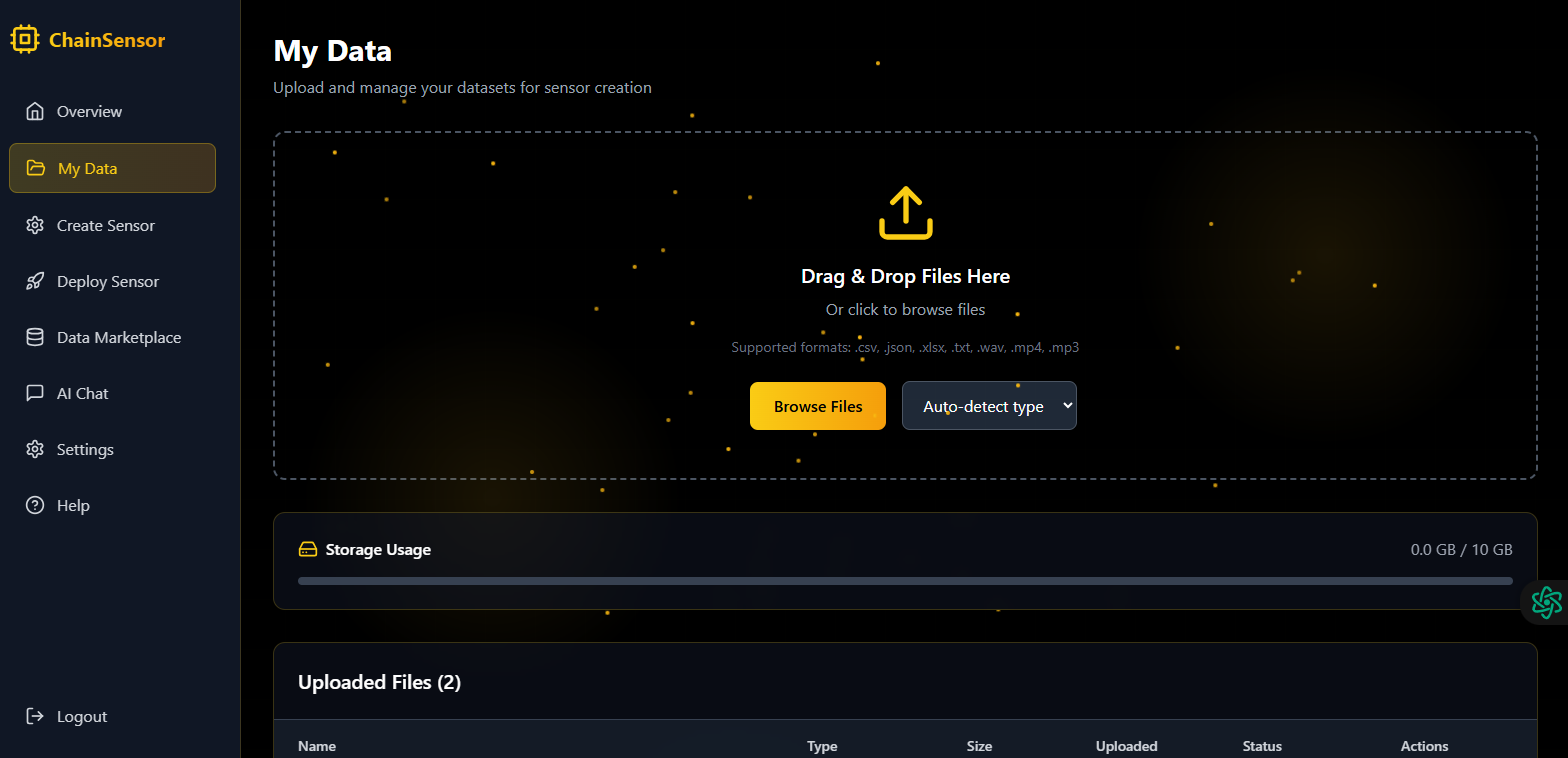
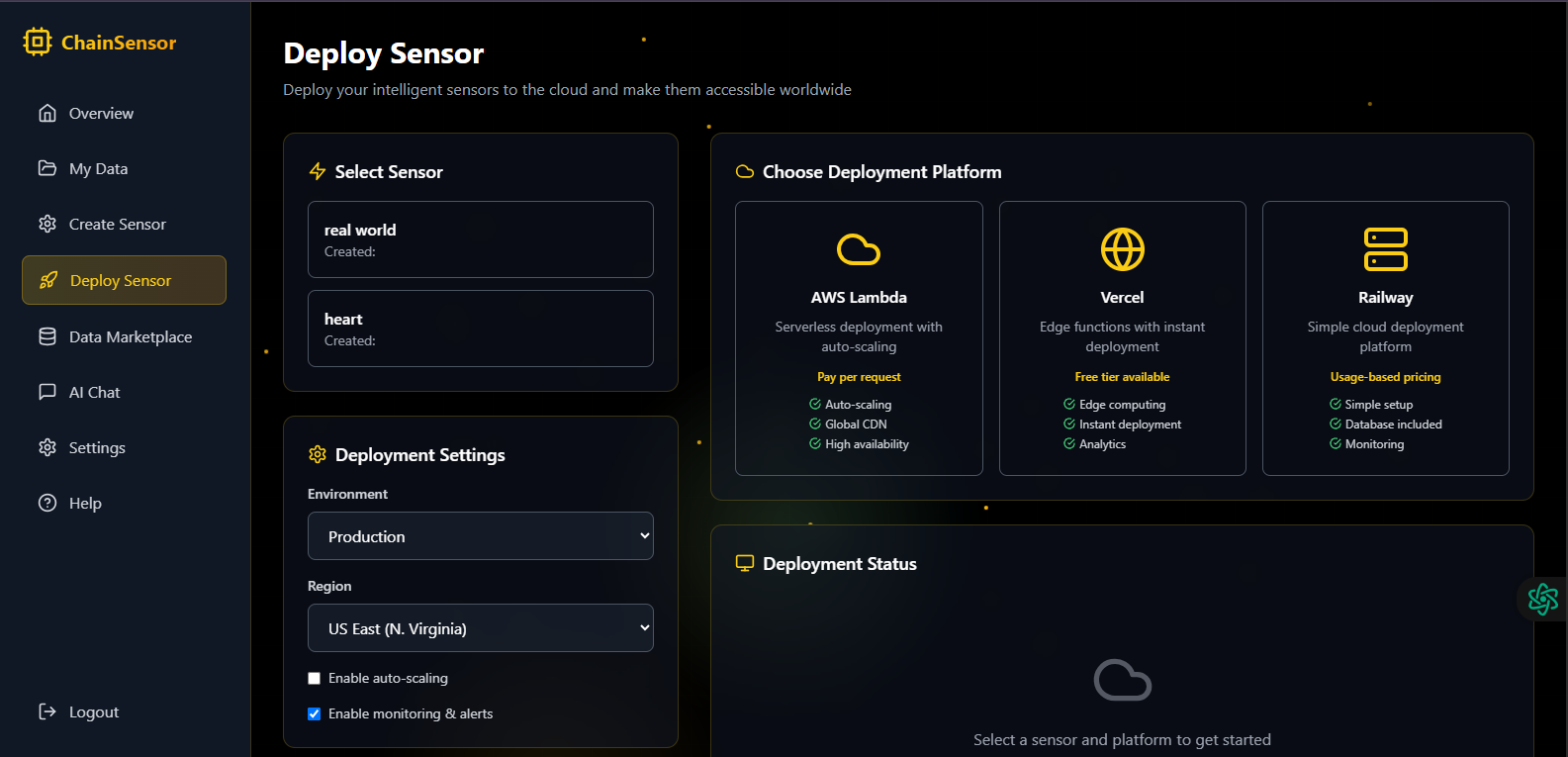
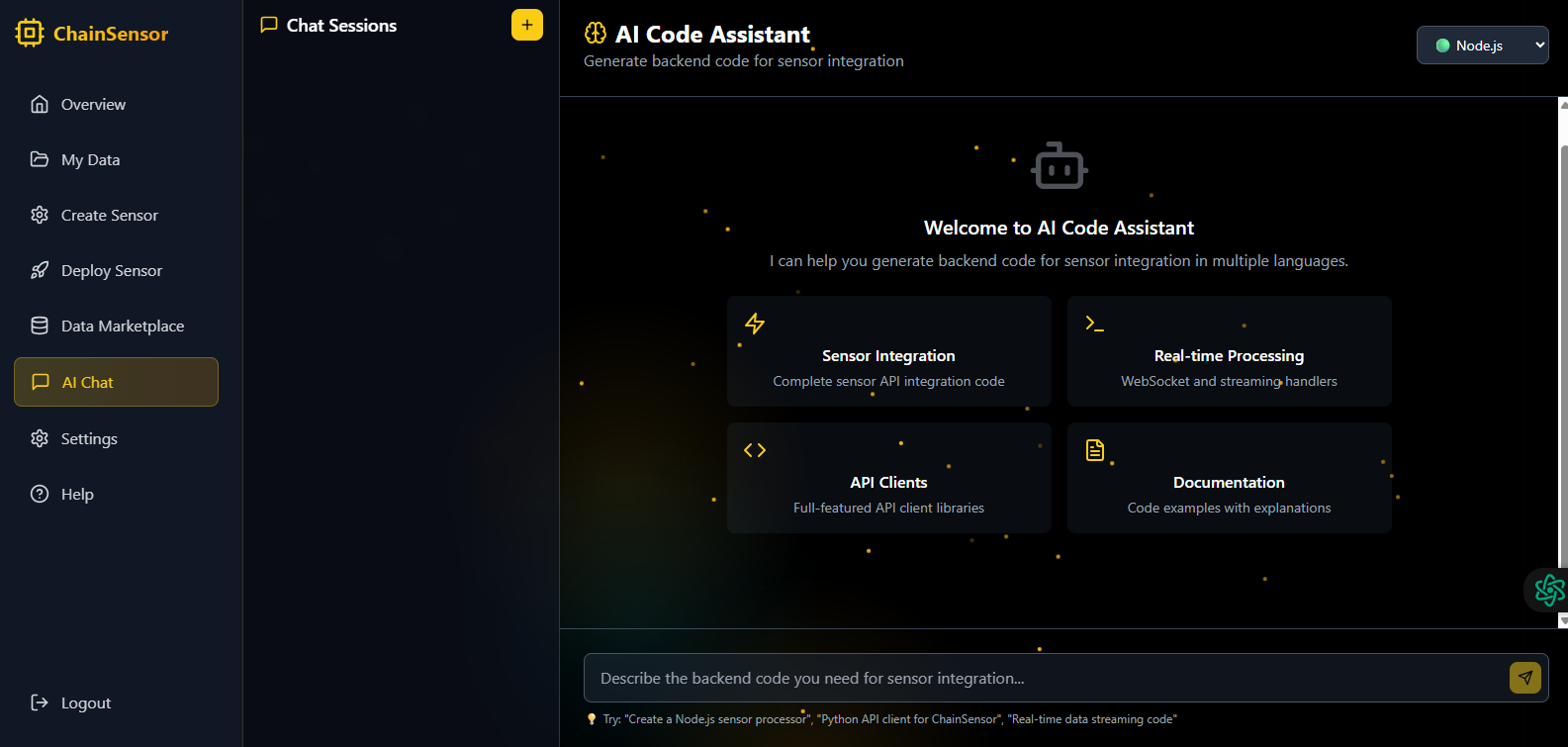
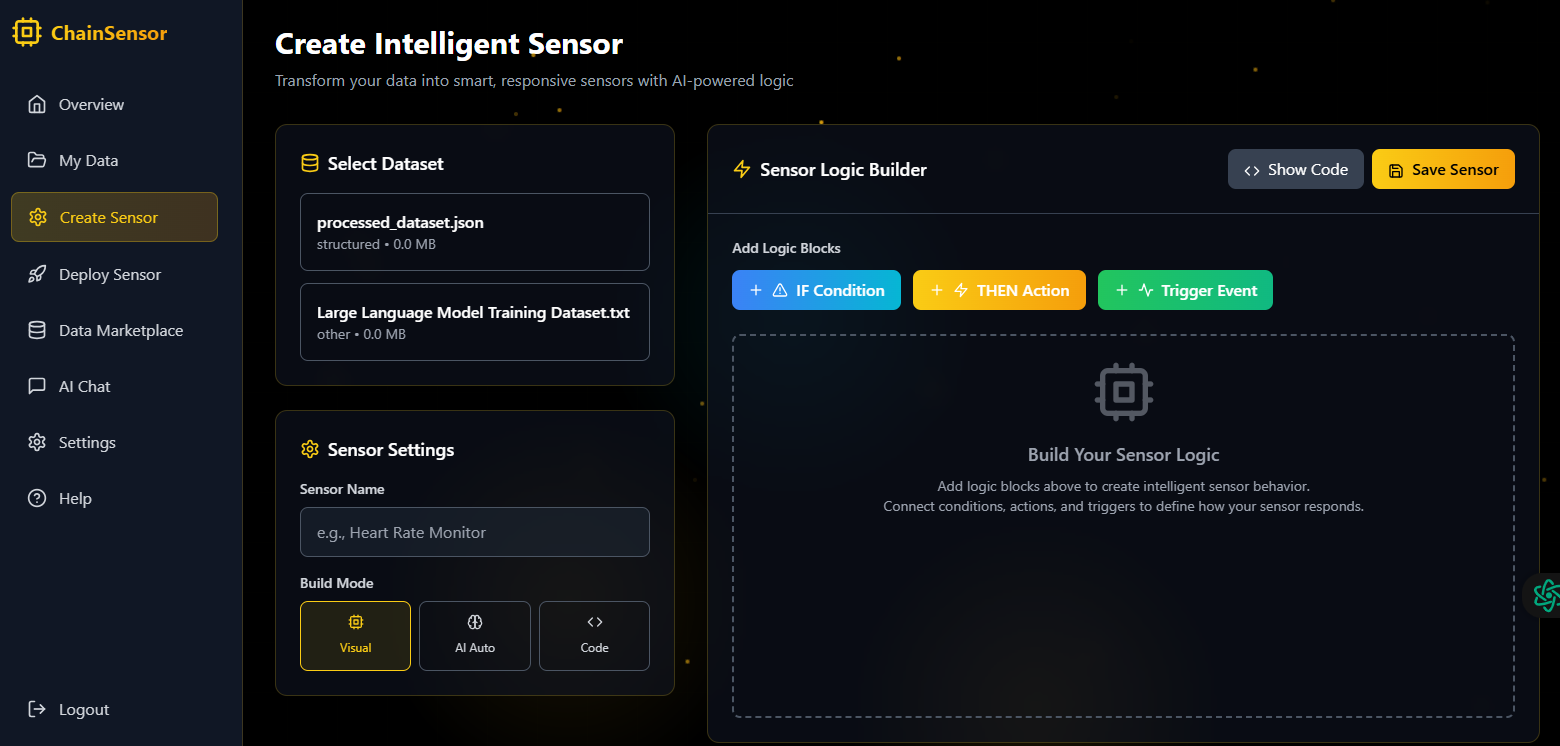
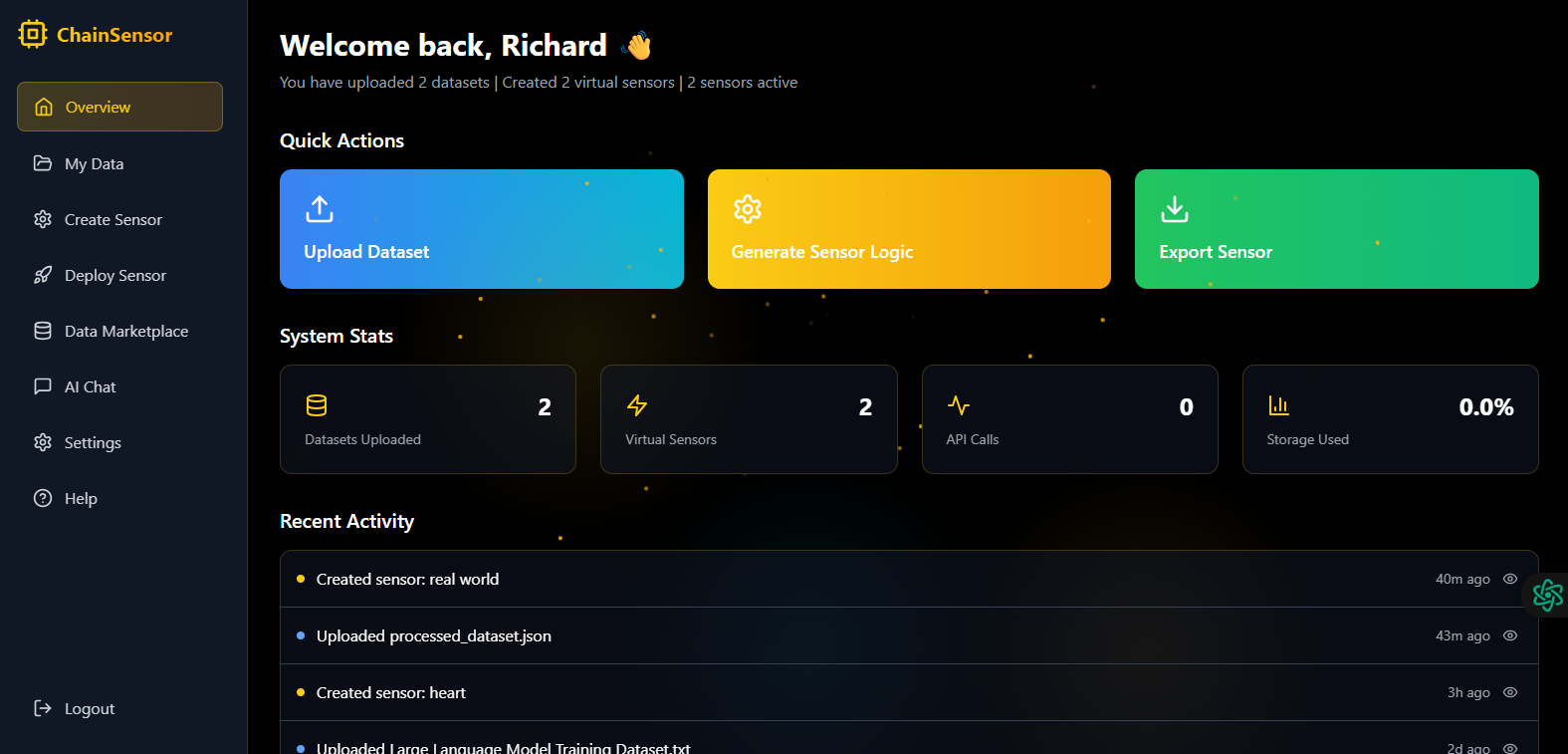
Here’s how the product works: Step 1: Upload Data Users can upload .csv, .json, .xlsx, .wav, or live-streamed data from wearables, devices, or manual records. Step 2: Build Sensor Logic Using a drag-and-drop builder, users define smart logic e.g., “If soil moisture < 20%, send a signal.” No programming needed. Step 3: Generate and Export ChainSensor generates sensor APIs, webhook triggers, or downloadable firmware for edge devices (ESP32, Arduino, Raspberry Pi, etc.). Step 4: Chat AI Code Assistant Users can open the ChainSensor Chat AI, a powerful conversational agent that generates backend code from natural language prompts. Simply ask: “Build a Python function that sends an alert when temperature crosses 40°C,” and get production-ready code instantly. Developers can fine-tune, test, and deploy code for cloud functions, embedded systems, or external APIs. Step 5: Deploy and Monitor Users deploy sensors into apps, devices, or automation systems and monitor them in real-time via the dashboard. ChainSensor is both a creation tool and a launchpad blending AI, no-code, and developer tools into one unified platform. It’s where anyone can turn their world into an intelligent, sensor-driven environment fast.
How we built it
How We Built ChainSensor ChainSensor was built with a vision: to make it easy for anyone to transform real-world and human data into intelligent, deployable sensors. To bring this vision to life quickly and efficiently, we combined powerful no-code and developer-friendly tools primarily Bolt AI for the frontend interface and sensor logic automation, and Supabase as our robust backend infrastructure. We used Bolt AI to design a sleek, responsive user dashboard where users can upload datasets, build sensor logic through a no-code interface, and interact with our integrated AI assistant. Bolt’s natural language to functionality engine allowed us to generate frontend components and sensor logic flows with high-speed iteration and precision. It enabled us to provide features like dataset management, drag-and-drop condition builders, and live previews without writing hundreds of lines of code manually. For the backend, we chose Supabase as our core because it offered everything we needed: real-time database, authentication, file storage, and RESTful APIs all under one platform. User datasets are securely uploaded and stored in Supabase’s storage system, while sensor metadata, user sessions, and API keys are managed via its PostgreSQL database and authentication services. By leveraging these tools, we were able to focus on our mission rather than reinvent infrastructure. The result is a fast, intelligent, and scalable platform where innovation flows from data to deployment empowering anyone to build their own smart sensors with ChainSensor.
Challenges we ran into
Handling Diverse Data Formats Users uploaded a wide variety of data types — from .csv health logs to .json IoT streams and .wav audio files. Designing a unified parser and validator that could support flexible data ingestion was complex and required custom preprocessing logic.
Real-Time Feedback from Sensor Logic We needed users to see immediate outputs from the sensors they created such as alerts or data-driven triggers. Integrating this with Bolt AI’s frontend flow while syncing it with Supabase’s backend events posed timing and sync issues during early builds.
Balancing No-Code Simplicity with Developer Power It was challenging to keep the interface clean and simple for no-code users, while also allowing pro developers to generate or edit backend code using our AI prompt system. We had to carefully structure logic layers and permissions to serve both audiences effectively.
Scaling Upload and Storage on Supabase Supabase’s storage system is powerful, but as we began testing with larger datasets (especially from biosensors or video), we encountered upload latency, size limitations, and the need for optimized file compression and async processing.
AI Prompt Accuracy for Backend Code Integrating Chat AI to generate backend code for sensors was powerful, but ensuring accuracy, safety, and logic consistency in the generated code was a continuous iteration process.
Accomplishments that we're proud of
Built a Fully Functional MVP in Weeks Using Bolt AI for rapid frontend development and Supabase for scalable backend services, we built a complete end-to-end platform in record time from dataset upload to real-time sensor generation.
Created a No-Code Sensor Builder We designed and implemented an intuitive no-code logic builder that lets users create custom sensor workflows without writing a single line of code empowering makers, researchers, and non-developers.
Integrated AI for Backend Code Generation One of our proudest innovations is the Chat AI Assistant, which allows users to write simple prompts and get backend-ready sensor logic code. This bridges the gap between creativity and technical deployment.
Secure, Scalable Data Infrastructure With Supabase, we achieved secure storage, authentication, and real-time database sync for all user-uploaded data and generated sensors enabling scale without compromising performance.
Built for Global, Real-World Use Cases From healthcare monitoring to smart farming and environment tracking, ChainSensor supports diverse applications with early adopters already experimenting with real-world sensor prototypes.
Enabled Instant API & Firmware Exports We successfully implemented one-click API generation and device firmware exports, allowing users to deploy their custom sensors on web apps or microcontrollers in minutes.
Designed for Inclusivity We built ChainSensor to serve both no-code creators and full-stack developers a rare balance that ensures accessibility and technical power.
What we learned
What We Learned Data Is Powerful — But Only If Actionable Collecting data is easy. Making it useful, timely, and responsive is the real challenge. We learned that the true value of data lies in turning it into intelligent, real-world actions — which is what ChainSensor enables.
No-Code Needs Deep Thinking Building for non-developers taught us that simplicity is incredibly complex. It takes rigorous UX design, edge-case handling, and clear logic mapping to create tools that feel effortless but are deeply capable.
AI Can Accelerate But Needs Guardrails Integrating Chat AI to generate backend code was powerful, but we learned that AI outputs need structure, context, and validation layers to ensure safety, clarity, and real-world usability.
Real-Time Syncing Is Harder Than It Looks Coordinating file uploads, sensor logic, and live outputs across the frontend and backend required a lot of debugging and architectural iteration especially with Supabase’s real-time features.
Users Think in Outcomes, Not Inputs Most users don't care about the technical process they care about the result. We learned to design flows around outcomes (like "send an alert" or "detect heart issue"), rather than features.
Build Fast, But Think Long-Term Using Bolt AI and Supabase helped us move fast, but every shortcut taught us the importance of modularity, scalability, and documentation for the long haul.
What's next for Chainsensor
Launching the Mobile Experience We’re building a mobile-first version of ChainSensor to make it even easier for users to upload sensor data, monitor events in real-time, and deploy sensors on-the-go.
Sensor Marketplace Soon, users will be able to publish, share, or sell their custom sensors in a public marketplace — enabling global collaboration and monetization of real-world intelligence.
Device Integrations & SDKs We're developing SDKs and native integrations for hardware platforms like Arduino, ESP32, Raspberry Pi, and edge AI chips — so users can seamlessly deploy sensors in physical devices.
Smarter AI Code Prompts Our Chat AI assistant will evolve to support multi-step backend logic, real-time code validation, and integrations with external APIs — transforming it into a co-pilot for developers building complex sensor systems.
Enhanced Privacy & Data Ownership We're introducing advanced privacy controls, on-device encryption, and user-owned storage options to give users full control over their data and its use in sensor generation.
Partnering with Industry Verticals We plan to partner with healthcare, agriculture, environmental, and smart city stakeholders to bring ChainSensor into high-impact, real-world deployments.
Open API for Developers A fully documented API will allow developers to build custom apps, automation systems, and dashboards powered by ChainSensor’s backend engine.
Built With
- bolt
- supabase

Log in or sign up for Devpost to join the conversation.